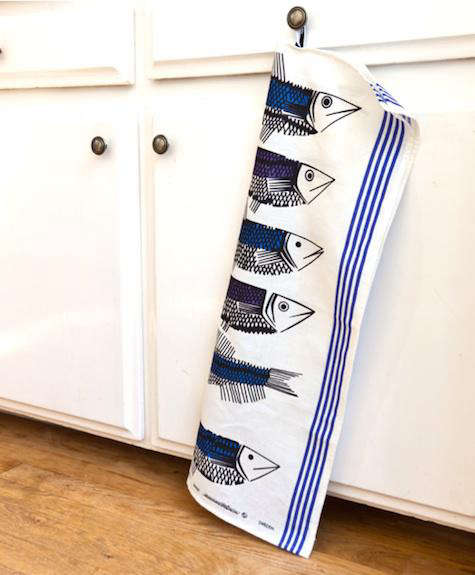
The Kärringen mot Strömmen Tea Towel is not just a kitchen towel. It is a tiny Swedish rebellion folded neatly beside your sink. At first glance, it looks like a charming Scandinavian textile: fish, movement, graphic rhythm, vintage color, and that effortless Nordic confidence that makes even drying dishes feel like a design decision. But the real personality sits inside the name. “Kärringen mot strömmen” is a Swedish expression often understood as “the old woman against the current,” or more naturally, “the woman who goes against the flow.” In other words, this tea towel is for anyone who has ever looked at a trend, smiled politely, and done the opposite.
That is what makes this piece memorable. Many kitchen towels are useful. Some are pretty. A few are collectible. This one manages to be all three while carrying a wink of folklore, a splash of mid-century Swedish design, and a practical cotton-linen construction that actually belongs in a working kitchen. Whether you discovered it through Scandinavian home decor, vintage textile hunting, or a deep internet dive that began with “fish tea towel” and ended with Swedish idioms, the Kärringen mot Strömmen Tea Towel has a story worth unfolding.
What Is the Kärringen mot Strömmen Tea Towel?
The Kärringen mot Strömmen Tea Towel is commonly associated with Almedahls, a Swedish textile name known for bringing classic Scandinavian patterns into everyday home goods. The design is attributed to Marianne Westman, one of Sweden’s beloved mid-century designers, whose work is often recognized for its playful simplicity, organic shapes, and cheerful domestic spirit.
The towel is often described as a cotton and linen blend, with many listings noting a composition of approximately 55% linen and 45% cotton. A common size listed for this style is about 47 x 70 cm, or roughly 18.5 x 27.5 inches. That makes it large enough for drying dishes, wrapping bread, lining a tray, or hanging as decorative kitchen art when you decide it is too charming to risk spaghetti sauce.
Its visual identity is typically linked to a school of Scandinavian design that values function, clarity, and warmth. It is not fussy. It is not overly polished. It has personality without shouting across the room. The fish motif gives the towel a lively, aquatic rhythm, while the Swedish title gives it a stubborn little backbone.
The Meaning Behind “Kärringen mot Strömmen”
The phrase “kärringen mot strömmen” comes from Swedish idiomatic language and folklore. Literally, it refers to an older woman going against the current. Figuratively, it describes a person who resists the crowd, argues with expectations, or does things in their own wonderfully contrary way.
In English, we might say “swimming against the tide,” “going against the grain,” or “marching to the beat of your own drum.” But the Swedish version has a more visual, almost comic energy. You can practically see the determined character pushing upstream while everyone else floats lazily in the easy direction. It is stubbornness with a storybook hat on.
That meaning gives the tea towel a personality beyond decoration. It becomes a small statement about independence. In a kitchen full of mass-produced objects, this towel says, “No thank you, I will be functional and philosophical.” It is the kind of item that makes guests pause and ask, “What does that mean?” which is exactly how a humble dish towel suddenly becomes the most interesting person at brunch.
Why This Tea Towel Appeals to Design Lovers
It blends usefulness with art
Great Scandinavian design often works because it refuses to separate beauty from everyday life. A chair should support you and look good. A lamp should illuminate and create atmosphere. A tea towel should dry dishes and make your kitchen feel less like a chore zone. The Kärringen mot Strömmen Tea Towel fits this tradition neatly. It is practical enough for daily use, but graphic enough to frame, display, or gift.
It carries mid-century Swedish charm
Marianne Westman’s broader design reputation is tied to joyful mid-century Swedish patterns, especially in ceramics and household goods. Her visual language often feels friendly rather than formal. Instead of cold minimalism, her work has movement, humor, and domestic ease. The Kärringen mot Strömmen design captures that spirit: simple shapes, recognizable imagery, and a sense that the kitchen should be both useful and alive.
It starts conversations
Some kitchen decor looks nice and says nothing. This tea towel practically clears its throat. The Swedish title, the fish imagery, and the proverb-like meaning make it a natural conversation starter. It works especially well in homes where design is personal rather than showroom-perfect. Put it near a coffee station, hang it from an oven handle, or use it at a summer table setting, and someone will eventually ask about it. Congratulations: your tea towel now has social skills.
Material Matters: Cotton, Linen, and Everyday Performance
A cotton-linen blend is one of the reasons tea towels like this remain popular. Linen is valued for being strong, quick-drying, and naturally crisp. It tends to become softer and more absorbent with use. Cotton adds softness, flexibility, and easy care. Together, the two fibers create a towel that can handle real kitchen tasks while still looking refined enough to hang in plain sight.
This blend is especially helpful for drying glassware and dishes because a smoother tea towel generally leaves less lint than fluffy terry cloth. It is also lighter, easier to fold, and often more attractive as a decorative object. Terry towels are excellent for heavy spills, but a printed cotton-linen tea towel is the dinner-party guest: polished, useful, and unlikely to shed all over the wine glasses.
Because linen can feel slightly stiff at first, new owners should not panic if the towel does not behave like a soft bath towel straight out of the package. Linen relaxes over time. After a few washes, it usually becomes more flexible while keeping its structure. That slow improvement is part of the charm. Like a good cast-iron skillet or a favorite pair of jeans, it gets better once it has lived a little.
How to Use the Kärringen mot Strömmen Tea Towel
For drying dishes and glassware
The most obvious use is also the most practical. Keep the towel near the sink for drying plates, cups, and flatware. Because it has visual appeal, it does not need to be hidden in a drawer. Let it hang where it can earn compliments while doing its job.
For serving bread or pastries
A clean tea towel can line a bread basket or wrap warm rolls at the table. The fish motif and Swedish phrase make it especially fun for casual brunches, seafood dinners, picnic spreads, or any meal where the table needs a little character.
For kitchen styling
If you are styling a Scandinavian-inspired kitchen, this towel offers an easy accent. It brings pattern without clutter and color without overwhelming the room. Pair it with wood cutting boards, white ceramic dishes, glass jars, blue-and-white accents, or simple open shelving.
For wall art
Many people collect illustrated tea towels as affordable textile art. If the Kärringen mot Strömmen Tea Towel feels too special for everyday wiping, frame it or hang it from a simple wooden magnetic poster rail. It can look especially good in a breakfast nook, pantry, laundry room, or cottage-style kitchen.
How to Care for a Cotton-Linen Tea Towel
Good care keeps a printed tea towel attractive and hygienic. Always check the care label first, because exact instructions may vary by production run or retailer. In general, cotton-linen tea towels can usually handle regular washing, but printed designs deserve a little respect.
Wash kitchen towels frequently, especially if they touch hands, counters, spills, or food-prep areas. U.S. food-safety guidance commonly recommends laundering cloth kitchen towels often and using a hot cycle when appropriate. This is important because towels can spread bacteria if they are used for too many jobs without being washed. A tea towel may look innocent, but after wiping hands, a cutting board, and a mystery splash near the sink, it has seen things.
For best results, separate decorative drying towels from heavy-duty cleaning rags. Use one towel for clean dishes and another cloth for spills or counters. Let towels dry fully between uses, because damp fabric can develop odors. Avoid fabric softener when absorbency matters, since it can leave a coating on fibers. Air drying is gentle, while ironing can restore that crisp Scandinavian “I have my life together” look, even if the junk drawer tells a different story.
Who Should Buy This Tea Towel?
The Kärringen mot Strömmen Tea Towel is ideal for several types of buyers. First, it suits fans of Scandinavian design who appreciate everyday objects with history and humor. Second, it appeals to collectors of Marianne Westman or Almedahls textiles. Third, it makes a thoughtful gift for someone with Swedish heritage, a love of language, or a personality best described as “politely impossible to herd.”
It is also a clever housewarming gift. Instead of bringing another candle that smells like “abstract beige,” you can give something useful, beautiful, and meaningful. Add a short note explaining the phrase: “For when you feel like going against the current.” Suddenly, a tea towel becomes a tiny manifesto.
Styling Ideas for a Scandinavian-Inspired Kitchen
To style this towel well, let it be the patterned element in a calm setting. Scandinavian kitchens often work with light, natural materials: pale woods, white walls, ceramic dishes, simple metal hooks, and practical open storage. The Kärringen mot Strömmen Tea Towel can add personality without disrupting that clean rhythm.
Try hanging it from a brass or black hook near the sink. Fold it lengthwise over an oven handle so the fish design shows. Use it as a color accent beside navy bowls or clear glass canisters. For a coastal look, pair it with sea-salt jars, striped napkins, and simple white plates. For a retro look, place it near enamelware, vintage ceramics, or a cheerful fruit bowl.
The secret is restraint. Let the towel speak. It already has fish, Swedish words, and a rebellious worldview. It does not need to compete with twelve rooster figurines and a neon sign that says “But First Coffee.” Unless that is your thing, in which case, swim upstream proudly.
Collectibility and Availability
Depending on the market, the Kärringen mot Strömmen Tea Towel may appear as a current product, a discontinued item, or a vintage-style textile sold through Scandinavian design shops, home decor retailers, or secondhand marketplaces. Because availability can change, buyers should check product details carefully before purchasing. Look for clear information about the designer, brand, material, dimensions, and condition.
If buying vintage or pre-owned, inspect photos for fading, stains, thinning fabric, or frayed edges. Light wear can add charm, but serious damage may make the towel better suited for display than use. If buying new, confirm whether the towel is officially licensed or produced by a reputable textile retailer. The design’s appeal comes from its heritage, so authenticity matters.
Why a Tea Towel Can Be More Than a Tea Towel
The best household objects do more than perform a task. They create rituals. A favorite mug makes morning coffee feel more personal. A good wooden spoon becomes the one you reach for without thinking. A beautiful tea towel can make drying dishes feel less like punishment for cooking and more like the final scene of a good meal.
The Kärringen mot Strömmen Tea Towel belongs in that category. It is practical, yes. But it also carries a phrase about independence, a link to Swedish visual culture, and a design language that turns a plain kitchen object into something memorable. It reminds us that the everyday things we touch can have stories, humor, and identity.
Experiences Related to the Kärringen mot Strömmen Tea Towel
Living with a tea towel like this is a little different from owning a plain white dish cloth. A plain towel disappears into the routine. The Kärringen mot Strömmen Tea Towel keeps reintroducing itself. You reach for it while drying a mug, and the fish seem to be moving across the fabric. You glance at the Swedish phrase and remember that going against the current is sometimes less of a flaw and more of a personal brand.
In daily use, the towel feels best when it has a specific role. Many owners prefer to reserve decorative cotton-linen towels for clean tasks: drying glassware, covering bread, lining a serving tray, or hanging as a visual accent. That approach keeps the print fresher longer and prevents the towel from becoming the unfortunate victim of beet juice, curry splatter, or whatever happens when someone opens a jar of marinara with too much confidence.
One of the most enjoyable experiences is using it when guests are present. The design has just enough mystery to invite questions. Someone will notice the Swedish words, attempt pronunciation, and immediately look as if they have swallowed a Scrabble bag. Then comes the explanation: it means a woman going against the current. The mood changes. People laugh. Someone says, “That sounds like my grandmother.” Someone else says, “That sounds like me before coffee.” Suddenly, a kitchen textile has become a family discussion.
It also works beautifully as a gift because it feels personal without being overly intimate. A Kärringen mot Strömmen Tea Towel suits a friend who loves Nordic design, a parent who appreciates practical gifts, or a colleague who has strong opinions about doing things properly. It is useful enough not to become clutter, but special enough not to feel generic. Wrap it around a loaf of sourdough, pair it with a jar of jam, or tuck it into a basket with coffee and Swedish cookies. The result feels thoughtful, not like a last-minute panic purchase from the “kitchen stuff” aisle.
For collectors, the experience is more visual and historical. The towel connects to a broader world of Scandinavian domestic design, where textiles, ceramics, and tableware often carry a sense of optimism. It is easy to imagine it in a bright kitchen with open shelves, enamel pots, and a radio playing softly while someone prepares lunch. That nostalgic quality does not feel dusty. It feels warm, like the design equivalent of soup on a cold afternoon.
There is also a small emotional pleasure in owning something that celebrates nonconformity. Kitchens are full of rules: wash this, chop that, do not burn the toast, please stop using the good knife on cardboard. In the middle of all that order, the Kärringen mot Strömmen Tea Towel adds a rebellious grin. It says that usefulness does not have to be boring, tradition does not have to be stiff, and even a towel can have an opinion.
Over time, the towel may soften, fade slightly, and become more familiar. That is not necessarily a loss. With cotton-linen textiles, wear can become part of the story. A framed version may preserve the design perfectly, but a used version records breakfasts, dinners, holidays, and ordinary Tuesdays. Both choices are valid. Display it if you want a tiny piece of Swedish graphic art. Use it if you want beauty to participate in real life. The true spirit of the Kärringen mot Strömmen Tea Towel may be that it refuses to be only one thing.
Conclusion
The Kärringen mot Strömmen Tea Towel is a small object with a surprisingly large personality. It combines Scandinavian design, Swedish idiom, practical cotton-linen function, and mid-century charm in a way that feels both collectible and useful. Its phrase celebrates the person who goes against the flow, while its construction makes it suitable for everyday kitchen life. Whether you hang it, frame it, gift it, or actually use it to dry dishes, it brings wit and warmth to the room.
In a world full of forgettable kitchen accessories, this tea towel stands apart. It is proof that practical objects can still tell stories. It is proof that a fish motif can carry philosophical weight. And it is definitely proof that sometimes the best design choice is the one swimming cheerfully upstream.