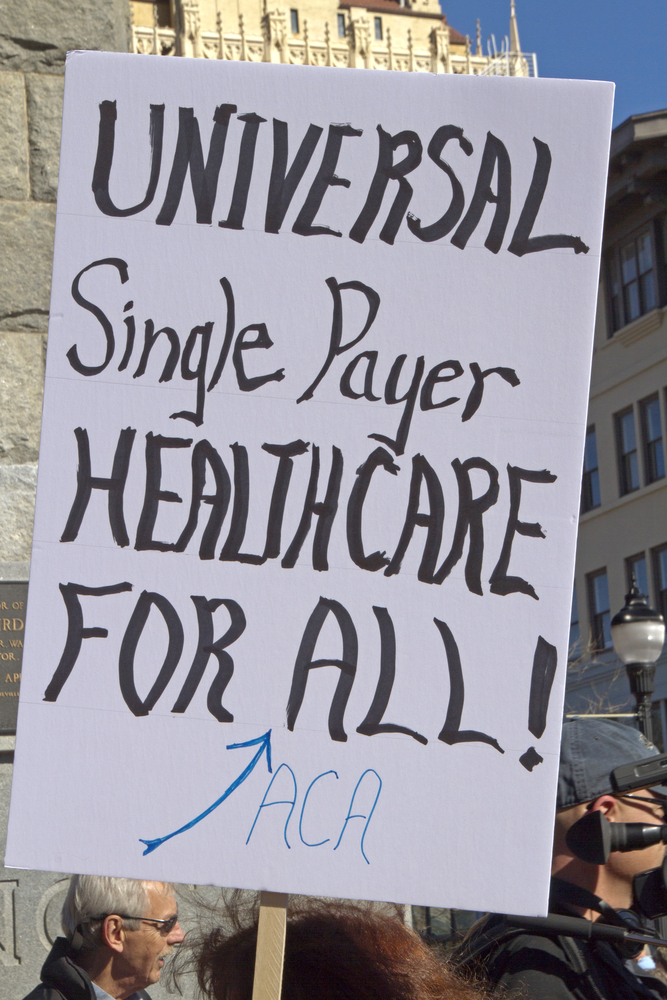
America loves a practical fix. We built interstate highways because potholes and patchwork roads were no way to run a modern economy. We created public schools because opportunity should not depend entirely on a parent’s wallet. We built Social Security and Medicare because aging should not feel like stepping off a financial cliff. So when people say a single-payer health care system is “un-American,” it is worth asking a very American question: compared with what?
The current U.S. health care system is not exactly a Norman Rockwell painting. It is more like a group project where everyone uses a different password, half the forms are out of date, and the printer jams right before the deadline. Patients deal with premiums, deductibles, copays, surprise bills, narrow networks, prior authorizations, pharmacy benefit managers, employer plan changes, and insurance cards that multiply like rabbits in a junk drawer.
A single-payer system would not mean every doctor becomes a government employee or every hospital turns into a federal building with fluorescent lights and sad coffee. In its simplest form, single payer means one public financing system pays for medically necessary care, while doctors, clinics, and hospitals can remain largely private. The point is not to make health care boring. The point is to make paying for it less ridiculous.
The argument that a single-payer system is the American way is not about copying another country with a different history, culture, or appetite for cheese. It is about applying America’s own best habits: pooling risk, using scale, cutting waste, protecting families, rewarding work, and making essential services reliable enough that people can build lives around them.
What Is a Single-Payer Health Care System?
A single-payer health care system is a model in which one public or quasi-public payer finances covered health care services for the population. Instead of thousands of private plans each using different rules, provider networks, billing codes, and approval systems, a single-payer approach creates one broad coverage framework.
That does not automatically mean there is only one way to deliver care. Private doctors can still treat patients. Hospitals can still operate independently. Medical groups can still innovate. The major change is on the payment side: fewer insurance middlemen, fewer billing games, and more predictable access to care.
Single Payer Is Not the Same as Socialized Medicine
One of the most common misunderstandings is that single payer equals socialized medicine. It does not. The Veterans Health Administration is closer to a publicly owned and operated care delivery system. Medicare, by contrast, is a public insurance program that pays private and public providers. A national single-payer plan would likely look more like an expanded financing system than a government takeover of every exam room in America.
Think of it this way: when you use a public road to drive to a privately owned grocery store, nobody says the tomatoes have been nationalized. Public financing can support private activity. Americans already understand this every time we use highways, mail service, airports, public universities, emergency response, and yes, Medicare.
Why the Current System Feels So Un-American
The United States spends more on health care than any other wealthy nation, yet millions of people still struggle to afford care. In 2024, U.S. national health expenditures reached about $5.3 trillion, or roughly $15,474 per person, and accounted for about 18% of gross domestic product. That is not pocket change. That is “did we accidentally subscribe to the platinum plan for the entire planet?” money.
Despite that enormous spending, coverage remains fragmented. In 2024, most Americans had health insurance for at least part of the year, but private coverage was still far more common than public coverage. Many people are insured through employers, which means a job loss can also become a health coverage crisis. That arrangement may have made more sense in the mid-20th century, when long-term employment at one company was more common. In today’s economy of contractors, layoffs, gig work, startups, career changes, and remote work, tying health insurance to a job can feel like tying your oxygen supply to your office badge.
Employer-Based Insurance Is Expensive and Fragile
Employer-sponsored insurance is often described as a benefit, and for many families it is. But it is also expensive. In 2025, the average annual premium for employer-sponsored family coverage reached nearly $27,000, with workers contributing thousands of dollars directly and employers paying the rest as part of overall compensation costs. That employer share is not magic money from a corporate fairy. It is part of the total cost of employing people, and economists have long argued that rising benefit costs can put pressure on wages.
For workers, the result can be maddening. You can do everything “right”get a job, pay premiums, choose an in-network doctor, show up on timeand still face a deductible that makes a basic procedure feel like buying a used car. A health system that requires people to become part-time insurance scholars before seeing a specialist is not efficient. It is exhausting with a billing department.
The American Case for Single Payer
The strongest argument for single payer is not that America should become less American. It is that health care financing should finally catch up with American values. We say we believe in freedom, entrepreneurship, family stability, competition, efficiency, and personal responsibility. The current system often undermines all five.
1. Single Payer Supports Freedom
Freedom is not just the freedom to choose between five insurance plans with names like Silver Enhanced Choice Plus Select. Real freedom is the ability to leave a bad job without risking your child’s asthma medication. It is the ability to start a small business without wondering whether one accident will bankrupt your family. It is the ability to move across state lines without rebuilding your entire medical network from scratch.
A single-payer system could separate health coverage from employment. That would give workers more bargaining power, entrepreneurs more room to take risks, and families more stability during career transitions. If America wants people to innovate, relocate, create, and compete, health insurance should not function like a leash.
2. Single Payer Rewards Work Instead of Punishing Illness
Americans are famous for working hard. But illness does not respect work ethic. Cancer does not check your attendance record. A broken leg does not care whether you have met your quarterly goals. Chronic disease does not politely wait until open enrollment.
A single-payer health care system recognizes that sickness is not a moral failure. It spreads risk across the whole population, which is exactly what insurance is supposed to do. The healthy help pay for the sick today because tomorrow the roles may reverse. That is not charity. That is civilization with a billing code removed.
3. Single Payer Can Reduce Administrative Waste
One of the least glamorous but most important arguments for single payer is administrative efficiency. The United States spends heavily not only on care itself but also on the machinery required to bill, deny, appeal, code, recode, authorize, and re-authorize care. Doctors hire staff to fight with insurers. Hospitals maintain armies of billing specialists. Patients receive statements that look like they were designed by a committee of haunted accountants.
Research has estimated that administrative expenses account for a large share of U.S. health care spending. A single-payer system would not eliminate administration, but it could simplify it. One set of rules, one broad payer, and standardized billing could reduce friction for providers and patients. That means more money can go toward nurses, primary care, mental health services, rural clinics, prescription drugs, and preventive care instead of paperwork gymnastics.
Medicare Already Shows the American Instinct
Medicare is not perfect. Anyone who has tried to compare Original Medicare, Medicare Advantage, Part D plans, Medigap policies, formularies, premiums, and network rules knows that “simple” is not the first word that springs to mind. Still, Medicare proves something important: Americans are comfortable with public health insurance when it works for people they love.
Millions of older adults and people with disabilities rely on Medicare. The program is popular because it solves a basic problem: private insurance markets often do not handle older age and serious health needs affordably on their own. Medicare is a public answer to a private market failure. That is not radical. That is pragmatic.
A single-payer system would build on the same instinct: when a need is universal, the financing should be universal too. We do not ask each household to negotiate its own fire department contract. We do not require seniors to crowdfund their Social Security checks. We do not make parents shop for twelve competing versions of third grade. For some essentials, a shared public structure is not the enemy of freedom. It is the foundation that makes freedom usable.
What About Choice?
Opponents often argue that single payer would take away choice. But the current system already limits choice in ways people experience every day. Your employer chooses your menu of plans. Your insurer chooses the network. Your plan chooses whether your doctor is covered. Your pharmacy benefit manager affects which medication is affordable. Your prior authorization reviewer may decide whether your doctor’s recommendation gets approved.
That is not patient choice. That is a maze with a customer service number.
A well-designed single-payer system could actually expand meaningful choice by allowing patients to see any qualified participating provider without worrying about whether the doctor is in network this month. The choice that matters most is not the choice of insurance brand. It is the choice of doctor, hospital, treatment, and timing.
What About Taxes?
No serious discussion of single payer can dodge the tax question. A single-payer system would require large public financing. Federal spending would rise because money now paid through premiums, deductibles, employer contributions, and out-of-pocket bills would shift into taxes or public contributions.
That sounds scary until we remember that Americans are already paying. We pay premiums. We pay deductibles. We pay copays. We pay out-of-network bills. We pay in delayed wages. We pay in medical debt. We pay when hospitals absorb uncompensated care and pass costs through the system. We pay when untreated illness becomes disability, bankruptcy, or emergency care.
The real question is not whether single payer costs money. The real question is whether Americans would rather pay in a clearer, more predictable, more equitable wayor keep paying through a chaotic mix of bills that arrive at the worst possible moment, often printed in fonts too small for emotional stability.
What Single Payer Would Need to Get Right
A single-payer health care system is not a magic wand. If designed poorly, it could create new problems. If designed well, it could solve old ones. The details matter enormously.
Provider Payment Must Be Fair
If payment rates are set too low, hospitals and clinicsespecially rural and safety-net providerscould struggle. If rates are too high, savings disappear. A smart system would need balanced payment rules, regional adjustments, and special protection for providers serving vulnerable communities.
Coverage Must Be Comprehensive
Universal coverage is strongest when it includes primary care, hospital care, mental health care, prescription drugs, maternity care, rehabilitation, preventive services, and long-term care supports. If major needs are left out, families can still face crushing bills.
The Transition Must Be Practical
Millions of people work in the private insurance industry and related administrative roles. A humane transition would need job training, placement support, phased implementation, and clear communication. America should not fix one group’s insecurity by creating another group’s crisis.
Patients Need Timely Access
Coverage does not help enough if patients cannot get appointments. A single-payer system would need investments in primary care, nursing, rural health, community clinics, mental health professionals, and modern health technology. Universal coverage should come with a serious access strategy, not just a new card in the mail.
Why “American Way” Does Not Mean “Every Person Alone”
There is a myth that the American way means everyone handles every risk alone. That is not our real history. Barn raisings were communal. Rural electric cooperatives brought power to places the market ignored. Public universities expanded opportunity. The GI Bill helped millions build middle-class lives. Medicare and Medicaid reduced poverty and improved access to care for older adults, people with disabilities, children, and low-income families.
The American way has always included a practical bargain: individuals work hard, and society builds certain platforms that make hard work more likely to pay off. Health care should be one of those platforms. Without health, freedom becomes theoretical. Without affordable care, opportunity becomes fragile. Without coverage, one diagnosis can turn a stable family into a financial emergency.
A Single-Payer System and Small Business
Small businesses are often described as the backbone of the American economy. Yet health insurance can make that backbone ache. Small employers typically have less bargaining power than large corporations. They may face steep premium increases, limited plan choices, and the annual ritual of explaining to employees why coverage costs more while benefits somehow feel smaller.
Single payer could remove health insurance administration from the small-business to-do list. Imagine a bakery owner spending less time comparing health plans and more time perfecting sourdough. Imagine a contractor hiring based on skill rather than worrying about benefit costs. Imagine a startup founder recruiting talent without being crushed by insurance negotiations. That is not anti-business. That is pro-getting-back-to-business.
Medical Debt Is Not a Personality Trait
Medical debt is one of the clearest signs that the current system is not working as it should. People do not choose appendicitis for fun. Nobody schedules a stroke because they were bored on a Tuesday. Yet medical bills can follow families for years, damaging credit, delaying home purchases, and forcing impossible trade-offs.
A single-payer system would not make illness pleasant. Nothing makes a colonoscopy feel like a spa weekend. But it could make illness less financially catastrophic. It could replace fear of the bill with focus on recovery. In a wealthy country, that seems like a modest request.
The Patriotic Argument for Universal Care
Patriotism is not only about flags, anthems, and arguing over barbecue styles. It is also about whether we believe our neighbors should survive treatable illness without financial ruin. It is about whether a child in Ohio, a farmer in Iowa, a nurse in Georgia, a veteran in Arizona, and a freelance designer in Oregon all deserve a fair shot at getting care when they need it.
A single-payer system is patriotic because it says Americans are worth investing in. Healthy people learn better, work better, parent better, serve better, and participate more fully in civic life. Public health is not separate from national strength. It is national strength with a stethoscope.
Common Experiences That Make the Case Personal
To understand why a single-payer system feels deeply American to many people, listen to ordinary experiences rather than campaign slogans. Picture a middle-class parent with employer insurance who still hesitates before taking a child to urgent care because the deductible has not been met. The parent is not irresponsible. The parent is doing math while worried, which is one of the least charming forms of multitasking ever invented.
Consider a self-employed graphic designer who wants to grow a business but stays part-time at a job mainly for health benefits. America celebrates entrepreneurship, yet our health insurance system often tells entrepreneurs, “Fantastic dream you have there. Have you considered waiting until after open enrollment?” A single-payer system would make it easier for people to take professional risks without gambling with medical security.
Think about a 58-year-old worker who gets laid off after decades on the job. The mortgage remains. The prescriptions remain. The need for checkups remains. What disappears is the employer plan. COBRA may be available, but the price can feel like a second rent payment. In that moment, health coverage tied to employment does not feel efficient. It feels like a trapdoor.
Or imagine a doctor spending the end of a long clinic day arguing with an insurer over a medication the patient has already tried successfully. The doctor trained to diagnose and treat illness, not to perform ritual combat with a fax machine. Nurses, physicians, therapists, and office staff routinely lose time to administrative tasks that do not make anyone healthier. Patients feel the delay. Clinicians feel the burnout. The system calls it utilization management; the rest of us call it Tuesday.
There is also the family caregiver trying to coordinate appointments for an aging parent. One specialist takes the plan, another does not. One drug is covered, another requires a substitution. A bill arrives from a lab no one remembers choosing. The caregiver becomes a detective, accountant, advocate, and emotional support animal all at once. Single payer would not remove the stress of caregiving, but it could remove some of the needless confusion around payment and access.
These experiences matter because health policy is not only written in budgets and white papers. It is lived at kitchen tables, pharmacy counters, HR offices, hospital parking lots, and late-night online portals with forgotten passwords. When Americans say they want a system that is simpler, fairer, and less financially dangerous, they are not asking for luxury. They are asking for health care to behave like an essential service in a country that already knows how to build essential services.
The American way is not perfect, but at its best it is practical, generous, inventive, and stubbornly hopeful. A single-payer system fits that tradition. It says we can stop pretending that paperwork is freedom. It says we can pool risk because everyone eventually has a body, and bodies are famously high-maintenance. It says the richest country in the world should be able to organize health care without making patients feel like contestants on a game show called “Guess the Bill.”
Conclusion: Single Payer as an American Upgrade
A single-payer system is not a foreign fantasy. It is an American upgrade waiting for the courage of good design. The United States already uses public programs to solve shared problems. We already accept that some services are too important to leave entirely to fragmented private arrangements. Health care belongs in that category because illness is universal, unpredictable, and often expensive enough to overwhelm individual planning.
The case for single payer is not that government always does everything better. It is that the current health insurance system often does the financing of care badly, expensively, and unfairly. A well-built single-payer model could reduce administrative waste, expand real choice of providers, support entrepreneurship, protect families from medical debt, and make coverage stable from birth to old age.
America does not need a health care system that wins awards for complexity. It needs one that works when people are scared, sick, tired, or simply trying to stay well. That is why a single-payer system can reasonably be called the American way: not because it is radical, but because it is practical; not because it rejects freedom, but because it makes freedom more real; and not because it promises perfection, but because it offers a better bargain than the one Americans are currently stuck paying for.