Movies love giving us unforgettable romances, dramatic reunions, and kisses timed so perfectly that ordinary people should never attempt them near moving traffic. What they rarely provide is a glimpse of the next generation. What might Jack and Rose’s child have looked like? Would Tony Stark and Pepper Potts have raised a tiny engineering genius? Could Mulder and Scully’s kid detect a government conspiracy before breakfast?
To explore those questions, I used artificial intelligence and digital editing to imagine the children of 24 famous fictional couples. The results are playful visual interpretations rather than scientific predictions. Some couples already had children in their stories, while others never received anything resembling a conventional happy ending. A few barely survived the closing credits.
Still, that is what makes the experiment irresistible. AI-generated fictional children let us wander into alternate timelines where doomed romances continue, superheroes tackle parent-teacher conferences, and Hogwarts receives yet another Potter who probably ignores every safety rule in the student handbook.
How AI Imagines the Children of Fictional Couples
Creating a believable fictional child involves more than placing one face over another and asking the computer to “make it younger.” The process begins with clear reference photographs taken from reasonably similar angles. Lighting, expression, image quality, hairstyle, and camera perspective can all influence the result.
An AI tool may blend recognizable characteristics such as face shape, eyes, eyebrows, hair color, and smile. Human editing is then needed to correct strange details, soften unnatural textures, balance the parents’ influence, and remove the glassy skin that makes some generated people look as if they were manufactured in a luxury candle factory.
Even after careful editing, the portrait is only one possible interpretation. Human traits are not inherited through a simple fifty-fifty facial mixer. Eye color, skin tone, hair texture, height, and facial structure can involve many genes, and siblings from the same parents may look remarkably different. Think of each image as visual fan fictionnot a genetic forecast wearing a school-picture-day sweater.
24 AI-Generated Kids of Famous Fictional Couples
1. Jack Dawson and Rose DeWitt Bukater Titanic
Combining Leonardo DiCaprio’s youthful features with Kate Winslet’s expressive eyes produced an elegant imaginary descendant. In an alternate ending, this child grows up hearing that an enormous door once caused a family argument that lasted several decades.
2. Kim Boggs and Edward Scissorhands Edward Scissorhands
Winona Ryder’s softness and Johnny Depp’s angular appearance create a delicate, slightly gothic portrait. The child looks perfectly suited to a Tim Burton suburb, although Edward should probably delegate diaper changes to someone with conventional hands.
3. Fox Mulder and Dana Scully The X-Files
A blend of David Duchovny and Gillian Anderson results in a serious face that already seems suspicious of official explanations. This kid would ask for evidence before accepting the tooth fairy and maintain a classified folder about missing cookies.
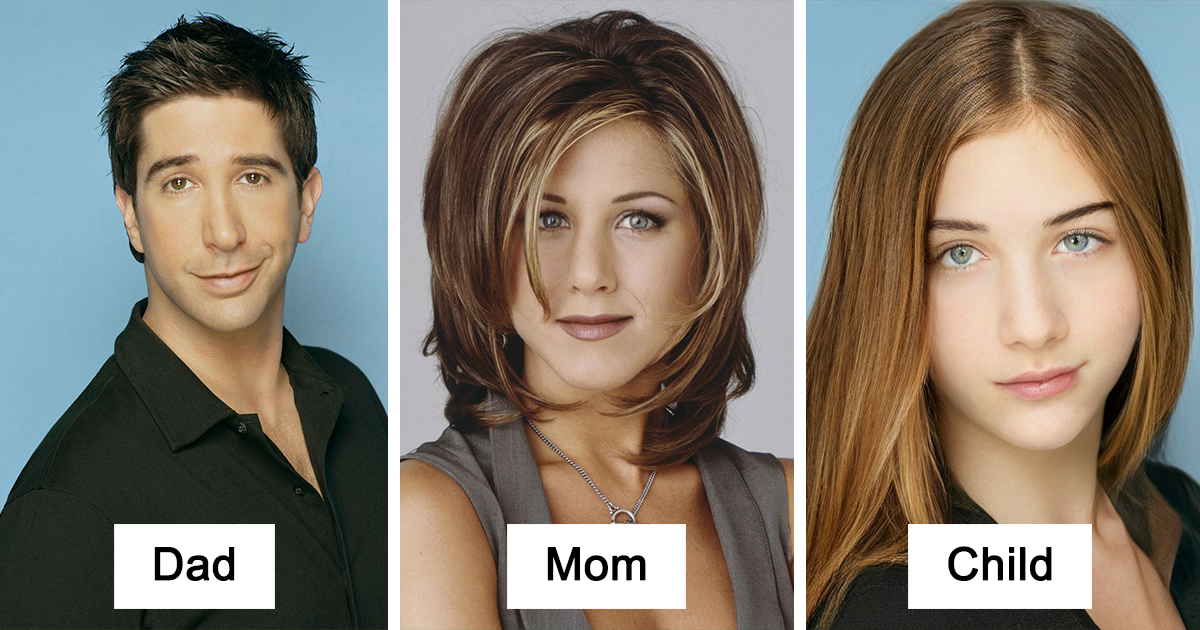
4. Ross Geller and Rachel Green Friends
Ross and Rachel already have Emma, but this experiment imagines another possible child using David Schwimmer and Jennifer Aniston as visual references. The result has Rachel’s polished charm and Ross’s thoughtful expressionhopefully without inheriting the debate over whether they were on a break.
5. Wade Wilson and Vanessa Deadpool
Ryan Reynolds and Morena Baccarin contribute strong, highly recognizable features to this imagined daughter. She looks sweet, confident, and entirely capable of delivering a sarcastic comeback before Wade finishes his fourth-wall-breaking explanation.
6. Frances “Baby” Houseman and Johnny Castle Dirty Dancing
Jennifer Grey’s bright expression and Patrick Swayze’s defined features create an energetic-looking child. Dance lessons would be unavoidable, and nobody would dare place this babyor any member of the familyin a corner.
7. Peter Parker and Mary Jane Watson Spider-Man
This portrait combines Tobey Maguire and Kirsten Dunst, producing a friendly face with unmistakable early-2000s superhero-movie energy. Whether the child inherits spider powers is outside AI’s jurisdiction, but the family insurance premiums would be heroic.
8. Thor Odinson and Jane Foster Thor
Chris Hemsworth’s broad features and Natalie Portman’s refined appearance make an impressive imaginary heir. This child could inherit scientific curiosity, Asgardian confidence, and the lifelong burden of receiving a hammer for every birthday.
9. Superman and Lois Lane Superman
Using Christopher Reeve and Margot Kidder as references creates a child with classic cinematic features. The difficult part of parenting would not be bedtime; it would be explaining why floating above the mattress does not count as lying down.
10. Tony Stark and Pepper Potts Iron Man
Robert Downey Jr.’s expressive face and Gwyneth Paltrow’s lighter features produce a polished, self-assured result. The child appears ready to launch a technology company, redesign the lunchbox, and invoice the school for consulting services.
11. Danny Zuko and Sandy Olsson Grease
John Travolta and Olivia Newton-John create a distinctly retro-looking combination. This imaginary child would possess excellent hair, suspiciously coordinated friends, and an unexplained ability to turn routine school events into full-scale musical productions.
12. Harry Potter and Ginny Weasley Harry Potter
Harry and Ginny have three children in the original story, but the AI portrait offers another visual interpretation based on Daniel Radcliffe and Bonnie Wright. Red hair, intense eyes, or an appetite for dangerous school adventures would all seem plausible.
13. Kathleen Kelly and Joe Fox You’ve Got Mail
Meg Ryan and Tom Hanks produce a warm, approachable combination that belongs in a cozy romantic comedy. Their imaginary child would likely love books, New York in the fall, and online messages composed before social media turned everyone into unpaid detectives.
14. Scarlett O’Hara and Rhett Butler Gone with the Wind
Vivien Leigh’s striking eyes and Clark Gable’s strong facial structure create a suitably dramatic portrait. This child looks prepared to win every argument and postpone all inconvenient responsibilities until tomorrow.
15. Sam Wheat and Molly Jensen Ghost
Patrick Swayze and Demi Moore combine into a gentle, photogenic result. The romance itself is tragic, so the image imagines a happier timelinepreferably one with fewer betrayals, fewer supernatural emergencies, and pottery classes with clear personal boundaries.
16. Emmeline and Richard The Blue Lagoon
Brooke Shields and Christopher Atkins supply the visual references for this tropical portrait. The story already includes a child, although its premise and the characters’ family relationship remain controversial. This image is best understood as a speculative interpretation of the filmnot an endorsement of its circumstances.
17. Edward Cullen and Bella Swan Twilight
Twilight gives Edward and Bella a daughter, Renesmee, but this portrait imagines a son using Robert Pattinson and Kristen Stewart as references. He looks appropriately mysterious and already appears tired of explaining the family’s unusual dietary arrangements.
18. Edward Lewis and Vivian Ward Pretty Woman
Richard Gere and Julia Roberts create a smooth blend of classic features and a memorable smile. Their imaginary child looks ready for a polished family portrait, although choosing between corporate restraint and Vivian’s bold personality could make adolescence interesting.
19. Christian and Satine Moulin Rouge!
Nicole Kidman and Ewan McGregor produce an elegant child who seems destined for the stage. In a kinder alternate universe, this family enjoys music without tragedy, tuberculosis, jealous dukes, or chandeliers behaving in an alarming manner.
20. Troy Bolton and Gabriella Montez High School Musical
Vanessa Hudgens and Zac Efron create an unmistakably youthful combination. Their child would face one impossible decision: join the basketball team, audition for the musical, dominate the academic decathlon, or simply do all three before lunch.
21. Rick Blaine and Ilsa Lund Casablanca
Humphrey Bogart and Ingrid Bergman give this image the atmosphere of a rediscovered studio-era portrait. The imaginary child appears calm and sophisticated, perhaps because family conversations are conducted entirely through meaningful pauses and unforgettable farewell speeches.
22. Hazel Grace Lancaster and Augustus Waters The Fault in Our Stars
Shailene Woodley and Ansel Elgort produce a tender-looking portrait connected to one of modern young-adult fiction’s most emotional couples. It represents a hopeful path the original story never allowed them to experience.
23. Rachel Marron and Frank Farmer The Bodyguard
Whitney Houston and Kevin Costner create a striking imagined descendant. Musical talent might run through one side of the family, while the other contributes composure, vigilance, and an understandable tendency to inspect every backstage exit.
24. Clark Kent and Lana Lang Smallville
Tom Welling and Kristin Kreuk produce a wide-eyed, youthful portrait with strong teen-drama energy. If this fictional child inherited Kryptonian abilities, Smallville would need another insurance policyand possibly fewer meteor rocks lying around town.
What Creating These Fictional Children Was Really Like
Finding the Right Reference Images Was Half the Battle
The most surprising part of the project was discovering how much the source photographs controlled the final result. Two perfectly clear images could still work poorly together if one actor faced the camera while the other looked sideways. A bright studio portrait blended with a dark movie still often created mismatched skin texture, uneven shadows, or the digital equivalent of a child standing under two different suns.
I learned to look for photographs with similar angles, neutral expressions, and comparable lighting. Dramatic screenshots were tempting, but a raised eyebrow or half-smile could dominate the generated face. Once I started treating image selection as an essential creative step rather than preparation, the portraits became more consistent.
The First Result Was Rarely the Best One
AI can produce something impressive in seconds, but “impressive” and “believable” are not identical. Some early attempts looked almost entirely like one parent. Others had oversized eyes, waxy skin, uneven ears, or hairlines that appeared to be reconsidering their career choices.
I generated multiple variations and compared them instead of accepting the first attractive face. The strongest portrait was usually the one that suggested both characters without looking like a direct copy of either actor. Subtle resemblance worked better than an exaggerated collection of famous features.
Manual Editing Still Mattered
Digital retouching helped correct details the AI misunderstood. I adjusted contrast, softened harsh edges, matched skin tones, and repaired occasional irregularities around the eyes, teeth, and hair. Those small changes often made the difference between a plausible portrait and something that looked friendly until you stared at it for three seconds too long.
The experience reinforced that AI is most useful as part of a workflow. It can rapidly propose possibilities, while the person directing the project decides which possibility fits the story. Selection, restraint, correction, and presentation remain creative decisions.
Nostalgia Made Certain Couples Harder to Judge
Some pairings carried more emotional weight than others. Jack and Rose immediately brought back the heartbreak of Titanic. Hazel and Augustus made the experiment feel bittersweet rather than merely playful. With characters such as Tony and Pepper or Harry and Ginny, it was easy to imagine not only a face but an entire household.
That familiarity sometimes made objectivity difficult. I would reject a technically strong result because it did not “feel” like the couple’s child. Of course, feelings are not genetics, but they matter in fan art. Viewers arrive with years of memories, interpretations, and opinions about fictional relationships. A convincing image must speak to that shared imagination.
Audience Reactions Became Part of the Experiment
People rarely agree about which parent a child resembles, even in real families, so disagreement was inevitable. One viewer might immediately recognize a mother’s eyes, while another sees only the father’s jaw. Someone else will announce that the result resembles an unrelated celebrityand suddenly nobody can unsee it.
Those reactions are part of the fun. They remind us that AI-generated portraits are open-ended interpretations. The goal is not to settle how a fictional child must look, but to begin a conversation about characters audiences still care about long after the credits roll.
The Project Also Required Clear Limits
Photorealistic synthetic faces can be mistaken for photographs, so transparency matters. Every image should be identified as AI-assisted or digitally created. The portraits should never be presented as real children, scientific genetic projections, or official artwork from the movies and television series involved.
Generative tools can also reproduce biases found in their training material. That makes human review especially important when depicting skin tone, ethnicity, age, and other personal characteristics. A polished result is not automatically a fair or accurate one. The artist remains responsible for checking the image, correcting harmful distortions, and providing honest context.
Why AI-Generated Fictional Families Fascinate Us
The appeal of these images has less to do with predicting genetics than extending stories. Audiences form strong connections with fictional couples because their relationships represent hope, sacrifice, humor, regret, or the romantic fantasy of meeting someone while repeatedly saving the universe.
Imagining their children creates a tiny sequel. It allows Jack and Rose another future, gives Christian and Satine a life beyond tragedy, and lets Mulder and Scully pass their legendary skepticism to a new generation. The portraits become visual prompts for stories that were never filmed.
AI makes that kind of experimentation faster, but human imagination gives it meaning. The technology blends pixels; viewers supply the memories. Used thoughtfully and labeled honestly, AI fan art can be funny, moving, and wonderfully strangethe ideal combination for discovering that Tony Stark’s imaginary son might resemble a pop star.
Conclusion
These 24 AI-generated children offer playful alternatives to familiar movie and television endings. Some portraits feel surprisingly convincing, while others invite immediate debate about inherited eyes, hair, smiles, and jawlines. None should be mistaken for a biological prediction, but all of them demonstrate how artificial intelligence and careful human editing can turn a simple “what if?” into engaging visual storytelling.
The best result may not be the most realistic face. It is the one that makes viewers pause, recognize both fictional parents, and imagine what might happen in the next scene.