The East Palestine train wreck was not just another rail accident that flashed across television screens and disappeared beneath the next news cycle. It became a national test of railroad safety, chemical emergency response, environmental monitoring, corporate accountability, and the very human question of whether a small town can ever feel normal again after a disaster rolls through on steel wheels.
On February 3, 2023, a Norfolk Southern freight train derailed near the Ohio-Pennsylvania border in East Palestine, Ohio. The crash involved hazardous materials, a massive fire, evacuations, a controversial chemical burn, and years of cleanup, health concerns, lawsuits, and policy debates. The wreck showed how one failed wheel bearing could trigger consequences far larger than a broken railcar.
What Happened in the East Palestine Train Wreck?
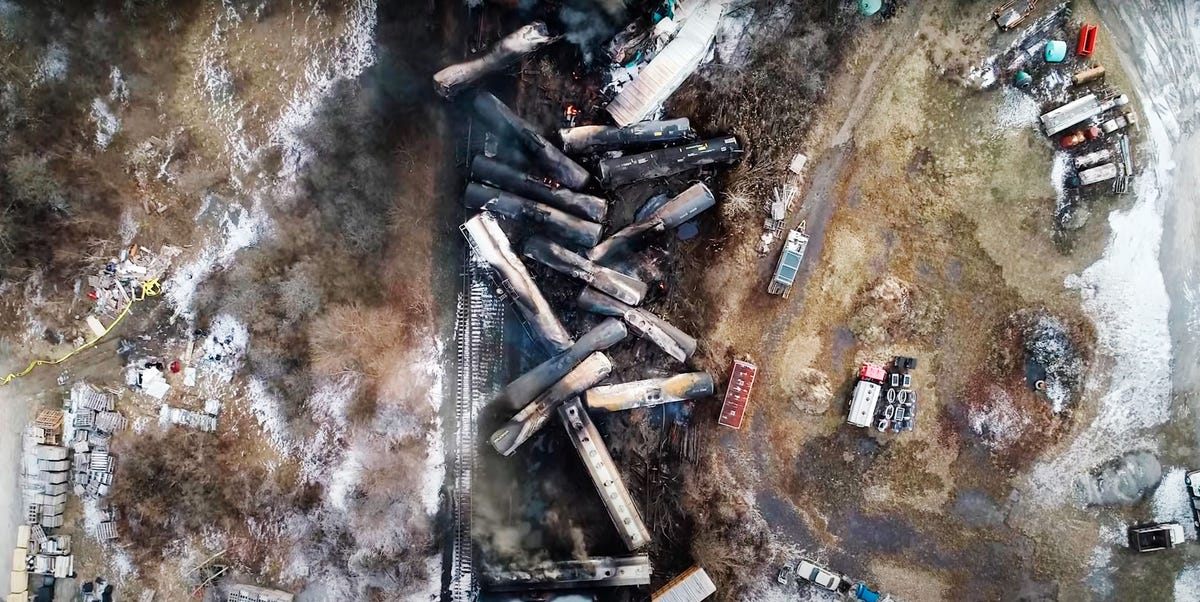
At approximately 8:55 p.m. on February 3, 2023, a Norfolk Southern freight train derailed in East Palestine, a village of roughly 4,700 people in eastern Ohio. Thirty-eight railcars left the tracks, and about 20 affected cars contained hazardous materials. The derailment sparked a fire that burned for days and immediately turned a quiet community into the center of a national emergency.
The train carried several industrial chemicals, including vinyl chloride, butyl acrylate, ethylhexyl acrylate, ethylene glycol, and isobutylene. These are not exactly the ingredients for a cozy Friday night. They are chemicals used in manufacturing, plastics, coatings, and other industrial processes, and some can pose health or environmental risks depending on exposure levels.
Evacuations and the Chemical Fire
Emergency officials issued evacuation orders for residents near the derailment site as crews worked to control the fire and assess damaged tank cars. The biggest concern centered on vinyl chloride, a flammable chemical used to make PVC plastic. Responders feared that pressure inside several damaged tank cars could lead to a catastrophic rupture.
On February 6, contractors carried out a “vent and burn” operation on five vinyl chloride tank cars. The process released the chemical from the cars and ignited it to reduce pressure. It produced the now-famous black plume over the region, an image that became the visual symbol of the East Palestine derailment.
Why Did the Train Derail?
The official investigation found that the East Palestine derailment began with an overheated wheel bearing. A wheel bearing is a mechanical component that helps a railcar wheel rotate smoothly. When it becomes too hot, it can fail. In this case, the bearing overheated, damaged the axle, and caused a wheelset to fail.
The National Transportation Safety Board concluded that the train’s hot-bearing detection system did not provide the crew with enough warning to stop before the failure became catastrophic. A detector recorded a high temperature before the derailment, but the final alert came only after the bearing had reached a much more dangerous condition.
A Tiny Part With Enormous Consequences
The lesson is painfully simple: rail safety often depends on small pieces of equipment doing their jobs correctly, while humans and systems respond quickly when something looks wrong. A wheel bearing is not glamorous. Nobody writes movie scripts about wheel bearings. But when one fails on a long freight train carrying hazardous materials, it can turn into a disaster with national consequences.
Investigators also raised concerns about the spacing and performance of hot-bearing detectors, emergency communication, hazardous-material information sharing, and the broader safety culture of freight rail operations. The East Palestine train wreck became a reminder that safety systems must work together. A warning system is only useful when it provides a warning early enough for someone to act.
Why the Vent-and-Burn Decision Remains Controversial
The vent-and-burn operation remains one of the most debated parts of the East Palestine train wreck. At the time, officials believed the vinyl chloride tank cars faced a serious risk of explosion caused by a possible chemical reaction inside the cars. The decision was made under intense pressure, with emergency crews trying to prevent a worse disaster.
However, the National Transportation Safety Board later concluded that the vent-and-burn operation was unnecessary. Investigators determined that the feared polymerization reaction was unlikely and that the tank cars were not on the verge of the catastrophic rupture initially feared.
That conclusion mattered because the controlled burn exposed emergency responders and nearby residents to additional hazards. Burning vinyl chloride can create harmful combustion byproducts, including hydrogen chloride and phosgene under certain conditions. The debate was not merely technical. It became a trust issue. Residents wanted to know whether the emergency response had protected them or added a new layer of risk.
In disasters, uncertainty is unavoidable. But unclear communication is optional. The East Palestine response demonstrated how quickly public confidence can collapse when information changes, warnings feel incomplete, and people believe major decisions were made without enough independent verification.
Chemical Exposure, Air Quality, Water Safety, and Health Concerns
The health questions surrounding the East Palestine train wreck are complicated because chemical exposure is not a simple yes-or-no issue. Exposure depends on factors such as distance from the derailment, time spent outdoors, ventilation, wind direction, personal health history, and the specific chemical involved.
Federal and state agencies conducted extensive air, water, soil, and groundwater monitoring after the derailment. Environmental Protection Agency data has included more than 100 million air-monitoring data points and tens of thousands of environmental samples. EPA officials have said their ongoing reviews have not found a derailment-related threat to residents from drinking water, soil, or air.
At the same time, many residents reported headaches, nausea, respiratory irritation, rashes, fatigue, anxiety, and other symptoms in the months after the crash. Those reports should not be dismissed simply because large-scale monitoring did not identify widespread contamination above federal health thresholds. Monitoring data and personal experiences can coexist, even when they do not fit neatly into a single headline.
Health Research Is Still Developing
Long-term health research is especially important because some effects of chemical exposure may not be fully understood immediately after a disaster. Federal health agencies, universities, and research institutions have continued to study the physical and mental health consequences of the derailment.
Research released after the disaster has pointed to significant stress, distrust, anxiety, depression, and post-traumatic stress symptoms among some people living in affected areas. A community survey published in 2025 found elevated rates of post-traumatic stress disorder and major depression among respondents living near the disaster zone. These findings do not prove that every health problem in the region was caused by the derailment, but they do show that the emotional consequences of the event are real and deserve long-term attention.
Cleanup Efforts and Environmental Recovery
Cleaning up the East Palestine train wreck has been a massive undertaking. Crews removed contaminated soil, wastewater, debris, damaged rail infrastructure, and material from nearby streams and drainage areas. The work required excavation, water treatment, transportation, testing, disposal, and repeated environmental checks.
By late 2025, more than 174,000 tons of contaminated soil had been removed, along with more than 39 million gallons of wastewater collected during cleanup operations. Major excavation work was completed, but environmental monitoring and follow-up work continued as agencies evaluated groundwater, wetlands, stream areas, and remaining site conditions.
Cleanup is not just about loading contaminated soil into trucks and declaring victory. It also includes restoring land, managing runoff, checking wells, monitoring streams, and answering questions from residents who may still be nervous every time they smell something unusual. That is the difficult part of environmental recovery: the physical cleanup may end before the emotional cleanup does.
Questions About Data and Public Trust
In 2026, the EPA announced action after concerns were raised about subcontractor analysts altering certain cleanup measurements. The agency said EPA-validated testing did not show new groundwater contamination or a new threat to public health. Even so, the episode reinforced a major lesson from East Palestine: public trust is fragile, and agencies must communicate clearly, correct errors openly, and show residents exactly how safety decisions are being made.
Legal Settlements and Corporate Accountability
The East Palestine derailment led to major legal action against Norfolk Southern. In 2024, the U.S. Department of Justice announced a settlement valued at more than $310 million. The agreement required the company to pay for past and future cleanup costs, support health monitoring, fund community services, and make safety improvements.
Norfolk Southern also agreed to a separate $600 million class-action settlement involving residents and businesses affected by the derailment. A federal court approved that settlement in September 2024. Appeals were resolved in March 2026, allowing the settlement process to move forward.
Money can help cover property losses, business interruptions, medical concerns, and relocation costs. But compensation has limits. A settlement cannot erase the fear of hearing a freight train at night, the frustration of arguing over air-monitoring results, or the feeling that a hometown has been turned into a case study.
How the East Palestine Train Wreck Changed Rail Safety Conversations
The East Palestine derailment revived national debate about freight rail regulation. Lawmakers, labor unions, safety advocates, emergency responders, and community groups called for stronger rules on railcar inspections, hazardous-material transportation, detector technology, train crew staffing, and emergency response training.
One major lesson involves hot-bearing detectors. Railroads use these systems to identify overheated wheel bearings before they fail. After East Palestine, regulators and investigators pushed for more consistent standards on detector spacing, alarm thresholds, maintenance, and data-sharing. It is not enough to install technology and hope it behaves. Safety equipment needs clear performance standards and regular verification.
Another lesson involves hazardous-material information. First responders need fast, accurate details about what a train is carrying. Delays in receiving train-consist information can make already difficult emergency decisions even harder. A volunteer firefighter should not have to play detective while standing near burning tank cars.
The derailment also highlighted the importance of local preparedness. Rural communities often rely on volunteer fire departments and limited emergency resources. When hazardous materials move through those communities every day, training, equipment, communication systems, and planning cannot be treated as optional extras.
Experiences Related to the East Palestine Train Wreck
The experience of East Palestine was not limited to the night of the derailment. For many residents, the disaster began with confusion: flashing emergency lights, smoke in the distance, phone alerts, rumors, and the uncomfortable realization that a familiar neighborhood had suddenly become dangerous. Some people left quickly with pets, medications, school supplies, work uniforms, and whatever they could fit into a car. Others waited for instructions, trying to decide whether the smell in the air was something to worry about or simply the latest terrifying detail in an already confusing situation.
The first few days brought an unusual mix of urgency and boredom. Evacuated families had to live out of hotels, stay with relatives, or sleep in temporary arrangements while watching news reports about their own streets. There is a strange helplessness in seeing helicopters circle above your town while you are sitting miles away, refreshing your phone for updates. Disaster response can make ordinary tasks feel enormous. Feeding children, finding clean clothes, getting to work, and checking on an elderly neighbor suddenly require a plan worthy of a military operation.
For first responders, the experience was different but equally intense. Firefighters, police officers, medics, public works employees, and volunteers had to make fast decisions in an environment filled with uncertainty. They were not responding to a routine vehicle accident or a house fire. They were dealing with derailed railcars, hazardous materials, flames, evacuation zones, technical reports, and pressure from state and federal agencies. The mental burden of making decisions while incomplete information is still arriving can last long after the emergency vehicles leave.
Residents also experienced the long shadow of distrust. When officials say water is safe, but a person still smells chemicals, sees unusual residue, or feels ill, reassurance can sound less like comfort and more like a debate. People may disagree about the science, but the feeling of not being heard is powerful. In communities affected by industrial disasters, trust is often as important as testing. A clean lab result matters, but so does explaining what was tested, when it was tested, what was not tested, and what happens if new concerns appear.
Small businesses faced their own version of the crisis. Restaurants, shops, contractors, landlords, farms, and service providers had to operate while customers stayed away, roads closed, and national headlines painted the area as a toxic disaster zone. Some businesses lost revenue because people could not enter the area. Others struggled because visitors feared coming near the village. For a small town economy, even a short interruption can leave a very long bruise.
The experience also changed how people viewed trains. Freight rail had long been part of the landscape in East Palestine. Trains passed through without becoming the subject of dinner-table conversations. After the wreck, every whistle, rumble, and vibration could carry a different meaning. That is one of the least visible impacts of a disaster: familiar sounds become reminders. Recovery is not only about restoring soil, water, and rail lines. It is also about helping a community regain the ability to hear an ordinary train and feel ordinary again.
East Palestine ultimately became a lesson in resilience, but resilience should never become a polite word for “people were forced to endure too much.” Residents showed strength by asking questions, attending meetings, documenting concerns, supporting neighbors, and refusing to let the story fade before the work was done. Their experience is a reminder that communities deserve more than emergency responses. They deserve transparency, accountability, long-term health support, and safety systems designed to prevent the next disaster before it starts.
Conclusion: Why East Palestine Still Matters
The East Palestine train wreck was caused by a mechanical failure, but its legacy reaches far beyond one failed wheel bearing. It exposed weaknesses in rail safety systems, emergency communication, hazardous-material planning, environmental oversight, and public trust.
The cleanup has made progress, legal settlements have been approved, and researchers continue to study possible long-term health effects. Yet East Palestine remains important because it asks a simple question with an uncomfortable answer: how safe are communities when hazardous freight moves through them every day?
The best tribute to East Palestine is not another press conference, another slogan, or another corporate promise wrapped in glossy language. It is better technology, faster warnings, stronger regulations, well-trained responders, transparent testing, and a commitment to listen when communities say they are still hurting.
Editorial note: This article synthesizes information from 12 U.S. public agencies, research institutions, court records, and nationally recognized news organizations current through June 2026. It is intended for general informational purposes and is not medical or legal advice.