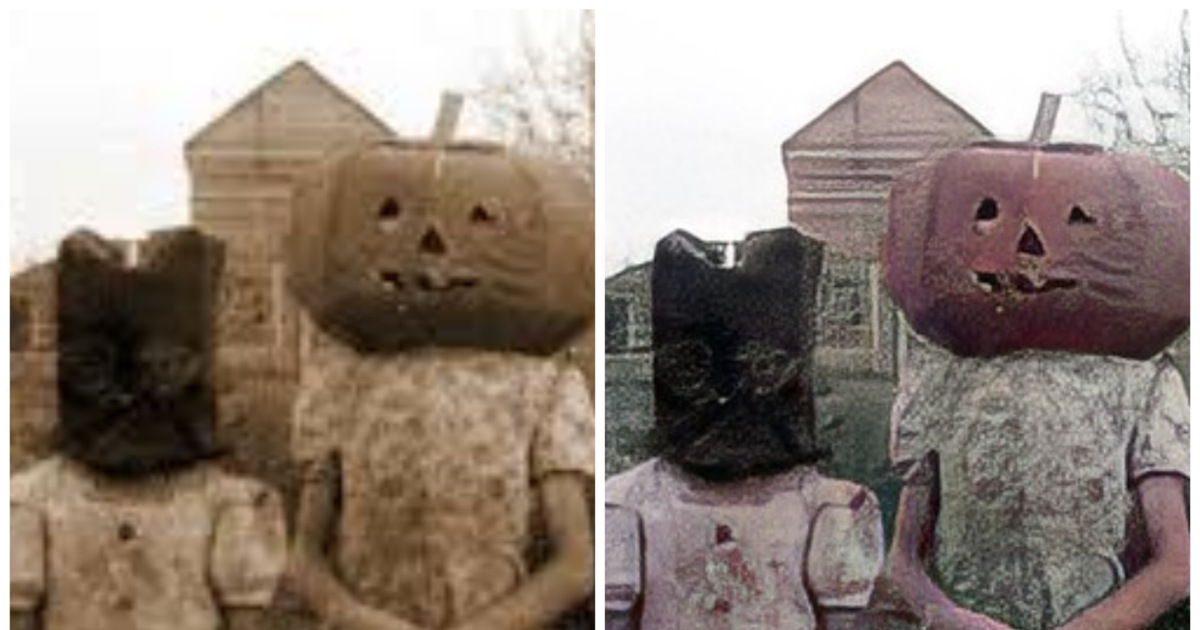
There are spooky photos, and then there are vintage Halloween costume photos that have been restored and colorized. Those belong in a category all their own: part history lesson, part nightmare fuel, part “why is that child dressed like a moon goblin and why can’t I look away?” The magic of these images is that they do not rely on modern horror tricks. No jump scares. No CGI fog. No soundtrack whispering ominous violins into your soul. Just old costumes, strange masks, and the unsettling realization that people once made Halloween outfits with whatever they had in the house and a truly heroic amount of confidence.
That is exactly why restored and colorized Halloween photos hit so hard. In black-and-white, old costume images can feel distant, almost abstract, like artifacts safely locked behind museum glass. But add color, clean up the scratches, sharpen the faces, and suddenly those people feel close enough to knock on your front door and ask for cider. Colorization pulls the past out of the attic and drops it right into your personal space. The effect is fascinating, eerie, and surprisingly emotional.
This article explores why these creepy vintage Halloween pictures feel so intense, what they reveal about the history of the holiday, and how nine classic costume-photo types become even more terrifying once restored. Think of it as a guided tour through the haunted family album you did not know you needed.
Why Vintage Halloween Photos Feel Scarier Than Modern Ones
Modern Halloween costumes usually aim for one of three things: recognizable, funny, or glamorous. Vintage costumes often aimed for something else entirely: disguise. In the early decades of the 20th century, many Halloween outfits were handmade, loosely assembled, and built around masks, draped fabric, crepe paper, face paint, hats, or whatever could transform the wearer into something not-quite-human. The goal was not always to look polished. The goal was to look other.
That “otherness” is where the chill comes from. Old masks rarely fit well. Eye holes sit slightly wrong. Mouths are too still. Fabric hangs in odd proportions. Children are dressed as clowns, witches, cats, goblins, and nameless creatures that seem to have been invented five minutes before the camera shutter clicked. Add sepia lighting, stiff posing, and expressions hidden behind paper or cloth, and you get the visual recipe for the uncanny.
Once restoration removes stains and blur, and colorization adds skin tones, pumpkin oranges, faded blacks, waxy whites, or sickly costume greens, the images stop feeling like antiques and start feeling immediate. That closeness is what makes them so effective. The past is no longer dusty. It is looking back at you.
The 9 Restored Photos That Turn Nostalgia Into Nightmare Fuel
Pic 1: The Pillowcase Ghost With Human Eyes
Nothing sounds more innocent than a sheet-ghost costume. It is the universal symbol of low-effort Halloween creativity. But in a restored vintage photo, that simplicity becomes deeply unsettling. The cloth is no longer a vague blur. You can see the wrinkles, the stitching, the drape around the shoulders, and most unsettling of all, the eyes peering through imperfect holes.
Colorization makes this worse in the best possible way. A faint cream-colored sheet, pinkish skin around the eye openings, and dim autumn tones in the background suddenly make the figure feel real. It is no longer a cartoon ghost. It is a person hiding in plain sight, which somehow feels creepier than any monster with fangs.
Pic 2: The Clown Who Clearly Did Not Come to Entertain
Vintage clown costumes deserve their own warning label. Before today’s polished party-store versions, clowns were often homemade combinations of baggy fabric, oversized collars, pointy hats, and hand-painted faces or masks. In old photographs, those design choices can look less “circus fun” and more “wandering carnival spirit with unfinished business.”
Restoration highlights every dot, ruffle, and painted grin. Colorization adds the final blow: faded reds, chalky whites, darkened eye makeup, maybe a washed-out blue trim. Suddenly the clown is not just odd. It is memorable in the exact way you did not ask for.
Pic 3: The Pumpkin-Head Child Standing Perfectly Still
There is something almost poetic about early pumpkin-themed costumes. They tie Halloween to harvest traditions, jack-o’-lantern imagery, and the cheerful side of fall. But a restored photo of a child in a pumpkin mask or pumpkin-colored hood often lands in eerie territory instead. Why? Because old masks rarely smiled in a comforting way. They grinned with commitment.
Once the orange tones are brought back and the photograph is sharpened, the costume can look oddly theatrical, like a tiny seasonal deity who wandered out of a cornfield and into a portrait studio. Cute? Technically. Alarming? Also yes.
Pic 4: The Witch Group Portrait That Looks Like a Coven Yearbook
Witches have been central to Halloween imagery for generations, so it is no surprise that many old Halloween costumes featured pointed hats, dark dresses, capes, and broom props. In a restored photo, though, a lineup of women or girls dressed as witches can feel unexpectedly cinematic. They are not doing much. They are just standing there. Yet the composition makes it seem like they are about to deliver a curse in excellent posture.
Colorization adds texture to the hats, deepens the blacks and purples, and creates contrast between pale faces and dark fabric. The result is part folklore, part fashion editorial, and part “we should probably not follow them into the woods.”
Pic 5: The Animal Mask Parade From Another Dimension
One of the strangest categories in vintage Halloween costume photos is the animal mask photo. Cats, rabbits, pigs, and unexplained furry creatures show up again and again in old images. But these masks are not plush, friendly, or movie-quality. They are often stiff, hand-painted, and slightly off in a way that makes the human body underneath feel wrong.
Restoration sharpens the edges of the snouts and ears. Colorization adds realistic fur tones or painted surfaces. Suddenly the image sits in the uncomfortable space between costume and transformation. It does not look like someone dressed as an animal. It looks like the animal look is winning.
Pic 6: The Homemade Devil With a Surprisingly Serious Expression
The vintage devil costume is a classic because it is simple, bold, and impossible to overthink. Red clothing, little horns, maybe a tail, maybe a trident if the household was feeling ambitious. But in old photos, these devils are often played completely straight. No grin. No wink. Just a child standing on a porch with the solemn intensity of someone auditing your moral choices.
That seriousness is what makes the restored image so memorable. Once the reds are revived and the shadows are cleaned up, the photo becomes strangely dramatic. It turns a familiar costume into a tiny theatrical performance about temptation, mischief, and the fact that children with props can be unintentionally terrifying.
Pic 7: The Couples Party Scene That Feels More Haunted Than Romantic
Early Halloween in America was not just about children roaming neighborhoods for candy. It was also a social holiday shaped by parties, parlor games, decorations, and courtship rituals. That history gives couples’ costume photos a special charm. They often show adults dressed in coordinated looks, standing in decorated interiors, trying very hard to look festive and dignified.
And yet, restored and colorized, these scenes can feel wonderfully haunted. Orange-and-black decorations glow again. Paper cutouts and lanterns pop. Guests in masks and makeup stand under indoor lighting that was never meant to flatter them. The result is less “date night” and more “if this party lasts one minute longer, someone is going to read fortunes in the dining room.”
Pic 8: The Front-Yard Group Shot Where Nobody Looks Entirely Human
Group portraits are where vintage Halloween really shows off. Put five or six people together in mixed homemade costumes, photograph them outdoors, and you get a glorious parade of visual confusion. One person is a clown. One is a witch. One appears to be a turnip spirit. Another is wearing a beard that suggests either wizardry or hardware-store improvisation.
Restoration brings the background into focus, which matters more than you might think. Fences, porches, trees, dirt paths, and modest homes make the weirdness feel domestic. These are not monsters in a castle. These are neighbors. Once colorization arrives, the scene becomes richly believable, and therefore much stranger.
Pic 9: The Child in a Store-Bought Transition-Era Costume
As Halloween became more commercialized, costumes gradually shifted from mostly homemade creations to packaged outfits and character-based looks. Some vintage photos capture that transition beautifully: a child wearing a more standardized costume, but still posed with the rigid seriousness common in old portrait photography. These images feel like history caught mid-change.
Restored and colorized, they also reveal how modern Halloween was born. You can see the manufactured sheen, the printed details, the early mass-market charm. But because the styling is still old-fashioned and the expression is still intense, the image lands in a deliciously uncanny middle ground. It is not fully old-world spooky and not fully modern fun. It is both. That is exactly what makes it linger in your mind.
What Restoration and Colorization Actually Change
Photo restoration does more than make old images prettier. It changes how we read them. Scratches, fading, torn corners, and blur create emotional distance. They remind us that an image is old. When those flaws are reduced, we begin to notice smaller details: the texture of crepe paper, the shine of a mask, the nervous position of a hand, the weird confidence of a child dressed as a bat.
Colorization adds another layer. Whether it is done conservatively or a little more dramatically, color brings bodies and costumes closer to the present. Black-and-white gives us symbolism; color gives us mood. Suddenly a witch costume is not just dark. It is charcoal-black with faded plum trim. A ghost is not white in theory. It is off-white cloth with warm shadows. A pumpkin costume is not a concept. It is orange enough to feel festive and just muted enough to feel old.
This is why restored vintage photos feel so powerful online. They satisfy two urges at once. We want history to stay historical, but we also want to feel it. Restoration and colorization let us do both. They preserve the archive while making it emotionally accessible. In Halloween’s case, that accessibility just happens to be gloriously creepy.
The Real History Behind the Horror
Part of the appeal of these images is that they sit on top of genuine Halloween history. The holiday’s roots are often traced to older seasonal customs associated with Samhain, masking, disguise, and beliefs about blurred boundaries between the living and the dead. By the early 20th century in the United States, Halloween had also become a community holiday shaped by parties, homemade decorations, costumes, and social performance.
That helps explain why many vintage costumes look less like specific characters and more like moods. Ghosts, witches, clowns, moons, devils, cats, and oddball creatures dominated because they matched Halloween’s atmosphere better than celebrity impressions ever could. In other words, these people were not trying to go viral. They were trying to embody the season.
There is also a design lesson hiding in these photos. Imperfection is powerful. Homemade costumes were frequently asymmetrical, awkward, and inventive. That made them expressive. Today, polished costumes can look impressive, but vintage outfits often feel more alive because they were made by hand, adjusted on the fly, and worn by real families participating in a ritual that was still delightfully unruly.
A Quick Word on Preserving Your Own Old Halloween Photos
If you have family Halloween snapshots tucked into a box somewhere, do your future descendants a favor and treat them kindly. Old photographs are vulnerable to heat, humidity, direct light, careless handling, and acidic storage materials. Even simple steps like using photo-safe sleeves, keeping prints in stable, cool, dry conditions, and scanning them before damage worsens can make a real difference.
And yes, those blurry photos of your uncle dressed as a pirate in 1978 absolutely count as cultural treasures. Today’s goofy family photo is tomorrow’s priceless seasonal artifact. One day, someone may restore it, colorize it, and discover that your family has apparently been serving haunted-energy portraits for generations.
The Experience of Looking at Restored Vintage Halloween Photos
Spending time with restored vintage Halloween images is a surprisingly layered experience. At first, most people react with laughter. The costumes are odd, the proportions are strange, and some of the faces seem unintentionally theatrical. You think, “Well, that is delightfully weird.” Then you keep looking. The humor stays, but something else creeps in. You begin noticing details: a child clutching a costume hem, a porch step worn smooth, a handmade mask with careful paint strokes, a woman standing proudly in a witch hat that was probably cut, folded, and pinned together an hour before the photo was taken. The image stops being just “old and creepy” and becomes personal.
That emotional shift is what makes the topic so compelling. Restored photos do not simply revive the image; they revive the people inside it. You can suddenly imagine the weather that day, the rustle of leaves, the scratchiness of wool stockings, the smell of candles or paper decorations, the fussing before the camera, and the excitement of an autumn evening that mattered enough to photograph. Colorization intensifies all of that. It turns abstraction into atmosphere. The past no longer feels silent. It feels inhabited.
There is also a special thrill in how these images blur the line between nostalgia and discomfort. Halloween has always played in that space. It invites us to dress up, to act differently, to flirt with fear while standing safely on the porch light side of the dark. Vintage photos show that this tension is not new at all. In fact, it may have been stronger in the homemade era, when costumes were less polished and more imaginative. A paper mask with uneven eye holes can be fun, but it can also be eerie because it reveals the human urge to transform with just a few scraps of material and a little nerve.
For collectors, historians, and ordinary curious people, these photos also offer a rare kind of time travel. You are not looking at presidents, wars, or famous landmarks. You are looking at ordinary celebration. That matters. It reveals how people decorated their homes, what they considered spooky, how communities gathered, and how children performed for the camera. These are tiny records of taste, craft, humor, and social ritual. In a world obsessed with polished public images, there is something deeply refreshing about an old Halloween snapshot that is awkward, earnest, and a little bit chaotic.
And perhaps that is the strangest pleasure of all: restored vintage Halloween photos remind us that people in the past were not distant, gray, and serious all the time. They were playful. They were crafty. They were dramatic. They were willing to put a child in a deeply alarming clown suit and call it festive. Once you see that clearly, the images stop being museum curiosities and become evidence of continuity. We are still doing the same thing now, just with better lighting and easier access to fake blood.
So yes, the results are terrifying. But they are also charming, revealing, and oddly affectionate. They scare us because they feel close. They fascinate us because they are real. And they linger because underneath every eerie mask and every strangely colored costume is a very familiar human impulse: to make one fall night feel magical enough to remember forever.
Final Thoughts
Vintage Halloween costume photos restored and colorized are more than a seasonal curiosity. They are proof that Halloween has always thrived on transformation, improvisation, and a little tasteful chaos. The old images may look terrifying by modern standards, but that is part of their brilliance. They show a holiday before it became fully polished, when weirdness was handmade and charm came with a side of accidental horror.
If these nine scenes teach us anything, it is this: the scariest Halloween images are not always the bloodiest or the loudest. Sometimes they are just old enough, clear enough, and human enough to make you stare for one second too long. That is where the real fun begins.