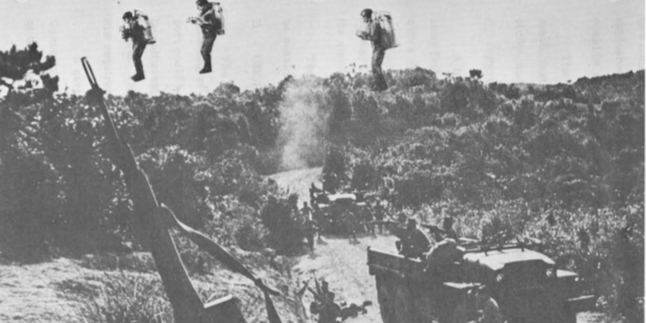
It sounds like a scene deleted from a comic book: American troops skimming above Vietnam’s rice paddies with rifles, helmets, and personal flying machines strapped to their backs. Yet the idea was not pure fantasy. During the 1960s, while helicopters were changing the way the United States moved soldiers across jungles, mountains, and coastlines, Bell Aerosystems was exploring something even stranger: individual flight systems for soldiers. In plain English, jetpacks.
The phrase “U.S. troops could have fought the Vietnam War with jetpacks” is not a joke pulled from late-night television. Bell developed and promoted a family of personal aerial vehicles called Light Mobility Systems, or LMS, and imagined them being used for reconnaissance, raids, beach assaults, psychological operations, and fast escape from ambushes. The concept was bold, futuristic, and visually irresistible. It also had one tiny problem: war is not a trade show, and a flying soldier makes a very noticeable target.
The Strange but Real History Behind Military Jetpacks
Jetpacks were a serious military dream before they became a pop-culture punchline. In the late 1950s and early 1960s, Bell engineer Wendell F. Moore worked on the Small Rocket Lift Device, better known as the Bell Rocket Belt. The device used concentrated hydrogen peroxide, which passed through a catalyst and turned into high-temperature steam. That steam blasted through nozzles, creating enough thrust to lift a person into the air.
It was brilliant engineering, but not exactly a commuter vehicle. The Rocket Belt could hover, turn, and leap over obstacles, but its flight time was measured in seconds. The most famous limitation was endurance: about 20 seconds of useful flight. That is enough time to wow a crowd, cross a small obstacle, or make James Bond look cooler than everyone at the party. It is not enough time to conduct a serious patrol in a jungle war.
Still, the U.S. military had reasons to pay attention. Infantry mobility has always been a battlefield obsession. Soldiers who can cross rivers, trenches, fences, canals, minefields, or dense terrain faster than the enemy gain an advantage. In Vietnam, mobility mattered even more because the terrain often worked against conventional movement. Thick vegetation, muddy paddies, mountains, rivers, and limited roads made helicopters essential. Bell’s pitch was simple: if helicopters helped whole units move, why not give individual soldiers their own vertical lift?
Vietnam Was Already the “Helicopter War”
To understand why jetpacks seemed tempting, you have to understand Vietnam’s airmobility revolution. In December 1961, U.S. Army H-21 helicopters and hundreds of personnel arrived in Saigon, marking an early symbol of American combat power and the beginning of a new era of Army airmobility. Days later, helicopters were used in Operation Chopper, one of the first major airmobile actions in the conflict.
As the war escalated, helicopters became the sound of Vietnam in the American imagination. Hueys inserted troops, evacuated wounded soldiers, delivered supplies, scouted routes, and provided gunship support. They allowed commanders to leap over bad roads and dense terrain. They also showed the dangers of low-altitude flight. Helicopters could be shot down by ground fire, damaged by weather, and strained by the brutal operating environment.
That is where the jetpack idea gets interesting. Bell’s Light Mobility Systems proposal tried to shrink the helicopter’s mobility advantage down to the individual soldier. A jetpack soldier could theoretically scout ahead, cross obstacles, reach a rooftop, leave an ambush zone, or move from ship to shore without waiting for a landing craft. On paper, that sounded like tomorrow’s war arriving early. On the battlefield, it would have looked more like one very brave person asking every rifle in the area to please notice him.
Bell’s Light Mobility System: The Jetpack Family That Almost Was
Bell’s 1967 concept did not describe just one backpack rocket. It imagined a family of Light Mobility Systems, from one-man flying devices to larger platforms capable of carrying more weight. Some versions looked like personal jet belts; others looked more like tiny flying platforms. Bell promoted them as fast, agile, and useful for missions where speed and surprise mattered.
Reconnaissance and Scouting
The first obvious use was reconnaissance. Instead of sending a patrol through thick brush, Bell imagined a soldier lifting above the ground to spot enemy movement, check terrain, or provide point and flank security. In theory, a flying scout could cover more distance than a man on foot and return intelligence faster than a ground patrol.
The problem was visibility. Reconnaissance works best when the scout is hard to detect. A jetpack is many things; subtle is not one of them. The exhaust, noise, motion, and human silhouette would have made the pilot stand out. In a place where enemy fighters often used concealment, tunnels, vegetation, and close-range ambush tactics, a noisy flying scout could quickly become the most interesting target in the sky.
Amphibious Assaults and Beach Raids
Bell also imagined troops using personal flight systems in assaults from offshore ships. In this scenario, jetpack-equipped Marines or soldiers could launch from a vessel, skim toward the shoreline, bypass obstacles, and land near or behind enemy positions. It is a dramatic image: a swarm of flying troops arriving like angry hornets with government paperwork.
But amphibious assault is not only about getting ashore. Troops need ammunition, radios, medical supplies, water, heavier weapons, and follow-on support. A jetpack could move a person, but not the logistical ecosystem that keeps that person alive. Once the flying soldier landed, he was still an infantryman in a dangerous place, only now carrying a complicated flying machine that needed fuel, maintenance, and probably a very nervous technician.
Psychological Operations
Bell’s proposal also considered psychological operations. Light Mobility Systems could distribute leaflets, carry loudspeakers, move small propaganda equipment, or broadcast messages from the air. The idea fit the era. Vietnam included not only conventional battles but also information campaigns, leaflet drops, loudspeaker broadcasts, and attempts to influence enemy morale.
Would a jetpack have been psychologically impressive? Absolutely. Seeing a person fly over a village in the 1960s would have made an impression. But psychological impact cuts both ways. A dramatic flying device can inspire awe, but it can also become a priority target. Once the surprise wears off, the enemy stops saying “What is that?” and starts saying “Aim higher.”
Rocket Belt vs. Jet Belt: What Was the Difference?
The early Bell Rocket Belt was rocket-powered and relied on hydrogen peroxide. It was compact and spectacular but limited by fuel. Bell later worked on a Jet Flying Belt that used a small turbine-style power system, including the Williams WR-19 engine concept, to improve endurance, range, and military usefulness. The goal was to move beyond short hops and toward missions that could actually matter in the field.
Military documents described possible uses such as observation, reconnaissance, forward observation, liaison, crossing natural and man-made obstacles, clandestine operations, and delivering personnel or parts for maintenance. Those mission categories were practical on paper. They were also broad enough to make the system sound useful almost anywhere. That is a classic defense-technology temptation: when a machine is new and exciting, people imagine it solving every problem from scouting to supply delivery to “Can someone please get this colonel across that canal?”
The improved Jet Belt promised more than the Rocket Belt, but improvement did not equal readiness. More fuel meant more weight. More endurance meant more complexity. More complexity meant more maintenance. More maintenance in Vietnam meant more things to break in heat, mud, humidity, and combat conditions.
Why Jetpacks Made Tactical SenseAt First Glance
It is easy to laugh at the idea of jetpack troops, but the concept did address real tactical frustrations. A soldier on foot is limited by terrain. A helicopter is powerful but large, noisy, expensive, and dependent on landing zones. A small personal flight system seemed to offer a middle path: less infrastructure than a helicopter, more mobility than walking.
- Obstacle crossing: A jetpack could help a soldier cross canals, streams, fences, ravines, or minefields without using a bridge.
- Rapid scouting: A flying observer might quickly inspect terrain that would take a patrol much longer to reach.
- Ambush escape: A soldier could theoretically lift out of a kill zone if the device were ready and functioning.
- Urban movement: In built-up areas, a personal flying system could help troops reach rooftops or upper floors.
- Special operations: For niche missions, personal flight had a certain James Bond appeal, minus the tuxedo and with much worse humidity.
These advantages were real enough to study. The issue was not that personal flight had no value. The issue was that the value came with serious trade-offs that were hard to ignore.
Why Jetpacks Would Have Been a Nightmare in Vietnam
They Were Too Vulnerable
A helicopter is vulnerable, but it has speed, altitude options, armor in some cases, crew coordination, door gunners, and support from other aircraft. A jetpack pilot would have had very little protection. At low altitude, he could be hit by rifles, machine guns, or even fragments. At higher altitude, he would be visible and exposed. There was no safe zone where a flying infantryman magically stopped being a target.
They Could Not Carry Enough
Infantry combat is heavy. Soldiers carry weapons, ammunition, grenades, radios, water, rations, medical gear, and protective equipment. Add a personal flight device, fuel, controls, and safety gear, and the load becomes a serious problem. Every pound spent on flight hardware is a pound not spent on ammunition, batteries, water, or armor.
They Were Hard to Control
Flying a personal lift device is not like riding a bicycle, unless your bicycle is strapped to your spine and powered by hot exhaust. Control required training, balance, calm nerves, and careful handling. Combat does not provide calm conditions. A pilot taking fire, landing on uneven ground, avoiding trees, and managing fuel would face an extreme workload.
They Had Limited Safety Margins
A helicopter can autorotate in some emergencies. A plane can glide. A parachute needs altitude. A low-flying jetpack pilot has very few options if the engine quits. In Vietnam’s terrain, a hard landing could mean injury, capture, or both. For commanders, that risk would have been difficult to justify unless the mission payoff was extraordinary.
The Jungle Was Not a Friendly Runway
Vietnam’s environment was unforgiving. Jungle canopy could block takeoff and landing. Mud could make footing unstable. Rain and humidity could complicate maintenance. Rivers, paddies, and tree lines created unpredictable hazards. A flight system that looked elegant in a demonstration field might become much less charming when landing beside elephant grass under fire.
Could Jetpacks Have Changed the Vietnam War?
No. They might have changed a few demonstrations, tests, or small experimental missions, but they would not have changed the war’s outcome. Vietnam was shaped by politics, strategy, local knowledge, logistics, airpower, insurgency, conventional offensives, and the limits of U.S. military power. Jetpacks could not solve those problems.
The most realistic use would have been narrow: special reconnaissance, obstacle crossing, ship-to-shore experiments, or emergency movement in carefully selected environments. Even then, helicopters, boats, ropes, ladders, ground vehicles, and trained patrols were usually more practical. The jetpack was an answer to a real question, but not the best answer.
Why the Idea Still Fascinates Us
The Vietnam jetpack concept remains fascinating because it sits at the crossroads of imagination and reality. It was not fake. Engineers built working personal flight devices. Test pilots flew them. The military studied them. Bell tried to sell the idea for combat. The technology was just not ready for the messy, brutal, low-altitude reality of war.
That is what makes the story so compelling. It is not simply “the Army wanted flying soldiers.” It is a lesson in how military innovation works. New technology often begins with a dazzling demonstration. Then come the harder questions: Can it be maintained? Can ordinary troops use it? Does it survive weather? Does it help more than it hurts? Does it solve a battlefield problem better than existing tools?
For Bell’s jetpacks, the answer was mostly no. The machines flew, but the mission case never flew high enough.
Experience-Based Perspective: What Jetpack Warfare Might Have Felt Like
To appreciate why the idea was both thrilling and flawed, imagine the experience from the ground up. A soldier assigned to test a Vietnam-era jetpack would not simply “put it on and go.” First would come the fitting, the harness, the weight, the fuel checks, the controls, the briefing, and the uncomfortable awareness that the machine on his back had very little patience for mistakes. It would feel less like wearing a backpack and more like being buckled into a science experiment with boots.
Before takeoff, the soldier would need a clear launch area. That alone would be a challenge in Vietnam. A rice paddy might look open, but mud can swallow footing. A jungle clearing might look usable, but branches, vines, and uneven ground can ruin a landing. A ship deck might provide a cleaner launch point, but salt air, motion, and operational clutter would create their own problems. Even in ideal conditions, everyone nearby would know something unusual was about to happen. Jetpacks do not sneak into the room; they announce themselves like a mechanical dragon clearing its throat.
Then comes ignition. The noise, heat, and vibration would instantly turn theory into adrenaline. The pilot would feel the lift through the harness and shoulders, with the body becoming part of the control system. Small movements would matter. Lean too much, correct too late, or panic at the wrong moment, and the flight could become a very expensive tumble. In demonstrations, pilots made the Rocket Belt look graceful. In combat gear, under stress, with uneven terrain below, grace would be harder to find.
Now place that pilot in Vietnam. Below him are paddies, trails, tree lines, canals, and possible enemy positions. If he rises high enough to see, he is also high enough to be seen. If he stays low, he has less reaction time and more obstacles. If he carries a weapon, recoil and balance become concerns. If he carries no weapon, he depends on speed and surprise. Either way, the flight clock is always ticking. Fuel is not an abstract number; it is the difference between landing where planned and landing where gravity votes.
After landing, the experience changes again. The pilot is no longer a futuristic flying scout. He is a soldier with a hot, noisy, specialized machine that needs protection, refueling, and maintenance. If the mission is reconnaissance, he must report what he saw. If the mission is assault, he must fight while managing the burden of equipment. If the mission is escape, he must hope the device was ready at exactly the right second. In real combat, timing is rarely that polite.
This is why the jetpack story feels so human. It captures the optimism of engineers, the curiosity of military planners, and the hard-earned skepticism of anyone who has ever carried gear through bad terrain. The idea promised freedom from the ground, but war has a way of pulling every machine back down to earth. A jetpack could make a soldier fly for a moment. It could not make him immune to bullets, weather, fear, logistics, or physics.
Conclusion
U.S. troops really could have entered the Vietnam era with jetpacks in the experimental sense. Bell Aerosystems had the hardware, the imagination, and the military proposals. The company saw personal flight as a way to give soldiers speed, surprise, and freedom from difficult terrain. In a war defined by helicopters and mobility, that dream made a certain kind of sense.
But the battlefield is the world’s harshest product review. The Bell Rocket Belt was too short-ranged. The Jet Belt was more ambitious but too complex and risky. The Light Mobility System looked exciting in drawings, yet it offered limited protection, limited payload, limited safety margins, and questionable value against an enemy skilled at using terrain and small arms. In the end, Vietnam did not need flying infantrymen. It needed workable strategy, reliable logistics, clear objectives, and technology that could survive more than a spectacular demonstration.
The jetpack remains one of the most unforgettable “almost futures” in military history. It was real enough to test, wild enough to inspire, and flawed enough to stay out of combat. Sometimes the future arrives wearing polished fuel tanks and a helmet. Sometimes it hovers for 20 seconds, lands carefully, and quietly goes back to the drawing board.