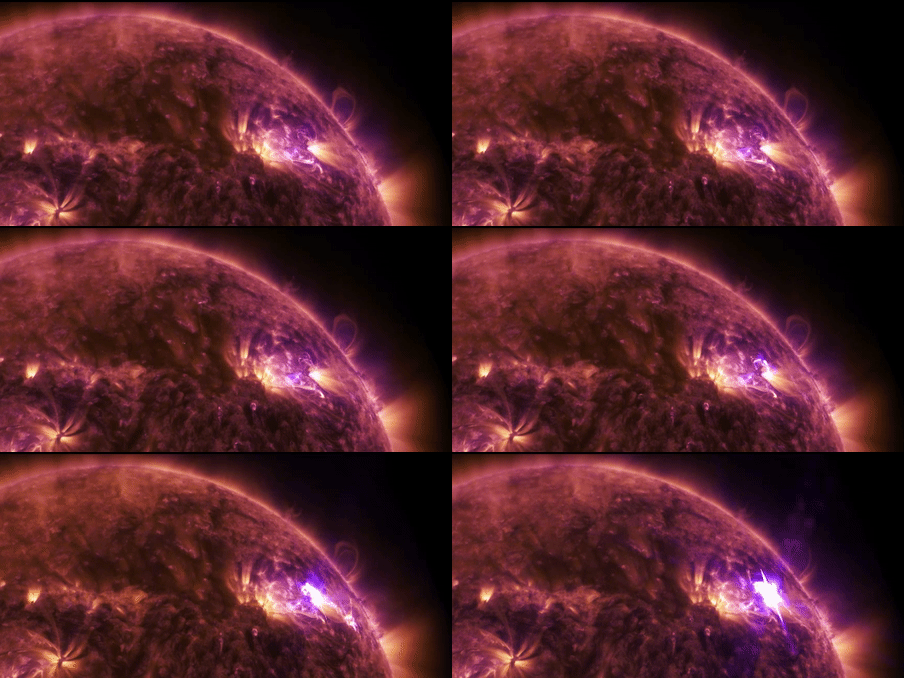
There are many things your monitor was built to handle: spreadsheets, streaming shows, cat videos, maybe a heroic number of browser tabs. But then NASA points the Solar Dynamics Observatory at the Sun, captures solar flares in 4K, and suddenly your screen looks like it is politely trying not to faint. The Sun, our nearest star and the solar system’s loudest overachiever, does not merely glow. It boils, loops, snaps, erupts, and occasionally throws a magnetic tantrum so large that Earth has to check its radio signals.
That is why 4K solar flare footage feels so unreal. It looks like science fiction, except the production budget is gravity, plasma, nuclear fusion, and a spacecraft that has been watching the Sun since 2010. No CGI artist needs to add drama. The Sun arrives with its own lighting department.
The title sounds playful, but the story behind it is serious and fascinating. Solar flares are not just pretty space fireworks. They are powerful bursts of radiation linked to tangled magnetic fields on the Sun. They can cause radio blackouts, affect satellites, disturb navigation signals, and help trigger auroras that make the night sky look like it downloaded a premium wallpaper pack.
What Makes 4K Solar Flare Footage So Stunning?
When people say “4K solar flare,” they usually refer to ultra-high-definition imagery from NASA’s Solar Dynamics Observatory, often shortened to SDO. This spacecraft continuously observes the Sun in multiple wavelengths of extreme ultraviolet light. These wavelengths reveal structures that human eyes cannot normally see: coronal loops, active regions, prominences, filaments, and the bright flash of solar flares.
In ordinary visible light, the Sun is basically an overexposed yellow-white disk. Beautiful, yes, but not exactly chatty. In extreme ultraviolet light, however, the Sun becomes a living map of magnetic chaos. Different colors are often assigned to different wavelengths, showing solar material at different temperatures. That is why NASA’s Sun videos can look gold, blue, green, red, or electric orange. The colors are not fake in the “made-up for fun” sense. They are visual translations of real data, made understandable for our very limited human eyeballs.
Why Your Monitor Cannot Fully Do It Justice
The joke that space is “too cool for your monitor” lands because 4K still feels inadequate for the scale of what is happening. A solar flare can stretch across regions larger than Earth. A coronal loop may look like a delicate glowing thread, but it is actually a giant arch of plasma guided by magnetic fields. What appears on your screen as a graceful shimmer may represent temperatures of hundreds of thousands or even millions of degrees.
It is like watching a thunderstorm from space, except the lightning is magnetic, the clouds are plasma, and the thunder may arrive as disturbed radio communications. Your monitor is not showing a special effect. It is showing a star doing star things with absolutely no concern for your display settings.
What Is a Solar Flare?
A solar flare is an intense burst of radiation from the Sun. It happens when magnetic energy stored in the solar atmosphere is suddenly released. Think of the Sun’s magnetic field as a drawer full of charging cables. Over time, things twist, knot, and tangle. Eventually, something snaps into a new arrangement, and energy explodes outward in the form of light and radiation across the electromagnetic spectrum.
Solar flares are commonly associated with active regions, especially around sunspots. Sunspots look darker because they are cooler than the surrounding solar surface, but do not let that fool you. They are magnetic troublemakers. When magnetic fields around these regions become unstable, they can release flares that range from minor flashes to X-class events, the strongest category used in regular solar flare classification.
Solar Flare Classes: C, M, and X Without the Headache
Solar flares are classified by their X-ray brightness. The main categories most people hear about are C-class, M-class, and X-class flares. C-class flares are relatively small and usually have little effect on Earth. M-class flares are medium-sized and can cause brief radio blackouts, especially in polar regions. X-class flares are the big ones. These can produce strong radio blackouts and may be associated with major space-weather events.
The scale is logarithmic, which is science’s way of saying, “Buckle up, the numbers get dramatic fast.” An X-class flare is ten times stronger than an M-class flare of the same number and one hundred times stronger than a C-class flare of the same number. So, an X1 flare is not just a slightly angrier M1 flare. It is in a different league.
Solar Flares vs. Coronal Mass Ejections
Solar flares and coronal mass ejections, or CMEs, are often mentioned together, but they are not the same thing. A flare is a flash of radiation. A CME is a huge eruption of plasma and magnetic field from the Sun’s corona. If a solar flare is the camera flash, a CME is the furniture leaving the room.
Sometimes a flare happens without a major CME. Sometimes a CME erupts with a flare. When a CME is directed toward Earth, it can interact with our planet’s magnetosphere and produce a geomagnetic storm. That is when auroras can become brighter and visible farther from the poles. It is also when satellite operators, power-grid managers, aviation planners, and communication systems start paying very close attention.
Why This Matters Beyond Pretty Videos
The 4K footage is gorgeous, but it also serves a real scientific purpose. Observing the Sun in high resolution helps scientists study how magnetic energy builds and releases. It helps researchers understand the structure of the corona, the behavior of plasma, and the origins of space weather. Better observations support better forecasting, and better forecasting matters because modern life depends on technology that can be affected by solar activity.
High-frequency radio communication, GPS accuracy, satellites, spacecraft electronics, and even power grids can be affected by strong solar events. For most people on the ground, a solar flare is not something to panic about. Earth’s atmosphere and magnetic field do excellent protective work. Still, the systems we rely on above and around the planet are more exposed.
NASA’s Solar Dynamics Observatory: The Sun’s Dedicated Paparazzi
NASA launched the Solar Dynamics Observatory in 2010 to study the Sun and its influence on Earth and near-Earth space. SDO watches the full disk of the Sun with remarkable consistency. Its Atmospheric Imaging Assembly captures the Sun in multiple ultraviolet wavelengths at a rapid cadence, allowing scientists to create detailed movies of solar activity.
This is why SDO footage feels so fluid. The Sun is not being photographed once in a while like a reluctant celebrity outside a restaurant. It is being monitored continuously. As a result, researchers can watch solar material move along magnetic field lines, see active regions evolve, and track eruptions as they unfold.
Why 4K Is Not Just a Buzzword Here
In consumer tech, “4K” often means sharper movies, better gaming, and more visible pores on actors who never asked for that level of honesty. In solar science, 4K resolution helps reveal fine details in the Sun’s atmosphere. It allows viewers to see structure in eruptions, loops, and waves that would be lost in lower-resolution imagery.
The beauty of NASA’s 4K Sun videos is that they operate on two levels. For the public, they are breathtaking visual experiences. For scientists, they are data-rich observations of magnetic and plasma behavior. The same clip that makes a casual viewer whisper “wow” can help researchers ask sharper questions about how energy moves through the solar atmosphere.
The Sun Is More Active Than It Looks
From Earth, the Sun seems steady. It rises, sets, warms the sidewalk, powers solar panels, and makes people regret forgetting sunscreen. But the Sun is not calm. It follows an approximately 11-year cycle of activity, moving between solar minimum and solar maximum. During solar maximum, sunspots become more common, and solar flares and eruptions tend to occur more frequently.
Solar Cycle 25 has brought renewed attention to solar activity. NASA and NOAA have confirmed that the Sun entered its solar maximum period, a phase when dramatic solar events become more likely. That does not mean every day is a cosmic disaster movie. It means the Sun is in a naturally more active part of its rhythm, giving scientists and skywatchers more events to study and admire.
Auroras: The Beautiful Side Effect
One of the most beloved consequences of solar activity is the aurora. When charged particles from the Sun interact with Earth’s magnetic field and upper atmosphere, atoms and molecules can glow in shimmering colors. Oxygen can produce green and red light, while nitrogen can contribute blue and purple tones. The result is one of nature’s greatest shows, and yes, it comes with better reviews than most streaming finales.
Strong geomagnetic storms can push auroras farther south than usual in the Northern Hemisphere and farther north than usual in the Southern Hemisphere. That is why people in places not normally associated with aurora viewing sometimes get surprise sky shows after major solar activity.
How 4K Solar Videos Change Public Interest in Space
Space science can feel abstract when described only in numbers. Say “magnetohydrodynamics” at a dinner party and watch everyone suddenly become fascinated by the salad. But show a 4K video of plasma arcing across the Sun, and people immediately understand that something extraordinary is happening.
Visuals help translate complex science into emotional understanding. A viewer may not know the details of ionized gas, magnetic reconnection, or coronal heating, but they can see motion, scale, intensity, and beauty. That emotional doorway matters. It invites people to learn more.
NASA’s public solar imagery also reminds us that scientific instruments are not just tools for experts. They are bridges. A spacecraft collecting ultraviolet data for heliophysics research can also inspire students, artists, educators, photographers, and ordinary viewers who simply enjoy seeing the universe behave like a lava lamp with a PhD.
What 4K Solar Flares Teach Us About Technology on Earth
The modern world is deeply connected to space-based infrastructure. Weather forecasting, navigation, banking timestamps, aviation routing, emergency communication, military systems, and global logistics all benefit from satellites and radio technologies. Space weather is not a distant curiosity; it is part of the environment in which our technology operates.
NOAA’s Space Weather Prediction Center monitors solar activity and issues alerts when conditions may affect Earth. Large solar flares can change the ionosphere, disrupting high-frequency radio signals on the sunlit side of the planet. CMEs can trigger geomagnetic storms if their magnetic structure connects effectively with Earth’s magnetosphere.
That is why solar observation matters. Beautiful 4K videos are the public-facing side of a serious monitoring system. Behind the mesmerizing colors are real questions: Will this flare affect radio communication? Did it launch a CME? Is the CME Earth-directed? When might it arrive? How strong could the geomagnetic storm be?
The Coolest Part: We Are Still Learning
Despite decades of solar research, the Sun still keeps secrets. Scientists continue studying why the corona is much hotter than the visible surface, how the solar wind accelerates, and how magnetic energy turns into explosive events. Missions like SDO, Parker Solar Probe, SOHO, and tools such as Helioviewer all contribute pieces of the puzzle.
Parker Solar Probe has flown closer to the Sun than any previous spacecraft, sampling the solar environment directly. Meanwhile, Earth-based observatories such as the Daniel K. Inouye Solar Telescope provide extremely detailed views of the solar surface. Together, these missions and instruments are changing the way we understand our star.
The result is a golden age of solar watching. We can observe the Sun from Earth, orbit, and near the corona itself. We can turn invisible wavelengths into vivid images. We can track eruptions, model solar wind, and improve forecasts. We can also sit at our desks, click play on a 4K video, and feel delightfully underqualified to witness a star casually rearranging magnetic fields the size of planets.
Experience Section: Watching Solar Flares in 4K Feels Like Seeing the Internet Grow Up
The first experience many people have with 4K solar flare footage is disbelief. You press play expecting a science clip, maybe something educational and slightly dusty, and instead the Sun appears like a living ocean of fire. It pulses. It swirls. It throws glowing loops into space with the confidence of a chef flipping pancakes in zero gravity. For a moment, the viewer forgets this is data. It feels cinematic, even though the Sun has never hired a cinematographer.
Watching solar flares in 4K on a large monitor is especially strange because the image is both intimate and impossibly distant. You can see details that make the Sun feel close, almost touchable, yet every rational part of your brain knows that this is a star about 93 million miles away. The screen creates a false closeness. It says, “Here, inspect this glowing magnetic storm from your chair.” That contrast is part of the magic.
There is also a humbling experience in realizing that the most spectacular things in the video are not special effects. A bright flare blooms, and it may look like a digital explosion designed for a superhero movie. But it is real. The loops are real. The plasma is real. The magnetic fields are real. The scale is so large that Earth could be treated as a minor prop, which is rude but scientifically fair.
For students, creators, and casual space fans, these videos can become a gateway into astronomy. One minute you are admiring the colors; the next you are searching for what 171 angstrom light means, why the corona is so hot, and whether an X-class flare is something you should worry about. The answer, thankfully, is usually no for ordinary daily life, but yes if you care about satellites, communications, astronauts, and the invisible technological web around Earth.
The funniest part is that 4K footage makes even expensive screens feel modest. Your monitor can display the video, but it cannot capture the true scale, brightness, temperature, or violence of the event. It is like viewing the Grand Canyon through a keyhole, except the canyon is made of plasma and occasionally interferes with radio signals. Still, that tiny window is enough. It makes the Sun feel less like a flat symbol in a weather app and more like what it truly is: a dynamic star with moods, cycles, storms, and an alarming amount of personality.
In that sense, the experience of watching solar flares in 4K is not just visual. It is emotional. It reminds us that science is not boring; sometimes it is simply waiting for the right camera angle. It reminds us that beauty and danger can share the same frame. Most of all, it reminds us that space is not empty, silent wallpaper behind our planet. It is active, dramatic, measurable, and often far cooler than anything our monitors can comfortably explain.
Conclusion
Solar flares in 4K show us a version of the Sun that is both scientifically valuable and visually unforgettable. NASA’s Solar Dynamics Observatory turns invisible wavelengths into vivid solar portraits, revealing magnetic loops, active regions, eruptions, and flares with astonishing clarity. These images are not just pretty space content; they help researchers understand the forces that shape space weather and affect technology on and around Earth.
The next time a 4K solar flare video appears on your screen, treat it as more than eye candy. It is a front-row seat to the behavior of a star. It is a reminder that our calm-looking Sun is constantly moving, twisting, and releasing energy. And yes, it is proof that space may be too cool for your monitor, but your monitor deserves credit for trying.