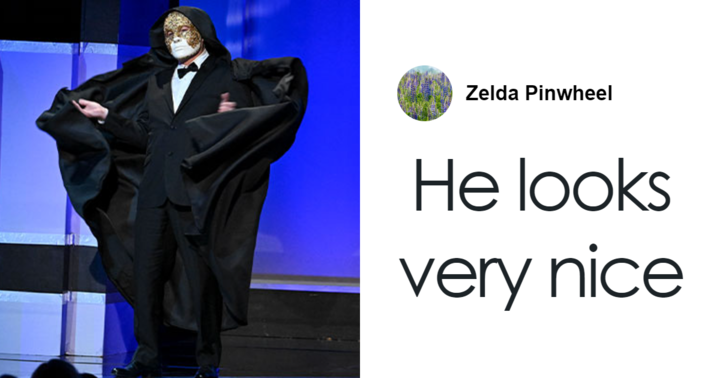
Mike Myers has built a career on disappearing into characters: a shaggy-haired Wayne Campbell, a velvet-suited Austin Powers, the pinky-raising Dr. Evil, and a certain green ogre with surprisingly tender feelings. So when he stepped onto the stage at the 49th AFI Life Achievement Award Gala in a cloak and mask, the move felt perfectly on-brand. Then came the reveal.
At the Hollywood ceremony honoring Nicole Kidman, Myers removed his mask and surprised the audience with a dramatically different look: a short gray buzzcut, a neat gray beard, and a polished black tuxedo. For fans who still picture him with the brown hair and mischievous grin of his Austin Powers years, the reaction was immediate: “Wait, that’s Mike Myers?”
The viral moment was not just about a haircut. It was a clever celebrity appearance, a tribute to Kidman’s film legacy, and a reminder that famous faces do not stay frozen in the exact decade we first loved them. Shocking, yes. Human? Also yes. Time, like Dr. Evil, does not ask permission before executing its plan.
What Happened At The AFI Gala?
The American Film Institute honored Nicole Kidman with its 49th AFI Life Achievement Award at the Dolby Theatre in Hollywood on April 27, 2024. The gala brought together major names from film and television, including Meryl Streep, Reese Witherspoon, Morgan Freeman, Naomi Watts, Zac Efron, Miles Teller, Keith Urban, and Mike Myers.
Myers appeared during the tribute portion of the evening wearing a dark cloak and a mask. The costume was a nod to Eyes Wide Shut, Stanley Kubrick’s 1999 psychological drama starring Kidman and Tom Cruise. In other words, this was not a random Phantom of the Opera detour. It was a carefully staged joke for a room full of movie people who understood the reference instantly.
As Myers approached the podium, he removed the mask and revealed himself. The audience got the gag, but online viewers quickly focused on something else: his new look. The actor, then 60, had traded the longer brown hair often associated with his classic roles for a close gray buzzcut and short beard. The result was elegant, understated, and noticeably different from the mental snapshot many fans had been carrying around since the late 1990s.
Why Fans Called Mike Myers “Unrecognizable”
The word “unrecognizable” is one of the internet’s favorite celebrity adjectives. It can mean anything from “this person changed their hairstyle” to “my entire childhood just aged in front of me.” In Myers’s case, the reaction made sense because his public image has always been tied to highly specific visual signatures.
Wayne’s World gave audiences the long-haired, baseball-cap-wearing Wayne Campbell. Austin Powers turned Myers into a walking carnival of teeth, glasses, ruffles, chest hair, and catchphrases. Shrek made his voice famous to a generation that might not even recognize his face immediately. His most memorable characters are not subtle. They are loud, designed, exaggerated, and intentionally cartoonish.
The AFI look was the opposite. No wig. No costume teeth. No psychedelic suit. No green makeup. Just a clean tuxedo, silver hair, and the confidence of a performer who no longer needs to shout to be recognized. Ironically, that simplicity is what made people look twice.
The Mask Was A Smart Tribute To Nicole Kidman
Myers’s entrance worked because it connected directly to the honoree. Nicole Kidman’s career is filled with bold choices, and Eyes Wide Shut remains one of her most discussed films. By entering with a mask and cloak, Myers gave the evening a small theatrical wink. It was funny, cinematic, and specific to Kidman’s body of work.
That matters because AFI tributes are not ordinary red carpet events. They are celebrations of film history, craft, risk-taking, and influence. Kidman’s career spans prestige dramas, surreal thrillers, musicals, television dramas, and fearless performances that refuse to sit politely in one category. A tribute to that kind of career should have a little mystery. Myers understood the assignment.
The reveal also played with one of Hollywood’s oldest tricks: transformation. The audience first saw a masked figure, then a familiar comedian, then an unexpectedly changed public image. In a single moment, Myers moved from mystery guest to nostalgic icon to viral topic. That is a lot of work for one mask. Somewhere, a publicist probably shed a tear of professional joy.
Mike Myers Has Always Loved Transformation
The AFI moment feels even more fitting when viewed through Myers’s career. Few modern comedians have used transformation as consistently. On Saturday Night Live, he created memorable characters with distinct voices, rhythms, and physical traits. In Austin Powers, he played multiple roles, including Austin Powers, Dr. Evil, Fat Bastard, and Goldmember. Each character had a different body language, accent, face, and comic engine.
In Shrek, Myers did not need his face at all. His voice carried the character’s sarcasm, loneliness, irritation, and heart. Shrek became one of the most recognizable animated characters in movie history, powered largely by Myers’s Scottish-accented performance and comic timing.
That history makes the AFI gala reveal feel less like a shocking makeover and more like another Myers-style switch. The difference is that this time, the transformation was not into a character. It was into an older, quieter, more private version of himself. The public reaction says as much about audiences as it does about him: fans often remember celebrities as they were when those celebrities became meaningful to them.
A Rare Public Appearance Made The Reaction Bigger
Myers has not been the kind of celebrity who appears everywhere, all the time, with a smoothie in one hand and a ring light in the other. He has taken long breaks between major projects and has often kept a lower profile than many stars of his generation. That rarity adds power to any public appearance.
When fans see an actor constantly, small changes feel gradual. When they see someone after a long gap, every change arrives at once. Hair color, facial hair, styling, posture, age, and mood all become part of a single visual update. That is why the AFI photos spread so quickly. Myers did not look strange; he looked current. The internet, however, had been comparing him to a version stored in a 1999 memory folder labeled “Yeah, baby!”
The new gray buzzcut also changed the frame of his face. It made him look sharper, calmer, and more mature. Combined with the beard and formal tuxedo, it created a sophisticated look that contrasted sharply with the goofy, rubber-faced energy of his best-known roles.
What The Moment Says About Celebrity Aging
Celebrity culture has a strange habit of demanding two impossible things at once. Fans want stars to stay exactly the same, but they also want them to surprise us. If a public figure ages naturally, people call them unrecognizable. If they appear not to age, people speculate. It is a lose-lose game, and the prize is usually a comments section nobody should read before coffee.
Myers’s AFI appearance is a useful reminder that aging is not a plot twist. It is life. Actors change because everyone changes. Hair turns gray. Faces mature. Style evolves. The real story is not that Mike Myers looks different. The real story is that he made a rare appearance, delivered a clever tribute, and still knew how to command a room with timing and theatrical flair.
There is also something refreshing about a famous comedian embracing a look that does not seem desperate to chase youth. The gray hair and beard gave Myers a distinguished presence. He looked like someone who has earned the right to appear exactly as he wants: relaxed, funny, and not overly concerned with whether strangers can still match him to a movie poster from three decades ago.
From Austin Powers To Shrek: Why Myers Still Matters
Mike Myers’s cultural impact is bigger than one red carpet moment. Wayne’s World helped turn an SNL sketch into a box office phenomenon. Austin Powers revived and parodied the spy genre with absurd confidence. Dr. Evil became a pop culture language all his own. Shrek reshaped animated comedy by mixing fairy-tale satire with emotional storytelling and adult-friendly humor.
His comedy often works because it is both silly and precise. Myers does not merely put on funny voices; he builds whole comic systems around them. Austin Powers is not just a character with bad teeth. He is a walking collision between 1960s sexual confidence and modern awkwardness. Dr. Evil is not just a Bond villain parody. He is a needy, oddly domestic supervillain who wants world domination and family validation, preferably in that order.
That is why fans reacted so strongly to seeing him at the AFI gala. Myers represents a particular era of comedy, but his best work continues to travel. Younger viewers may know him as Shrek first. Older fans may think of Wayne Campbell or Austin Powers. Film fans may remember his supporting turns in Inglourious Basterds, Bohemian Rhapsody, or Amsterdam. The mask reveal pulled all those versions together for one public moment.
Why The AFI Reveal Went Viral
The Mike Myers AFI Gala moment had every ingredient for internet attention: nostalgia, surprise, a famous face, a visual reveal, a glamorous setting, and a headline-friendly phrase like “unrecognizable new look.” It was not controversial in any meaningful way, which may be part of why it traveled so easily. People could react without needing a legal team, a moral philosophy degree, or twelve tabs of context.
The moment was also easy to understand visually. A masked man removes a disguise. The man is Mike Myers. Mike Myers looks different. That is the whole clip. In the speed-run environment of social media, clean visual stories win.
Still, the best reading of the moment is not “celebrity looks older.” It is “comedian uses film reference to honor Nicole Kidman, then accidentally reminds the world that he remains interesting.” The new look became the headline, but the performance instinct was the real engine.
What Fans Should Not Assume
Because celebrity appearance stories can quickly become messy, it is worth saying clearly: there is no need to turn Myers’s gray hair or beard into speculation about health, cosmetic procedures, or private life. A haircut is not a medical report. A beard is not a biography. A rare public appearance does not automatically mean something dramatic has happened behind the scenes.
The confirmed facts are simple. Myers attended the AFI gala honoring Nicole Kidman. He wore a cloak and mask as a reference to Eyes Wide Shut. He removed the mask onstage. He showed a gray buzzcut and beard. Fans reacted because he looked different from the version many remembered.
That is enough. Sometimes the story really is just a beloved comedian arriving in style, honoring a colleague, and letting his silver era begin.
Experience: Why This Mike Myers Moment Felt So Memorable
For many viewers, the experience of seeing Mike Myers remove that mask was strangely personal. Not because anyone expected to be emotionally ambushed by a haircut, but because pop culture has a way of storing time for us. We do not only remember the actor; we remember where we were when we first laughed at him.
A person who watched Wayne’s World as a teenager may still hear “Party on” in the voice of old friends and basement hangouts. Someone who discovered Austin Powers in college may remember quoting Dr. Evil in dorm rooms, offices, or family living rooms until everyone begged them to stop. Parents who took children to Shrek may associate Myers’s voice with car rides, DVD menus, and small kids laughing at jokes they only half understood.
Then a new photo appears. Myers is in a tuxedo, gray-haired, composed, and older. The first reaction might be surprise. The second reaction is often recognition of something larger: time has moved for him because it has moved for us too. The internet calls him “unrecognizable,” but part of the shock comes from recognizing ourselves in the change.
That is the emotional trick of celebrity nostalgia. We freeze performers in the moment they entered our lives. We remember Jim Carrey bending reality in the 1990s, Adam Sandler in oversized T-shirts, Julia Roberts with movie-star curls, and Mike Myers grinning through one absurd disguise after another. When those stars reappear looking like real adults who have lived real years, it disrupts the fantasy. The old poster in our minds gets updated, whether we asked for the software patch or not.
The AFI reveal also felt memorable because Myers did not seem to be fighting the update. He did not arrive dressed like Austin Powers to prove he could still do the bit. He did not hide behind a character for the entire appearance. He used the mask as a joke, then removed it. That small action gave the moment a neat symbolic quality: the performer who made a career out of disguise stepped out as himself.
There is comfort in that. Fans do not need Mike Myers to look like 1997 forever. They need the spark to still be there: the timing, the intelligence, the affection for movie culture, the willingness to commit to a strange visual idea because it might make the room laugh. At the AFI gala, all of that was present.
The “unrecognizable” label may have driven clicks, but the deeper experience was recognition. Viewers recognized a comedian who has always understood spectacle. They recognized a star who can still turn one entrance into a conversation. And perhaps they recognized that growing older does not erase an icon. Sometimes it simply gives him better tailoring and a much cleaner haircut.
Conclusion
Mike Myers removing his mask at the AFI Gala was more than a viral celebrity appearance. It was a clever tribute to Nicole Kidman, a nod to Eyes Wide Shut, and a reminder of Myers’s lifelong gift for theatrical transformation. His gray buzzcut and beard may have startled fans who still picture the shaggy-haired comedian of Wayne’s World and Austin Powers, but the moment worked because it felt both surprising and completely Mike Myers.
The new look did not erase the old characters. It added another chapter. Myers remains one of comedy’s great shape-shifters, whether he is behind a mask, under green ogre makeup, or simply standing at a podium with silver hair and perfect timing.
Note: This article is based on verified public reporting about the AFI Life Achievement Award Gala and Mike Myers’s appearance. It avoids speculation about private health, surgery, or personal matters.