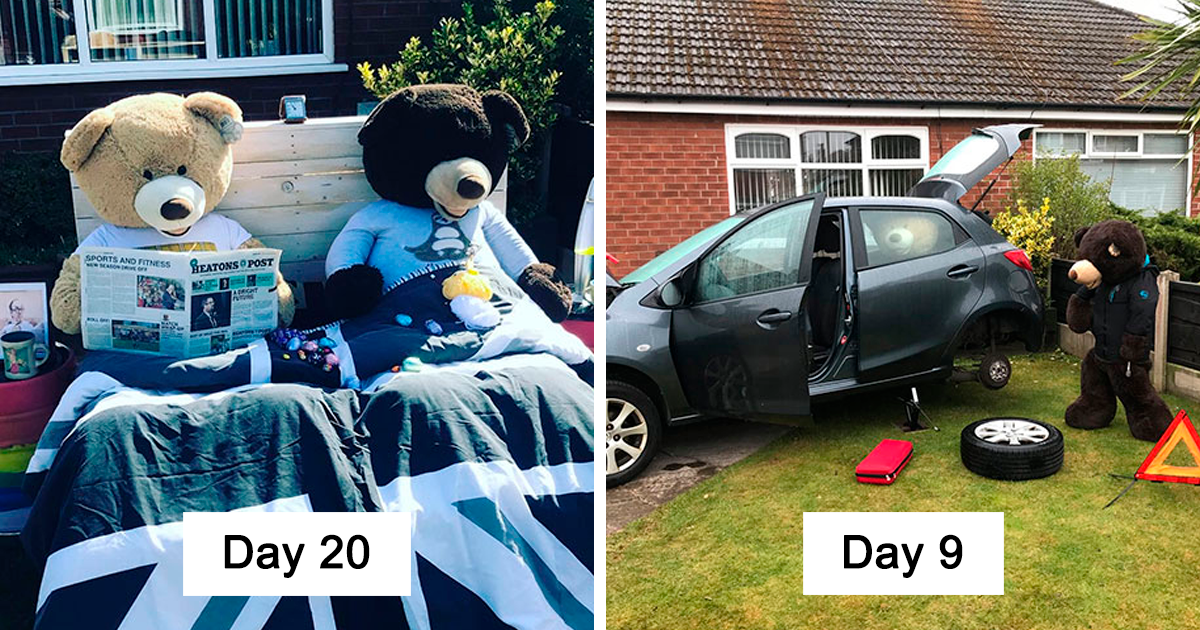
During the pandemic, many neighborhoods discovered that joy does not always arrive wearing a cape. Sometimes, it shows up as two enormous teddy bears doing yard work, lounging outside, or pretending to be busier than most adults on a Monday morning. Meet Ted and Ed, the giant stuffed stars affectionately known online as The Moor Bears. In a time when streets felt quiet, routines collapsed, and families were searching for safe ways to smile, these two plush legends turned an ordinary front yard into a tiny theater of hope.
The idea was wonderfully simple: place Ted and Ed outside in different scenes each day so neighbors could spot them while walking past. One day they might be washing the car. Another day they might be camping, playing music, mowing the lawn, or relaxing like retired celebrities with excellent fur care. The scenes were playful, harmless, and deeply human. They reminded people that even when life feels heavy, a little creativity can still sneak through the window, wave politely, and say, “Hey, look at these bears.”
At first glance, Ted and Ed might seem like a cute internet story. But their popularity reveals something bigger about pandemic life: people needed connection. Children missed school and friends. Adults missed normal conversations. Elderly neighbors missed casual hellos. A pair of giant teddy bears could not solve a public health crisis, of course. But they could give people a reason to laugh, take a walk, wave at a neighbor, and remember that community spirit was still alive.
The Story Behind Ted & Ed: The Moor Bears With Big Personalities
Ted and Ed became neighborhood heroes in Stockport, England, during the early months of lockdown. Their owner began arranging them outdoors in humorous everyday scenes, transforming the front garden into a cheerful stage. Ted, the lighter-colored bear, and Ed, the chocolate-brown bear, were already beloved household characters, but the pandemic gave them a public mission: lift spirits without breaking social distancing rules.
That mission worked. Neighbors started looking forward to the next scene. Children could walk by and guess what the bears were doing. Adults could enjoy the absurdity of two giant plush animals performing tasks many humans were avoiding. Vacuuming the grass? Why not. Playing golf? Obviously. Having a spa day? Frankly, after weeks indoors, everyone understood.
The humor came from contrast. Ted and Ed are not tiny stuffed animals tucked into a window. They are large, expressive, impossible-to-ignore teddy bears staged like two slightly chaotic roommates. Their size made every scene feel theatrical. Their silence made them funnier. They looked as if they had been caught in the middle of a busy schedule, despite being made of fluff and optimism.
Why Giant Teddy Bears Became Pandemic Superheroes
The pandemic changed the emotional temperature of everyday life. A simple trip around the block became an event. Sidewalk chalk, window rainbows, balcony singing, and teddy bear hunts became small but meaningful ways for communities to stay connected from a safe distance. Ted and Ed fit perfectly into that cultural moment because they offered something people urgently needed: predictability mixed with surprise.
Predictability mattered because routines had vanished. Schools closed, offices moved home, birthdays happened over video calls, and grocery shopping suddenly felt like an expedition. When neighbors knew Ted and Ed would appear in a new setup, the bears became a tiny anchor in the week. Surprise mattered because each new scene delivered a fresh laugh. Nobody knew whether the bears would be gardening, having a snack, or pretending to complete home repairs they were wildly unqualified to handle.
For children, the bears turned a neighborhood walk into an adventure. For parents, they offered a safe activity that did not require another worksheet, craft kit, or heroic attempt to explain fractions at the kitchen table. For adults living alone, they became a friendly visual message: someone nearby was still thinking about others.
The Wider Teddy Bear Hunt Movement
Ted and Ed were part of a broader pandemic-era wave of teddy bear hunts. Across the United States, the United Kingdom, Australia, New Zealand, and other countries, families placed teddy bears and stuffed animals in windows, yards, fences, and porches. Children could count them during walks or drives, turning social distancing into something a little less lonely.
The trend was inspired by the beloved children’s book We’re Going on a Bear Hunt, and the concept spread quickly through Facebook groups, Nextdoor posts, local news stories, and word of mouth. In San Jose and the Bay Area, families placed bears in windows to cheer children who could no longer play normally with friends. In Tennessee, families organized neighborhood hunts where kids dressed like explorers and used binoculars. In other places, teddy bears appeared with handmade signs, rainbows, and reminders to stay hopeful.
The magic was that anyone could participate. You did not need money, expertise, or a production crew. You needed a window, a stuffed animal, and a willingness to be slightly silly in public. That low barrier made the movement powerful. It invited everyone into the same gentle joke.
Why Small Acts of Positivity Matter During Crisis
When people talk about resilience, they often imagine dramatic acts of courage. But resilience also lives in small rituals: waving from the driveway, leaving a thank-you note for a delivery driver, drawing a rainbow on a window, or setting up two teddy bears so they look like they are doing household chores. These gestures are not small because they are meaningless. They are small because they are accessible.
During the pandemic, uncertainty was constant. Public health rules changed. News updates felt endless. Families worried about work, school, health, and loved ones. In that environment, humor became emotional oxygen. A funny scene with Ted and Ed could not erase fear, but it could interrupt it. For a few seconds, a passerby was not thinking about case numbers or restrictions. They were thinking, “Why is that bear holding a rake?” That tiny interruption mattered.
Community Connection, One Bear Scene at a Time
Social connection is not only about long conversations or big gatherings. It is also built through shared symbols. Ted and Ed became a shared symbol for their neighborhood. People could talk about them, look for them, photograph them, and share their favorites online. The bears created a common topic at a time when many people felt separated from common life.
This is why community-based positivity projects often work better than polished campaigns. They feel personal. Ted and Ed were not corporate mascots. They were two oversized teddy bears in a real neighborhood, created by someone who wanted to make people smile. That authenticity gave the project charm. The scenes were funny because they looked homemade, not because they were perfect.
In fact, imperfection was part of the appeal. A teddy bear doing chores will never look completely professional. That is the point. The humor says, “We are all improvising here.” During lockdown, everyone was improvising. Ted and Ed simply did it with better fur.
What Ted & Ed Teach About Pandemic Kindness
The story of Ted and Ed teaches a practical lesson: kindness does not need to be complicated to be effective. Their owner did not build an app, launch a nonprofit, or write a ten-step positivity manifesto. The project began with what was already available: two giant teddy bears, a front yard, imagination, and a sense of humor.
That is a useful reminder for anyone who wants to help their community. Start where you are. Use what you have. Make the effort visible. A cheerful window display, a free little library, a sidewalk chalk message, or a funny seasonal decoration can all become small landmarks of connection. People remember places that make them feel seen.
1. Humor Helps People Breathe
Humor creates distance from fear. It does not deny difficulty; it gives people a moment to step outside it. Ted and Ed made pandemic life feel less mechanical and more human. Their scenes said, “Yes, things are strange. Let’s be strange together.”
2. Repetition Builds Anticipation
Because the bears appeared in new scenes regularly, neighbors had something to anticipate. That rhythm mattered. A repeated act of kindness becomes part of a community’s emotional calendar.
3. Public Joy Is Contagious In The Best Way
When one household creates joy, others often join. That is how bear hunts spread. One stuffed animal became ten. Ten became a route. A route became a neighborhood tradition. Positivity has a way of multiplying when people can see it.
Specific Examples Of Ted & Ed’s Neighborhood Charm
Part of the fun was watching Ted and Ed participate in ordinary life as if they were responsible citizens with a suspicious amount of free time. They were seen doing household chores, washing cars, mowing lawns, enjoying food, playing instruments, relaxing outdoors, and taking part in leisure activities. The scenes worked because they were familiar. Everyone knew the chore. Everyone understood the mood. The bears simply made it ridiculous.
A scene of Ted and Ed doing yard work might remind people of their own unfinished gardens. A scene with the bears relaxing could feel like a tiny permission slip to rest. A musical setup suggested that even entertainment had moved outside. A food-themed scene was funny because, during lockdown, snacks became a legitimate hobby for many people. Ted and Ed reflected pandemic habits back to the neighborhood, but in a softer, fluffier mirror.
Why Children Loved The Bear Hunts
Children process big events differently from adults. They may not fully understand public health updates, but they understand routine, play, and visual surprises. Teddy bear hunts gave children a safe mission: find the bears. That mission turned walking into exploring and gave families a reason to leave the house while still respecting distancing guidelines.
The activity also helped children feel that the neighborhood was still friendly. Houses were not just closed doors. Behind the windows were people participating in the same game. For young kids, that can be comforting. It says the world is weird right now, but it is not empty.
Why Adults Needed Ted & Ed Too
Let’s be honest: adults needed the bears as much as children did. Maybe more. Children could openly admit they wanted to see teddy bears. Adults had to pretend they were “just walking for exercise” while secretly hoping the bears had changed outfits. That is fine. No judgment. The bears understood.
For adults, Ted and Ed offered emotional relief without demanding anything. You did not have to comment, join a meeting, donate, register, or download anything. You only had to notice. In a stressful season, that kind of low-pressure joy was valuable. It asked for nothing and gave a smile back.
How To Create A Ted & Ed Style Positivity Project
Anyone inspired by Ted and Ed can create a neighborhood-friendly project with a few simple principles. First, keep it safe. Make sure displays do not block sidewalks, create hazards, or encourage crowds. Second, keep it consistent. A weekly or daily update gives people something to look forward to. Third, keep it light. The best displays feel playful rather than forced. Fourth, invite participation without pressure. A sign, a hashtag, or a neighborhood group can help others join in.
Most importantly, make it personal. The charm of Ted and Ed comes from their homemade spirit. They are funny because someone cared enough to set them up, photograph them, and share them. That care is the heart of the project.
Experiences Related To Ted & Ed: What A Neighborhood Learns From Two Bears
Imagine walking the same route every afternoon during lockdown. The streets are familiar, but they feel different. Fewer cars pass. Playgrounds are quiet. People cross the street politely to give each other space. Every porch seems to carry a little question mark: How is everyone doing in there? Then, at the corner, you see two giant teddy bears staged outside like they have just taken over the household management committee. Suddenly, the walk has a destination.
That is the experience Ted and Ed created. They gave neighbors a reason to look up. During stressful times, people often move through the day with their heads down, focused on tasks, worries, and the latest updates. A visual surprise breaks that pattern. It says, “Pause here.” That pause is powerful. A parent can point and laugh with a child. A teenager can take a photo. An older neighbor can smile without needing to start a conversation. The bears become a shared experience without requiring close contact.
For families, the experience may have become part of daily structure. Breakfast, online school, lunch, walk past Ted and Ed, dinner, repeat. That small ritual could make the day feel less shapeless. Children might guess what the bears would do next. Parents might use the walk as a reward after homework. The bears turned exercise into a story.
For people living alone, the experience could feel quietly reassuring. Loneliness often grows when days become too similar. Seeing a new scene outside showed that someone nearby was still creating, still joking, still aware of the neighborhood. Even without speaking, the display communicated care. It was a soft message in a hard season.
For the person arranging the bears, the project likely offered purpose as well. Helping others can help the helper. Planning scenes, choosing props, and imagining reactions all create a sense of contribution. In a time when many people felt powerless, making a neighbor smile was something concrete. It was not grand, but it was real.
There is also an important creative lesson here. Ted and Ed prove that good storytelling does not require a complicated plot. Two characters, a setting, and a daily change are enough. The neighborhood supplied the audience. The pandemic supplied the emotional backdrop. The bears supplied the comedy. Together, these pieces made a story people wanted to follow.
Years later, the memory of pandemic teddy bear hunts still carries emotional weight because it represents ordinary people choosing tenderness under pressure. Nobody had a perfect plan. Nobody knew exactly how long restrictions would last. Yet people found ways to decorate windows, wave from porches, and turn stuffed animals into tiny ambassadors of hope. Ted and Ed were not just cute. They were proof that community can survive in small gestures.
Conclusion: The Big Lesson From Two Big Bears
Ted and Ed became beloved because they arrived at the exact moment people needed joy that was simple, safe, and sincere. Their story is funny, but it is also moving. Two giant teddy bears helped neighbors feel connected during a time of distance. They reminded children that the world still had games in it. They reminded adults that silliness is not childish; sometimes, it is survival with a smile.
The pandemic revealed how much communities depend on small acts of care. A teddy bear in a window, a chalk message on the sidewalk, or two giant plush bears pretending to do chores can become more than decoration. It can become a signal: we are still here, we still see each other, and we can still make room for laughter.
Ted and Ed may be made of stuffing, but their impact was real. And honestly, if two bears can bring a neighborhood together while vacuuming the grass, the rest of us have no excuse.