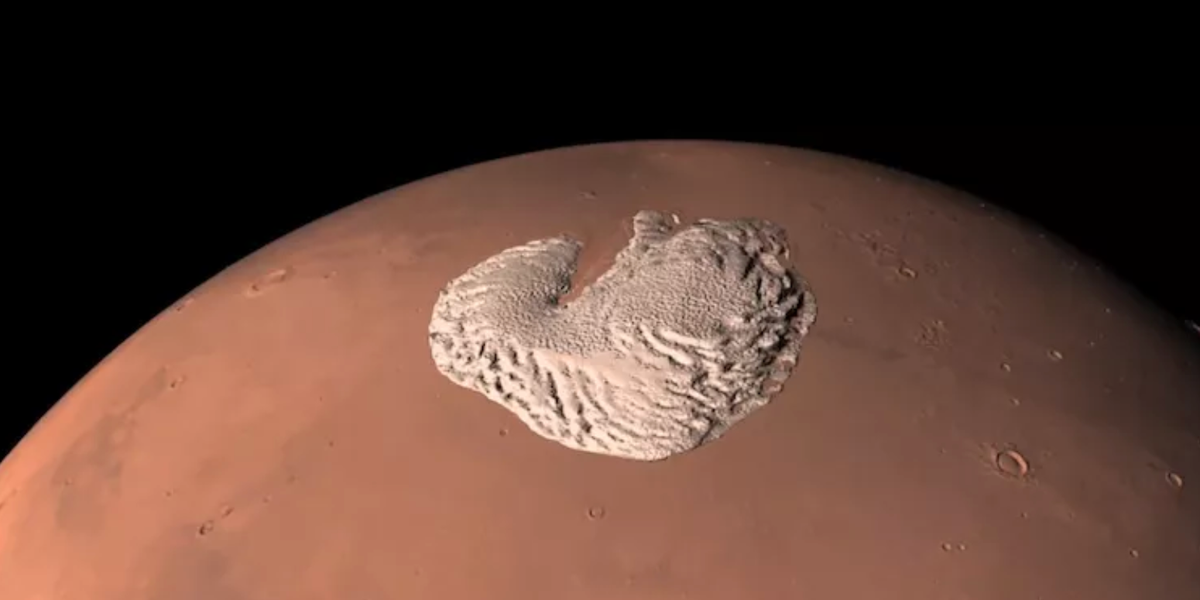
Is there water on Mars? Yesbut not in the “grab a towel and book a beach chair” way. Mars is not hiding a sparkling ocean with tiny red umbrellas. Today, the Red Planet is mostly a cold, dry desert where liquid water cannot last long on the surface because the atmosphere is extremely thin. Still, scientists have found strong evidence that water exists there in several forms: frozen beneath the soil, locked inside minerals, preserved in polar caps, hinted at in salty seasonal features, and possibly stored as deep liquid water inside fractured rock far below the surface.
That answer is both exciting and complicated, which is basically Mars’ brand. Every time scientists think they have solved the planet’s water mystery, Mars gives them another dusty riddle and walks away wearing a red cape. The newest research suggests that large amounts of liquid water may be trapped deep in Mars’ crust, while earlier missions have confirmed water ice and revealed ancient river valleys, lakebeds, deltas, and minerals that could only have formed with liquid water. In other words, Mars may look dry today, but its geology is practically shouting, “I used to be wetter!”
Water on Mars Today: The Short Answer
Water exists on Mars today, but mostly as ice or chemically bound water. The planet’s polar regions hold large deposits of water ice mixed with dust and seasonal carbon dioxide frost. Near-surface ice has also been confirmed by landers and mapped by orbiters. Some water is trapped inside hydrated minerals, which are minerals that contain water or hydroxyl groups in their crystal structures. Think of them as rocks that once got very friendly with water and never fully let go.
Liquid water on the surface is much harder to confirm. Mars has low air pressure, intense cold, and harsh radiation. Pure liquid water would quickly freeze, boil, or evaporate. However, salty brines may briefly remain liquid under certain conditions, because salts lower water’s freezing point. That is why scientists have spent years studying dark streaks on slopes, radar reflections under polar ice, and chemical signatures of hydrated salts.
Scientists Find Possible Deep Water Bodies on Mars
One of the most important recent findings came from a new analysis of data collected by NASA’s retired InSight lander. InSight was designed to listen to Marsquakes and study the planet’s interior. By analyzing seismic waves, gravity data, and rock physics models, researchers concluded that Mars may contain a large amount of liquid water in fractured igneous rock deep within the crust, roughly 7 to 13 miles below the surface.
This is not a neat underground lake with a “Welcome, Martian Fish” sign. The proposed reservoir is more like water filling tiny cracks and pores inside rock, similar to groundwater stored in Earth’s deep crust. Scientists estimate that if this water were spread across the Martian surface, it could form a global layer more than a mile deep. That is an astonishing possibility, but future astronauts should not pack a straw just yet. Drilling that deep on Mars would be a heroic engineering challenge, even for humans who already think assembling furniture with missing screws is a weekend adventure.
Why Deep Martian Water Matters
The deep-water finding matters because it may help answer one of the biggest questions in planetary science: where did Mars’ ancient water go? Billions of years ago, Mars appears to have had rivers, lakes, deltas, groundwater systems, and possibly even oceans. Over time, the planet lost much of its atmosphere, making it colder and drier. Some water escaped into space. Some became ice. Some became locked inside minerals. And now, scientists think a significant amount may still be hiding underground.
Deep water also matters for astrobiology, the study of life in the universe. On Earth, microbes can live deep underground, away from sunlight, surviving in rock pores and groundwater systems. That does not mean Mars has life today. It means that if liquid water exists deep below Mars, it could be one of the most interesting places to investigate for habitability.
Ancient Mars Was Much Wetter Than Today
The strongest evidence for water on Mars is not a single discovery. It is a long, stubborn pile of clues collected by orbiters, landers, and rovers. Mars has dry river channels, carved valleys, alluvial fans, lakebed sediments, delta deposits, and minerals that form in watery environments. If Mars were a crime scene, water left fingerprints everywhere and then tried to pretend it was never there.
NASA’s Perseverance rover landed in Jezero Crater because scientists believe the crater once held a lake and river delta. More than 3.5 billion years ago, river channels likely carried water and clay minerals into the crater. Deltas are especially exciting because, on Earth, they can preserve organic matter and possible signs of ancient life. That is why Perseverance has been collecting rock samples that may one day be returned to Earth for detailed laboratory analysis.
NASA’s Curiosity rover, exploring Gale Crater, has also found evidence of ancient lakes. Sedimentary rocks, clay minerals, sulfates, and ripple-like patterns suggest that water once moved through the area. Some ripple marks look like they were formed by waves in shallow, ice-free lakes. That is a big deal because it suggests parts of early Mars may have had stable surface water long enough to shape sediments in ways familiar to geologists on Earth.
Confirmed Water Ice on Mars
Water ice on Mars is no longer speculation. In 2008, NASA’s Phoenix Mars Lander confirmed water ice near the surface in the far northern plains. The lander dug into the soil and exposed bright chunks that vanished over several Martian days. Scientists concluded the material was water ice sublimating directly into vapor. Carbon dioxide ice would not have behaved the same way under those local conditions.
Orbiters have expanded that picture dramatically. NASA’s Mars Reconnaissance Orbiter and other missions have helped map buried water ice, especially in mid- and high-latitude regions. The Subsurface Water Ice Mapping project has produced maps showing likely ice deposits within the upper few feet of the surface in some areas. That matters for future astronauts because water ice could support drinking water, oxygen production, agriculture experiments, radiation shielding, and rocket fuel manufacturing.
In simple terms, water is not just something astronauts drink after a long day of rover driving. It is a survival resource, a fuel resource, and a scientific time capsule. Ice layers can preserve records of Mars’ climate history, much like ice cores in Antarctica help scientists study Earth’s past climate.
Hydrated Minerals: Rocks That Remember Water
Some of the most persuasive evidence for Mars’ watery past comes from hydrated minerals. These include clays, sulfates, silica-rich deposits, and other minerals that typically require water to form or alter. When rovers and orbiters detect these minerals, they are not just finding interesting rocks. They are finding chemical memories of past environments.
For example, clay minerals often form when water interacts with volcanic rock over long periods. Sulfates can form when salty water evaporates. Silica-rich deposits can point to hydrothermal systems, where hot water circulated through rock. On Earth, hydrothermal areas such as Yellowstone are famous for mineral-rich fluids, hot springs, and microbial ecosystems. Mars is not Yellowstone with a worse tourism board, but silica and hydrated minerals do suggest that some ancient Martian environments may once have been chemically active and potentially habitable.
What About Lakes Under the South Pole?
Reports of possible liquid water beneath Mars’ south polar ice cap generated huge excitement. Radar data from the Mars Express spacecraft revealed bright reflections beneath the ice, which some researchers interpreted as a possible subglacial lake or salty brine system. Later studies suggested there might be multiple wet areas nearby.
However, science is not a magic wand; it is more like a group project where everyone checks everyone else’s math. Other studies have challenged the liquid-water interpretation, suggesting that clays, layered rock, dust, or other dry materials could produce similar radar reflections. As of now, the south-pole “lake” idea remains debated. It is possible, intriguing, and scientifically valuablebut not settled.
Did NASA Really Find Flowing Water on Modern Mars?
In 2015, NASA announced strong evidence that salty liquid water might flow intermittently on present-day Mars. The evidence came from recurring slope lineae, or RSLdark streaks that appear on steep slopes during warmer seasons and fade when conditions cool. Scientists detected hydrated salts in some of these areas, supporting the idea that briny water could be involved.
Later research complicated the story. Some RSL may be dry granular flows, more like sand sliding downhill than water trickling through soil. The current best answer is cautious: certain salty processes may involve small amounts of water, but Mars does not have reliable rivers, streams, or puddles flowing across the surface today. If Mars has liquid surface water, it is likely brief, salty, thin, and very unfriendly to anything hoping for a spa day.
Where Did Mars’ Water Go?
Mars probably lost its water through several processes. First, the planet lost much of its atmosphere. Without a thick atmosphere and strong global magnetic field, solar wind and radiation helped strip gases away over billions of years. As the atmosphere thinned, surface water became unstable. Some water vapor was broken apart by sunlight, allowing hydrogen to escape into space.
Second, a large amount of water likely froze into the ground and polar caps. Third, water became chemically trapped in minerals. Studies funded by NASA and conducted by researchers at institutions such as Caltech and JPL suggest that a substantial fraction of Mars’ original water may have been locked into the crust through mineral hydration. Finally, the newer InSight-based research suggests that some ancient water may still survive as deep groundwater in fractured rock.
So the answer is not “Mars lost all its water.” The better answer is: Mars changed, and its water changed address.
Why Water on Mars Is So Important
1. Water Helps Reveal Whether Mars Was Habitable
Water is essential to life as we know it. Finding evidence of past liquid water helps scientists identify places where microbial life might once have survived. Ancient lakebeds, deltas, clay deposits, and groundwater systems are high-priority targets because they can preserve chemical and geological signs of habitability.
2. Water Is a Resource for Human Exploration
Future human missions will need local resources. Transporting every gallon of water from Earth would be expensive and impractical. If astronauts can access Martian ice, they could use it for drinking, growing plants, producing oxygen, and making hydrogen-based rocket fuel. Water ice could turn Mars exploration from a camping trip with limited supplies into something closer to a long-term settlement plan.
3. Water Tells the Story of Planetary Climate Change
Mars is a natural laboratory for studying how rocky planets evolve. Earth stayed wet and habitable. Mars became cold and dry. Understanding why helps scientists study atmospheres, climate stability, magnetic fields, and the conditions that make planets livable. Mars is basically the universe’s dramatic climate-history textbook, except the pages are made of basalt and dust.
Could There Be Life in Martian Water?
No mission has confirmed life on Mars. That point is important. Water increases the possibility of habitability, but it does not prove biology. A planet can have water and still be lifeless, just as a kitchen can have flour and still not produce cookies. Someoneor somethinghas to do the baking.
Still, if Mars once had long-lived lakes, rivers, and groundwater, then ancient microbial life is scientifically plausible enough to investigate. The best places to search are not necessarily the harsh surface today, but ancient sediments, protected subsurface environments, and mineral deposits that may preserve biosignatures. That is why scientists are eager to study samples from Jezero Crater and continue mapping buried ice and possible deep-water systems.
What Scientists Still Need to Learn
Despite decades of exploration, major questions remain. How much water did ancient Mars have? Did it have a northern ocean, or mostly regional lakes and rivers? How long did liquid water persist? Was early Mars warm and wet, cold and icy with occasional melting, or a mix of both? How much water escaped to space, and how much remains trapped underground?
The biggest question is whether any Martian environment ever hosted life. Answering that requires better instruments, returned samples, deeper drilling, and careful planetary protection. Scientists must avoid contaminating Mars with Earth microbes while also making sure any future discovery is truly Martian and not a hitchhiker from our own planet. Space science is thrilling, but it also requires good housekeeping.
Experiences and Reflections: What the Mars Water Story Teaches Us
Reading about water on Mars feels a little like following a detective story where the suspect keeps changing outfits. First, scientists saw channels and valleys and thought, “Water did this.” Then rovers found minerals and sediments and said, “Water definitely did this.” Then orbiters mapped ice, landers touched it, radar hinted at buried lakes, and seismic data suggested deep groundwater. Mars, meanwhile, sat there looking dusty and mysterious, probably enjoying the attention.
One fascinating experience for anyone following Mars exploration is realizing how science changes without becoming weaker. A headline may say “water found on Mars,” then a later study may say “maybe not that kind of water.” That does not mean scientists are confused in a bad way. It means they are doing the job correctly. They test ideas, challenge claims, update conclusions, and keep the parts that survive. The south-polar lake debate is a perfect example. The original radar signal was exciting. Then other researchers asked whether clay, dust, or layered materials could mimic the same signal. That back-and-forth is not a failure. It is science wearing its work boots.
The Mars water story also reminds us that discovery is rarely simple. Most people imagine water as something obvious: oceans, rivers, rain, or a glass sweating on a summer table. On Mars, water is sneakier. It hides as frost, ice, brine, mineral chemistry, ancient mudstone, buried deltas, and possibly deep groundwater. Scientists have to read clues from rock textures, spectral signatures, seismic waves, and radar reflections. It is like trying to reconstruct an entire movie from a few frames, some popcorn crumbs, and a suspiciously damp ticket stub.
For students, space fans, and future scientists, Mars offers a powerful lesson in curiosity. The question “Is there water on Mars?” sounds simple, but the answer opens doors to geology, chemistry, climate science, engineering, biology, and human exploration. A single water molecule can become a clue about ancient lakes, lost atmospheres, possible microbes, and future astronauts. That is the magic of planetary science: small details can carry enormous stories.
There is also something deeply human about looking for water on another world. Water is familiar. We swim in it, drink it, cook with it, complain when it leaks through the ceiling, and panic when our phone falls into it. Finding water on Mars connects a distant planet to daily life on Earth. Suddenly, Mars is not just a red dot in the sky. It becomes a place with a past, a climate history, buried resources, and perhaps environments that once resembled parts of our own world.
The practical side is just as exciting. If humans ever live or work on Mars, water ice could be the difference between short visits and sustainable exploration. Astronauts could convert water into oxygen and fuel, use it for food production, and study it to understand Martian climate cycles. But the challenge will be choosing landing sites where ice is accessible, temperatures are manageable, terrain is safe, and science targets are valuable. Mars does not hand out convenience. It makes engineers earn every sip.
Ultimately, the discovery of water on Mars is not one single “Eureka!” moment. It is a growing body of evidence built over decades. The answer is yes, there is water on Marsbut it is frozen, buried, mineral-bound, possibly briny, and maybe deep underground as liquid. That makes Mars more mysterious, not less. And if the Red Planet has taught us anything, it is this: when a world looks dead and dry from far away, look closer. Sometimes the most important stories are hiding under the dust.
Conclusion
So, is there water on Mars? Yes. Scientists have confirmed water ice, mapped buried ice deposits, identified hydrated minerals, studied ancient river and lake environments, and found possible evidence for deep liquid water trapped inside the Martian crust. What Mars does not have today is easy, stable, open surface water like Earth’s oceans and lakes. The planet is too cold, too dry, and too thin-aired for that.
Still, Mars is far from waterless. Its rocks record a wetter past, its poles and soil preserve frozen water, and its deep crust may contain enormous hidden reservoirs. These findings matter because water is central to habitability, the search for life, and future human exploration. Mars may not be ready for beachfront condos, but it remains one of the most compelling places in the solar system to ask big questions: Was it ever alive? Could it still host life underground? And can humans one day use its water to explore farther?
Editorial note: This article is an original synthesis based on reputable scientific information from NASA, NASA JPL, USGS, UC Berkeley, Caltech, peer-reviewed planetary science studies, and Mars mission findings. It contains no copied source text and is written for web publication.