Note: This article is written in standard American English and synthesizes real, established temperature-scale information from authoritative science, education, meteorology, and measurement references.
Introduction: Celsius to Kelvin Without the Brain Freeze
Converting Celsius to Kelvin sounds like something that belongs in a science lab next to bubbling beakers and someone dramatically saying, “Stand back!” Fortunately, it is much easier than that. In fact, learning how to convert Celsius to Kelvin requires only one formula, a little attention to detail, and the confidence to add 273.15 without making your calculator sweat.
The Celsius scale is common in weather reports, cooking discussions outside the United States, science classes, and many everyday measurements around the world. Kelvin, on the other hand, is the temperature scale scientists use when they need an absolute temperature scale. Chemistry, physics, astronomy, engineering, meteorology, and thermodynamics all use Kelvin because it begins at absolute zero, the theoretical point where thermal motion is at its minimum.
The good news? Celsius and Kelvin use the same size interval. A change of 1 degree Celsius is the same temperature change as 1 kelvin. That means there is no multiplying, dividing, or math gymnastics involved. To convert Celsius to Kelvin, you simply add 273.15. That is the whole trick. The rest of this guide will show you how to use the formula correctly, avoid common mistakes, and understand why this conversion matters.
What Is the Celsius to Kelvin Formula?
The standard Celsius to Kelvin formula is:
K = °C + 273.15
In this formula, K stands for temperature in Kelvin, and °C stands for temperature in degrees Celsius. If the temperature is 25°C, you add 273.15:
25 + 273.15 = 298.15 K
So, 25°C equals 298.15 K. Notice that Kelvin is written as K, not °K. This is a common formatting mistake. Celsius uses the degree symbol, but Kelvin does not. You write 300 K, not 300°K. Think of Kelvin as the cool scientist who refuses unnecessary punctuation.
How to Convert Celsius to Kelvin: 10 Steps
Step 1: Identify the Celsius Temperature
Start by finding the temperature given in degrees Celsius. It may appear in a textbook problem, a chemistry experiment, a weather chart, a scientific article, or a recipe from someone who believes Fahrenheit is needlessly dramatic.
Example: Convert 18°C to Kelvin.
Step 2: Write Down the Formula
Before doing any math, write the formula clearly:
K = °C + 273.15
This helps prevent the most common mistake: subtracting when you should add. When converting Celsius to Kelvin, always add 273.15.
Step 3: Substitute the Celsius Value
Replace °C in the formula with the Celsius temperature you were given.
K = 18 + 273.15
At this point, the problem is no longer mysterious. It has turned into basic addition, which is much friendlier than it looked five seconds ago.
Step 4: Add 273.15
Now add the numbers together:
18 + 273.15 = 291.15
So, 18°C equals 291.15 K.
Step 5: Use the Correct Kelvin Symbol
Write the final answer with the symbol K. Do not use the degree symbol.
Correct: 291.15 K
Incorrect: 291.15°K
This small detail matters in scientific writing. Kelvin is an SI base unit for thermodynamic temperature, and its symbol is simply K.
Step 6: Check Whether Rounding Is Allowed
Some school assignments, lab reports, or online calculators may ask you to round your answer. If no rounding instruction is given, keeping two decimal places is usually safe because the conversion constant is 273.15.
For example:
22°C = 295.15 K
If rounding to the nearest whole number, it becomes:
295 K
However, in science classes, follow your teacher’s instructions for significant figures. Science teachers love significant figures the way cats love knocking things off desks.
Step 7: Remember That Negative Celsius Temperatures Still Work
One of the nicest things about the Celsius to Kelvin conversion is that the same formula works for negative Celsius temperatures.
Example: Convert -10°C to Kelvin.
K = -10 + 273.15
K = 263.15 K
So, -10°C equals 263.15 K. You still add 273.15, even when the Celsius value is below zero.
Step 8: Know the Important Reference Points
A few familiar temperatures make Kelvin easier to understand:
- 0°C = 273.15 K, the freezing point of water under standard conditions.
- 100°C = 373.15 K, approximately the boiling point of water under standard atmospheric pressure.
- -273.15°C = 0 K, absolute zero.
- 20°C = 293.15 K, close to typical room temperature.
These examples help you estimate whether your answer makes sense. If you convert room temperature and get 29,315 K, something has gone wildly wrong, and your calculator may need a calm conversation.
Step 9: Avoid Mixing Celsius, Fahrenheit, and Kelvin Formulas
Temperature conversions can get confusing because Fahrenheit uses a different interval size. Celsius to Fahrenheit requires multiplying by 9/5 and adding 32. Celsius to Kelvin does not. The Celsius and Kelvin scales have equal-sized units, so the conversion is only an offset.
Use this rule:
Celsius to Kelvin: add 273.15
That is it. No 9/5. No 32. No emotional damage.
Step 10: Review the Final Answer
Before you submit your answer, check three things:
- Did you add 273.15?
- Did you write the unit as K?
- Does the answer make sense compared with common reference points?
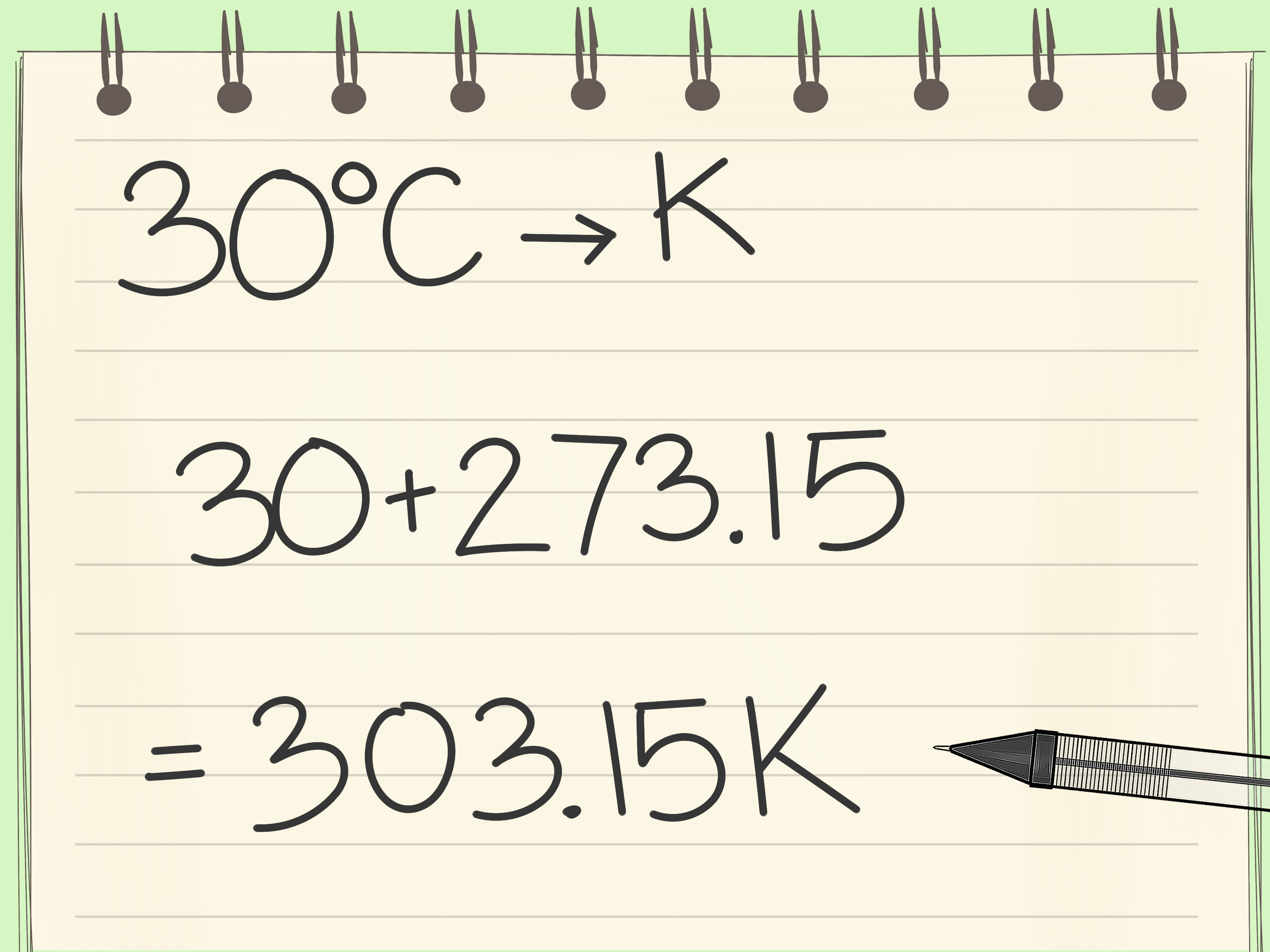
For example, if you convert 30°C, your answer should be slightly above room temperature in Kelvin:
30 + 273.15 = 303.15 K
That makes sense. A warm day at 30°C becomes 303.15 K, not 30 K. A temperature of 30 K would be extremely cold, far colder than anything you want happening at a picnic.
Why Do Scientists Use Kelvin?
Kelvin is useful because it starts at absolute zero. Celsius is convenient for daily life because it is tied to familiar water-related reference points, but Kelvin is more useful in scientific formulas where temperature must represent absolute thermal energy.
In physics and chemistry, many equations require temperature in Kelvin. The ideal gas law, for example, uses absolute temperature. If you plug Celsius into a formula that requires Kelvin, your answer can be seriously wrong. This is not the fun kind of wrong, like wearing mismatched socks. It is the “my lab results make no sense” kind of wrong.
Kelvin is also used in astronomy. Scientists often describe the temperatures of stars, planets, cosmic background radiation, and cryogenic instruments in Kelvin. Because Kelvin begins at zero, it gives scientists a direct way to compare extremely cold and extremely hot temperatures.
Celsius to Kelvin Examples
Example 1: Convert 0°C to Kelvin
K = 0 + 273.15
K = 273.15 K
So, 0°C equals 273.15 K.
Example 2: Convert 37°C to Kelvin
K = 37 + 273.15
K = 310.15 K
So, 37°C equals 310.15 K. This is close to normal human body temperature.
Example 3: Convert -40°C to Kelvin
K = -40 + 273.15
K = 233.15 K
So, -40°C equals 233.15 K. Fun fact: -40°C is also -40°F, which is one of the few times Celsius and Fahrenheit agree on anything.
Example 4: Convert 100°C to Kelvin
K = 100 + 273.15
K = 373.15 K
So, 100°C equals 373.15 K.
Common Mistakes When Converting Celsius to Kelvin
Mistake 1: Subtracting 273.15
Subtracting 273.15 is used when converting Kelvin to Celsius, not Celsius to Kelvin. If you are going from Celsius to Kelvin, add.
Mistake 2: Writing “Degrees Kelvin”
Kelvin is not written with a degree symbol. The correct format is 300 K, not 300°K.
Mistake 3: Rounding Too Early
If you are doing a longer calculation, keep the full Kelvin value until the final step. Rounding too soon can create small errors that grow larger in multi-step science problems.
Mistake 4: Using Fahrenheit Rules
Celsius to Kelvin does not require multiplying by 9/5 or adding 32. Those steps belong to Fahrenheit conversions, and they should stay in their own lane.
Mistake 5: Forgetting Absolute Zero
Kelvin cannot go below 0 K. If your conversion produces a negative Kelvin value, check your math. A negative Kelvin answer in a basic conversion problem is usually a sign that something went sideways.
Quick Celsius to Kelvin Conversion Chart
| Celsius | Kelvin | Common Meaning |
|---|---|---|
| -273.15°C | 0 K | Absolute zero |
| -40°C | 233.15 K | Extremely cold weather |
| 0°C | 273.15 K | Water freezes |
| 20°C | 293.15 K | Comfortable room temperature |
| 25°C | 298.15 K | Common lab reference temperature |
| 37°C | 310.15 K | Approximate human body temperature |
| 100°C | 373.15 K | Water boils under standard pressure |
When Should You Use Kelvin Instead of Celsius?
You should use Kelvin when a scientific formula requires absolute temperature. This often happens in chemistry, physics, engineering, and advanced environmental science. Kelvin is especially important when working with gases because gas behavior depends on absolute temperature, not everyday temperature scales.
Use Kelvin for:
- Gas law calculations
- Thermodynamics problems
- Chemistry experiments
- Physics formulas involving temperature
- Astronomy and space science
- Cryogenic temperature measurements
- Scientific lab reports
Use Celsius for everyday temperature descriptions, such as weather, cooking, and general conversation in countries that use the metric system. If someone says it is 22°C outside, you do not need to reply, “Ah yes, 295.15 K, sweater weather.” You could, but you may not be invited to many picnics.
How to Convert Kelvin Back to Celsius
Once you understand Celsius to Kelvin, the reverse conversion is easy. To convert Kelvin to Celsius, subtract 273.15:
°C = K – 273.15
Example: Convert 300 K to Celsius.
°C = 300 – 273.15
°C = 26.85°C
So, 300 K equals 26.85°C. This reverse formula is helpful when reading science data and translating it into a temperature scale that feels more familiar.
Practice Problems
Problem 1
Convert 10°C to Kelvin.
Answer: 10 + 273.15 = 283.15 K
Problem 2
Convert 50°C to Kelvin.
Answer: 50 + 273.15 = 323.15 K
Problem 3
Convert -25°C to Kelvin.
Answer: -25 + 273.15 = 248.15 K
Problem 4
Convert 15.5°C to Kelvin.
Answer: 15.5 + 273.15 = 288.65 K
Problem 5
Convert 100°C to Kelvin.
Answer: 100 + 273.15 = 373.15 K
Helpful Memory Tricks
If you only remember one thing, remember this phrase: “Kelvin climbs from Celsius.” In other words, Kelvin is always 273.15 higher than Celsius for the same temperature. If Celsius is the ground floor, Kelvin is the penthouse suite with a very precise elevator.
Another trick is to connect Celsius and Kelvin with freezing water. Since 0°C equals 273.15 K, every Celsius temperature is shifted upward by 273.15. Once that reference point is locked in your memory, the formula becomes much easier to recall.
You can also remember that Kelvin is an absolute scale, so ordinary temperatures usually look like larger numbers. Room temperature is around 293 K, not 20 K. If your Kelvin answer looks too small for an everyday temperature, double-check your work.
Real-Life Experiences Related to Converting Celsius to Kelvin
One of the most common experiences with Celsius to Kelvin conversion happens in school science classes. Many students first meet Kelvin during a chemistry unit on gases. Everything feels normal until the teacher writes the ideal gas law on the board and says temperature must be in Kelvin. Suddenly, every Celsius number in the homework assignment needs a tiny makeover. The conversion is easy, but forgetting it can throw off the entire answer. It is like baking cookies and forgetting the sugar; technically something comes out of the oven, but nobody is celebrating.
In lab reports, Celsius to Kelvin conversion becomes even more important. Suppose a student records the temperature of a solution as 24°C. That value is perfectly understandable in everyday terms, but if the experiment requires calculations involving molecular motion, pressure, or gas volume, the temperature often needs to be converted to 297.15 K. The number looks more formal, but it represents the same physical temperature. The difference is that Kelvin works properly in equations where absolute temperature matters.
Weather and climate discussions can also introduce Kelvin, especially when reading scientific data. Most people talk about weather in Fahrenheit or Celsius, but satellite measurements, atmospheric models, and climate science datasets may use Kelvin. A temperature reading of 288 K may sound mysterious at first, but subtracting 273.15 reveals that it is about 14.85°C. Once you know the conversion, Kelvin stops looking like a secret code and starts looking like a useful scientific language.
Another real-world example appears in astronomy. Space science often uses Kelvin because the universe has temperatures far beyond ordinary human experience. The cosmic microwave background is only a few kelvins above absolute zero, while stars can reach thousands of kelvins at their surfaces. Using Kelvin makes these comparisons clearer because the scale begins at absolute zero. When reading about planets, telescopes, infrared instruments, or extremely cold space environments, Kelvin is the temperature scale you will see most often.
Engineering is another field where converting Celsius to Kelvin matters. Engineers working with engines, heating systems, refrigeration, aerospace equipment, batteries, or materials often need absolute temperature for calculations. A temperature difference may be described in Celsius, but a thermodynamic equation may require Kelvin. The conversion step looks small, yet it helps keep large systems safe, efficient, and scientifically accurate.
Even lighting can bring Kelvin into everyday life, though in a slightly different way. Light bulbs are often labeled with color temperatures such as 2700 K, 4000 K, or 5000 K. These numbers describe the appearance of light, from warm yellowish tones to cooler bluish tones. While this is not the same as measuring room temperature, it shows how often Kelvin appears outside textbooks. The next time you buy a light bulb, you may notice Kelvin quietly hanging out on the packaging like a science teacher in aisle five.
The best experience-based advice is simple: do not wait until a test or lab deadline to practice conversions. Try converting common temperatures you already know. Convert 0°C, 20°C, 25°C, 37°C, and 100°C. After a few examples, the formula becomes automatic. You will see 25°C and immediately think 298.15 K. That is when the conversion stops feeling like memorization and starts feeling like a useful tool.
Another practical habit is to write units at every step. Many mistakes happen when numbers float around without labels. If you write 25°C + 273.15 = 298.15 K, your work stays clear. Units are not decoration; they are the traffic signs of math. Ignore them, and eventually you end up in the wrong neighborhood.
Finally, remember that converting Celsius to Kelvin is not about making temperature more complicated. It is about choosing the right scale for the job. Celsius is excellent for everyday life. Kelvin is essential for science. Once you understand how the two scales connect, you can move between daily experience and scientific calculation with confidence. That is a pretty good return on one addition problem.
Conclusion: The Fastest Way to Convert Celsius to Kelvin
To convert Celsius to Kelvin, add 273.15 to the Celsius temperature. The formula is K = °C + 273.15. Because Celsius and Kelvin use the same size interval, the conversion is simple and direct. The only difference is where the scales begin: Celsius is based on familiar water-related reference points, while Kelvin begins at absolute zero.
Whether you are solving chemistry homework, reading a physics formula, studying astronomy, checking a lab report, or simply trying to understand why scientists keep using big temperature numbers, Celsius to Kelvin conversion is a skill worth knowing. It is quick, practical, and much less scary than it looks. Add 273.15, write K, skip the degree symbol, and enjoy the rare math moment where the universe keeps things mercifully simple.