LED lightbulbs have quietly taken over the lighting aisle, and for good reason. They sip electricity instead of guzzling it, last far longer than old incandescent bulbs, and come in so many shapes, colors, and smart features that buying one can feel like choosing a tiny glowing roommate. Yet for many shoppers, LEDs still come with a fog of confusing terms: lumens, watts, Kelvin, CRI, dimmable, enclosed-fixture rated, daylight, soft white, smart bulb, tunable white. Suddenly, replacing a burned-out bulb feels like studying for a pop quiz at the hardware store.
The good news is that LED lightbulbs are not nearly as mysterious as they look. Once you understand a few simple ideas, you can choose the right bulb for your kitchen, bedroom, bathroom, porch, desk lamp, or dramatic “I’m reading a novel in a cozy corner” moment. This guide breaks down what LED bulbs are, why they save energy, how to read the package, and how to avoid common buying mistakes. No electrical engineering degree required. A sturdy step stool, however, may still be useful.
What Is an LED Lightbulb?
LED stands for light-emitting diode. In plain English, it is a tiny semiconductor device that produces light when electricity passes through it. Unlike incandescent bulbs, which create light by heating a wire filament until it glows, LEDs create light much more efficiently. Less electricity is wasted as heat, which is why LED bulbs can deliver bright light while using far fewer watts.
That difference is the heart of the LED revolution. Traditional incandescent bulbs were charming in the same way a fireplace is charming: warm, familiar, and not exactly energy efficient. A lot of their power turned into heat rather than visible light. LEDs, by contrast, are designed to turn more of the electricity they use into useful illumination. That is why a bulb that once needed 60 watts of incandescent power may now be replaced by an LED using around 8 to 10 watts, depending on the model.
Why LED Bulbs Became the New Standard
LED lightbulbs became popular because they solve several household problems at once. They lower energy use, reduce how often bulbs need replacing, produce less heat, and offer more control over color and brightness. For homes with dozens of fixtures, the savings can add up quickly over time.
Energy-efficient LED lighting is especially valuable in rooms where lights stay on for long periods, such as kitchens, living rooms, home offices, hallways, and outdoor security fixtures. A porch light that runs all night can quietly become a tiny electricity vampire. Replace it with an efficient LED, and suddenly that vampire is on a very strict diet.
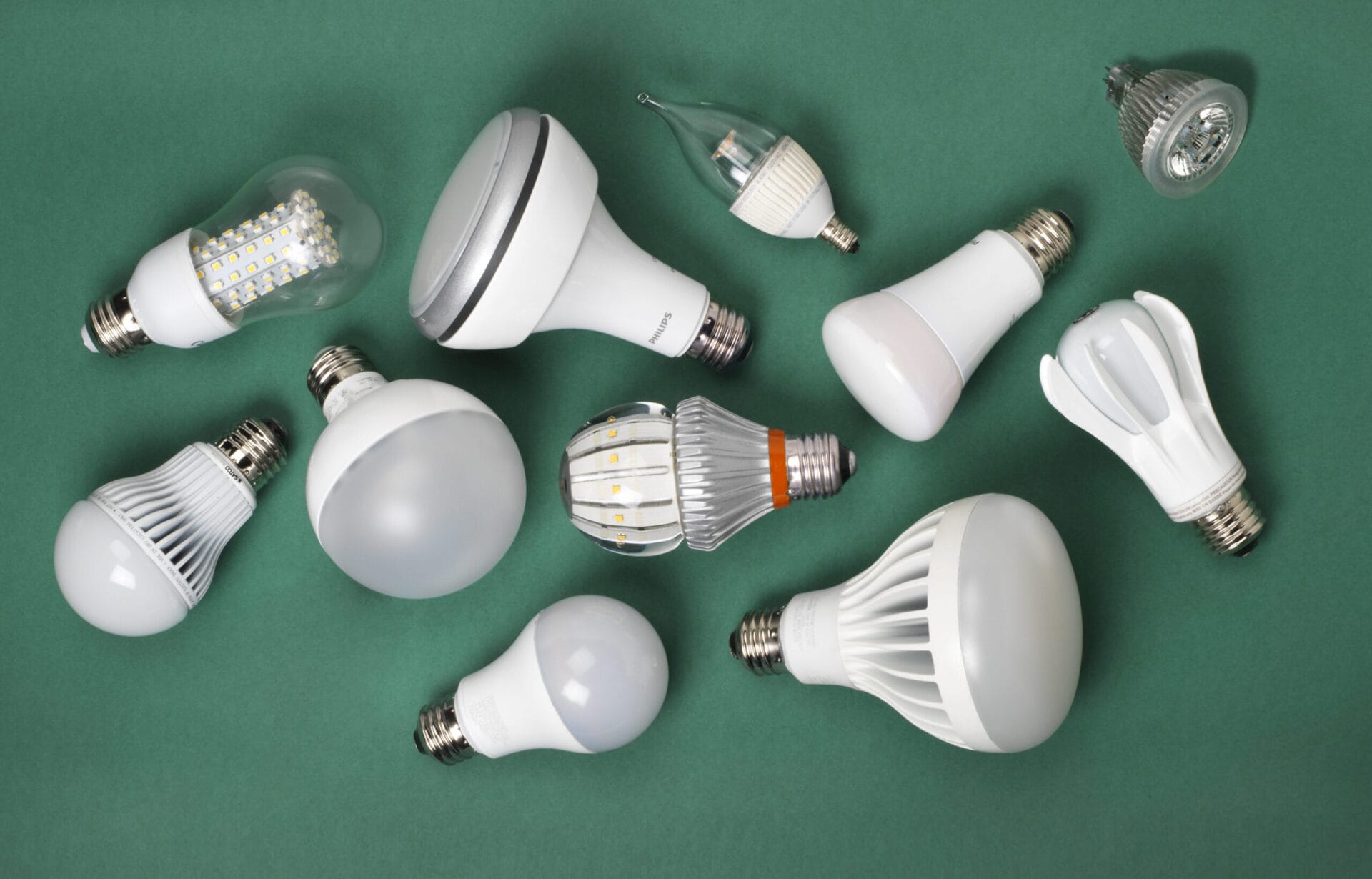
LEDs also work well in many specialty applications. You can find LED floodlights, globe bulbs, chandelier bulbs, recessed downlights, strip lights, under-cabinet lights, smart bulbs, vintage-style Edison bulbs, and color-changing options. In other words, LEDs are no longer just “that weird bluish bulb from 2010.” The technology has matured, and today’s better LED bulbs can look warm, flattering, and surprisingly close to traditional incandescent light.
Lumens vs. Watts: The Most Important LED Lesson
If you remember only one thing about buying LED lightbulbs, make it this: shop by lumens, not watts. Lumens measure brightness. Watts measure energy use. In the incandescent era, people used watts as a shortcut for brightness because most bulbs worked the same way. A 60-watt bulb was brighter than a 40-watt bulb, and a 100-watt bulb was the “I need to find a contact lens on the floor” option.
With LEDs, watts no longer tell the whole story. Two LED bulbs can use similar wattage but produce different levels of brightness. That is why the front of the package usually highlights lumens. More lumens mean more light. Fewer lumens mean a dimmer glow.
Common Brightness Comparisons
Here are useful rough equivalents when replacing old incandescent bulbs:
- 450 lumens: similar to a traditional 40-watt incandescent bulb
- 800 lumens: similar to a traditional 60-watt incandescent bulb
- 1,100 lumens: similar to a traditional 75-watt incandescent bulb
- 1,600 lumens: similar to a traditional 100-watt incandescent bulb
These are not perfect matches in every fixture, but they are excellent starting points. For a bedside lamp, 450 to 800 lumens may be plenty. For a kitchen ceiling fixture, you may want multiple bulbs or higher-lumen lighting. For a garage, laundry room, or workspace, brighter light can make tasks easier and safer.
Understanding Color Temperature: Soft White, Bright White, and Daylight
Color temperature tells you whether a bulb looks warm and golden, neutral and crisp, or cool and bluish. It is measured in Kelvin, often shown as “K” on the package. Here is where the terminology gets a little backwards: lower Kelvin numbers look warmer, while higher Kelvin numbers look cooler. Lighting likes to keep us humble.
Warm White: 2,200K to 3,000K
Warm white LED bulbs create a cozy yellowish glow similar to classic incandescent bulbs. They are ideal for bedrooms, living rooms, dining rooms, and lamps where comfort matters more than surgical precision. If you want a room to feel relaxed, soft white LEDs around 2,700K are usually a safe bet.
Bright White or Neutral White: 3,500K to 4,100K
Bright white bulbs look cleaner and more neutral. They are useful in kitchens, bathrooms, closets, laundry rooms, and home offices. This range provides a crisp look without going fully blue-white. If warm white feels too yellow but daylight feels too intense, bright white may be the Goldilocks zone.
Daylight: 5,000K to 6,500K
Daylight LED bulbs produce a cool, bluish-white light that can feel energizing and sharp. They work well in garages, workshops, basements, craft rooms, and task areas where visibility is the priority. However, daylight bulbs can feel harsh in bedrooms and cozy spaces. Unless your living room aesthetic is “friendly dental office,” use daylight bulbs thoughtfully.
What CRI Means and Why Your Sofa Looks Weird
CRI stands for Color Rendering Index. It measures how accurately a light source shows colors compared with a natural or ideal reference light. The scale runs up to 100. A higher CRI generally means colors look more natural and vibrant.
Why does this matter? Because poor color rendering can make a beautiful room look flat, dull, or oddly gray. Food can look less appetizing. Makeup can look different indoors than outdoors. Paint colors can shift in surprising ways. If you have ever installed a bulb and thought, “Why does my wall suddenly look like oatmeal with commitment issues?” CRI may be partly to blame.
For general household use, a CRI of 80 or higher is common and acceptable. For kitchens, bathrooms, art spaces, closets, and anywhere color accuracy matters, look for LED bulbs with a CRI of 90 or higher. High-CRI LEDs often cost a little more, but they can make a room feel noticeably better.
Reading the Lighting Facts Label
The Lighting Facts label on bulb packaging is your best friend in the lighting aisle. It usually includes brightness in lumens, estimated yearly energy cost, life expectancy, light appearance, wattage, and sometimes other details such as mercury content or voltage. Instead of relying on vague claims like “super bright” or “cozy glow,” you can compare actual numbers.
When choosing LED lightbulbs, check these details:
- Brightness: Choose lumens based on the room and task.
- Estimated energy cost: Compare how much the bulb may cost to operate each year.
- Life: Look at the rated hours, but remember that heat, fixtures, and usage patterns affect real-world lifespan.
- Light appearance: Match Kelvin temperature to the mood and function of the room.
- Energy used: Lower wattage means lower energy consumption for similar brightness.
Are LED Bulbs Really Cooler?
LED bulbs produce far less heat than incandescent bulbs, but they are not magically cold. The base or heat sink can still become warm because LEDs need to manage heat to protect their internal electronics. Heat is one reason bulb quality and fixture compatibility matter.
Some LED bulbs are not designed for enclosed fixtures, such as fully covered ceiling lights or sealed outdoor fixtures. If heat gets trapped, the bulb’s electronic components may wear out faster. Always check the package for phrases such as “suitable for enclosed fixtures” or “not for use in totally enclosed luminaires.” This one label can save you from replacing a “long-lasting” bulb after an embarrassingly short career.
Dimmable LEDs: Helpful, But Check Compatibility
Dimmable LED bulbs can create wonderful mood lighting and save additional energy when used at lower brightness. However, not every LED bulb is dimmable, and not every dimmer switch plays nicely with LEDs. Older dimmer switches were often designed for incandescent bulbs, which use much higher wattage. Pairing them with LEDs can sometimes cause flickering, buzzing, limited dimming range, or bulbs that refuse to behave like civilized objects.
If you want dimming, buy bulbs clearly marked “dimmable” and use an LED-compatible dimmer when possible. For best results, check the bulb manufacturer’s compatibility list or choose bulbs and dimmers designed to work together. This is especially important in dining rooms, bedrooms, and living rooms where smooth dimming matters.
Smart LED Bulbs: Fun, Convenient, and Occasionally Bossy
Smart LED bulbs connect to apps, voice assistants, schedules, motion sensors, or smart home systems. They can dim, change color, turn on automatically, or make your living room purple because someone said, “Wouldn’t it be funny?”
Smart bulbs are useful for security, accessibility, energy management, and atmosphere. You can schedule porch lights, create sunrise-style bedroom routines, dim movie-night lighting, or turn off forgotten lamps from your phone. However, smart bulbs cost more than standard LEDs and may require Wi-Fi, Bluetooth, a hub, or an app. Before buying, check compatibility with your preferred smart home platform.
Choosing LED Bulbs by Room
Living Room
Choose warm white LEDs around 2,700K to 3,000K for a comfortable, welcoming feel. Use floor lamps, table lamps, and accent lighting instead of relying only on one bright overhead fixture. A dimmable bulb or smart bulb can make the room more flexible.
Kitchen
Kitchens need clear task lighting. Consider neutral white LEDs around 3,000K to 4,000K, with higher lumens for counters, islands, and sinks. High-CRI bulbs are helpful because food should look like food, not a suspicious science project.
Bedroom
Soft white bulbs are usually best for bedrooms. Choose lower lumens for bedside lamps and consider dimmable LEDs for evening routines. Very cool daylight bulbs may feel too stimulating before sleep.
Bathroom
For bathrooms, look for flattering, high-CRI bulbs in the 3,000K to 4,000K range. If the fixture is near moisture, make sure the bulb and fixture are appropriate for damp locations. Good bathroom lighting helps with grooming and prevents the classic “makeup looked fine inside” outdoor surprise.
Garage, Basement, and Workshop
Brighter, cooler LEDs can work well in utility areas. Look for higher lumens, good coverage, and bulbs or fixtures designed for the temperature conditions of the space. In cold areas, LEDs generally perform better than older fluorescent bulbs.
Outdoor Fixtures
Use bulbs rated for outdoor, damp, or wet locations as needed. For security lighting, choose enough lumens to illuminate the area without blasting your neighbor’s bedroom like a stadium. Motion sensors and dusk-to-dawn LEDs can reduce wasted energy.
Common LED Lightbulb Mistakes
One common mistake is buying by wattage instead of lumens. Another is choosing daylight bulbs for every room and then wondering why the house feels like a supermarket freezer aisle. A third mistake is ignoring fixture ratings. Enclosed fixtures, recessed cans, damp locations, and dimmer switches all require attention.
People also overlook bulb shape and base type. An A19 bulb with an E26 base is common in many U.S. lamps, but chandeliers, recessed lights, ceiling fans, and decorative fixtures may need different shapes or bases. Bring the old bulb to the store if you are unsure. It may feel silly, but it is less silly than making three trips for one hallway light.
Do LED Bulbs Save Money?
Yes, LED bulbs can save money over time because they use less electricity and last longer than incandescent bulbs. The exact savings depend on your electricity rate, how many bulbs you replace, how long they run each day, and the cost of the bulbs. The biggest savings usually come from replacing high-use bulbs first: kitchen lights, porch lights, living room lamps, bathroom vanity lights, and home office fixtures.
Although LEDs may cost more upfront than old-style bulbs, prices have dropped significantly over the years. Many standard LED bulbs are now affordable, and utility rebates may be available in some areas. When you factor in lower energy use and fewer replacements, LEDs usually make strong financial sense.
How Long Do LED Bulbs Last?
LED packaging often lists rated life in hours, such as 15,000, 25,000, or more. These numbers are based on testing standards and estimated performance, not a magical promise that the bulb will survive every attic, porch, dimmer, and questionable ceiling fan on Earth.
Real-world lifespan depends on heat, build quality, switching frequency, fixture design, voltage conditions, and whether the bulb is used as intended. A quality LED in an open, well-ventilated lamp may last for many years. A cheap bulb trapped in a hot enclosed fixture may retire early and dramatically.
Are LED Bulbs Eco-Friendly?
LED lightbulbs are generally more environmentally friendly than incandescent bulbs because they use much less electricity and last longer, which can reduce energy demand and waste. They also do not contain mercury like compact fluorescent lamps do. However, LEDs contain electronic components, so recycling is still a smart choice when local options are available.
Disposal rules can vary by location. Incandescent and halogen bulbs are often allowed in regular trash, while CFLs and fluorescent tubes require more careful handling because they contain mercury. For LEDs, check local recycling programs, hardware store collection options, or municipal waste guidance. Responsible disposal is not glamorous, but neither is a drawer full of dead bulbs labeled “future problem.”
Quick LED Buying Checklist
- Choose brightness by lumens, not watts.
- Pick color temperature by room: warm for cozy spaces, neutral or cool for task areas.
- Look for high CRI where color accuracy matters.
- Check whether the bulb is dimmable before using it with a dimmer.
- Confirm enclosed-fixture, damp-location, or outdoor ratings when needed.
- Match the bulb shape and base to your fixture.
- Buy from reputable brands when performance and lifespan matter.
My Real-World Experience With Demystifying LED Lightbulbs
The first time many people switch to LED lightbulbs, they make the same mistake: they grab whatever says “60-watt equivalent” and assume the room will look exactly the same. Sometimes it does. Sometimes the living room suddenly feels like a waiting area where magazines go to die. That is usually the moment when LED lighting stops being a simple replacement and becomes a lesson in lumens, Kelvin, CRI, and fixture compatibility.
One of the most useful experiences with LEDs is replacing bulbs one room at a time instead of buying a giant value pack and declaring victory. A warm 2,700K bulb may look perfect in a bedroom lamp but too yellow over a bathroom mirror. A 5,000K daylight bulb may be excellent in a garage but painfully bright in a dining room. Testing one or two bulbs first helps you understand how your wall colors, lampshades, ceiling height, and natural light affect the final look.
Another practical lesson is that brightness is personal. Some people want a kitchen bright enough to perform delicate surgery on a tomato. Others prefer a softer glow that says, “We are making pasta, not interrogating it.” That is why dimmable LEDs are so useful in shared spaces. When paired with the right LED-compatible dimmer, they let one room serve multiple moods: cooking, cleaning, relaxing, entertaining, or pretending you did not just eat shredded cheese directly from the bag.
High-CRI bulbs are also worth experiencing firsthand. The difference may not seem dramatic on the package, but in a bathroom, closet, kitchen, or reading nook, better color rendering can make everything look more natural. Clothes are easier to match. Food looks fresher. Wood tones, paint colors, and artwork appear richer. It is one of those upgrades that feels subtle until you switch back to a low-quality bulb and wonder why the room looks tired.
Outdoor lighting teaches another lesson: ratings matter. A bulb used outside should be suitable for the location, especially if it may face moisture or temperature swings. The same goes for enclosed fixtures indoors. Many early LED failures happen not because LED technology is bad, but because the bulb is trapped in a hot fixture it was never designed to handle. Reading the small print on the package is not thrilling, but it is cheaper than replacing bulbs every few months.
Smart LED bulbs can be delightful, too, as long as expectations are realistic. They are excellent for schedules, security, color scenes, and hard-to-reach lamps. A smart porch bulb that turns on at sunset is genuinely convenient. A bedroom bulb that gradually brightens in the morning can make waking up feel less like being launched from a cannon. But smart bulbs also depend on apps, networks, and compatibility. For simple closets or rarely used lamps, a regular LED may be the wiser choice.
The biggest takeaway from living with LED bulbs is that good lighting is not just about saving energy. It changes how a home feels and functions. The right LED can make a kitchen more practical, a bedroom calmer, a bathroom more flattering, and a porch safer. The wrong LED can make a cozy room feel cold or a workspace feel dim. Once you understand the basics, choosing LED lightbulbs becomes less mysterious and much more satisfying. You are not just buying a bulb. You are choosing the mood, comfort, and usefulness of a space.
Conclusion
Demystifying LED lightbulbs comes down to a few simple ideas. Lumens tell you brightness. Watts tell you energy use. Kelvin tells you whether the light looks warm, neutral, or cool. CRI tells you how naturally colors appear. Fixture ratings tell you where the bulb can safely perform. Once these pieces make sense, the lighting aisle becomes far less intimidating.
LED bulbs are efficient, long-lasting, versatile, and available for nearly every room and fixture. They can reduce energy costs, improve comfort, support better task lighting, and give your home a more polished feel. The best LED lightbulb is not always the brightest or the cheapest. It is the one that fits the room, the fixture, and the way you actually live.