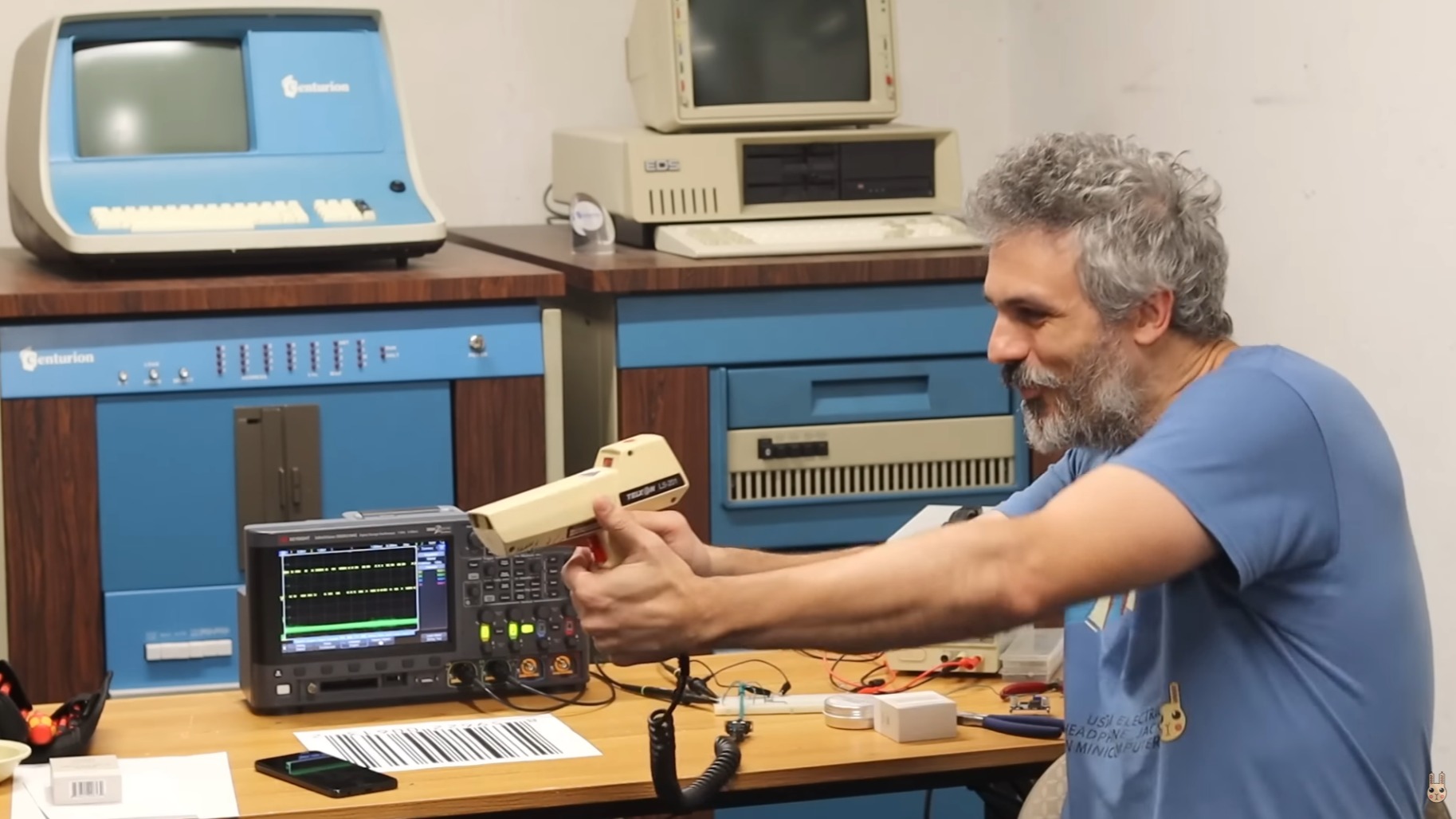
The humble barcode is one of those inventions that looks suspiciously simple, like toast or a paper clip. You glance at a few black stripes, a scanner goes beep, and somehow the machine knows you are buying cereal instead of cat litter. It feels like magic until you look closer. Then you realize the trick is not magic at all. It is optics, contrast, timing, geometry, and a very nerdy dash of signal processing.
In other words, barcode technology is what happens when retail, engineering, and mathematics all agree to wear the same name tag. The bars and spaces form a visual pattern, the scanner turns that pattern into a signal, and software decodes the signal into useful data. Somewhere in the background, concepts like convolution, sampling, and Fourier transforms are quietly doing the heavy lifting while the checkout lane takes all the applause.
So let’s pull back the curtain. Here is how barcodes work, why not every scanner is really a “laser,” and why Fourier transforms deserve a cameo in this supposedly ordinary story of black lines on a box of crackers.
What a Barcode Really Is
At its core, a barcode is a machine-readable pattern that encodes information through carefully arranged visual elements. In a classic 1D barcode, those elements are vertical bars and the spaces between them. In a 2D code, such as a QR code or DataMatrix symbol, the information is packed into a grid of squares or dots. The important point is that the code is not random decoration. Every width, gap, start marker, stop marker, and quiet zone is doing a job.
That is why a barcode does not behave like a picture. A photograph can be slightly messy and still look like a dog. A barcode can be slightly messy and suddenly become “congratulations, you just bought 4,000 cans of soup.” Barcode standards are strict because the scanner needs predictable structure. The empty margin around a barcode, often called the quiet zone, matters just as much as the dark bars. It tells the scanner where the symbol begins and ends, which is the optical equivalent of saying, “Ahem, the real content starts here.”
The Bars Are Not Words. They Are Patterns.
One reason barcodes fascinate engineers is that they are really patterns first and data second. A UPC code, for example, is built from a specific numeric structure, but the scanner does not “read English.” It reads changes in reflected light. Black absorbs more light, white reflects more light, and the transition between dark and light becomes a timing pattern the hardware can interpret. The decoded number is the final result, not the first thing the machine sees.
Think of a barcode as a tiny one-dimensional landscape. Peaks and valleys of reflectance are laid out with exact spacing. The scanner moves across that landscape and converts visual contrast into an electrical waveform. Once you view it that way, the connection to signal processing becomes much more obvious.
Why UPC Became a Giant Deal
The Universal Product Code changed commerce because it turned item identification into a repeatable machine task. Instead of typing prices by hand, retailers could scan a symbol, look up the item, and move on. That sounds ordinary now, but it was a massive operational leap. Faster checkout, better inventory tracking, fewer manual errors, and cleaner data all came from those stripes.
Barcode history also has a certain glorious practicality. The first famous grocery scan in the 1970s involved a pack of chewing gum, which feels exactly right. Human civilization did not launch this revolution with a moon rock or a rare manuscript. We started with gum and a beep. Honestly, that feels on brand for retail.
Why People Say “Laser Scanner” Even When That Is Not the Whole Story
Ask most people how a barcode scanner works and they will say some version of this: “A laser shines on the code, and the machine reads it.” That description is not wrong, but it is incomplete. It describes a classic style of barcode reader, not the entire modern family.
Traditional laser scanners use a focused beam that sweeps across the code. As the beam crosses black bars and white spaces, the amount of reflected light changes. A detector picks up those changes, electronics turn the variations into a signal, and decoding software figures out which symbol was scanned. The red line you see in a store is dramatic, memorable, and excellent at convincing children that checkout counters run on science fiction.
But modern barcode reading is much broader than that. Many scanners are linear imagers or area imagers. A linear imager captures a line of data rather than sweeping a beam across the symbol. An area imager behaves more like a small camera, capturing a full image and letting software decode the code from that image. That is why many modern scanners can read 1D barcodes, QR codes, damaged labels, and even symbols shown on a phone screen.
The Red Line Gets the Fame. The Sensor Gets the Job Done.
The most important thing to understand is that light alone does not “know” anything. The useful action happens when reflected light is detected and converted into an electrical signal. That means the scanner lives or dies by contrast, focus, motion, exposure, and signal quality. The laser may be the celebrity, but the detector and decoding pipeline are the people actually running the show backstage.
This is also why a wrinkled label, low ink, glossy packaging, harsh sunlight, or a cracked phone screen can make scanning harder. The scanner is not reading abstract numbers floating in space. It is trying to extract a clean signal from imperfect optics in the real world, which is a much less glamorous job than the marketing brochure suggests.
Where Fourier Transforms Enter the Scene
Now for the fun part. A barcode looks spatial, but it can also be treated as a signal. Move across a 1D barcode from left to right and you have a changing pattern of dark and light. That pattern can be represented as a function of position. Once you have a function, signal-processing ideas walk in like they own the place.
A Fourier transform breaks a signal into its frequency content. In plain English, it tells you how much of the pattern is made of slow changes and how much is made of rapid changes. A barcode with crisp edges contains strong high-frequency information because it changes abruptly from black to white. A blurred barcode loses some of that sharp high-frequency content, which is exactly why blur makes decoding harder.
Barcodes as Stripe Patterns in Frequency Space
Imagine a perfectly printed barcode with sharp transitions. In the spatial domain, it is a pattern of bars and spaces. In the frequency domain, it becomes a mix of components representing how often those transitions occur. Wide bars contribute lower-frequency structure. Narrow bars and sharp edges contribute higher-frequency detail. The scanner and decoder do not need to lecture themselves about Fourier analysis every time they beep, but the underlying behavior follows that logic.
This is especially useful when engineers analyze performance. If a printing process smears edges, if motion blur softens transitions, or if the optics are slightly out of focus, the captured signal no longer matches the ideal one. Frequency-domain thinking helps explain why. Blur acts a bit like a low-pass filter: it suppresses the fine, sharp details first. That is terrible news for tiny bars trying to survive on a busy package.
Convolution: The Silent Villain of Bad Scans
In imaging and signal processing, blur is often modeled as convolution between the ideal signal and some blur kernel. That sounds intimidating, but the everyday version is simple: the real scanner never sees the perfect barcode. It sees a softened version shaped by optics, distance, motion, and noise.
This is exactly why barcode researchers talk about deblurring and reconstruction. If the observed signal is the ideal pattern after being blurred and contaminated by noise, then decoding becomes an estimation problem. The machine is asking, “Given this messy waveform, what original sequence of bars most likely produced it?” Suddenly the checkout lane is doing applied math with the confidence of a PhD candidate and the attitude of a tired cashier.
Why Real-World Scanning Is Messier Than the Textbook
Textbook barcodes are beautiful. They are centered, sharp, well lit, and apparently printed by angels with calipers. Real barcodes live on curved cans, crumpled snack bags, shipping labels with adhesive wrinkles, and glossy packaging that reflects overhead lights like a tiny disco ball. This is why scanner design matters so much.
A strong barcode system has to deal with skew, rotation, motion, partial obstruction, low contrast, glare, and print defects. In retail, the scanner needs to work fast enough that nobody notices the computation. In warehouses, the code may be far away, scratched, or slapped onto cardboard that has all the geometric dignity of a defeated accordion. In healthcare, barcode reliability is not merely convenient; it can be tied to traceability and safety.
Examples You Have Probably Seen
A grocery checkout scanner can often read a code from multiple orientations because the system is built for speed and human impatience. A warehouse scanner may prioritize long range and rugged performance. A phone camera reading a QR code relies heavily on image processing, perspective correction, and software decoding. A medical-device label may carry structured identification data where accuracy matters far beyond the cash register.
The underlying mission is the same in every case: capture enough trustworthy visual information to decode the symbol correctly. The implementation changes, but the drama remains familiar. More light is not always better. More pixels are not always enough. And the barcode never stops demanding its quiet zone like a diva demanding the exact room temperature.
Common Myths About Barcodes, Lasers, and Fourier Transforms
Myth 1: The Laser Does All the Work
Not even close. The useful part is the entire sensing and decoding chain. The emitted light, the optics, the detector, the analog-to-digital conversion, the timing, and the decoding algorithm all matter. In many modern devices, the “laser scanner” label is outdated shorthand rather than a precise technical description.
Myth 2: A Barcode Is Just Black Bars With a Number Underneath
The human-readable digits are mostly for us, the error-prone primates. The barcode itself follows a formal symbol structure with encoded patterns, quiet zones, and validation logic. It is a designed optical language, not decorative striping.
Myth 3: Fourier Transforms Are Too Fancy for Checkout Lanes
Fancy, yes. Unrelated, no. Fourier transforms are one of the best ways to understand how patterns, blur, noise, and resolution interact. Even when a scanner does not literally run a Fourier transform in the most obvious way, engineers still use frequency-domain thinking to design optics, evaluate image quality, and understand decoding limits.
Myth 4: If the Code Looks Fine to You, the Scanner Should Read It
Human vision is forgiving. Barcode systems are picky in different ways. A code can look readable to your eyes while still failing because of low contrast, poor margins, motion smear, or spec violations. Your eyeballs are talented, but they are not a barcode verifier.
Final Thoughts
Barcodes are a wonderful reminder that powerful technology does not always look dramatic. Sometimes world-changing systems arrive disguised as black stripes on a toothpaste box. Behind that plain exterior is a layered story about standards, optics, sensors, error reduction, and signal analysis.
The “laser” part makes for good visual theater, but it is only one chapter. Modern barcode systems span laser scanners, linear imagers, area imagers, and software-heavy decoding pipelines. And once you view a barcode as a signal rather than just a symbol, Fourier transforms stop seeming like overkill and start feeling inevitable.
So the next time a scanner chirps successfully on the first try, take a moment to appreciate the elegance. The machine just recognized a structured optical pattern, converted light into data, filtered out real-world mess, and matched the result to a meaningful identifier in a blink. That is not magic. But it is a pretty excellent trick.
Practical Experiences: What This Topic Feels Like in the Real World
Spend enough time around barcode systems and you learn that the theory is clean, but the lived experience is gloriously chaotic. The first practical lesson is that a barcode is never just a barcode. It is a printed object living on a real surface under real lighting in the company of real humans, and humans are not exactly famous for presenting labels to scanners with laboratory precision.
In a checkout setting, the difference between a smooth scan and a stubborn one often comes down to package shape and surface finish. A flat cereal box is cooperative. A shiny frozen-food bag, on the other hand, behaves like it personally resents being inventoried. Tilt it one way and the code is readable. Tilt it another and you get a flash of glare strong enough to convince the sensor it is staring at a tiny sun. That moment teaches you quickly that barcode reading is less about “seeing a label” and more about capturing usable contrast.
Warehouses add another layer of drama. A shipping label may be printed well, but then it gets folded over a box seam, rubbed during transport, or exposed to dust and moisture. Suddenly the bars are no longer crisp and the quiet zone has been invaded by tape, dirt, or somebody’s ambitious marker note. This is where the practical value of robust scanners becomes obvious. A strong system does not just read pristine symbols. It survives the daily abuse of logistics, where the label has had a harder week than anyone in the room.
Camera-based scanning creates a different kind of experience. When you use a phone to scan a code, you become aware of how much software is doing behind the curtain. The phone has to find the symbol, handle perspective, deal with focus, estimate exposure, and separate the code from background clutter. That is why a QR code on a clean poster feels effortless while a tiny 1D code on a curved bottle can feel like you are negotiating a peace treaty with your camera app.
The signal-processing angle becomes especially real when you try to inspect or debug barcode images on a computer. A code that looks “mostly okay” can still fail because the edges are softened just enough to confuse thresholding. Once you zoom in, you see the actual problem: transitions that should be sharp are smeared, narrow bars are bleeding into nearby spaces, and the pattern in the image is no longer the pattern the decoder expects. In that moment, ideas like blur, filtering, and frequency content stop being abstract textbook topics. They become painfully practical.
That is the real charm of barcodes, “lasers,” and Fourier transforms. The topic connects everyday experience to serious engineering without changing its outfit. One minute you are watching a cashier scan gum. The next minute you are talking about optics, detectors, convolution, noise, and frequency-domain behavior. Very few technologies move so smoothly between supermarket life and mathematical elegance. Barcodes do it every day, usually in under a second, and then they have the nerve to act like it was no big deal.