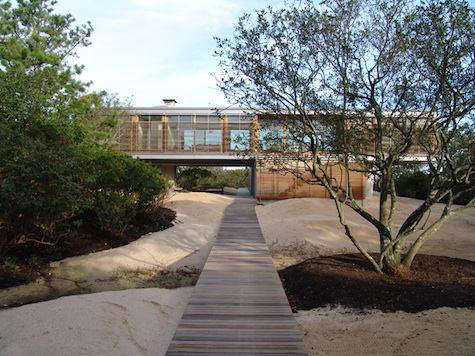
Some architecture firms shout. Stelle Lomont Rouhani Architects, based in Bridgehampton, New York, has built a reputation by doing something far more difficult: listening. Listening to the wind off the Atlantic. Listening to the angle of afternoon light over Mecox Bay. Listening to clients who want a home that feels elegant but not fussy, modern but not cold, luxurious but not loud enough to scare the hydrangeas.
Located at 48 Foster Avenue in Bridgehampton, with an additional New York City presence, Stelle Lomont Rouhani Architects has become one of the most respected names in Hamptons modern architecture. The firm is known for environmentally sensitive houses, quiet coastal confidence, low-lying silhouettes, carefully framed views, and interiors that understand the difference between minimal and empty. In other words, these are homes where the architecture does not need to wear a tuxedo to look sophisticated.
This architect visit explores the firm’s history, design philosophy, notable projects, and the experience of seeing its work through the lens of Bridgehampton itselfa village where farmland, dunes, ocean air, and high expectations all sit at the same very well-appointed table.
The Bridgehampton Setting: Where Landscape Runs the Meeting
Bridgehampton sits on the South Fork of Long Island, between Southampton and East Hampton, and its identity is shaped by a rare blend of beaches, agricultural fields, wetlands, equestrian culture, and high-end residential design. That mix creates a fascinating challenge for architects. A house here must be beautiful, but beauty alone is not enough. It has to survive salt air, strong sun, changing weather, flood regulations, storm exposure, and neighbors who may know the difference between cedar siding and wishful thinking.
For Stelle Lomont Rouhani Architects, the Hamptons are not simply a market; they are a working laboratory. The firm’s best houses seem to understand that a coastal home should not merely occupy a site. It should negotiate with it. A house may need to open toward the ocean while shielding itself from wind. It may need broad glass walls for views, but screens or louvers for shade and privacy. It may need to feel light, relaxed, and vacation-ready, while being engineered with the seriousness of a small fortress in linen pants.
Who Are Stelle Lomont Rouhani Architects?
Stelle Lomont Rouhani Architects, often associated with the initials SLRA or SLR, is a modern architecture and interior design firm rooted in the East End of Long Island. The studio traces its local presence to Frederick Stelle, who opened Stelle Architects on the East End in 1985 after earlier work in Manhattan. Over time, the practice evolved into the collaborative firm now identified with Frederick Stelle, Michael Lomont, Viola Rouhani, and Eleanor Donnelly.
Each principal brings a distinct strength. Frederick Stelle contributes decades of design experience and a long-standing conservation ethic. Michael Lomont brings modernist clarity, construction knowledge, and a strong commitment to sustainability. Viola Rouhani, trained in architecture and planning, is known for site-responsive work and a careful dialogue between landscape and building. Eleanor Donnelly leads the interiors practice, creating spaces where furnishings, finishes, art, and architecture speak the same language rather than arguing over the rug.
The firm’s work spans private residences, beach houses, second homes, interior design, restoration, and select non-residential projects. Yet its strongest public identity is tied to coastal modern homeshouses that are crisp, calm, and deeply aware of where they stand.
The Design Philosophy: Less Is More, But Make It Livable
The phrase “less is more” can be dangerous in architecture. In the wrong hands, it becomes “less storage, more expensive chairs.” In the work of Stelle Lomont Rouhani Architects, the idea is more thoughtful. It means reducing visual noise so that light, water, grasses, dunes, wood, stone, and daily life can take center stage.
The firm’s philosophy emphasizes non-invasive design, low maintenance materials, native plantings, smaller footprints when possible, and respect for the natural landscape. Their houses often begin with the character of a site: the slope of land, the path of breezes, the best view, the worst exposure, the neighboring structures, the privacy concerns, and the emotional rhythm of how a family wants to live.
Modern, But Not Aggressive
One reason the firm’s work resonates in the Hamptons is that it offers an answer to a long-running local debate: can modern architecture belong in a historically shingled, village-scaled, landscape-driven place? Stelle Lomont Rouhani’s answer is yesbut only if modernism behaves itself. Their homes tend to defer to the landscape rather than dominate it. Rooflines stay low. Materials weather naturally. Openings are precise. Outdoor rooms are treated as seriously as indoor rooms. The result is modern architecture with manners.
Sustainability as a Design Habit
Sustainability in the firm’s work is not presented as a decorative badge. It is woven into decisions about footprint, orientation, material durability, reusing existing structures, preserving native species, and designing houses that last. In the Hamptons, where environmental sensitivity and luxury often have to share the same driveway, this practical approach matters.
Notable Projects and What They Reveal
Stelle Lomont Rouhani Architects has a long portfolio of houses that illustrate its range: oceanfront retreats, bluff houses, wooded renovations, farm-inspired compounds, and carefully restored modernist structures. Several projects help explain why the firm has become a reference point for Bridgehampton architecture and Hamptons modern design.
House on the Point: Compact, Coastal, and Clever
House on the Point is one of the clearest examples of the firm’s ability to make a modestly scaled house feel expansive. Located between Mecox Bay and the Atlantic Ocean, the project works within a tight footprint and demanding coastal conditions. Instead of treating constraints as disappointments, the design uses them as fuel.
The open first floor connects ocean and bay views, while the more private upper level prioritizes indoor-outdoor living. Decks, glass doors, cedar siding, impact-resistant elements, and careful screening all work together. The house feels relaxed, but its design responds to storms, privacy, sun, and salt air. That is the magic trick of good coastal architecture: the building looks easy because the hard work is hidden.
Bay Residence: The Long, Low Language of the Landscape
The Bay Residence, featured in earlier design coverage, shows the firm’s interest in simple forms and strong site relationships. Described as a steel, glass, and wood volume set on a rolling site, the house uses a long horizontal form and a concrete plinth to create clarity and calm. Rolling wood louvers filter summer sun, while outdoor spaces below and around the structure turn the house into a series of shaded, breezy experiences.
Here, architecture becomes a framing device. The building does not compete with the land; it sharpens awareness of it. Views are edited. Sun is softened. Materials are reduced to a disciplined palette. The house feels composed without feeling stiff, which is no small accomplishment when glass, steel, concrete, and wood are all invited to the same beach weekend.
Tree House: Renovation Instead of Replacement
The Tree House project in Amagansett is especially important because it demonstrates the firm’s preference for thoughtful renovation when possible. Rather than demolishing an existing structure perched among trees, the design strategy retained and reworked it, adding a horizontal volume while allowing the original tower-like form to keep its identity.
This is where sustainability becomes more than solar panels and good intentions. Renovating an existing structure can preserve embodied energy, reduce waste, and maintain a relationship with the site that a new building might erase. The result is not nostalgia. It is adaptive modernismrespectful, efficient, and still fresh.
Stillwater: Restoring a Modernist Legacy
Stillwater reveals another side of the firm: restoration with restraint. The project involved a house originally designed by Norman Jaffe, one of the East End’s significant modernist architects. Rather than overwrite the original spirit, Stelle Lomont Rouhani approached the work through restoration, careful additions, and an effort to honor Jaffe’s fascination with light, simplicity, and form.
For a firm known for new coastal houses, this kind of project is telling. It shows that SLRA understands architecture as a conversation across time. A renovation can be contemporary without being rude. An addition can be useful without elbowing the original house out of the photograph.
Light House and the Bold Side of Hamptons Modernism
While much of the firm’s work is quiet and landscape-driven, projects such as Light House show that Stelle Lomont Rouhani can also handle a bolder architectural statement. Recognized in regional design coverage, the residence uses intersecting walls, cantilevered elements, strong geometry, and carefully framed water views. It has been described as part of a new typology within Hamptons modernism.
That range matters. The firm is not trapped in one look. Its projects can be serene, sculptural, restorative, compact, expansive, beachy, wooded, or gallery-like. What connects them is not a repeated style, but a repeated method: understand the site, reduce what is unnecessary, detail what remains, and let the landscape do some of the talking.
Interior Design: The View Continues Indoors
One of the most appealing qualities of Stelle Lomont Rouhani Architects is that the interiors do not feel like afterthoughts. The firm’s interior design work, led by Eleanor Donnelly, often extends the architectural idea rather than decorating around it. Finishes are quiet but tactile. Furniture is refined but usable. Art is given room to breathe. Kitchens and living spaces favor simplicity, proportion, and connection to outdoor terraces, decks, and gardens.
In a Hamptons home, interiors can easily become over-performed: too much white linen, too many decorative shells, too many objects that whisper, “I was purchased on purpose.” SLRA’s interiors tend to avoid that trap. The mood is warm modernism. Rooms feel composed, not staged. The best spaces appear ready for bare feet, strong coffee, wet towels, dinner guests, and one very opinionated dog.
Why the Firm Matters in Hamptons Architecture
Stelle Lomont Rouhani Architects matters because the firm has helped define a version of Hamptons modern architecture that is elegant without being showy, environmentally aware without being preachy, and luxurious without losing touch with sand, weather, and daily use.
That balance is difficult. The Hamptons are full of dramatic sites and demanding clients, but also strict regulations, fragile landscapes, and communities with strong opinions about scale and character. A successful architect here must act as designer, diplomat, environmental translator, and occasional magician. The firm’s portfolio suggests a deep understanding of those overlapping pressures.
Architecture That Knows the Codes and the Culture
Building in coastal Long Island involves more than choosing a pretty elevation. Architects must think about flood prevention, coastal erosion areas, building codes, wetlands, stormwater, height limits, view corridors, and approvals. They must also understand the local culture of summer houses, family compounds, outdoor living, and privacy. A glass wall is beautiful until it turns your living room into a community theater production called “Dinner at 7:30.”
SLRA’s work often solves this with screens, louvers, careful window placement, courtyards, planted buffers, and floor plans that reveal and conceal in equal measure. The houses are open, but not exposed. They are transparent, but not naive.
Experience Section: What an Architect Visit Feels Like in Bridgehampton
Arriving in Bridgehampton to think about Stelle Lomont Rouhani Architects is not like walking into a conventional design district. The experience begins before the studio door. You notice the flatness of farm fields, the sudden glamour of hedges, the silvered wood of older buildings, the clean flash of a modern roofline behind grasses, and the way the sky feels larger than it has any right to feel. The Hamptons may be famous for summer traffic and celebrity sightings, but the better story is environmental: light, wind, salt, sand, wetlands, and the constant negotiation between privacy and openness.
An architect visit to a firm like SLRA is best understood as a change in attention. You start noticing edges. How does a deck meet the dune? How does cedar age in salt air? Why does one house feel calm while another, with the same budget and ocean view, feels like it is trying to win an argument? You begin to understand that the firm’s best work is not about making a house disappear. It is about making a house belong.
In Bridgehampton, that belonging can look deceptively simple. A low roofline may echo the horizon. A screened porch may catch the breeze while protecting a family dinner from mosquitoes, glare, and the occasional overconfident seagull. A concrete floor may run from inside to outside, making the living room feel less like a sealed box and more like a shaded platform. A kitchen island may be rectangular and plain, but its placement can organize an entire day: breakfast facing the garden, lunch after the beach, late-night conversation while the sliders are still open.
The experience of studying SLRA’s houses also changes how you think about luxury. Luxury is not only marble, square footage, or a pool long enough to have its own weather system. In these projects, luxury is often spatial intelligence. It is waking up to the right view, having a protected outdoor room when the wind shifts, entering a house through shadow before stepping into light, or feeling that a bedroom does not need to be enormous because the real room is the landscape outside.
There is also a quiet discipline in the firm’s approach that becomes more impressive the longer you look. Many of the choices are not flashy. Native planting instead of ornamental excess. Durable siding instead of fragile finishes. Renovation instead of demolition. Screens instead of heavy curtains. Smaller bedrooms so shared spaces and outdoor connections can matter more. These decisions may not scream from a magazine cover, but they are the difference between a house that photographs well once and a house that lives well for decades.
The Bridgehampton context heightens all of this. A home here must handle guests, sand, wet bathing suits, changing seasons, serious entertaining, and long quiet mornings when the only event is the light moving across a wall. Stelle Lomont Rouhani Architects seems especially skilled at designing for both modes: the social and the contemplative. Their houses can host a lively summer dinner, then settle back into silence as if nothing happened. That is harder than it sounds. Houses, like people, can become exhausted by too much performance.
By the end of an architect visit, the main takeaway is not a single detail or project. It is a way of seeing. SLRA’s work encourages a slower reading of place. The best house is not always the loudest, tallest, newest, or most expensive. Sometimes it is the one that understands the breeze, respects the dune, keeps the bedrooms modest, frames the water without bragging, and lets the family feel lucky to be exactly where they are.
Conclusion: A Quiet Masterclass in Coastal Modernism
Stelle Lomont Rouhani Architects in Bridgehampton, New York, represents a mature and meaningful form of Hamptons modern architecture. The firm’s work is clean but warm, modern but rooted, refined but practical. From House on the Point to Stillwater, from coastal new builds to sensitive restorations, SLRA shows how architecture can serve both people and place.
What makes the firm compelling is not simply its portfolio of beautiful homes. It is the consistency of its values: site sensitivity, environmental awareness, material restraint, careful detailing, and a collaborative process. In a region where architecture can easily become a contest of spectacle, Stelle Lomont Rouhani Architects offers a calmer and more enduring proposition. Build with the landscape, not against it. Design for light, air, weather, family, and time. And when in doubt, let the ocean have the final word.