Some construction projects begin with a shovel. The Giant Magellan Telescope begins with glass, patience, math, and the kind of engineering confidence normally reserved for people who casually say, “Sure, let’s move a mirror the size of a swimming pool.” This next-generation observatory, now taking shape for Chile’s Las Campanas Observatory, is designed to look deeper into the universe than today’s best ground-based optical telescopes. But before it can study newborn galaxies, ancient starlight, black holes, and possibly the atmospheres of Earth-like exoplanets, it needs one thing above all: giant mirrors.
Not one mirror. Not two. Seven.
The Giant Magellan Telescope, often shortened to GMT, will use seven enormous primary mirror segments, each 8.4 meters wide, arranged like petals around a central mirror. Together, they will act like a single light-collecting surface about 25.4 meters across. That is not just big in the “please measure twice before buying curtains” sense. It is big in the “this could change modern astronomy” sense.
Why the Giant Magellan Telescope Needs Giant Mirrors
Telescopes are, at heart, light buckets. The bigger the bucket, the more faint light it can collect from distant objects. A larger mirror lets astronomers see dimmer galaxies, study smaller details, and separate objects that blur together in smaller telescopes. When the subject is a planet orbiting a star many light-years away, or gas surrounding a galaxy billions of years in the past, every photon matters. Space is not generous with light. It sends tiny postcards across cosmic distances and expects us to read the handwriting.
The GMT’s mirror system is built to gather those postcards by the billions. Its seven primary mirrors will provide a total light-collecting area of about 368 square meters. That enormous collecting power will help astronomers perform spectroscopy, the technique of splitting light into its component wavelengths to learn what distant objects are made of, how fast they move, how hot they are, and whether an exoplanet atmosphere may contain interesting chemical clues.
Big mirrors also improve resolution, the ability to distinguish fine detail. The Giant Magellan Telescope is expected to produce images several times sharper than today’s most advanced telescopes, depending on wavelength and observing mode. In some cases, with adaptive optics working properly, it may reveal details from the ground that once seemed possible only from space. That is the astronomical equivalent of cleaning your glasses and discovering the smudge was actually a galaxy.
The Seven-Mirror “Flower” Design
The GMT does not use one single 25-meter glass disk because making, transporting, supporting, and controlling such a slab would be nightmarishly difficult. Instead, its design uses seven of the largest optical mirrors ever made. One sits in the center. Six surround it in a flower-like pattern. This gives the telescope a huge effective aperture while keeping each segment within the limits of what can be manufactured at the University of Arizona’s Richard F. Caris Mirror Lab.
That flower pattern is elegant, but it is not simple. The central mirror is symmetric. The six outer mirrors are off-axis segments, meaning each one is shaped as if it were cut from a larger parent mirror. Their surfaces are not ordinary bowls. They are subtly complex, carefully polished optical landscapes that must direct starlight with nanometer-level precision. In other words, these mirrors are not just large. They are large, weird, and spectacularly picky.
Why 8.4 Meters Matters
Each GMT primary mirror segment measures 8.4 meters, or about 27 feet, in diameter. That size reflects decades of progress in large mirror manufacturing. The Richard F. Caris Mirror Lab specializes in producing lightweight honeycomb mirrors using a rotating furnace. The result is a mirror that is stiff and stable but much lighter than a solid glass disk of the same size. For a telescope that must move smoothly while tracking objects across the sky, weight is not a footnote. It is a design battle.
Inside each mirror is a honeycomb structure. This internal architecture reduces mass while preserving strength, a bit like nature’s own engineering trick inside a beehive. The mirrors are made from low-expansion borosilicate glass, chosen because it holds its shape well when temperatures change. That matters in a mountain observatory where day-night temperature swings can turn sloppy engineering into blurry astronomy.
How a Giant Telescope Mirror Is Made
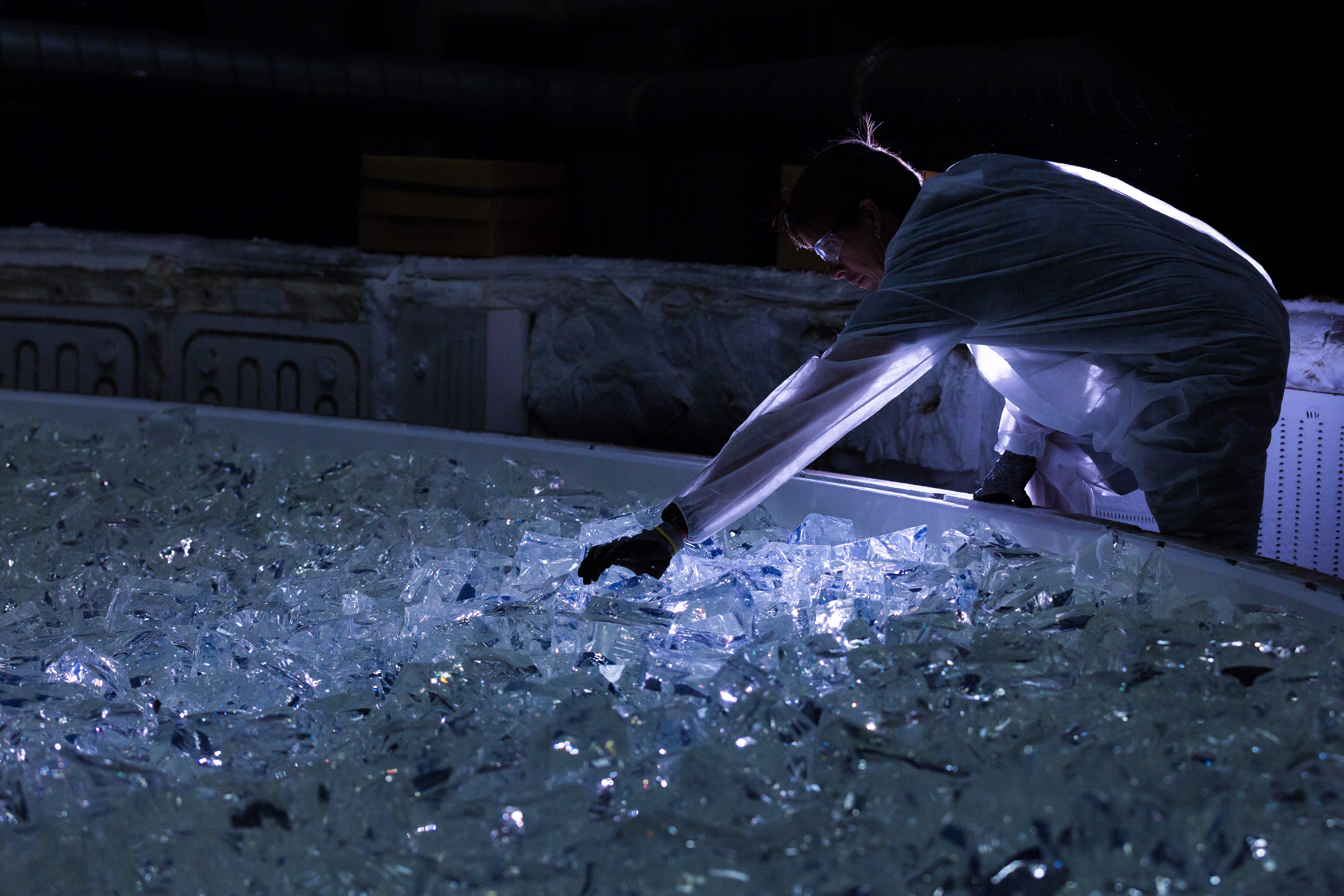
Making a GMT mirror is not like pouring pancake batter, though both involve heat and the hope that nothing sticks where it should not. At the Mirror Lab, technicians load tons of glass into a custom mold inside a rotating furnace. The mold contains thousands of ceramic fiber cores that create the honeycomb voids inside the mirror. As the furnace heats, the glass melts and flows around the mold. The rotation helps shape the molten glass into a curved surface, giving the mirror a head start toward its final optical form.
Then comes cooling. Slowly. Very slowly. If the glass cools too quickly, internal stress can ruin the mirror. A giant telescope mirror does not appreciate being rushed. After casting, the mirror is cleaned, inspected, ground, and polished through a process that can take years. Each GMT primary mirror takes roughly four years to complete, with the polishing stage alone requiring extraordinary care.
The target surface precision is measured in nanometers. To picture that, imagine polishing a surface wider than a house until the highest peaks and valleys are smaller than a tiny fraction of a human hair. Now imagine doing that while accounting for gravity, temperature, vibration, support systems, and the fact that the mirror’s final job is to focus light that may have traveled for billions of years. No pressure.
Polishing: Where Glass Becomes Astronomy
Casting creates the rough masterpiece. Polishing turns it into a scientific instrument. The surface of each primary mirror must be shaped so precisely that light from the sky arrives at the correct focus. Even tiny imperfections can scatter light or distort images. That is why the polishing process uses advanced measurement systems, including interferometry, to detect surface errors far too small for the eye to see.
The GMT’s outer mirror segments are especially difficult because they are off-axis. A normal round mirror can be tested around its center of symmetry. The GMT’s outer mirrors do not offer that convenience. They require specialized testing and polishing methods. This is one reason the project is not merely a bigger version of familiar telescopes. It is a manufacturing challenge disguised as a scientific dream.
By October 2024, three primary mirror segments had been completed, while the remaining four were in various stages of polishing or preparation. The seventh and final primary mirror was cast in 2023, marking a major milestone for the project. The mirrors are not just parts; they are the heart of the telescope.
Mirror Support: Holding the Universe Steady
A giant mirror is only useful if it is supported correctly. Glass bends under its own weight, even when it looks solid enough to intimidate a forklift. The GMT primary mirrors will sit in sophisticated support cells designed to hold them in the correct shape as the telescope tilts and tracks objects across the sky. These support systems must handle gravity, temperature changes, motion, and maintenance operations without compromising optical performance.
In 2024, testing began on the primary mirror support system, another crucial step in turning polished glass into working astronomy. The support structure must keep the mirrors aligned as though they are one optical surface. Seven giant mirrors must behave as one larger mirror, which is a little like asking seven cats to walk in formation while wearing tuxedos. Possible? Yes. Easy? Absolutely not.
Adaptive Optics: Fighting the Twinkle
Earth’s atmosphere is beautiful, breathable, and extremely annoying to astronomers. The same moving air that makes stars twinkle also blurs telescope images. Adaptive optics solves this by correcting distortions in real time. The GMT is designed with adaptive optics built into its system from the start, rather than added later as a high-tech afterthought.
The telescope will use seven deformable secondary mirrors. These thin, flexible mirrors can change shape thousands of times per second to counteract atmospheric turbulence. Incoming starlight reflects first from the seven giant primary mirrors, then from the adaptive secondary mirrors, which make rapid corrections before the light reaches scientific instruments.
This is one of the reasons the Giant Magellan Telescope is expected to be so powerful. Its size gives it light-gathering muscle. Adaptive optics gives it sharp vision. Together, they make the telescope less like a bucket and more like a cosmic detective with very expensive contact lenses.
Why Build It in Chile?
The GMT is being built at Las Campanas Observatory in Chile, one of the world’s premier sites for optical astronomy. The region offers dark skies, dry air, high altitude, and many clear nights each year. For a telescope designed to study faint objects, the site matters almost as much as the mirror. A great telescope under poor skies is like a sports car stuck in traffic.
Chile’s southern sky also provides access to important astronomical targets, including the center of the Milky Way and regions not visible from northern observatories. This makes GMT a powerful complement to other facilities around the world, including space telescopes and large survey observatories. A discovery made by one telescope can become a detailed follow-up target for another.
What the Giant Magellan Telescope Will Study
The GMT’s science goals are ambitious because its mirror system is ambitious. Astronomers plan to use it to study the earliest galaxies, the formation of stars and planets, the growth of black holes, dark matter, dark energy, and the chemical evolution of the universe. Its instruments will help researchers analyze light from extremely faint and distant objects, turning tiny signals into physical stories.
Exoplanets and the Search for Life
One of the most exciting goals is the study of exoplanets, especially planets that may be rocky and located in habitable zones around their stars. The telescope’s large collecting area and high-resolution instruments could help scientists detect and analyze the atmospheres of distant worlds. That does not mean GMT will casually snap a vacation photo of alien palm trees. Science is more careful than that, and sadly less tropical. But it may help identify atmospheric molecules that tell us whether a planet is worth deeper study.
Galaxies in the Early Universe
The GMT will also help astronomers look back in time. Because light takes time to travel, distant galaxies show us the universe as it was billions of years ago. With the GMT, scientists hope to map gas around young galaxies, study how stars formed, and understand how galaxies grew into the structures we see today. This is cosmic archaeology, except the ruins are made of light and the dig site is the universe.
The Telescope Is Also an Engineering Ecosystem
Mirrors get the spotlight, but they are part of a much larger system. The telescope mount, enclosure, instruments, controls, software, and maintenance plans all have to work together. The mount alone is an enormous precision machine. It must carry the mirrors, secondary optics, and instruments while moving smoothly enough to track objects across the sky.
Engineers are even using advanced simulation tools to plan operations and maintenance. For a telescope of this size, practicing complex procedures virtually can reduce risk before anyone moves a multimillion-dollar mirror in the real world. When your equipment includes some of the largest optical mirrors ever made, “oops” is not an acceptable project management strategy.
Why Giant Mirrors Still Matter in the Space Telescope Era
Space telescopes like the James Webb Space Telescope have changed astronomy forever, but ground-based giants still have major advantages. They can be much larger than most space telescopes because they do not need to fit inside a rocket fairing. They can be upgraded, maintained, and equipped with new instruments over time. They can also work in partnership with space observatories, each doing what it does best.
The GMT is part of a broader era of extremely large telescopes. These observatories are not incremental upgrades. They represent a new class of instruments that combine enormous apertures, advanced adaptive optics, and precision engineering. Their goal is not simply to make prettier space pictures, though prettier space pictures are always welcome. Their goal is to answer questions that smaller telescopes cannot reach.
The Human Experience of Giant Mirrors
It is easy to talk about the Giant Magellan Telescope in numbers: seven mirrors, 8.4 meters each, 25.4 meters across, 368 square meters of collecting area. Numbers are useful, but they can flatten the wonder. The real experience of this project is stranger and more human. Imagine walking into a mirror lab and seeing a disk of glass so large that it feels less like an object and more like a frozen pond. It is not yet looking at galaxies. It is sitting under lights, being measured, moved, cleaned, and polished by people who understand that a dropped tool could become a very expensive crater.
There is something almost old-fashioned about the craft, even though the technology is cutting-edge. Human hands load glass. Engineers design molds. Technicians monitor temperatures. Optical scientists chase errors smaller than viruses. The work is slow because the universe rewards patience. A mirror that takes years to polish may later collect light that has traveled for billions of years. Compared with that, four years of mirror-making is practically a coffee break.
For students, science fans, and future engineers, the GMT offers a powerful lesson: discovery is physical. We often imagine astronomy as data on a screen, but before the data appears, someone has to build the machine. Someone has to design the support cell, calculate the stresses, inspect the glass, write the control software, and test what happens when a mountain observatory meets wind, dust, cold, heat, and gravity. The romance of astronomy depends on the practical skills of people who know where the bolts go.
The mirror story is also a good reminder that “big science” is collaborative science. No single person builds a Giant Magellan Telescope. Universities, observatories, engineers, machinists, donors, scientists, software developers, and technicians all contribute. The result is a shared tool for questions that belong to everyone: Where did galaxies come from? How common are planets like Earth? What is the universe made of? Are we alone? These are not small questions, so perhaps it makes sense that the mirrors are not small either.
There is also an emotional experience in the idea of seven mirrors acting as one. Individually, each segment is a triumph. Together, they become something more powerful. That is a neat metaphor, but it is also an optical requirement. The telescope’s future depends on alignment, coordination, and correction. In a way, the GMT is a machine built around cooperation: glass cooperating with steel, software cooperating with sensors, Chilean skies cooperating with human curiosity.
When the Giant Magellan Telescope finally opens its eye to the sky, its first images will not be the end of the story. They will be the beginning of a long scientific career. The mirrors will need maintenance. Instruments will improve. Astronomers will ask new questions. Unexpected discoveries will rewrite observing plans. That is the fun part. A giant mirror is not just a bigger mirror. It is an invitation for the universe to surprise us at higher resolution.
Conclusion: Bigger Mirrors, Deeper Questions
The title says it plainly: a Giant Magellan Telescope needs giant mirrors. But the deeper truth is that modern astronomy needs giant ambition. The GMT’s seven 8.4-meter primary mirrors are not oversized trophies. They are precision tools built to gather faint light, sharpen cosmic images, and open new territory in the search for planets, galaxies, black holes, and the early universe.
From the rotating furnace in Arizona to the dark skies of Las Campanas, the telescope’s story is one of scale and precision working together. The mirrors are massive, but their surfaces must be polished to nanometer accuracy. The structure is enormous, but it must move with grace. The science goals are grand, but they depend on countless careful details.
If the Giant Magellan Telescope succeeds, it will not merely be because humanity built something big. It will be because we built something big enough, precise enough, and clever enough to let the universe tell us stories we have never heard before.