Some bars try to impress you with smoke, mirrors, and a bartender who looks like he majored in chemistry and minored in theater. Oval Bar in Barcelona takes a different route. It wins you over with space, texture, light, and that quietly confident kind of design that never has to shout. Set in the Eixample district inside a 19th-century building, Oval Bar feels less like a trendy stunt and more like a smart conversation between old Barcelona and modern taste. That is exactly why it still deserves attention.
At first glance, Oval Bar looks simple. Then you keep looking. The whitewashed brick, the honest wood, the exposed structure, the sense of breathing room in a city that can often feel joyfully packed to the edges, all of it works together to create a place that is stylish without being precious. It is the kind of room that makes you want to linger, talk longer, and pretend you suddenly understand architecture on a spiritual level.
This is not just a story about a bar. It is a story about how Barcelona does social spaces so well, how good design can rescue a tired interior, and why Oval Bar feels unmistakably local even though its appeal is universal. Whether you care about hospitality design, neighborhood culture, or simply finding places with more personality than a generic chain spot, Oval Bar gives you plenty to talk about.
Why Oval Bar Stands Out in Barcelona
Barcelona is not short on bars. That is putting it mildly. The city has cocktail lounges, vermuterías, natural wine bars, neighborhood dives, and polished hotel spaces that double as social hubs. In Barcelona, the bar is not just a place to grab a drink and leave. It is part of daily life, part of work life, part of family life, and part of that long, unhurried style of socializing the city wears so well.
Against that backdrop, Oval Bar earns attention because it does not compete through noise. It competes through atmosphere. In a city known for expressive design and serious nightlife, Oval Bar offers something calmer and more grounded. It has the confidence to let its materials do the talking. Instead of layering in fake nostalgia or overdesigned cool, the space leans into the bones of the building and lets the room feel real.
That matters in Barcelona, where authenticity is not a marketing word people toss around lightly. Places that resonate tend to feel tied to their neighborhood, their building, and the rhythm of the city. Oval Bar succeeds because it feels rooted. It belongs to Eixample instead of merely occupying it.
A 19th-Century Shell With a Modern Pulse
One of the most compelling things about Oval Bar is its architectural backstory. The project was developed by Flexoarquitectura, which approached the space not as a blank canvas but as a site with memory. The venue sat on the ground floor of a 19th-century building in Eixample, and like many urban interiors, it had lost some of its original identity over time. Different layers of construction and renovation had piled up, dulling the character of the place.
Rather than erase everything and start from scratch, the designers did something smarter. They treated the old layers as part of the point. The goal was to recover the spaciousness and industrial character of the interior, not by turning it into a museum piece, but by updating the existing shell and setting old and new elements side by side. It is a subtle idea, but a powerful one: not old versus new, but old with new.
Material Honesty, No Fancy Costume Required
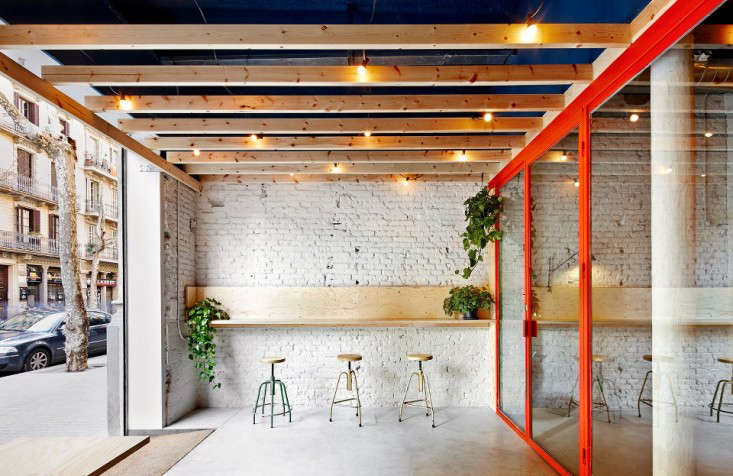
That philosophy is visible everywhere. White-painted brick walls give the room a clear, bright, industrial edge. Original columns and brickwork are allowed to remain present instead of being hidden behind smoother, shinier finishes. The wood elements add warmth without making the place feel rustic. Together, the materials balance one another beautifully. The result is crisp, but not cold; minimal, but not empty.
Oval Bar also makes excellent use of straightforward construction choices. Wooden boards were used extensively for seating, tables, and wall paneling, creating visual continuity throughout the space. It is the kind of move that sounds almost too simple on paper, yet lands perfectly in practice. Good design loves restraint. Oval Bar proves it.
Economy as a Design Strength
Here is the part that makes designers nod approvingly and budget-conscious readers breathe a tiny sigh of relief: the project’s constraints actually helped shape its identity. Because of financial limitations, the renovation preserved layers of the existing structure rather than replacing everything. That decision reportedly saved both time and money, and it also gave the bar much of its character. In other words, the budget did not ruin the project. It sharpened it.
There is something wonderfully Barcelona about that. The city’s best spaces often mix beauty with practicality. They do not always rely on extravagance. Instead, they rely on proportion, atmosphere, texture, and the clever use of what is already there. Oval Bar embraces that mindset fully.
The Eixample Effect
Location matters, and Oval Bar benefits from being in Eixample, one of Barcelona’s most architecturally rich and socially dynamic districts. Eixample is famous for its grand avenues, Modernist landmarks, and block-by-block variety. It is also one of the city’s most diverse nightlife areas, with everything from elegant cocktail rooms to relaxed wine bars and busy neighborhood haunts.
That diversity makes Oval Bar feel especially well placed. Eixample supports venues with personality. A bar here does not need to be loud to matter; it needs to have a point of view. Oval Bar’s point of view is clear: make the space memorable, make it comfortable, and let conversation do the rest.
A Neighborhood Built for Lingering
Barcelona rewards lingering in general, and Eixample may be one of the city’s best examples of that habit. People move between restaurants, bars, terraces, and walkable streets with very little urgency. Evenings often start later than many American visitors expect, and places can come alive as the night settles in. That makes a well-designed interior especially important. If people are going to stay, the room had better be worth staying in.
Oval Bar is built for that kind of use. The interior does not feel rushed. It feels arranged around the idea that a social space should invite people to remain present. You can imagine it as a stop for a casual meal, a design-minded meetup, or a long conversation that somehow turns one hour into three. Barcelona has a talent for that kind of time warp.
Barcelona’s Drinking Culture, Without the Stereotypes
To understand why Oval Bar works, it helps to understand Barcelona’s broader bar culture. The city has long embraced beer, wine, and vermouth as social drinks, but recent years have also strengthened its reputation for natural wine and serious cocktails. Catalonia’s deep wine culture adds another layer, and that regional confidence shows up all over the city, from polished wine bars to casual counters.
But the real story is not simply what is in the glass. It is the pace around it. In Spanish drinking culture, especially around vermouth traditions, the drink is often tied to slow conversation and shared time. The point is not speed. The point is presence. That cultural rhythm fits Oval Bar perfectly, because the design also encourages attention rather than hurry.
That said, the appeal of Oval Bar is not limited to adult drinkers. It is the kind of place where atmosphere carries a lot of the experience. Even someone more interested in architecture, food, or simply seeing how Barcelona turns ordinary social spaces into stylish destinations can appreciate what makes the bar special. The room itself is part of the attraction.
What the Design Gets Exactly Right
Some interiors are photogenic but tiring. Oval Bar avoids that trap. It is easy on the eyes because it understands scale. Nothing feels too crowded, too glossy, or too eager to be noticed. The color palette is controlled. The structure is visible. The furnishings feel integrated rather than dropped in from a catalog labeled “Urban Cool, Page 12.”
The white brick brightens the room while preserving texture. The wood adds warmth and softness. The industrial framework gives the bar its backbone. Vintage seating introduces a lived-in note that keeps the space from looking over-edited. Even the visual imperfections feel useful. They remind you that this is a real place with history, not a stage set trying too hard to trend.
There is also a welcome lack of gimmick here. Oval Bar does not rely on neon slogans, faux speakeasy secrecy, or ten pounds of curated irony. It trusts proportion, contrast, and material memory. In design terms, that is elegant. In human terms, it means you can actually relax.
Why Oval Bar Still Feels Relevant
Hospitality design has changed a lot in the last decade. Trends have come and gone. There have been waves of hyperminimalism, maximalism, soft luxury, industrial revival, and enough terrazzo mania to tile a small planet. Yet Oval Bar still feels fresh because its best ideas were never trend-dependent.
It respects the original building. It uses simple materials well. It creates atmosphere through spatial intelligence instead of visual clutter. And it aligns with the social habits of its city. Those are durable ideas. A well-made room does not expire just because someone on the internet discovered curved banquettes and decided they had invented civilization.
For readers interested in hospitality spaces, Oval Bar is a lesson in how to build identity without overexplaining it. For travelers, it is a reminder that Barcelona’s best experiences often come from places that understand tone as much as taste. For designers, it is proof that constraints can become a project’s greatest strength. And for everyone else, it is an excellent excuse to admire brick, wood, and good judgment in one sitting.
Final Take
Oval Bar in Barcelona succeeds because it understands something many flashy venues forget: people remember how a place feels long after they forget the cleverest detail in the room. This bar feels grounded, open, textural, and quietly alive. It uses architecture to create comfort, not just image. It turns an old Eixample shell into a setting that feels distinctly modern without severing ties to the past.
That balance is rare. It is also what makes Oval Bar worth writing about. In a city filled with famous buildings and unforgettable nightlife, this bar holds its own by being thoughtful instead of loud. It is proof that a hospitality space does not need to perform gymnastics to be memorable. Sometimes exposed brick, honest wood, and a room with good manners are more than enough.
Extended Experience: What an Evening Around Oval Bar Feels Like
Step into the idea of Oval Bar at dusk and the first thing you notice is not a menu. It is the exhale. Barcelona outside can be cinematic in the best possible way: scooters humming past, footsteps bouncing off stone facades, conversations stacking on top of one another, and that soft golden light that makes even an ordinary corner look like it has excellent taste. Then you cross into Oval Bar and the city does not disappear, but it changes volume. The room steadies you.
The white brick catches the light in a way that feels clean rather than stark. Wood surfaces soften the edges. The industrial elements keep the room honest. Nothing seems to be begging for attention, and that is exactly why the place is so magnetic. It does not feel engineered for a quick photo and a quick exit. It feels built for staying put. You settle in, look around, and realize the design is doing something subtle but important: it is making everyone inside seem a little more relaxed and a little more interesting. That is one of architecture’s sneakiest superpowers.
As the evening moves on, the bar begins to feel less like a venue and more like part of the neighborhood’s pulse. You imagine a mix of locals, design lovers, casual diners, curious travelers, and people who wandered in because the exterior hinted at something good. The best Barcelona spaces often work that way. They do not scream exclusivity. They invite discovery. Oval Bar seems to fit that tradition beautifully.
What makes the experience memorable is the balance between roughness and polish. The older bones of the building remain visible enough to add character, while the updated elements keep the room from tipping into nostalgia. It never feels too rough to be comfortable or too polished to be human. There is an easy confidence to that balance. It is the kind of setting where a casual bite can feel elevated, and where a simple conversation can start to feel like the main event.
Even the spacing matters. In many fashionable bars, you feel either packed in like carry-on luggage or stranded in a giant room with all the emotional warmth of an airport lounge. Oval Bar appears to land in the sweet spot. The room breathes. That spaciousness changes how the whole place functions. People do not just occupy the interior; they move through it naturally. Sightlines remain open. Materials stay visible. The architecture keeps participating in the experience from start to finish.
And then there is the larger Barcelona effect. Outside, Eixample keeps doing what Eixample does best: offering order on the grid and surprise at street level. The district’s broad avenues and strong architectural identity create a natural frame for a place like Oval Bar. The bar does not need to compete with the neighborhood. It complements it. After time inside, stepping back onto the street would probably feel like rejoining a film already in progress, one with great buildings, late dinners, and people who are in absolutely no rush to call it a night.
That is what makes the Oval Bar experience resonate beyond food or drink. It is really about atmosphere shaped with intelligence. It is about how design can hold history and modern life in the same room without making either one feel forced. It is about why Barcelona remains such a compelling city for anyone interested in hospitality, architecture, and the art of social space. Oval Bar may not need fireworks to impress. It has something better: a strong sense of place, a memorable interior, and the rare ability to make an ordinary evening feel unusually well composed.