Note: This article looks at famous parties as cultural history, public spectacle, and celebrity storytelling. It is not an endorsement of reckless behavior, overindulgence, or trying to recreate events that belonged to very different times, budgets, and public-relations departments.
When a Party Becomes a Legend
Most parties are simple: snacks, music, someone hovering near the dip like a security guard, and at least one guest asking for the Wi-Fi password. But every so often, a famous person throwsor becomes part ofa celebration so theatrical that history refuses to let it go. These are not just parties. They are social earthquakes with seating charts.
The best-known celebrity parties usually have three ingredients: a bold idea, famous guests, and a detail so strange it sounds invented. A masked ball at the Plaza Hotel. A giant cheese in the White House. A dinner served to guests on horseback. A disco horse moment that became more famous than half the people in the room. These stories survive because they show how fame, money, art, politics, and ego can all collide under one chandelier.
Below are 15 epic feats of partying by famous people, from presidents and socialites to artists, musicians, athletes, and pop stars. Some were elegant. Some were ridiculous. Some were charity powerhouses. A few were cautionary tales wearing sequins.
1. George Washington’s Farewell Dinner Had a Historic Beverage Bill
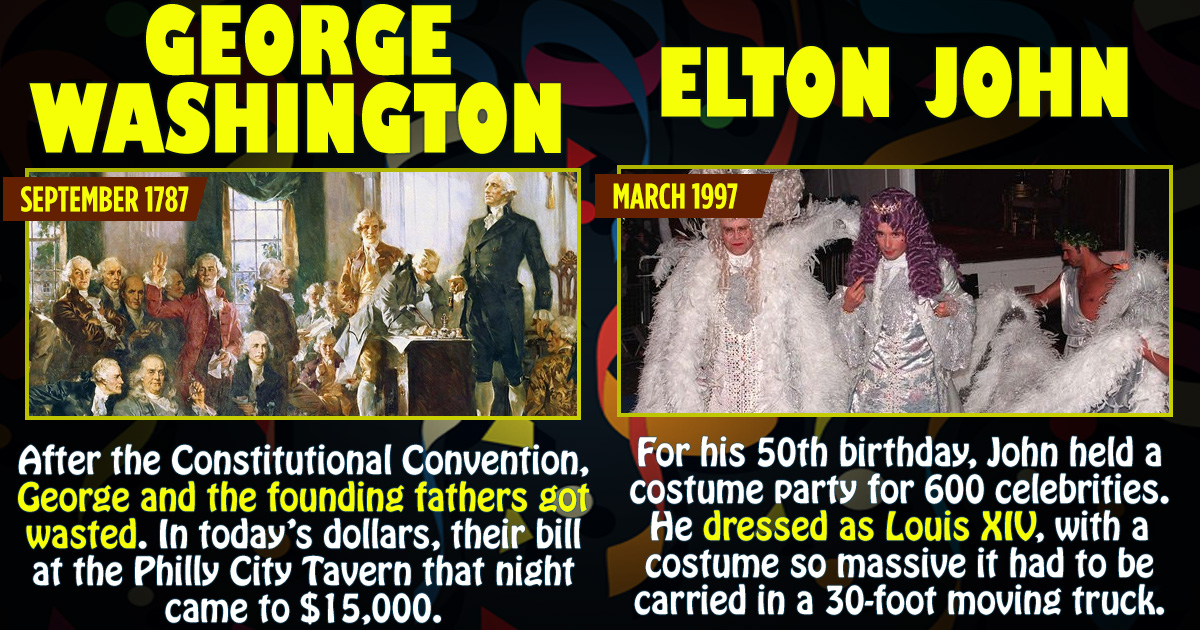
In September 1787, after the Constitutional Convention, George Washington was honored at a farewell dinner at Philadelphia’s City Tavern. The surviving bill has become famous because the gathering was not exactly modest. For roughly 55 attendees, the record listed large amounts of wine, porter, cider, beer, and punch. In other words, the Founding Fathers did not draft the Constitution and then celebrate with lukewarm lemonade and a polite handshake.
The event matters because it shows that political history was also social history. Deals, friendships, rivalries, and reputations were built at tables. Washington’s dinner was less a wild modern party than a grand 18th-century ritual of respect, status, and hospitality. Still, the tab has made generations of readers raise one eyebrow and whisper, “That is a lot of colonial enthusiasm.”
2. Andrew Jackson Turned the White House Into a Cheese Scene
President Andrew Jackson’s 1837 open house featured one of the most bizarre party favors in American history: a 1,400-pound block of cheese. The cheese had been aging in the White House, and Jackson eventually invited the public to help eat it. The crowd did exactly that, carving into the giant dairy monument until it was gone.
Was it refined? Not exactly. Was it memorable? Absolutely. Reports describe the cheese disappearing quickly while its smell lingered far longer than any host would prefer. In the long history of famous parties, Jackson’s cheese reception proves that you do not always need a celebrity DJ. Sometimes you just need democracy, open doors, and enough cheddar to frighten a lactose-intolerant ghost.
3. Alva Vanderbilt Used a Costume Ball as Social Strategy
In 1883, Alva Vanderbilt hosted a costume ball in New York that became one of the defining events of the Gilded Age. The party was not merely entertainment; it was a social chess move. The Vanderbilts were fabulously wealthy but still fighting for acceptance among New York’s old-money elite. Alva understood that a dazzling invitation could sometimes do what money alone could not.
The ball featured elaborate costumes, dramatic decorations, and a guest list that helped cement the Vanderbilt family’s place in high society. It was a masterclass in branding before anyone used the word “branding” outside of livestock. Today, the Vanderbilt Ball is remembered as one of the most famous parties in American social history because it turned velvet, feathers, and ambition into a power move.
4. C.K.G. Billings Served Dinner on Horseback
In 1903, millionaire horse enthusiast C.K.G. Billings hosted a dinner at Sherry’s in New York where guests ate while seated on horses. Yes, actual horses. The ballroom was transformed to suit the equestrian theme, and servers reportedly attended to guests in a setting that looked like a luxury restaurant had collided with a stable and decided to keep the reservation.
The horseback dinner is one of those Gilded Age stories that sounds like satire but is historically real. It captured the era’s appetite for spectacle and competitive extravagance. If today’s hosts worry about whether the playlist is too loud, Billings worried about whether the horses would tolerate fine dining. That is not party planning; that is logistical gymnastics in a tuxedo.
5. Marilyn Monroe Turned a Birthday Gala Into Pop-Culture History
On May 19, 1962, Marilyn Monroe performed “Happy Birthday” for President John F. Kennedy at Madison Square Garden during a Democratic Party fundraiser. The event was already star-studded, but Monroe’s appearance turned it into one of the most famous birthday moments in American history.
The performance became legendary because it mixed politics, celebrity, glamour, and television-era intimacy. It was not a party in the backyard sense. It was a massive public gala with thousands in attendance, yet one performance made it feel like the entire room leaned forward at the same time. In the history of famous people partying, Monroe proved that sometimes the most unforgettable party trick is not excessit is timing, presence, and a microphone.
6. Truman Capote’s Black and White Ball Became “The Party of the Century”
Truman Capote’s 1966 Black and White Ball at the Plaza Hotel is still one of the most studied celebrity parties ever thrown. Hosted in honor of Washington Post publisher Katharine Graham, the masked ball gathered writers, actors, socialites, politicians, and cultural power brokers under one black-and-white dress code.
Capote understood suspense. The guest list itself became a social drama, with people desperate to know whether they had been invited. The masks made the event theatrical, but the real show was the mixing of America’s cultural tribes: old society, new media, Hollywood, literature, and politics. Capote did not just host a party. He staged a social portrait of 1960s power, then let everyone dance inside it.
7. Andy Warhol Made The Factory a Party-Lab for Pop Culture
Andy Warhol’s Factory in New York was not a traditional party venue, but it became one of the most famous creative hangouts of the 1960s. Artists, musicians, actors, writers, and Warhol “superstars” passed through its silver-coated world. It functioned as a studio, clubhouse, performance space, and social experiment.
The Factory’s importance lies in how it blurred work and nightlife. People did not simply attend; they became part of the art machine. Warhol’s orbit helped shape modern celebrity culture, where being seen, photographed, and discussed could become part of the creative product. The Factory was not always glamorous, and it had its darker side, but as a cultural party feat, it changed how fame looked.
8. Bianca Jagger’s Studio 54 Horse Moment Became Disco Mythology
Few celebrity party images are as famous as Bianca Jagger on a white horse at Studio 54 in 1977. The popular myth says she rode into the nightclub on horseback. Jagger later clarified that she did not enter the club that way; she got on the horse inside during the celebration. The correction matters, but so does the myth’s staying power.
Why did the image stick? Because it captured Studio 54’s fantasy in one frame: glamour, absurdity, fashion, celebrity, and a sense that normal rules had been checked at the door. The truth is less cartoonish than the rumor, but still iconic. Most birthday parties have cake. Bianca Jagger’s had a horse moment that disco historians are still brushing glitter off decades later.
9. Studio 54 Turned Nightlife Into Theater
Opened by Steve Rubell and Ian Schrager in 1977, Studio 54 became the nightclub most associated with 1970s celebrity partying. Its guest list included artists, actors, designers, musicians, socialites, and regular people who managed to pass the famously selective door. Andy Warhol’s line about the club being a dictatorship at the door and a democracy on the dance floor still explains its appeal.
Studio 54’s most epic feat was not one single night; it was the creation of a nightlife mythology. The club made entrance itself part of the drama. Its parties used theatrical sets, dramatic lighting, and celebrity appearances to make every evening feel like a scene from a movie that nobody had finished writing. It also became a cautionary symbol of excess, proving that a party can define an era and still come with consequences.
10. Malcolm Forbes Flew the Jet Set to Morocco
Publisher Malcolm Forbes celebrated his 70th birthday in 1989 with a lavish party in Tangier, Morocco. The guest list reportedly included business leaders, entertainers, social figures, and Elizabeth Taylor, who was closely associated with Forbes at the time. The setting alone made the event feel like a movie: palace grounds, music, formal arrivals, and a level of grandeur that belonged to the late-1980s language of wealth.
Forbes’s party became famous because it reflected an era when billionaires and media power players treated celebrations as global statements. It was not only a birthday; it was a press event, a society summit, and a postcard from the top of the money mountain. Whether one sees it as glamorous or excessive, it remains a landmark in celebrity party history.
11. Elton John Turned an Oscar Party Into a Philanthropy Machine
Elton John’s Academy Awards Viewing Party began in the early 1990s and became one of Hollywood’s most important annual charity events. Hosted for the Elton John AIDS Foundation, the party combines celebrity glamour with fundraising, auctions, performances, and a serious mission.
This is one of the best examples of a famous person using party power for more than photographs. The event proves that celebrity gatherings can become engines for awareness and public good. The gowns, cameras, and famous guests help attract attention, but the purpose gives the party its staying power. In a world full of forgettable red carpets, Elton John built one with a conscience.
12. Paris Hilton Made Her 21st Birthday a Global Party Tour
In 2002, Paris Hilton celebrated her 21st birthday with a series of parties across multiple cities. The celebrations helped define early-2000s celebrity culture, when paparazzi, nightlife, fashion, and tabloid attention merged into one giant flashbulb.
Hilton’s party feat was not just the scale; it was the media effect. Her birthday became part of a new celebrity economy where being visible could be a career strategy. The famous silver birthday dress became a fashion reference point years later, copied, reinterpreted, and remembered. In retrospect, the global birthday tour looks less like random extravagance and more like an early influencer-era blueprintminus the ring light.
13. Taylor Swift Made Fourth of July Parties Look Like Pop Branding
Taylor Swift’s Fourth of July gatherings at her Rhode Island home became famous during the 2010s for their celebrity guest lists, coordinated photos, beach-house setting, and all-American visuals. Friends from music, fashion, film, and modeling appeared in images that quickly spread online.
What made these parties epic was not old-school extravagance but modern shareability. Swift’s gatherings looked friendly, curated, and instantly recognizable. They showed how celebrity parties changed in the social media age: the guest list still mattered, but the image mattered just as much. A pool float, a group photo, and a patriotic color palette could become entertainment news before anyone had finished drying off.
14. The Met Gala Became the World’s Most Famous Costume Party
The Met Gala began as a fundraiser for the Metropolitan Museum of Art’s Costume Institute and evolved into fashion’s most watched annual party. Eleanor Lambert helped launch the event, Diana Vreeland helped turn it into a grander fashion spectacle, and Anna Wintour later shaped its modern celebrity power.
The Met Gala is epic because it made dressing up the main event. Guests are not merely attendees; they are walking interpretations of a theme. Some looks become masterpieces. Some become memes before midnight. Either way, the party dominates conversation because it turns fashion, celebrity, museum fundraising, and performance into one tightly controlled cultural circuswith better tailoring than most circuses, thankfully.
15. Dennis Rodman’s Vegas Break Became Sports-Nightlife Folklore
During the Chicago Bulls’ 1997–98 season, Dennis Rodman received permission for a short Las Vegas break that became one of the most talked-about stories from the Bulls dynasty era. The episode later gained renewed attention through documentaries and sports coverage, partly because it showed the unusual balance between Rodman’s off-court personality and his elite on-court value.
This party story is best understood as a cautionary sports legend, not a model to copy. Rodman was a uniquely gifted athlete in a highly controlled professional environment, surrounded by coaches and teammates who knew both his brilliance and his volatility. The reason people still discuss the Vegas trip is not simply that it was wild; it is that Rodman returned to perform at an extraordinary level. Most people cannot disappear for a dramatic getaway and then rebound like a Hall of Famer. Most people would just have unread emails and a headache.
What These Famous Parties Reveal About Celebrity Culture
Looking across these 15 legendary parties, a pattern appears. The parties that last in public memory are rarely remembered only because they were expensive. They survive because they represented something bigger. Capote’s ball represented social power. Studio 54 represented disco-era freedom and excess. The Met Gala represents fashion as performance. Taylor Swift’s Fourth of July parties represented the Instagram-ready celebrity friendship era. Andrew Jackson’s cheese reception represented public access in the strangest possible dairy format.
Another pattern is that great party stories often depend on one unforgettable image. Bianca Jagger on a horse. Marilyn Monroe at the microphone. Alva Vanderbilt’s costumed guests. C.K.G. Billings’s diners seated on horseback. These details operate like cultural shortcuts. You do not need to know every guest or menu item. One vivid image carries the entire legend.
There is also a lesson about mythmaking. Some party stories become exaggerated over time, and the exaggeration can become almost as famous as the truth. That is why it matters to separate fact from folklore. Bianca Jagger’s Studio 54 horse moment is iconic, but the “rode into the club” version is not accurate. Celebrity history often behaves like a group chat: the story gets forwarded, decorated, and suddenly the horse has its own entrance music.
Finally, many of these parties show that fame changes the meaning of celebration. For ordinary people, a party is usually private. For celebrities, it can become public theater, brand management, charity fundraising, social climbing, artistic experimentation, or media strategy. A good party ends when the lights come on. A legendary celebrity party ends when historians, gossip writers, museums, and documentaries finally stop arguing about itwhich may be never.
Experience Notes: What Modern Hosts Can Learn Without Copying the Chaos
The best experience related to these famous parties is not “spend a fortune” or “invite a horse.” Please do not invite a horse unless the horse has better legal representation than you do. The practical lesson is that memorable gatherings usually have a clear identity. Capote had black and white masks. The Met Gala has themes. Taylor Swift’s Fourth of July parties had a recognizable visual mood. Even Andrew Jackson’s event had a concept, although that concept was essentially “citizens versus giant cheese.” A strong theme helps guests understand the tone before they arrive.
Another experience-based lesson is that the guest mix matters more than the guest count. Capote’s genius was not simply inviting famous people; it was combining people from different worlds. Writers met politicians. Hollywood met publishing. Socialites met artists. The most enjoyable gatherings often have that same cross-pollination. A room full of identical conversations can feel flat, even if the decorations are perfect. A room where people are curious about one another feels alive.
Comfort also matters. The wildest historical parties still depended on planning: entrances, seating, food, timing, music, and flow. A party can look spontaneous while being carefully engineered behind the scenes. Hosts who want guests to relax should think about simple human needs first. Is there enough space to move? Is the music too loud for conversation? Is there food people can actually eat? Can guests leave easily and safely? Glamour is nice, but nobody remembers the centerpiece fondly if they spent two hours trapped behind a chair.
The stories above also show the power of one signature moment. For a normal gathering, that does not mean renting a ballroom or creating a press strategy. It can be a shared playlist, a funny dress code, a homemade dessert, a group photo wall, a trivia game, or a small tradition guests look forward to each year. The point is to create a memory hook. People remember how an event made them feel, but they retell it through details.
Most importantly, the responsible version of “epic” is not excess; it is connection. Some famous parties became cautionary tales because the spectacle overshadowed the people. The best gatherings leave guests feeling included, respected, and safe. That may sound less dramatic than Studio 54, but it ages better. Glitter gets vacuumed. Cheese smells fade eventually. A good memory lasts because everyone got home with their dignity, their friendships, and hopefully both shoes.
Conclusion
Famous people have turned parties into art projects, power moves, charity engines, fashion runways, political rituals, and historical punchlines. The 15 epic feats above prove that a legendary party is rarely just about luxury. It is about timing, symbolism, storytelling, and the one unforgettable detail that makes people say, “Wait, that really happened?”
From George Washington’s farewell dinner to Truman Capote’s masked masterpiece, from Studio 54 mythology to the Met Gala’s modern fashion theater, these parties reveal how celebration can become culture. Some were elegant, some were excessive, and some smelled strongly of cheese. Together, they show that the most famous parties are not always the ones with the biggest budgets. They are the ones that give history something irresistible to repeat.