For years, bonds had a reputation as the boring adult in the investment room: dependable, polite, and unlikely to start drama at dinner. Then interest rates rose, and suddenly bond investors were checking their account balances with the same expression people reserve for surprise plumbing bills. If you have ever wondered why a “safe” bond portfolio can still post ugly short-term numbers, you are asking exactly the right question.
Understanding bond returns and rising interest rates is less about memorizing Wall Street jargon and more about knowing how bond prices, yields, maturity, and duration interact. Once those pieces click, the bond market stops looking mysterious and starts looking mathematical. Not fun-fair mathematical, perhaps, but still useful.
This guide breaks down what rising rates do to bond returns, why some bonds get bruised more than others, and how investors can respond without panic-selling at the financial equivalent of the worst possible moment.
Why Bonds and Interest Rates Move in Opposite Directions
At the center of the story is one of fixed income’s most important rules: when interest rates rise, existing bond prices usually fall. When rates fall, existing bond prices usually rise.
Why? Because new bonds are issued at current market rates. If new bonds are suddenly paying more interest, older bonds with lower coupons become less attractive. To compete, the price of those older bonds has to drop until their effective return looks more appealing to buyers.
Imagine you own a bond paying 3%. Then newer bonds hit the market paying 5%. Your 3% bond is no longer the prom king. To sell it, you may need to offer it at a discount. That lower market price is how the bond’s yield adjusts upward.
So when people talk about “bond losses” during a rising-rate environment, they are usually talking about price declines in the secondary market, not necessarily a failure of the issuer to pay. That distinction matters more than most investors realize.
What Bond Returns Actually Mean
Many investors hear the word “return” and think only about the interest payment. Bonds, however, can generate return from several moving parts at once.
1. Coupon Income
This is the regular interest payment a bond makes. It is the most obvious part of bond investing and the reason many people buy bonds in the first place.
2. Price Change
If bond prices rise or fall after you buy, that changes your total return. Rising rates can drag prices down. Falling rates can lift them up.
3. Reinvestment Income
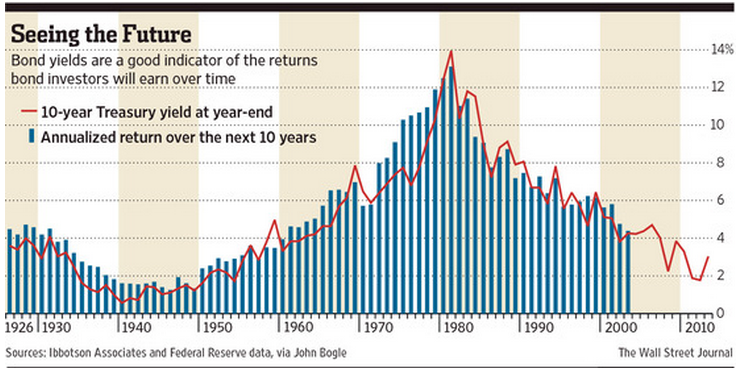
If you reinvest coupon payments, the rate you earn on those reinvested dollars affects your overall return too. This is why rising rates can hurt first and help later: prices may fall now, but future coupon payments may be reinvested at higher yields.
4. Return of Principal at Maturity
If you hold an individual bond to maturity and the issuer does not default, you generally receive your face value back. That can soften the emotional blow of watching market prices wobble along the way.
In other words, bond returns are not just about what happens this week on your statement. They are about the full life cycle of the investment.
Why Rising Rates Can Hurt in the Short Term but Help in the Long Term
This is where bond investing becomes wonderfully annoying: rising rates can be bad news and good news at the same time.
In the short term, higher rates tend to push down the market value of existing bonds. That is the painful part investors notice first. A bond fund that looked calm and sensible last year may suddenly behave like it found espresso.
Over the longer term, however, higher rates can improve future return potential. New bonds are issued with better yields. Matured bonds can be replaced with higher-paying ones. Coupon income can be reinvested at more attractive rates. So while rising rates may sting upfront, they can plant the seeds for stronger forward returns.
That is why many disciplined fixed-income investors do not automatically view higher rates as a disaster. Sometimes they are simply the uncomfortable price of setting up better future income.
Duration: The Secret Decoder Ring for Rate Risk
If there is one concept that helps explain how bonds behave when rates rise, it is duration. Duration estimates how sensitive a bond or bond fund is to changes in interest rates.
As a rule of thumb, if a bond fund has a duration of 7 years, a 1 percentage-point rise in rates could translate into roughly a 7% decline in price. That is an estimate, not a prophecy carved into marble, but it is a useful guide.
Duration usually rises when bonds have longer maturities and lower coupons. That means long-term bonds tend to be more vulnerable when rates move higher. Short-term bonds, by contrast, generally have lower duration and smaller price swings.
Think of duration as the bond market’s version of spice tolerance. Some portfolios can handle a hot rate environment with only mild discomfort. Others take one whiff of a yield increase and immediately regret every life choice.
Maturity Matters More Than Many Investors Expect
Bonds are often grouped by maturity:
- Short-term bonds mature in a few years or less and are generally less sensitive to rate increases.
- Intermediate-term bonds offer a middle ground between income and interest-rate risk.
- Long-term bonds often pay more yield, but they also face larger price declines when rates rise.
This is why two bond portfolios can both be “bond investments” and still behave very differently. A short-term Treasury strategy and a long-term corporate bond fund are not close cousins. They are more like distant relatives who show up to the same reunion wearing very different shoes.
Individual Bonds vs. Bond Funds in a Rising-Rate World
One of the biggest misunderstandings in fixed income is assuming individual bonds and bond funds behave the same way. They do not.
Individual Bonds
If you buy an individual bond and hold it to maturity, the daily market price changes may matter less, assuming the issuer remains financially sound. You still collect coupon payments, and you typically receive principal at maturity.
That does not mean individual bonds are risk-free. Credit risk, default risk, inflation risk, and opportunity cost all still exist. But you do have a clearer maturity date and a more visible path back to face value.
Bond Funds
Bond funds do not mature the way individual bonds do. They are ongoing portfolios. As a result, their net asset values rise and fall with the market, and there is no single maturity date where the entire fund snaps back to par like a movie ending.
On the flip side, bond funds offer diversification, professional management, and easier access for many investors. They can still be very useful. Investors just need to understand that rate pain in a bond fund may linger differently than rate pain in a single bond held to maturity.
Credit Risk Does Not Take a Vacation Just Because Rates Are Rising
When investors focus heavily on interest rates, they sometimes forget that bond returns also depend on the issuer’s financial strength. A Treasury bond and a lower-rated corporate bond can react very differently, even in the same rate environment.
Higher-quality bonds, such as U.S. Treasuries and many investment-grade bonds, typically have lower default risk. Lower-quality or high-yield bonds may offer higher income, but that extra yield is compensation for extra credit risk.
In a strong economy, some lower-quality bonds can hold up reasonably well because corporate fundamentals improve. In a slowing economy, however, credit concerns can pile onto rate pressures and create a double headache. Investors chasing yield without understanding credit quality can end up learning expensive lessons.
Inflation: The Uninvited Guest at the Bond Party
Rising interest rates are often tied to inflation concerns. When inflation runs hot, investors demand higher yields to compensate for the loss of purchasing power. That pushes borrowing costs up and bond prices down.
Even when a bond keeps paying exactly what it promised, inflation can reduce the real value of those payments. Getting 4% income feels a lot less thrilling if the cost of living is sprinting ahead at nearly the same pace.
That is why inflation-protected securities, such as TIPS, can attract attention when inflation risk is elevated. Their principal adjusts with inflation, which can help preserve purchasing power better than conventional fixed-rate bonds. They are not magic, but they are one of the more practical tools in the bond toolbox.
How to Think About Bond Strategy When Rates Are Rising
There is no single perfect response to rising rates, but there are several practical ways investors can reduce regret.
Keep Duration Reasonable
If you are worried about rising rates, reducing overall duration may help limit price sensitivity. Shorter-term bonds and short-duration funds usually take smaller hits than long-duration holdings.
Use a Bond Ladder
A bond ladder spreads maturities across different years. As each bond matures, you can reinvest at current rates. In a rising-rate environment, that can be especially helpful because it allows your portfolio to refresh gradually into higher yields instead of locking everything in at one moment.
Diversify by Sector and Maturity
Owning a mix of Treasuries, municipal bonds, investment-grade corporate bonds, or inflation-protected securities can help reduce the risk of putting all your fixed-income eggs in one basket. No basket enjoys being overburdened.
Do Not Chase Yield Blindly
A very high yield can be a signal of higher risk, not a gift from the universe. Always ask what you are being paid for: duration risk, credit risk, liquidity risk, call risk, or some spicy combination of all four.
Match Bonds to Your Goal
If you need reliable cash flow in the next few years, shorter maturities may make sense. If you are building long-term diversification inside a broader portfolio, intermediate exposure might fit better. The right bond strategy depends less on headlines and more on timeline.
A Simple Example of Bond Returns in a Rising-Rate Environment
Suppose you buy a $1,000 bond with a 3% coupon. That means it pays $30 per year in interest. Soon after you buy it, similar new bonds are issued at 5%.
Your bond still pays only $30 annually, so buyers will not pay full price for it unless the price drops enough to make its yield competitive. Maybe it falls to around $900 or so, depending on maturity and market conditions. Congratulations: your bond did nothing wrong, yet it still got marked down by the market.
Now imagine you ignore the temporary price decline and hold the bond to maturity. If the issuer remains sound, you continue collecting your coupon and eventually receive the full $1,000 principal back. Your temporary market loss may never become a permanent loss.
That is why context matters. A trader, a bond fund investor, and a buy-and-hold investor can all look at the same rate move and experience it very differently.
Common Mistakes Investors Make
Panic-Selling After Prices Fall
Selling just because bond prices dropped can lock in losses at exactly the wrong time. Sometimes the better question is whether the investment still fits your objective.
Ignoring Total Return
Some investors focus only on income and forget that price changes matter too. Others focus only on short-term price drops and forget that higher yields can improve future returns. Total return requires both sides of the equation.
Confusing “Safe” With “Stable Every Day”
Bonds are often less volatile than stocks, but that does not mean they move in a perfectly straight line. A conservative investment can still produce uncomfortable periods.
Taking Too Much Credit Risk for Extra Yield
When rates rise, investors may be tempted by riskier bonds that promise fatter yields. But higher yield is not free money. It is usually payment for added uncertainty.
The Bottom Line on Bond Returns and Rising Interest Rates
Rising interest rates can hurt bond prices, especially for long-duration holdings. That is the headline. But the full story is more nuanced. Higher rates can also improve future income, create better reinvestment opportunities, and reset return expectations to more attractive levels.
The key is to understand what you own, why you own it, and how rate risk fits your timeline. For short-term needs, lower duration may be your friend. For long-term investors, temporary price declines may be less scary than they look on a monthly statement. For everyone, matching bond choices to actual goals matters far more than trying to outguess every twist in interest rate policy.
So yes, rising rates can make bond investing feel less like a nap and more like a brisk uphill walk. But with the right expectations, a little duration awareness, and a refusal to panic at every yield jump, bonds can still play a valuable role in a portfolio.
Experiences Related to Bond Returns and Rising Interest Rates
One of the most common real-world experiences investors describe during a rising-rate period is simple disbelief. Many people buy bonds or bond funds expecting them to be the calm corner of a portfolio. Then rates rise, account values dip, and the first reaction is often, “Wait, I thought bonds were supposed to be stable.” That moment of surprise is not unusual. It happens because investors often understand bond income but underestimate bond price sensitivity.
Retirees, in particular, often feel this tension sharply. Someone who relies on fixed income for living expenses may see a long-term bond fund decline and feel tempted to bail out. But investors who stayed focused on their income needs rather than daily prices often found that the story improved with time. As older, lower-yield bonds rolled off and proceeds were reinvested into higher-yielding securities, portfolio income started to look healthier again. It was not instant relief, but it was a meaningful shift.
Another common experience comes from investors who built bond ladders before or during a rate upswing. Instead of putting all their money into one maturity, they spread their bonds over several years. When rates moved higher, the maturing bonds could be reinvested at better yields. Investors using this approach often describe it as emotionally easier than holding one large position with a single maturity date. A ladder did not eliminate price risk, but it made the rising-rate environment feel more manageable and less dramatic.
There are also lessons from people who reached for extra yield too aggressively. Some investors moved into lower-quality bonds thinking the additional income would offset rate risk. In some cases, that worked for a while. In others, economic uncertainty widened credit spreads and created additional losses. Their experience highlights an important truth: not all bond pain comes from interest rates alone. Credit quality still matters, and sometimes it matters a lot.
On the more positive side, newer investors entering the bond market during a higher-rate era often reported a very different experience from those who bought when yields were near historic lows. Instead of feeling stuck with modest coupons, they could buy Treasuries, certificates of deposit, or high-quality corporate bonds at yields that actually looked competitive. For them, rising rates were less of a market shock and more of an opportunity to lock in stronger income.
Perhaps the most useful shared experience is this: investors who knew their purpose usually handled volatility better. Those who owned bonds for near-term spending, diversification, tax efficiency, or inflation protection could make clearer decisions. Those who bought bonds vaguely, because “you’re supposed to have some,” were more likely to feel confused when rates jumped. In fixed income, clarity of purpose is not just helpful. It is often the difference between patience and panic.