Christmas in the ’90s had a very specific glow. It was not the polished, algorithm-approved holiday we scroll through today. It was grainy, loud, slightly chaotic, and usually documented by a disposable camera with a flash so powerful it could make Grandma’s fruitcake look radioactive. The decade gave us mall Santas, Sears Wish Books, Toys “R” Us wish lists, VHS movie nights, inflatable lawn decorations, plastic tinsel, and enough battery-powered toys to bankrupt a family before breakfast.
For anyone who grew up in that era, ’90s Christmas nostalgia is not just about presents under the tree. It is about circling toys in a catalog with a ballpoint pen, waiting for your favorite holiday special to air on TV, renting Home Alone from Blockbuster, and hoping your Tamagotchi did not die during Christmas dinner. These were the days when a great Christmas morning photo usually included pajamas, shaggy carpet, wrapping paper everywhere, and one parent holding a camcorder like they were filming a moon landing.
Below are 50 picture-perfect scenes that capture what Christmas was like in the ’90smessy, magical, commercial, cozy, and unforgettable.
Why ’90s Christmas Photos Still Hit So Hard
The 1990s sat between two worlds. Families still mailed paper Christmas cards, recorded memories on VHS tapes, and shopped in malls, but the internet was beginning to sneak into daily life. By the end of the decade, AOL, e-cards, early online shopping, and Pokémon websites were starting to appear beside catalogs, landlines, and Saturday morning cartoons.
That overlap is what makes 1990s Christmas memories so rich. A single holiday photo might show a Nintendo 64 box, a stack of VHS tapes, a fake pine tree, handmade ornaments, and a kid wearing a sweatshirt with a cartoon character nobody has thought about in 25 years. It was analog childhood with just enough digital sparkle to feel futuristic.
50 Pictures That Capture Christmas in the ’90s
1. The Sears Wish Book covered in circles
A true ’90s Christmas began when the holiday catalog arrived. Kids flipped straight to the toy section and circled everything from Barbie Dreamhouses to race-car sets. The catalog was not reading material; it was a legal document submitted to Santa for review.
2. The Toys “R” Us Big Toy Book on the kitchen table
The Big Toy Book was basically the Super Bowl program for children. Every page looked like a treasure map, especially the video game and action figure sections.
3. A mall Santa photo with a suspiciously shiny beard
Nothing says ’90s Christmas like a child in velvet overalls sitting nervously beside a mall Santa while fake snow and oversized candy canes fill the background.
4. A Christmas tree wrapped in chunky multicolored lights
Before soft white minimalism took over, trees glowed in red, blue, green, orange, and purple. The lights were big, warm, and occasionally one bulb could take down the whole strand like a tiny electrical villain.
5. Tinsel everywhere, including places tinsel should not be
The ’90s tree did not believe in restraint. Tinsel went on branches, carpet, pets, sweaters, and somehow inside the heating vent.
6. A Blockbuster bag beside a bowl of popcorn
Holiday entertainment often meant renting Home Alone, The Santa Clause, or The Muppet Christmas Carol. If the movie was already checked out, the family had to compromise, which is how many people accidentally watched something weird and called it tradition.
7. A VHS tape labeled “Christmas 1994”
The handwritten label was part of the charm. Inside: shaky footage, children yelling, someone asking if the camcorder was recording, and 12 minutes of the carpet.
8. A kid opening a Super Nintendo or Sega Genesis game
Video games were premium Christmas gold. A rectangular game box under the tree could cause more excitement than a pony, especially if it involved Mario, Sonic, Mortal Kombat, or Donkey Kong.
9. The Nintendo 64 box in 1996
When the Nintendo 64 arrived, Christmas morning suddenly had 3D graphics, four controller ports, and siblings arguing over who got to be Mario first.
10. A Game Boy with fresh batteries
A Game Boy photo is pure ’90s energy: greenish screen, gray buttons, and a child hunched over like they were decoding government secrets.
11. Pokémon cards spread across the living room floor
By the late ’90s, Pokémon became a holiday obsession. Packs of trading cards, Game Boy games, and Pikachu merchandise filled stockings across America.
12. A Tickle Me Elmo hidden behind the tree
The 1996 Tickle Me Elmo craze turned a giggling plush toy into a national shopping quest. Parents hunted for it like it was the last artifact in an adventure movie.
13. A Furby blinking from inside a gift box
Furby arrived in 1998 and looked like a fuzzy owl from another planet. It talked, blinked, and made adults wonder whether toys had become too powerful.
14. A Tamagotchi clipped to a backpack
Christmas in the late ’90s often included a tiny digital pet demanding food, attention, and emotional labor. It was festive, adorable, and mildly stressful.
15. Beanie Babies arranged like fine art
Beanie Babies were not just toys; they were “investments,” according to at least one adult who definitely kept the tag protector on.
16. A Lisa Frank stocking stuffer
Rainbow dolphins, neon tigers, glittery unicornsLisa Frank stationery made every stocking look like it had been attacked by happiness.
17. A Christmas morning Power Rangers figure
Mighty Morphin Power Rangers ruled toy aisles in the early and mid-’90s. A Megazord box under the tree could instantly elevate a child’s social status.
18. A Barbie aisle haul
From Holiday Barbie to dream cars and tiny accessories, Barbie gifts were a Christmas staple. Half the morning was opening the box; the other half was freeing Barbie from plastic restraints.
19. American Girl dolls near the tree
For many kids, an American Girl doll was the gift. The books, outfits, furniture, and tiny historical accessories turned Christmas into a miniature museum with better hair.
20. A LEGO set halfway built by lunchtime
LEGO Christmas photos usually show a child concentrating intensely while an uncle “helps” by building the coolest part without permission.
21. A holiday sweater with no irony at all
In the ’90s, Christmas sweaters were sincere. Snowmen, reindeer, bows, bells, and appliqué teddy bears appeared on clothing without a wink.
22. Matching family pajamas in flannel
Flannel pajamas were warm, practical, and perfect for photos where everyone looked half-awake but deeply committed to cocoa.
23. A tray of slice-and-bake cookies
Those sugar cookies with trees or snowmen in the center were a miracle of modern snack science. Were they homemade? Not exactly. Did anyone complain? Absolutely not.
24. A tin of butter cookies that became a sewing kit
The Danish butter cookie tin was everywhere. Children trusted it once, then learned the hard truth: someday, it would contain thread.
25. A holiday punch bowl at a family party
Every family had one mysterious red or green punch that tasted like sherbet, soda, and pure childhood excitement.
26. A fireplace mantel full of cards
Before social media updates, families mailed Christmas cards with school photos, newsletters, and occasionally a paragraph about someone’s new minivan.
27. A handwritten Christmas list on notebook paper
The best lists included brand names, page numbers, and underlined urgency. “Please” appeared often, especially near expensive electronics.
28. A stocking stuffed with candy canes and Lip Smackers
Stockings were small but mighty: candy, gum, tiny toys, gel pens, slap bracelets, and flavored lip balm that smelled better than it worked.
29. A disposable camera flash ruining the perfect photo
Disposable cameras captured Christmas with red eyes, blurry hands, and the timeless mystery of waiting days to see whether any picture turned out.
30. A Polaroid taped to the fridge
Instant photos made holiday memories feel magical. The image developed slowly, and everyone pretended not to shake it while absolutely shaking it.
31. A camcorder dad narrating everything
Many ’90s holiday videos include a parent saying, “Say Merry Christmas!” every 14 seconds. The family historian took the assignment seriously.
32. A TV Guide opened to Christmas specials
Streaming did not exist, so timing mattered. Miss the special, and you had to wait a year. It built character, or at least mild resentment.
33. Nickelodeon holiday episodes on the TV
Rugrats, Hey Arnold!, Rocko’s Modern Life, and other ’90s shows made holiday episodes feel funny, odd, and surprisingly heartfelt.
34. The “All I Want for Christmas Is You” music video on repeat
Mariah Carey’s 1994 holiday hit became one of the defining Christmas songs of the decade. Even then, it sounded like it had arrived with sleigh bells and a lifetime contract.
35. A CD tower full of Christmas albums
Holiday music came from CDs, cassette tapes, and radio stations that slowly transformed into nonstop Christmas machines after Thanksgiving.
36. A boombox playing carols in the kitchen
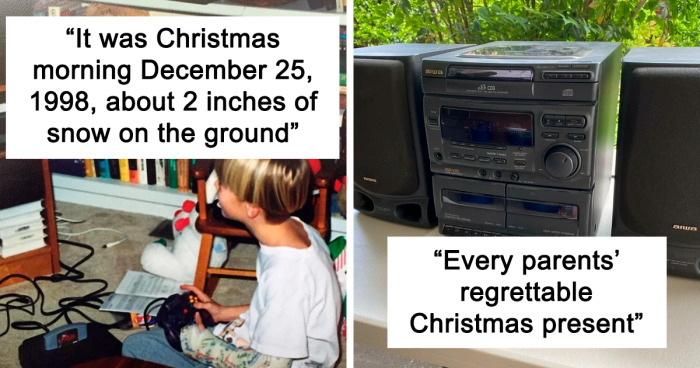
The kitchen boombox was essential technology. It played music while someone baked, wrapped gifts, or yelled, “Do not eat those yet!”
37. A school Christmas concert with paper antlers
Elementary school concerts were peak ’90s pageantry: crooked halos, recorder songs, handmade programs, and parents filming from the back row.
38. A classroom gift exchange
Secret Santa at school meant candy, pencils, stickers, and the tension of whether the $5 limit was a suggestion or a battlefield.
39. A handmade ornament with too much glitter
Craft ornaments were made with popsicle sticks, glue, yarn, and enough glitter to remain in the house until 2007.
40. A Christmas Eve church outfit
Many photos show kids in stiff shoes, velvet dresses, clip-on ties, or sweaters that itched like they were woven from festive cactus.
41. A suburban lawn with plastic reindeer
Before synchronized LED shows became common, lawn decorations were simpler: light-up reindeer, plastic Santas, candy-cane stakes, and one brave extension cord.
42. Icicle lights hanging from the roof
Icicle lights were the height of outdoor decorating sophistication. Every house suddenly looked like it was wearing glowing bangs.
43. A snowman built with mismatched gloves
If there was snow, there was a snowman. If there was not, children still hoped, stared at the sky, and took the weather personally.
44. A crowded mall food court during holiday shopping
Mall Christmas was sensory overload: cinnamon pretzels, perfume counters, toy-store noise, escalators, and parents carrying too many shopping bags.
45. A department store holiday window display
Animated window displays made shopping feel theatrical. Mechanical bears, tiny trains, and glittery fake villages could stop families in their tracks.
46. Wrapping paper tubes turned into swords
After the gifts were opened, the cardboard tubes became the real entertainment. Every living room briefly turned into a low-budget action movie.
47. A giant pile of wrapping paper in the corner
Christmas morning cleanup was a separate event. The wrapping pile was large enough to hide a toddler, a cat, or one missing instruction manual.
48. A family phone call on a corded landline
Holiday greetings often happened on landlines. Someone shouted, “It’s Aunt Linda!” and passed the phone around until the cord became a trap.
49. A computer showing a holiday screensaver
By the late ’90s, family computers brought digital snow, dancing Santas, and the sound of dial-up into the season. The future was slow, noisy, and exciting.
50. A tired kid asleep beside new toys
The most honest ’90s Christmas picture is the finale: a child asleep in pajamas, surrounded by toys, candy wrappers, and evidence of a very successful holiday tornado.
What Made Christmas in the ’90s Feel Different?
The biggest difference was anticipation. Today, nearly everything is instant: wish lists are digital, movies stream on demand, and gifts can arrive within days. In the ’90s, waiting was part of the holiday experience. Kids waited for catalogs, waited for commercials, waited for stores to restock popular toys, waited for holiday specials to air, and waited for film to be developed. That waiting made the season feel bigger.
Shopping also felt more physical. Families went to malls, department stores, toy stores, and video rental shops. You could see what everyone wanted because the aisles told the story: dolls in one section, action figures in another, video games locked behind glass, and parents comparing prices while kids “just happened” to stand near the thing they wanted most.
Entertainment was communal, too. Watching a Christmas movie meant gathering around the television at a specific time or renting a tape for the weekend. Holiday music came from the radio, CDs, and cassettes. Photos were fewer but more meaningful because nobody took 80 versions of the same pose. If someone blinked, congratulations: that was the photo.
Why These 50 Pictures Still Matter
These images matter because they capture more than products or trends. They show how families celebrated before smartphones became the center of memory-making. The ’90s Christmas aesthetic was imperfect, but that is exactly why it feels so warm now. The photos were overexposed. The decorations were excessive. The toys required batteries nobody remembered to buy. The sweaters were questionable. Yet somehow, it all worked.
Christmas in the ’90s was a blend of tradition and pop culture. Classic carols played beside Mariah Carey. Handmade ornaments hung near licensed cartoon decorations. A family might attend church, visit Santa at the mall, eat microwave appetizers, and finish the night watching a movie on VHS. It was not always elegant, but it was alive.
Extra Experience: Growing Up Around a ’90s Christmas Mood
The experience of a ’90s Christmas started weeks before December 25. You could feel it when the first toy commercials appeared during Saturday morning cartoons. Suddenly every commercial break became a research session. Children learned to recognize jingles, product names, and the exact angle at which a toy looked most impressive. A remote-control car could leap over plastic ramps on TV, even if the real one mostly crashed into the couch.
The catalog phase was even more serious. Sitting on the floor with a pen and a thick holiday catalog felt like planning a dream life. You did not simply circle toys; you ranked them, revised them, and sometimes added stars for emotional emphasis. Parents pretended not to notice, but everyone knew the catalog was a negotiation document.
Then came the mall trip. The mall in December felt like its own weather system. Warm air blasted through the entrance, holiday music echoed from every store, and the smell of cinnamon seemed to follow you like a friendly ghost. Kids pressed their faces against toy-store windows while parents whispered about budgets, coupons, and whether the line for Santa was worth it. The food court was packed, the escalators were busy, and every kiosk sold something that looked like a perfect stocking stuffer for exactly three minutes.
At home, the season had its own rhythm. Someone dragged boxes of decorations from the attic or basement. Ornaments came out wrapped in tissue, and every one seemed to have a story. There were school-made decorations with crooked photos, fragile glass balls, plastic candy canes, and at least one ornament nobody liked but everyone kept hanging out of loyalty. The tree did not look professionally styled. It looked like a family history project with lights.
Christmas Eve often felt electric. Kids were told to go to bed early, which was impossible because the entire house seemed to be buzzing. In some homes, the adults wrapped gifts late into the night while watching holiday movies. In others, relatives arrived with casseroles, cookies, and gossip. The refrigerator became a crowded museum of foil-covered dishes. The good plates appeared. Someone forgot ice. Someone else forgot batteries. These details were not interruptions; they were the texture of the holiday.
Christmas morning was controlled chaos. The first child awake became a tiny alarm clock for the entire house. Parents reached for cameras before coffee. Wrapping paper flew. Toys were assembled with tiny screwdrivers. Instruction manuals disappeared immediately. A new video game might take over the television for hours, unless a sibling demanded a turn and peace negotiations began. Breakfast was sometimes cinnamon rolls, sometimes leftovers, and sometimes candy from the stocking because rules were temporarily suspended.
Looking back, what made the ’90s Christmas experience special was not perfection. It was the combination of effort, anticipation, and shared attention. People watched the same movie at the same time. They listened to the same CDs in the car. They saved photos in albums instead of clouds. They remembered which toy was impossible to find and which relative always gave socks. That is why these “pictures” still feel powerful. They remind us of a Christmas that was bright, clumsy, sincere, and wonderfully human.
Conclusion
The 1990s gave Christmas a personality all its own. It was commercial, yes, but also deeply memorable: catalog pages, toy crazes, VHS movies, mall Santas, handmade ornaments, family photos, and living rooms covered in wrapping paper. These 50 pictures perfectly encapsulate what Christmas was like in the ’90s because they capture the details people actually rememberthe glow of the tree, the sound of a new toy, the panic of missing a TV special, and the joy of waking up to a morning that felt bigger than everyday life.
For anyone who lived it, ’90s Christmas nostalgia is more than a retro trend. It is a reminder of a time when the holidays were slower, louder, less curated, and somehow more magical. And honestly, if you still have a VHS tape labeled “Christmas 1997,” protect it like treasure. It probably contains 20 minutes of blurry footage, but it also contains a whole world.
Note: This article is written for web publication and synthesizes real 1990s holiday culture, including toys, films, music, retail traditions, television, photography, and family experiences, without inserting source links or citation placeholders into the HTML.