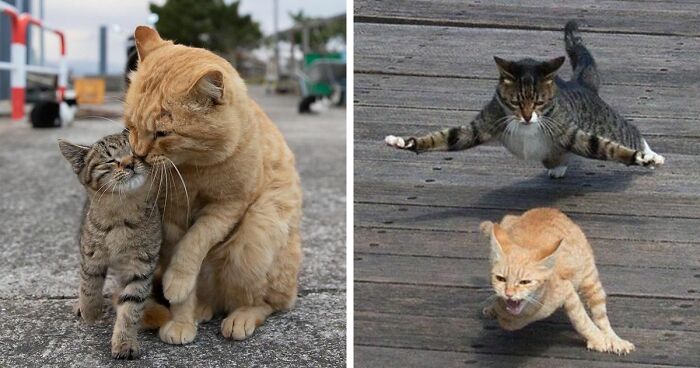
Japanese photographer Masayuki Oki does not merely photograph stray cats. He catches them arguing, stretching, plotting, loafing, flirting, fighting, and occasionally looking as though they have just remembered an embarrassing incident from 2017. His candid images reveal a lively feline society in which every alley has a mayor, every park has a philosopher, and every unattended cardboard box has already been claimed.
Street Cats With Main-Character Energy
A stray cat can cross a sidewalk in three seconds and somehow deliver an entire character arc. One moment, the animal is a silent hunter slipping beneath a bicycle. The next, it is rolling on its back with all the dignity of a dropped sandwich. Capturing that transformation requires patience, sharp reflexes, and a willingness to spend considerable time near ground level.
That is where Japanese cat photographer Masayuki Oki excels. For more than a decade, he has photographed outdoor cats in Tokyo and other parts of Japan, documenting unguarded moments rather than arranging polished pet portraits. His subjects are not brushed, posed, or promised a salmon-flavored performance bonus. They simply continue living while he waits for personality to appear.
Oki became especially well known for photographs of cats making exaggerated faces, wrestling with companions, squeezing through narrow openings, sleeping in ridiculous positions, and reacting to the world with magnificent amounts of attitude. His work has appeared in books and exhibitions and has attracted an international audience that recognizes an important truth: cats are naturally gifted visual comedians.
Why Masayuki Oki’s Cat Photography Feels So Alive
He Works at the Cat’s Level
Many of Oki’s most engaging photographs are taken close to the ground. This perspective removes the usual human advantage and places viewers inside the cat’s world. A curb becomes a stage. A drainpipe becomes a mysterious tunnel. Two paws rising behind a concrete wall suddenly resemble the opening scene of a low-budget feline action movie.
He Waits for Behavior, Not Perfection
Traditional animal portraits often celebrate symmetry, soft lighting, and tidy fur. Oki seems more interested in the second after elegance collapses. He notices a yawn that looks like an operatic solo, a leap that goes slightly sideways, or a tense neighborhood negotiation conducted through flattened ears and very serious staring.
These moments are funny because they are recognizable, but they also reveal genuine behavior. Cats communicate through posture, distance, scent, vocalization, ear position, eye contact, and tail movement. A photograph freezes those signals long enough for viewers to study a conversation that might otherwise pass in an instant.
He Allows Every Cat to Remain an Individual
Outdoor cats are often discussed as a population rather than as individuals. Oki’s work reverses that perspective. Coat color may catch the eye first, but expression, posture, relationships, and habits become the real subject. One cat appears fearless and theatrical. Another is cautious, observant, and prepared to leave before anyone gets emotionally complicated.
40 Unique Stray-Cat Personalities Seen Through Oki’s Lens
The following personality profiles are affectionate editorial interpretations of the candid behaviors frequently found throughout Oki’s work. The cats have not completed personality questionnaires. They were reportedly too busy.
-
1. The Alley Mayor
This confident cat sits in the middle of the neighborhood as though it personally approved every bicycle, vending machine, and recycling schedule. Residents may pass, but all municipal decisions clearly require feline authorization.
-
2. The Suspicious Inspector
Nothing escapes this cat’s review. The camera, the photographer, and the nearby plastic bag are examined with narrowed eyes. Its final report probably contains the phrase “human activity remains questionable.”
-
3. The Sunbeam Monarch
Stretched across warm pavement, this cat has discovered free luxury heating. It occupies the best patch of sunlight with royal confidence and no apparent intention of sharing.
-
4. The Tiny Acrobat
A wall, railing, or narrow pipe is not an obstacle. It is equipment. This cat twists through the air with impressive control, although the expression sometimes suggests that the original plan was slightly different.
-
5. The Neighborhood Gossip
Leaning toward another cat with its mouth open, this character appears to have urgent news. Perhaps a tabby visited the fish shop. Perhaps someone sat in someone else’s cardboard box. Scandal travels quickly.
-
6. The Stoic Samurai
This weathered cat sits perfectly still, eyes focused and body composed. It looks ready to defend the alley, protect the food bowl, or star in a historical drama with an unusually small costume budget.
-
7. The Shameless Food Critic
The meal is inspected, sampled, and silently judged. The cat’s face communicates that today’s menu lacks ambition. Nevertheless, it will finish every bite in the interest of professional fairness.
-
8. The Sleepy Commuter
Curled beside a bicycle or under a bench, this cat looks like someone who missed the morning train and decided employment was an overrated social experiment.
-
9. The Rooftop Philosopher
From an elevated position, this quiet observer studies the street below. Is it contemplating existence, urban development, or the location of lunch? Great thinkers rarely reveal their methods.
-
10. The Drainpipe Explorer
Any hole large enough for whiskers deserves investigation. Only a head or pair of paws may be visible, creating the impression that the city’s drainage system is operated by curious cats.
-
11. The Shadow Boxer
This energetic feline swats at leaves, insects, another tail, or an invisible opponent. The technique is enthusiastic, the footwork is unpredictable, and the championship belt is purely imaginary.
-
12. The Reluctant Romantic
Two cats sit close enough to suggest affection but far enough apart to preserve plausible deniability. One leans in; the other pretends to be deeply interested in a wall.
-
13. The Sidewalk Model
This cat does not walk past the camera. It arrives. Every paw placement feels deliberate, every whisker catches the light, and the tail provides a dramatic finishing flourish.
-
14. The Old Soul
A scarred face or faded coat gives this cat an air of experience. It appears to know where every safe shelter is located and exactly which humans can be trusted.
-
15. The Doorway Bouncer
Stationed beside an entrance, this muscular-looking cat decides who may proceed. There is no guest list, only prolonged eye contact and an uncomfortable sense that your shoes are being evaluated.
-
16. The Curious Rookie
A younger cat approaches the lens cautiously, ears forward and nose working overtime. Fear and fascination compete until curiosity wins by approximately one paw step.
-
17. The Feline Comedian
Caught mid-yawn, mid-sneeze, or mid-lick, this cat produces a face no studio photographer could request. The humor comes from timing rather than humiliation; everyone looks strange between expressions.
-
18. The Territorial Diplomat
Two neighborhood cats conduct negotiations using distance, posture, and hard stares. No one wants a fight, but neither representative is willing to surrender the premium sleeping spot.
-
19. The Silent Observer
Half-hidden behind plants, crates, or parked vehicles, this cat watches without participating. It knows everything occurring on the block and intends to reveal absolutely none of it.
-
20. The Dramatic Yawner
Some cats yawn discreetly. This one appears to swallow the entire afternoon. Teeth, tongue, whiskers, and theatrical commitment combine in a portrait worthy of an opera poster.
-
21. The Bench Potato
Why chase birds when a perfectly good bench exists? This cat has adopted a demanding schedule involving naps, stretches, additional naps, and one brief inspection of nearby snacks.
-
22. The Chaos Intern
This young cat is involved in every disturbance yet responsible for none of them. It climbs the wrong object, bumps into a companion, and leaves before management can ask questions.
-
23. The Gentle Head-Butter
Affection arrives in the form of a careful forehead press against a trusted companion. It is a small gesture, but in a tough outdoor environment, quiet closeness can carry enormous emotional weight.
-
24. The Strategic Beggar
This cat has perfected the look that says it has never eaten before, despite considerable evidence to the contrary. Its performance includes wide eyes, patient sitting, and occasional vocal commentary.
-
25. The Rainy-Day Pessimist
Huddled beneath cover, the cat stares at wet pavement with personal resentment. The weather has clearly violated an agreement, and someone will be receiving a strongly worded complaint.
-
26. The Parkour Specialist
Fences, roofs, concrete blocks, and parked scooters form a continuous obstacle course. The cat moves through it with such confidence that human architecture begins to look poorly designed.
-
27. The Protective Sibling
One cat positions itself near a smaller or more nervous companion. Whether they are related or simply bonded, the protective posture suggests that street-cat relationships can include loyalty and cooperation.
-
28. The Independent Nomad
This solitary traveler appears briefly, surveys the area, and continues onward. It does not seem lonely. It seems booked, busy, and unwilling to explain its itinerary.
-
29. The Instant Celebrity
Some cats notice a camera and retreat. This one moves closer. Its direct gaze suggests it understands publicity and would like to discuss image rights before the next photograph.
-
30. The Grass-Stalk Hunter
A moving blade of grass becomes serious prey. The cat crouches, waits, and launches with total concentration, proving that an epic adventure can occur within three square feet.
-
31. The Suspicious Sweetheart
This cat wants attention but distrusts the delivery system. It approaches, retreats, circles back, and finally allows a brief moment of contact under carefully negotiated terms.
-
32. The Alleyway Diva
The posture is elegant, the expression is unimpressed, and the surroundings are treated as a private dressing room. Even a pile of crates becomes glamorous when occupied with sufficient confidence.
-
33. The Zen Gardener
Sitting among leaves or flowers, this calm cat seems perfectly integrated with the landscape. It may be meditating, resting, or waiting for a beetle to make a career-ending mistake.
-
34. The Neighborhood Boxer
Front paws rise, bodies lean, and a brief sparring match begins. Such encounters can resemble a martial-arts film, especially when Oki freezes both cats during an airborne exchange.
-
35. The Accidental Dancer
A stretch, twist, or playful jump creates a pose that looks carefully choreographed. The cat resembles a modern dancer who refuses to explain the emotional meaning of the performance.
-
36. The Soft-Spoken Survivor
This cautious cat keeps its body low and maintains a safe distance. Its restraint is not a lack of character. It is an intelligent response shaped by experience and changing surroundings.
-
37. The Window Shopper
From outside a store or restaurant, the cat studies the interior with intense professional interest. It may be admiring the décor, although the fish display is probably contributing.
-
38. The Unofficial Crossing Guard
Standing near a road or path, this cat pauses traffic simply by existing. Pedestrians slow down, photographers crouch, and the cat crosses whenever it considers the audience sufficiently attentive.
-
39. The Camera Critic
This subject stares directly into the lens with visible disappointment. The lighting is wrong, the angle is predictable, and the photographer has once again failed to provide refreshments.
-
40. The Unscripted Hero
The final personality is simply the cat being itself: imperfect, alert, playful, vulnerable, and completely unaware that an ordinary second has become a memorable photograph.
Funny Photographs With a Serious Undercurrent
Oki’s pictures are easy to enjoy because the humor is immediate. A cat falling out of a graceful pose needs no translation. Yet the photographs also encourage viewers to look beyond the joke. These animals live outdoors, where food, shelter, medical care, and human tolerance may be inconsistent.
The term “stray cat” is often used casually, but outdoor cats can have very different histories. Some are lost or abandoned pets accustomed to people. Others were born outside and have had little human contact. Animal-welfare organizations often use the broader term “community cats” for unowned cats living outdoors. Their level of socialization can range from friendly to deeply cautious.
That distinction matters when interpreting a photograph. A cat hiding beneath a vehicle may not be “grumpy.” It may be frightened. Flattened ears, a tucked tail, crouching, hissing, and a tense body can signal fear or defensive aggression. A photographer who respects those signals avoids chasing, cornering, touching, or baiting an animal into an unsafe situation.
Humane community-cat programs may include regular feeding, monitoring, veterinary treatment, vaccination, and trap-neuter-return. In a managed TNR program, cats are humanely trapped, sterilized, often vaccinated, identified with an ear tip, and returned to their established outdoor area. The goal is to prevent new litters while allowing caregivers to monitor the existing group.
A Street-Level Experience: Learning to See Cats Instead of Chasing Photos
Anyone attempting street-cat photography quickly discovers that technical skill is only half the assignment. The other half is learning to wait without becoming annoying. A camera does not grant permission to enter an animal’s space, and a long lens is often more useful than a pocket full of ambitious ideas.
The most productive experience begins by walking slowly through an area where cats are already comfortable. Instead of heading directly toward the first animal, pause and observe. Notice where it rests, which paths it uses, whether it interacts with other cats, and how it responds to pedestrians. A relaxed cat may groom, stretch, blink slowly, or lie with a loose body. A worried cat may freeze, crouch, turn its ears backward, or prepare an escape route.
At first, very little may happen. One cat sleeps beneath a shrub. Another disappears behind a wall. A third watches from a distance with the expression of a security officer who has already denied your application. This quiet period can feel unproductive, but it is often when the photographer begins understanding the environment.
After several minutes, patterns emerge. A bold tabby patrols the same curb. Two bonded cats greet each other beside a fence. A younger animal repeatedly attacks a leaf, loses, and immediately requests a rematch. The photograph develops from observation rather than interference.
Lowering the camera changes the experience dramatically. At cat height, common objects become large graphic elements. Bicycle wheels create circular frames. Stairs become cliffs. Drain openings resemble stage entrances. A cat passing through these structures no longer appears small within a human city; it becomes the central character in a feline-sized landscape.
Patience also produces better expressions. Continuously calling to a cat may cause it to stare at the photographer, but every frame then contains the same alert face. Waiting allows the animal to return to grooming, playing, communicating, and exploring. Those unguarded transitions are where personality appears.
There is also value in leaving without a photograph. A cat may be eating, nursing kittens, showing fear, or resting in a place where approaching would block its escape. Respecting that boundary is more important than obtaining an image. Ethical wildlife and street-animal photography depends on a simple principle: the subject’s well-being matters more than the photographer’s collection.
The most memorable reward is not always the funniest shot. Sometimes it is a cautious cat relaxing after realizing it will not be pursued. Sometimes it is watching two outdoor companions share warmth. Sometimes it is recognizing the same individual on another day and noticing a new detail in its routine. The camera becomes less of a trophy-making device and more of a reason to pay careful attention.
That attentiveness explains much of Oki’s appeal. His photographs suggest familiarity with the places and animals he documents. He seems prepared for chaos but does not require it. A blink, a paw, a stretch, or an awkward landing can be enough. The experience is not about forcing cats to perform. It is about being present when they inevitably do something wonderfully catlike.
Conclusion: Forty Cats, Forty Ways to Own the Street
Masayuki Oki’s stray-cat photography transforms brief urban encounters into miniature stories. His cats are athletes, comedians, loners, friends, negotiators, and professional sleepers. Their personalities emerge not because they have been dressed up or directed, but because the photographer gives ordinary behavior enough time and attention to become meaningful.
The pictures invite laughter, but they also encourage empathy. Once viewers recognize an alley cat as an individual with habits, relationships, preferences, and boundaries, it becomes harder to treat outdoor cats as background scenery. Each animal is living a complicated life beyond the edge of the frame.
And that may be the greatest accomplishment of the series. Oki makes people stop scrolling long enough to meet a cat they may never see again. The encounter might last only a second, but the personality is difficult to forget.