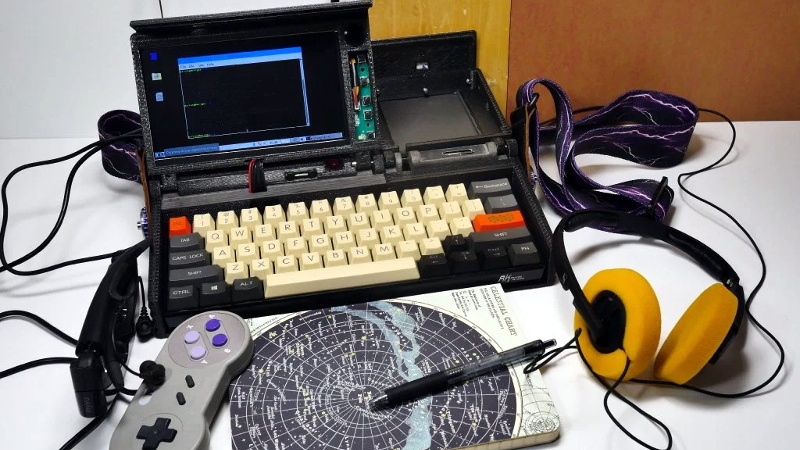
In the world of DIY computers, there are two kinds of builds. The first kind says, “Look what I made.” The second kind says, “Move aside, I actually need to use this thing.” The 3D Printed VirtuScope belongs firmly in the second camp. Yes, it looks like it wandered out of a cyberpunk novel after a long night of scanning radio signals and making poor life choices under neon lights. But unlike many flashy portable computer projects, this Raspberry Pi 4 cyberdeck was designed with a real job in mind.
That job is portability with purpose. The VirtuScope is not just a cool shell wrapped around a single-board computer for aesthetic points. It is a functional mobile rig built around the Raspberry Pi 4, a 7-inch display, a fully 3D-printed enclosure, and wireless tools that make it genuinely useful in the field. In a maker scene full of retro-futuristic props, this project stands out because it treats style as a bonus, not the whole meal.
For anyone interested in Raspberry Pi projects, cyberdeck design, portable Linux computers, or software-defined radio builds, the VirtuScope is the sort of machine that makes you want to clear your workbench, warm up the 3D printer, and pretend you suddenly have important missions. It is practical, replicable, and just dramatic enough to be fun.
What Makes the VirtuScope Different?
The word cyberdeck gets thrown around a lot, usually whenever someone bolts a keyboard and a display onto a compact computer and gives it a vaguely dystopian name. But the VirtuScope earns the label honestly. Its design channels the classic cyberpunk fantasy of a portable computer that feels specialized, personal, and mission-ready. More importantly, it avoids the trap that catches many builds in this category: looking amazing while being miserable to actually use.
The VirtuScope was created as a practical machine rather than a shelf ornament. That matters. Plenty of cyberdeck projects lean heavily on scavenged vintage hardware, which certainly wins points for visual drama, but often makes the build expensive, difficult to reproduce, or oddly precious. Nobody wants to gut an old collectible computer just to end up with an Instagram accessory that can barely survive a coffee shop.
The VirtuScope takes a smarter route. Its enclosure is 3D printed, the parts are approachable, and the geometry is simple enough that makers with ordinary FDM printers can produce most of the body themselves. In other words, this is a cyberdeck that does not act like it is too cool for your workshop. It actually wants to be built.
Why the Raspberry Pi 4 Was the Right Brain for the Job
If earlier Raspberry Pi boards often felt like charming little experiment platforms, the Raspberry Pi 4 was the model that made people stop squinting and say, “Wait, this could be a real computer.” That jump matters to the VirtuScope. A purpose-built portable machine needs enough performance to feel usable, not just technically alive.
The Raspberry Pi 4 brought meaningful improvements that changed the conversation around portable Linux computing. Compared with older Pi boards, it delivered a much stronger desktop experience, better overall speed, USB 3 support, true Gigabit Ethernet, and dual-display capability. Reviews at the time made a similar point from different angles: this was the first Pi that felt genuinely capable of light daily computing instead of merely flirting with the idea.
That is exactly why the Pi 4 makes sense inside the VirtuScope. A cyberdeck with a purpose needs enough horsepower to manage Linux tools, peripheral support, wireless adapters, and specialized software without turning every task into a character-building exercise. The seven-inch screen might not be ideal for writing the next great American novel, but for monitoring signals, running utilities, testing connections, and handling portable workflows, the Pi 4 gives the project credible computing muscle.
A Small Computer That Grew Up
Before the Pi 4, many Raspberry Pi portables felt like experiments with screens attached. After the Pi 4, they started feeling like mobile workstations with personality disorders. That shift is subtle but important. The VirtuScope benefits from a board that can support the fantasy and the function. It looks like a decker’s tool from speculative fiction, but underneath the shell it is powered by hardware that can legitimately pull its weight.
The Real Purpose: A Portable SDR Rig
Here is where the VirtuScope stops being merely cool and starts being interesting. Its purpose is tied to wireless work, specifically as a portable SDR setup. That transforms the whole conversation. A lot of cyberdecks feel like they are waiting for a reason to exist. The VirtuScope already has one.
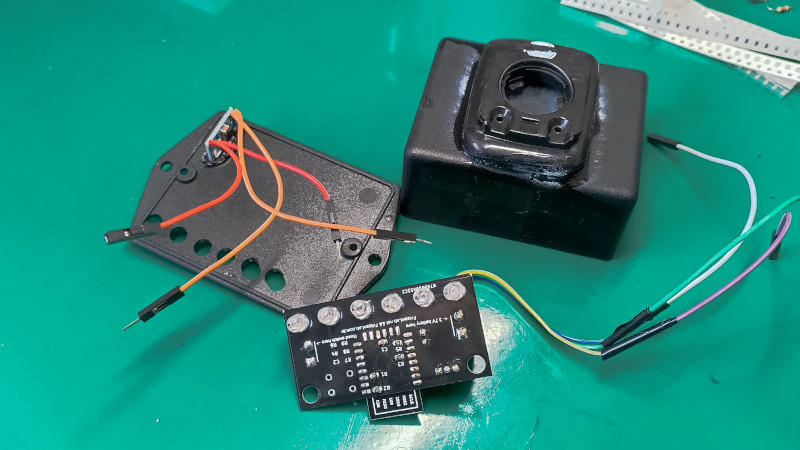
The build includes an internal NooElec SDR with an HF upconverter, along with a long-range Wi-Fi adapter. That combination gives the device a very different vibe from a generic portable Pi. This is not just a Linux machine you carry around because you can. It is a machine you carry because it helps you do something specific: monitor, experiment with, and interact with radio and wireless environments while mobile.
Portable SDR setups are appealing because they let enthusiasts, researchers, and tinkerers take signal analysis into the real world. A Raspberry Pi is especially attractive in that role because it keeps power consumption relatively manageable while offering enough flexibility for specialized tools. When paired with the right radio hardware, antennas, and software, a Pi-based device becomes a compact lab bench you can sling over your shoulder.
That is why the VirtuScope feels grounded. Every design decision starts to make sense once you accept that it is not trying to replace a laptop for everyone. It is trying to be a focused mobile tool. In that role, the smaller screen is less of a compromise and more of a reasonable tradeoff. A machine built for field utility does not need to win a comparison test against a 16-inch ultrabook. It needs to be portable, capable, and ready.
3D Printing Is Not Decoration Here, It Is Strategy
One of the smartest things about the VirtuScope is that 3D printing is used as an engineering solution, not just a styling gimmick. That distinction matters more than it sounds. In many maker projects, the printed shell is basically cosplay armor for electronics. On the VirtuScope, the enclosure is part of the project’s whole philosophy: accessibility, customization, and repeatability.
Because the body is printed rather than hacked out of old hardware, the design avoids the usual bottlenecks of vintage donor builds. You do not have to hunt through auction sites for a sacrificial relic. You do not need to cut apart something that was never meant to be modified. You do not need to explain to your wallet why a “cheap hobby project” somehow required a collector-grade shell from 1987.
The printable enclosure also lowers the barrier for experimentation. Need a different mount, port arrangement, internal payload, or external accessory? Change the model, print a new part, and keep going. That flexibility is one of the greatest strengths of modern maker culture. When you combine a Raspberry Pi with digital fabrication, you get a workflow where the case is no longer a prison. It becomes a living part of the design.
Replicable Beats Precious
Perhaps the most refreshing thing about the VirtuScope is that it feels reproducible. The maker shared STL files, and most of the parts can be produced on common FDM machines with a modest build area, while some finer details benefit from SLA printing. That balance makes the project feel ambitious but not absurd. It is polished enough to be admired and practical enough to inspire copycats, which in the maker world is basically a standing ovation.
Form Factor, Field Use, and the Joy of Specialized Machines
The modern consumer tech market worships the general-purpose device. One phone does everything. One laptop handles work, entertainment, video calls, shopping, and your increasingly embarrassing number of browser tabs. The VirtuScope pushes in the opposite direction. It celebrates the idea that a computer can be better because it is focused.
A purpose-built cyberdeck does not need to be the best all-around computer. It needs to be the best computer for its job. That job might be SDR work, wireless testing, remote monitoring, portable Linux administration, field experimentation, or simply having a machine that feels instantly ready for a certain class of tasks. In that sense, the VirtuScope belongs to a long and lovable lineage of special-purpose computers that trade broad convenience for tactile, intentional utility.
There is also something psychologically satisfying about using a device that tells you what it is for. Open a laptop and you could do anything, which often means you end up doing everything except the thing you meant to do. Open a machine like the VirtuScope and your brain immediately switches modes. This is the radio deck. This is the field tool. This is the “I am here to test, scan, monitor, and maybe look cooler than strictly necessary” machine.
Why Cyberdecks Keep Fascinating Makers
Cyberdecks occupy a strange and wonderful intersection of engineering, storytelling, and personal workflow design. They are not just computers. They are arguments in physical form. Each one says something about what the maker values, whether that is ruggedness, mobility, retro style, modularity, radio capability, or pure keyboard obsession.
The VirtuScope taps into that culture beautifully because it respects the fantasy while staying anchored in utility. It has the silhouette of fiction and the logic of a field instrument. That combination is rare. The best cyberdecks are not gimmicks and not sterile appliances. They feel like tools with personality.
This is also why Raspberry Pi hardware appears so often in cyberdeck builds. It sits in the sweet spot between affordability, openness, community support, and flexibility. Makers can build around it without reinventing every electrical detail from scratch. Add a display, battery solution, keyboard, wireless hardware, and a printed case, and suddenly you are not just assembling parts. You are shaping a computing experience around a use case.
What the VirtuScope Says About the Future of DIY Portable Computing
The most interesting thing about the VirtuScope may be what it predicts. As desktop 3D printing gets better, open hardware stays accessible, and single-board computers remain powerful, more builders are likely to create machines that sit between mainstream laptops and hobby prototypes. These devices will not try to beat MacBooks at being MacBooks. They will do something more exciting: become deeply personal tools optimized for real-world tasks.
That future is already visible in projects that mix 3D-printed enclosures, Raspberry Pi boards, SDR modules, touch displays, custom keyboards, and open-source software. Some are built for field radio work. Some are designed for travel, debugging, satellite reception, or maker education. The common thread is intentionality. The machine is built around a mission.
In that landscape, the VirtuScope looks less like a one-off curiosity and more like an early signpost. It shows what happens when a builder stops asking, “How do I make a cyberdeck?” and starts asking, “What problem should my cyberdeck solve?” That is a much better question. It leads to hardware that earns its existence.
The Experience of a Machine Like the VirtuScope
Spend enough time around ordinary laptops and phones, and they start to feel invisible. Efficient, yes. Useful, absolutely. But invisible. They disappear into routine. A machine like the VirtuScope does the opposite. It announces itself. Not in a loud, attention-seeking way, though it certainly has enough visual flair to raise eyebrows at a meetup. Rather, it changes the emotional experience of computing by making every interaction feel deliberate.
Imagine carrying a portable Raspberry Pi 4 cyberdeck that was clearly built for field use. The handle, the printed shell, the compact screen, the promise of wireless tools tucked inside the body, all of it creates the sense that you are not just opening a generic device. You are deploying equipment. That feeling matters more than many people admit. Specialized hardware can sharpen focus because the object itself frames the task.
There is a tactile pleasure in devices like this that modern consumer electronics rarely offer. A sleek ultrabook is beautiful, but it tends to feel finished, sealed, and politely distant. The VirtuScope feels authored. You can almost read the design process in its body lines and panel choices. You can picture the moments when the maker decided where the display should sit, how the controls should be arranged, how much room to leave for future payloads, and which features deserved internal real estate. It is a computer that still shows its fingerprints, metaphorically speaking, and that gives it character.
Then there is the practical experience. A portable SDR rig or wireless testing machine is exciting precisely because it invites use outside the desk. You are not limited to theory. You can move through environments, compare conditions, test signals, explore hardware behavior, and treat computing as something connected to place. A laptop can do some of this too, of course, but it does not feel purpose-built for the mission. The VirtuScope does. That difference creates a stronger sense of engagement.
Another part of the experience is customization. With a 3D-printed cyberdeck, the case is not sacred. If something annoys you, you can change it. If a mount should be stronger, reprint it. If the port layout needs rethinking, redesign it. If you want to add another radio tool, external connector, or internal component, the project can evolve with you. That makes ownership feel active rather than passive. You are not just using a product. You are living inside a design conversation.
The VirtuScope also delivers a kind of joy that is hard to measure on a spec sheet: the joy of using a weird machine that makes perfect sense once you understand it. To outsiders, it might look like a prop from a science-fiction convention. To the right user, it is a clean answer to a practical question. That tension is part of the magic. Good maker hardware often looks eccentric until you see the workflow it enables.
There is also a social side to the experience. Devices like this are conversation magnets. They invite questions from other makers, radio enthusiasts, Linux tinkerers, and curious bystanders. What is it for? What is inside? Did you print that case yourself? Is that a Raspberry Pi? Why does it look like it belongs in a dystopian detective film? In a world full of sealed black rectangles, a tool that visibly reflects its purpose becomes a bridge between technical interest and human curiosity.
Most of all, the VirtuScope reminds people why DIY computing still matters. It is easy to assume the age of personal hardware experimentation is fading because mass-produced devices are so polished. Projects like this argue the opposite. They show that there is still enormous value in building a computer around your own needs, your own workflow, and your own sense of what makes technology fun. Sometimes the best machine is not the one with the highest benchmark score. It is the one that makes you want to pick it up and go do something interesting.
Conclusion
The 3D Printed VirtuScope is more than a stylish Raspberry Pi 4 cyberdeck. It is a strong example of what happens when maker aesthetics meet real utility. By combining a fully 3D-printed enclosure, portable Linux computing, SDR capability, and a design that is actually reproducible, the project avoids the usual cyberdeck pitfalls and lands on something more valuable: a specialized tool that looks fantastic because it knows exactly what it is.
In a hobby space that sometimes confuses complexity with usefulness, the VirtuScope is refreshingly clear-headed. It proves that a portable computer does not have to imitate a laptop to be effective, and it does not need to sacrifice personality to be practical. It just needs a purpose. The VirtuScope has one, and that is what makes it memorable.