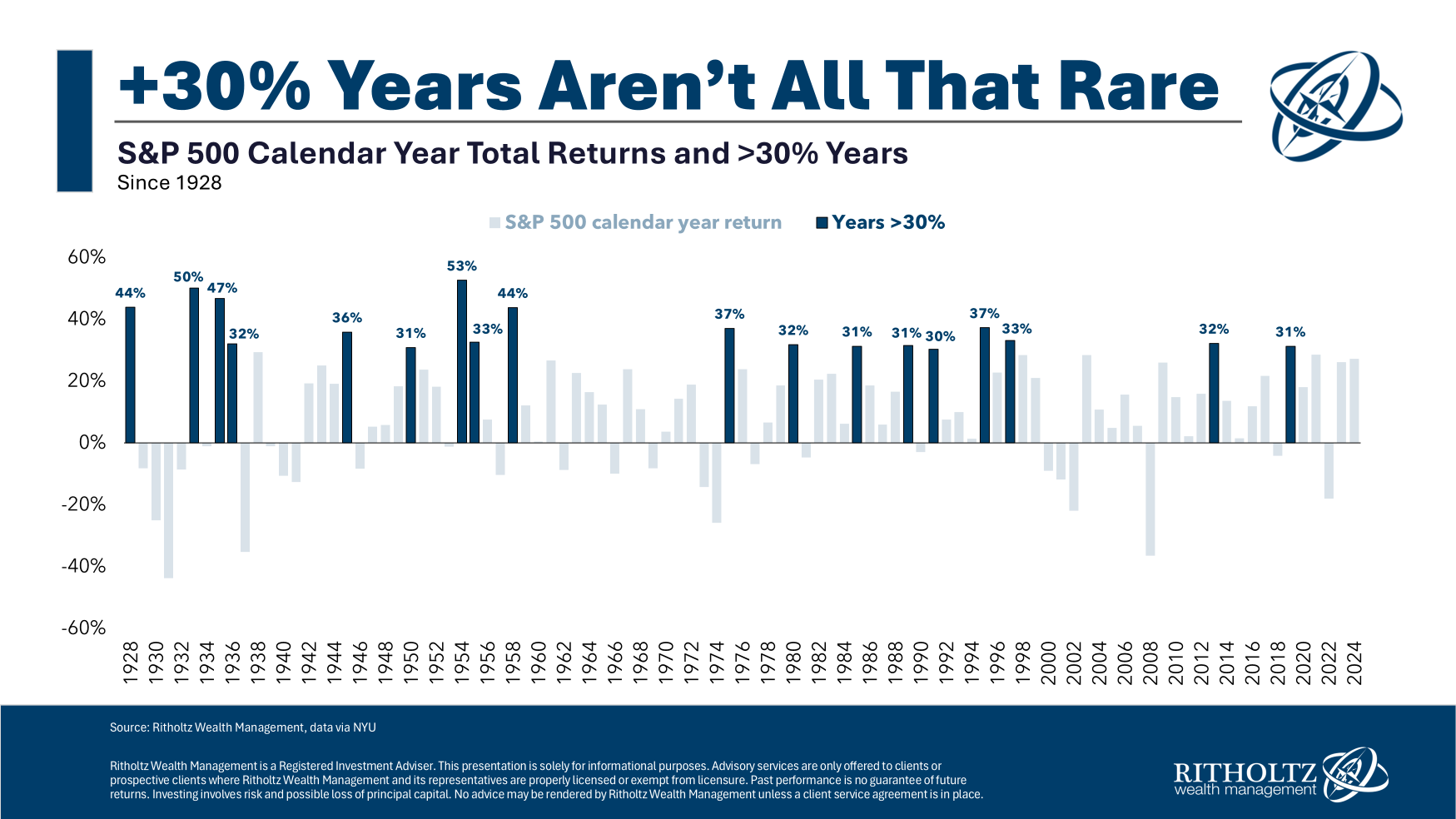
A 30% gain in the stock market sounds extraordinaryand it is. Yet it is not quite the once-in-a-lifetime event that breathless headlines may suggest. In the long history of U.S. stocks, blockbuster years have appeared during economic recoveries, technology booms, falling-interest-rate cycles, postwar expansions, and even periods when investors began January expecting the financial equivalent of a root canal.
Looking at the S&P historical total-return series from 1926 through 2025, the market gained at least 30% in 20 of those 100 calendar years. In other words, a 30% up year occurred about one-fifth of the time. That does not make such gains predictable, but it does make them an important part of long-term stock market returns.
Understanding these exceptional years can help investors avoid two common mistakes: assuming a big rally must immediately collapse and assuming every strong market can be chased safely. History supports neither extreme. The market, as usual, prefers keeping everyone slightly uncomfortable.
What Counts as a 30% Up Year?
Before comparing stock market returns, investors need to define what is being measured. A price return reflects only the change in an index’s quoted value. A total return includes both price appreciation and reinvested dividends.
This distinction matters. Dividends may look modest during any single quarter, but their contribution compounds over time. S&P Dow Jones Indices has estimated that dividends accounted for roughly 31% of the S&P 500’s long-term total return beginning in 1926. Ignoring them is a little like reviewing a restaurant after eating only the breadbasket.
The figures in this article therefore refer to calendar-year total returns. The historical series begins with the predecessor to today’s S&P 500. The index contained fewer companies before it expanded to 500 constituents in 1957, so the oldest observations are best understood as part of the broader S&P composite history.
The 20 Calendar Years With Returns of 30% or More
| Year | S&P Total Return | Year | S&P Total Return |
|---|---|---|---|
| 1927 | 37.49% | 1958 | 43.36% |
| 1928 | 43.61% | 1975 | 37.20% |
| 1933 | 53.99% | 1980 | 32.42% |
| 1935 | 47.67% | 1985 | 31.73% |
| 1936 | 33.92% | 1989 | 31.69% |
| 1938 | 31.12% | 1991 | 30.47% |
| 1945 | 36.44% | 1995 | 37.58% |
| 1950 | 31.71% | 1997 | 33.36% |
| 1954 | 52.62% | 2013 | 32.39% |
| 1955 | 31.56% | 2019 | 31.49% |
The average return during these 20 exceptional years was approximately 37.1%, while the median was about 33.6%. The difference between those figures reflects a handful of enormous rallies, including gains above 50% in 1933 and 1954.
Why Does the Stock Market Sometimes Gain 30%?
No single economic recipe reliably produces a 30% stock market return. Strong years often share several ingredients, but the portions vary.
Recovery From a Severe Decline
Some of the biggest up years followed periods of financial distress. In 1933, stocks surged after devastating losses during the early Great Depression. The 37.2% total return in 1975 followed the punishing 1973–1974 bear market.
This pattern demonstrates the mathematics of recovery. When prices have fallen dramatically, even a partial rebound can produce a spectacular percentage gain. A portfolio that drops 40% and then rises 40% is still below its starting value, because the gain occurs from a smaller base. Percentages, charming little troublemakers that they are, are not symmetrical.
Improving Corporate Earnings
Stock prices ultimately reflect expectations about future business profits. A powerful rally can occur when investors begin anticipating faster revenue growth, wider profit margins, improving productivity, or reduced recession risk.
The market does not wait for perfect economic news. It usually moves when expectations start changing. That is why stocks may rally while headlines remain gloomy. By the time every news anchor sounds cheerful, much of the improvement may already be reflected in prices.
Falling Interest Rates or Easier Financial Conditions
Lower interest rates can support stocks in several ways. Companies may borrow more cheaply, consumers may find credit more affordable, and future corporate cash flows may receive higher present valuations. Lower bond yields can also make equities more attractive by comparison.
Rates are not a magic switch, however. They sometimes fall because the economy is weakening. Investors must consider why financial conditions are changing rather than assuming that every rate cut comes with complimentary confetti.
Expanding Valuations
A stock market can rise because companies earn more, because investors become willing to pay more for each dollar of earnings, or because both happen at once. During especially strong years, valuation multiples frequently expand as confidence improves.
This is one reason a 30% rally does not necessarily mean the economy grew by 30%. Markets price expectations, risk, interest rates, liquidity, and investor sentimentnot merely the current year’s economic output.
What Usually Happens After a 30% Up Year?
A popular belief says that after gaining 30%, the market becomes “due” for a decline. Historical results are less dramatic.
Across the 20 completed 30%-plus years from 1927 through 2019, the following calendar year was positive 13 times, or 65% of the observations. The average following-year return was approximately 11.2%, and the median was about 12.8%.
Those averages hide a wide range of outcomes. After gaining 33.92% in 1936, the market lost 35.03% in 1937. After rising 52.62% in 1954, it added another 31.56% in 1955. A huge year can be followed by a crash, a moderate gain, a flat result, or another outstanding advance.
Strong Momentum Can Continue
The 1995 return of 37.58% did not end that bull market. Stocks gained 22.96% in 1996 and 33.36% in 1997. Likewise, the 32.39% return in 2013 was followed by a respectable 13.69% gain in 2014.
More recently, the S&P total return reached 31.49% in 2019. The following year included a rapid pandemic-driven bear market, yet the index still finished 2020 with an 18.40% total return. The journey was terrifying; the calendar-year result looked almost relaxed.
There Is No Automatic Reset Button
Markets do not become required to fall simply because they have risen. New highs often accompany improving earnings and durable economic expansion. Historical research has found that returns after an all-time high have not been meaningfully worse than returns during other periods.
That does not mean valuation is irrelevant. Expensive markets may offer lower expected returns, especially over longer horizons. It means only that a strong prior-year return, by itself, is a poor timing signal.
Big Annual Gains Can Include Painful Declines
A calendar-year return summarizes only two points: the beginning and the end. It says almost nothing about the emotional turbulence in between.
Since 1980, the S&P 500 has experienced a decline of at least 5% during nearly every calendar year. Drops of 10% or more have occurred in almost half of those years. Many positive years therefore included corrections that felt serious while they were happening.
An investor can enjoy a 30% full-year return and still endure a 10% summer decline, a frightening recession prediction, a geopolitical crisis, and approximately 4,700 television debates about whether the rally is “real.” Volatility is not evidence that the investment plan has failed. It is part of the price investors pay for the potential long-term rewards of owning stocks.
How Investors Can Respond to a 30% Market Year
Rebalance Instead of Making an All-or-Nothing Bet
A major rally can push a portfolio away from its intended asset allocation. Suppose an investor begins with 70% in stocks and 30% in bonds. After stocks soar while bonds remain relatively flat, the stock allocation may climb well above 70%.
Rebalancing restores the planned risk level by trimming assets that have grown beyond their targets and adding to underweight holdings. It is not a prediction that the winning asset will collapse. It is ordinary portfolio maintenancethe investing equivalent of rotating the tires before one rolls into a ditch.
Keep Contributing Consistently
Investors making regular retirement-plan contributions may benefit from continuing on schedule. Dollar-cost averaging means investing a similar amount at regular intervals, regardless of market fluctuations. It can reduce the temptation to make emotional decisions based on recent headlines.
Regular investing does not guarantee profits or prevent losses. It does create a repeatable process. During high markets, the fixed contribution buys fewer shares; during declines, it buys more. Most importantly, the investor does not have to guess which Tuesday will become the perfect buying opportunity.
Avoid Performance Chasing
After a 30% year, the hottest sectors, funds, and individual stocks often attract a parade of new buyers. Recent performance feels persuasive because it is visible, measurable, and usually accompanied by confident people on social media.
Yet the assets that led one rally may not lead the next. Concentrating a portfolio in last year’s winners can increase exposure just as valuations and expectations become demanding. Diversification will occasionally feel boring, but boring can be a useful feature when financial markets begin throwing furniture.
Match Risk to the Time Horizon
A younger investor saving for retirement decades away may be able to tolerate substantial stock volatility. Someone preparing to spend the money within a few years may need a more conservative allocation, regardless of how attractive recent returns appear.
Money needed for a home purchase, tuition payment, emergency fund, or near-term retirement expenses generally should not depend entirely on continued stock market gains. A 30% year is a reason to review risk, not an invitation to pretend risk has retired.
Lessons Hidden Inside 30% Up Years
- Exceptional gains are uncommon but not bizarre. They occurred in 20% of the calendar years in the 1926–2025 historical total-return series.
- Dividends matter. Total return offers a fuller picture than the price index shown in many headlines.
- Large gains often begin before the news feels comfortable. Waiting for certainty may mean waiting until prices have already moved.
- A strong year does not predict the next year. Historically, most years after a 30% gain were positive, but outcomes ranged from severe losses to another gain above 30%.
- Volatility remains normal during bull markets. Large intra-year declines can coexist with impressive full-year results.
- Portfolio discipline matters more than calendar forecasts. Diversification, regular contributions, appropriate risk, and periodic rebalancing are more controllable than next year’s index return.
Investor Experiences: What a 30% Up Year Actually Feels Like
Historical tables make 30% up years appear clean and orderly. Real investor experiences are considerably messier. The following scenarios are representative examples rather than promises about future results.
The Automatic Retirement Saver
Consider an employee who contributes to a diversified stock fund through every paycheck. At the beginning of a strong year, the investor may feel nervous because economists are debating recession risks. Contributions continue automatically anyway.
By summer, the portfolio has climbed, but a sudden correction erases several weeks of gains. The investor wonders whether contributions should be suspended until “things calm down.” They do not stop. The market eventually recovers, and the account finishes the year substantially higher.
The most important decision was not selecting the exact market bottom. It was keeping a routine in place when uncertainty made routine feel foolish. Automatic contributions transformed investing from a monthly emotional debate into a background financial habit.
The Retiree Who Rebalances
Now imagine a retiree with a balanced portfolio. After stocks rise roughly 30%, equities occupy a much larger share of the account than intended. The retiree is pleased with the gain but also realizes that another bear market would now have a greater impact on near-term spending.
Instead of selling every stock out of fear, the retiree rebalances. A portion of the stock gains moves into high-quality bonds and cash reserves. The portfolio remains invested for future growth while several years of planned withdrawals become less dependent on short-term market conditions.
This experience demonstrates why selling some appreciated assets is not automatically bearish. Sometimes it is simply good housekeeping. Nobody accuses a gardener of hating tomatoes because the tomatoes were harvested.
The New Investor Who Arrives After the Rally
A new investor sees a 30% annual gain and becomes convinced that waiting even one more day will destroy any chance of building wealth. They invest heavily in the market’s most celebrated companies, expecting the recent pace to continue.
When those holdings decline 12%, the investor feels betrayed. The problem was not necessarily investing near a high. The problem was expecting a 30% annual return to be normal and building a concentrated portfolio around that expectation.
A more durable approach would begin with a diversified allocation, realistic long-term assumptions, and an amount of stock exposure the investor can hold through a downturn. The goal is not to eliminate regret. Markets are exceptionally talented at producing regret in every direction. The goal is to prevent regret from controlling the portfolio.
The Investor Who Sold Too Early
Another investor enjoys the first 15% of a rally, decides the market has risen “too far,” and moves entirely to cash. Stocks keep climbing. The investor waits for a correction that never reaches the desired entry price.
Eventually, fear of missing out replaces fear of loss, and the investor buys back at a much higher level. The round trip produces taxes, trading friction, stress, and little strategic benefit.
This is the practical danger of market timing. Selling requires two correct decisions: when to leave and when to return. The market’s strongest and weakest trading days frequently occur close together, making the reentry decision especially difficult.
The Quietly Successful Experience
The least exciting experience is often the most effective. An investor begins the year with a written asset-allocation plan, keeps an emergency fund outside the stock market, makes regular contributions, reinvests distributions, and checks the portfolio only periodically.
When the market finishes up 30%, the investor celebrates briefly, rebalances if necessary, and continues. There is no dramatic prediction, no heroic trade, and no screenshot of a perfectly timed purchase. There is simply a process that can survive both excellent years and terrible ones.
That may not create thrilling dinner conversation, but retirement accounts have never required a standing ovation.
Conclusion
Thirty-percent up years are among the stock market’s most rewarding periods, but they are not mysterious gifts that appear only once in a generation. In the 100 completed calendar years from 1926 through 2025, the S&P historical total-return series produced 20 gains of at least 30%.
Those rallies emerged under very different conditions, and their aftermath varied widely. Some were followed by losses. Most were followed by another positive year. A few became part of powerful multiyear bull markets.
The practical lesson is not to predict the next blockbuster year. It is to build a portfolio capable of participating when one arrivesand capable of surviving when the market behaves far less generously. Diversification, reasonable expectations, consistent investing, and disciplined rebalancing may lack the excitement of forecasting a 30% gain, but they remain far more dependable than a crystal ball purchased from the internet.