In the world of maker hardware, a good contest does more than hand out prizes. It gives engineers, hobbyists, tinkerers, and occasionally sleep-deprived soldering wizards a reason to turn “what if?” into a real circuit board. The Take Flight With Feather Contest did exactly that. Built around the Adafruit Feather ecosystem, the contest challenged makers to design creative, practical, and manufacturable boards that could extend what Feather projects can do.
The results were a lively snapshot of open hardware culture: an open-source e-reader, a chipsat development board for space experiments, a LoRaWAN board for long-distance communication, a spider-like robot platform, a gesture-sensing daughterboard, and a retro serial interface that brought old-school hardware into the Feather family. In other words, it was not your average “blink an LED and call it a day” competition.
What Was the Take Flight With Feather Contest?
The Take Flight With Feather Contest was a hardware-design competition created through the collaboration of Hackaday, Digi-Key, and Adafruit. Its central idea was simple but powerful: design a board that fits into the Adafruit Feather ecosystem and make it useful enough, interesting enough, and manufacturable enough to stand out.
Adafruit Feather boards are compact microcontroller development boards designed for portability, modularity, and expansion. FeatherWings, the add-on boards that stack with them, allow makers to add displays, sensors, wireless radios, motors, storage, and other features without reinventing the whole project from scratch. That modular design is why the Feather ecosystem has become so popular among embedded developers and DIY electronics fans.
The contest focused heavily on manufacturability. That detail matters. A brilliant prototype made from hot glue, jumper wires, and pure optimism can be charming, but it may not be ready for production. The best entry would receive a small manufacturing run and be stocked by Digi-Key, which meant the winner needed more than a clever concept. It needed thoughtful layout, realistic parts, documentation, and a design that could survive the journey from workbench to warehouse.
Why the Feather Ecosystem Was the Perfect Playground
Feather is a clever name because the boards are light, portable, and designed to help projects “take flight.” But the real magic is standardization. Feather boards share a familiar form factor, pinout expectations, 3.3V logic, battery-friendly power design, and compatibility with many FeatherWings. That means a maker can prototype with one Feather board, swap in another with more memory or different wireless features, and still keep much of the same hardware strategy.
This is a huge advantage for contest builders. Instead of designing every subsystem from zero, entrants could focus on what made their idea unique. Need wireless communication? Use the Feather ecosystem as a launchpad. Need a display? Add a Wing. Need portability? Feather boards are already designed with battery-powered projects in mind. The contest rewarded designers who understood that ecosystem and used it intelligently.
Overall Winner: The Open Book Feather
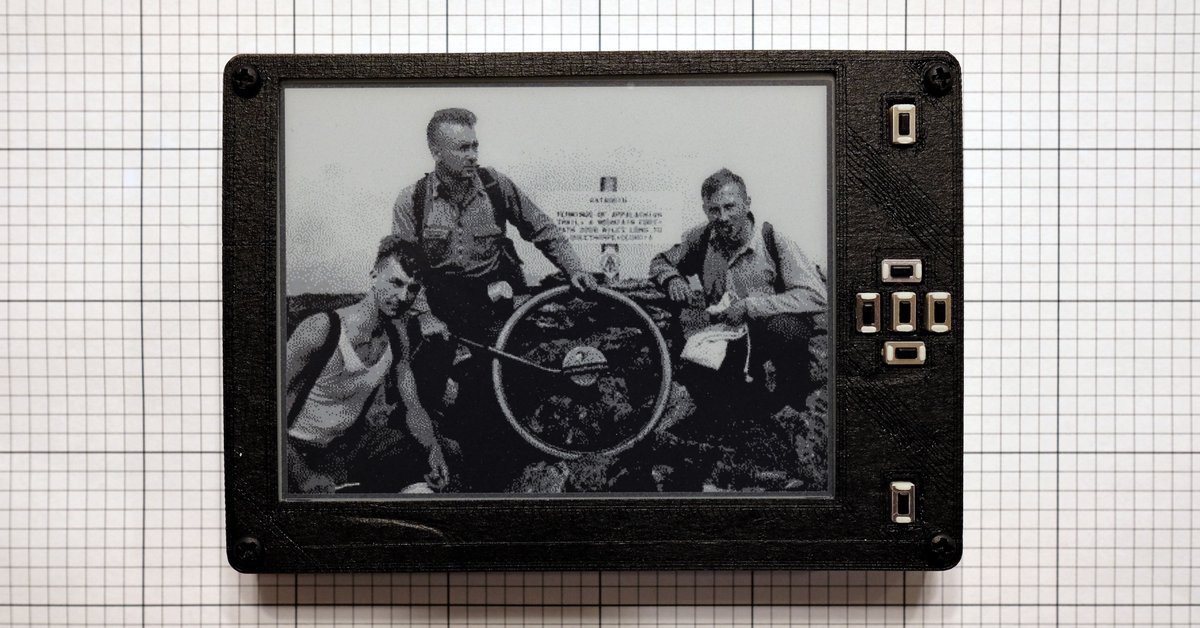
The overall winner of the Take Flight With Feather Contest was The Open Book Feather, created by Joey Castillo. It was not just another e-reader concept. It was an open hardware reading device rooted in the Feather ecosystem, designed for people who like books, electronics, and the radical idea that devices should be understandable.
The Open Book Feather featured a 4.2-inch e-paper display with a 300 by 400 resolution, microSD storage for reading files, front-facing buttons for navigation, a rechargeable LiPo battery, and a Feather-compatible expansion approach. It also included thoughtful extras: a headphone jack for audio, a built-in microphone, support for voice-control experiments, STEMMA headers for expansion, and enclosure options that could be laser-cut or 3D printed.
What made the Open Book Feather special was not simply that it could display text. Commercial e-readers already do that very well. The difference was openness. The project invited builders to understand the hardware, modify it, assemble it, repair it, and learn from it. In a market where many consumer devices are sealed mystery boxes, the Open Book Feather felt refreshingly transparent.
Why Open Book Feather Deserved the Top Spot
The design hit a sweet spot between usefulness and ambition. E-paper is practical for low-power reading. MicroSD support makes offline file storage simple. Physical buttons are reliable and accessible. The Feather expansion header makes the project adaptable. The documentation-focused mindset made it more than a flashy demo.
In short, the Open Book Feather was not just a product idea. It was a learning platform disguised as an e-reader. That is the kind of trick open hardware does best.
The Category Winners
Junebug: The Cutting-Edge Feather
Junebug, created by Brad Denby and Brandon Lucia, won the cutting-edge category. This project was designed as a development board for chipsats, extremely small satellite systems that operate under brutal constraints. Space is not exactly friendly to electronics. It brings extreme temperatures, limited energy, and the occasional reminder that repair technicians are not making house calls in low Earth orbit.
Junebug stood out because it focused on low-power and intermittent computing. Tiny space systems may only harvest enough energy for short bursts of operation, so the board was designed with that reality in mind. It used components suitable for harsh conditions and offered storage and processing capabilities for advanced sensor data and machine learning experiments.
LoRaWAN Feather: The Wireless Winner
The LoRaWAN Feather earned recognition in the wireless category. Based around an STM32 microcontroller and a long-range radio module, the board aimed to bring LoRaWAN connectivity into the Feather ecosystem in a practical and manufacturable way.
LoRaWAN is attractive for projects that need long-distance communication with modest power use, such as remote sensors, environmental monitors, farm devices, and infrastructure projects. The LoRaWAN Feather combined familiar Feather features like USB, LiPo charging, I2C, SPI, UART, GPIO, analog support, and user controls with wireless connectivity designed for real deployment.
SpiderWing: The Weirdest Feather
The SpiderWing took the “Weirdest Feather” title, and honestly, it understood the assignment. Built as a spider-like robot powered by Adafruit Feather boards and CircuitPython, it used multiple servos to create a walking quadruped platform.
The charm of SpiderWing was not just that it looked delightfully creepy. It also tackled a serious robotics problem: making walking robots easier to reproduce, program, and improve. Anyone who has built a legged robot knows that “make it walk” can quickly become “make it stop falling over like a newborn giraffe on roller skates.” SpiderWing approached that challenge with a more reliable, modular platform.
Gesture FeatherWing: The Assistive Technology Winner
The Gesture FeatherWing won in the assistive technology category. It used a capacitive gesture sensor to create a FeatherWing capable of detecting finger gestures. The goal was to provide a compact input solution that could be added to Feather-based devices.
Gesture control can be especially meaningful in accessibility-focused hardware. Physical buttons are useful, but they are not always ideal for every user or every environment. A gesture-sensing interface can support more flexible interactions, especially when paired with custom software, displays, audio feedback, or adaptive devices.
RS232 to TTL/I2C FeatherWing: The Retro Feather
The RS232 to TTL/I2C FeatherWing won the retro category by connecting modern Feather projects with older serial hardware. RS232 may no longer be the shiny new thing, but it remains important in legacy computers, industrial equipment, lab instruments, and embedded systems that refuse to retire gracefully.
This FeatherWing converted RS232 to TTL and I2C, while also including support for RTS and CTS signals. That made it more than a nostalgia piece. It was a practical bridge between old devices and modern microcontroller projects. Retro hardware fans understand the joy: sometimes the best new project begins with a connector that looks like it escaped from 1993.
What the Winners Had in Common
The winning projects were very different, but they shared several important traits. First, each one respected the Feather format. That meant they were not just random boards with nice labels. They were designed to participate in a larger ecosystem.
Second, the winners solved real problems. Open Book Feather addressed open reading hardware. Junebug explored computing for tiny satellites. LoRaWAN Feather improved long-range embedded communication. SpiderWing advanced reproducible robotics. Gesture FeatherWing created a new input method. RS232 to TTL/I2C FeatherWing helped old and new hardware communicate.
Third, they balanced creativity with practicality. A contest can reward wild imagination, but this one also asked whether a board could actually be manufactured. That changed the game. Successful entries needed sensible parts, clear design intent, and enough polish to move beyond “cool prototype” territory.
Lessons for Makers, Engineers, and Hardware Startups
1. Design for an Ecosystem, Not an Island
Feather projects win attention because they plug into something bigger. A board that follows established pinouts, voltage expectations, and physical constraints becomes easier to adopt. For hardware startups, that lesson is huge. Compatibility can be a growth strategy.
2. Documentation Is Part of the Product
The Open Book Feather showed that great hardware is not just copper traces and components. It is also build guides, diagrams, bills of materials, software examples, and explanations. If people cannot understand how to build or use a device, the device is only half-finished.
3. Manufacturability Beats Mystery Magic
A board can be brilliant and still fail if it depends on rare parts, impossible soldering, unclear assembly, or “just trust me” engineering. The Take Flight With Feather Contest rewarded designs that could realistically be made, tested, and shared.
4. Open Hardware Turns Users Into Collaborators
Open hardware invites people to inspect, modify, repair, and remix. That does not just make a project more transparent. It builds community. The best maker projects do not end when someone downloads the files. They begin there.
Why This Contest Still Matters
Even years after the winners were announced, the Take Flight With Feather Contest remains a useful case study in maker innovation. It demonstrated how a well-defined hardware ecosystem can inspire wildly different projects without becoming chaotic. It also showed that open hardware contests can produce designs with real educational value.
The Open Book Feather, in particular, continues to represent something bigger than an e-reader. It represents the desire to understand our devices. That idea is increasingly important as consumer electronics become thinner, glossier, and more difficult to repair. A handmade open e-reader may not replace every commercial device, but it reminds us that technology can be approachable.
The other winners expanded that message. Junebug looked upward toward space. LoRaWAN Feather looked outward toward long-range networks. SpiderWing looked down at the workbench and decided four tiny robot legs sounded reasonable. Gesture FeatherWing explored new ways to interact. RS232 FeatherWing proved that old ports still have stories to tell.
Experience Notes: What the Contest Teaches in Real Maker Life
The experience behind a contest like Take Flight With Feather is familiar to anyone who has ever started a hardware project with confidence and ended the evening searching for one missing resistor under the desk. Hardware is wonderfully physical. That is its charm, and also its comedy routine. Software bugs can hide in logic. Hardware bugs hide in solder joints, footprints, power rails, and that one connector you definitely placed backward because the datasheet diagram looked at you funny.
A Feather-based contest lowers the fear factor because it gives makers a known foundation. You are not designing an entire universe. You are designing one clever planet inside an existing solar system. The pinout is familiar. The size is familiar. The power expectations are familiar. That structure gives beginners a safer entry point and gives advanced builders a faster path to experimentation.
For someone building a FeatherWing, the first big lesson is constraint. The board cannot be any size it wants. It must respect headers, signals, voltage, stackability, and available current. These constraints can feel limiting at first, but they often improve the design. A smaller board forces sharper decisions. Every component needs a reason to exist. Every trace becomes part of the story.
The second lesson is that “working once” is not the same as “ready.” A prototype that behaves on your desk may fail when another person assembles it, powers it from a different battery, or uses a cable from the mysterious drawer of questionable USB accessories. Contest winners tend to think beyond the first demo. They consider assembly, documentation, part availability, edge cases, and how someone else will experience the project without the creator standing nearby saying, “Oh, just wiggle that wire.”
The third lesson is community feedback. Maker contests are public laboratories. Viewers ask questions, suggest improvements, point out problems, and sometimes make jokes that are too accurate to ignore. That feedback can be uncomfortable, but it is valuable. A project becomes stronger when it meets real curiosity from real people.
Finally, the Take Flight With Feather Contest shows that hardware success is not always about making the most complicated thing. The best projects are often the ones with a clear purpose. Open Book Feather wanted to make reading hardware open. Junebug wanted to explore computing in extreme low-power space environments. RS232 FeatherWing wanted to connect old interfaces to modern boards. Each winner had a strong “why,” and that is what made the technical details meaningful.
Conclusion
The winners of the Take Flight With Feather Contest proved that small boards can carry big ideas. From an open hardware e-reader to a chipsat development platform, from LoRaWAN communication to gesture sensing and retro serial connections, the contest celebrated the best parts of the maker movement: curiosity, practicality, openness, and a healthy willingness to build something unusual.
For readers, the story is more than a list of winners. It is a reminder that innovation often begins with a shared platform and a very specific challenge. Give makers a standard, a deadline, and a reason to dream, and they may respond with a robot spider, a satellite board, or an e-reader you can build yourself. That is the beauty of open hardware: it does not just ask what technology can do. It asks what people can learn by making it.