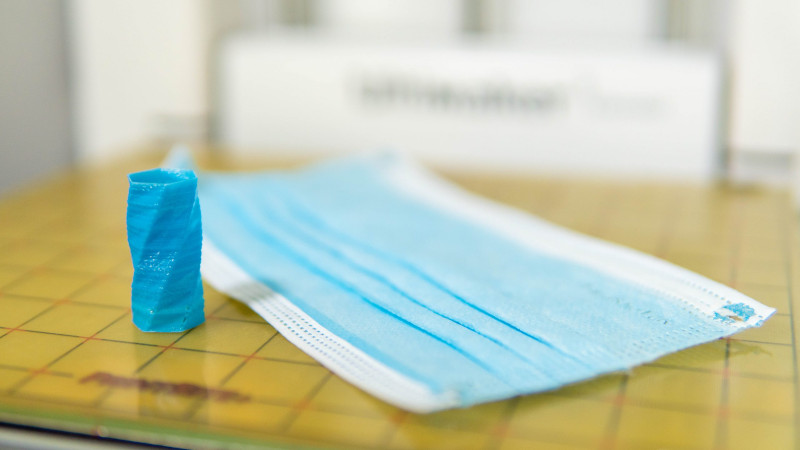
At first glance, a used disposable face mask does not look like the future of desktop manufacturing. It looks like something you find in a coat pocket three months too late, next to a receipt for coffee and a lint-covered mint. But under that crinkly blue surface is a surprisingly useful material: polypropylene, a common thermoplastic used in everything from food containers to car parts. That means old masks are not just pandemic leftovers. In the right controlled recycling stream, they can become raw material for 3D printer filament.
The idea of turning old masks into 3D printer filament sounds like a science fair project that accidentally escaped into an engineering lab. Yet the concept is very real. Researchers, makers, and recycling innovators have explored how disposable surgical masks and other polypropylene-rich personal protective equipment can be cleaned, separated, shredded, melted, extruded, and converted into filament for fused deposition modeling, also known as FDM or FFF 3D printing.
This is not a casual kitchen-table craft. Used masks can carry biological contamination, and heating plastics without proper ventilation is a bad idea wearing a lab coat. Still, the broader concept is exciting because it connects two huge conversations: plastic waste management and circular manufacturing. Instead of sending mountains of single-use masks to landfills or incinerators, specialized recycling systems may be able to recover value from them.
Why Disposable Masks Are a 3D Printing Opportunity
Most disposable surgical masks are built from layers of nonwoven polypropylene. A typical three-ply mask may include spunbond polypropylene on the outer and inner layers and melt-blown polypropylene in the filter layer. It may also include elastic ear loops, a metal or plastic nose strip, dyes, adhesives, and welded seams. That mixed construction is one reason mask recycling is more complicated than tossing bottles into a blue bin.
Polypropylene, often shortened to PP, is a thermoplastic. That means it can soften when heated and harden again when cooled. In theory, this makes it recyclable into pellets, sheets, molded products, or filament. In practice, every recycling process has to deal with contamination, sorting, degradation, additives, and consistency. A 3D printer is not very forgiving. Feed it uneven filament and it may respond with clogs, under-extrusion, warped parts, or the haunted spaghetti monster every maker has met at least once.
The attraction is obvious: masks were produced and discarded in enormous numbers during the COVID-19 era, and many of them are made from polymer materials that do not disappear politely. When masks are littered or mismanaged, they can contribute to plastic pollution and microplastic release. Converting mask waste into printable material does not solve plastic pollution by itself, but it does point toward a smarter habit: treating waste as a resource whenever it is safe and practical.
How Old Masks Can Become Filament
The basic concept follows the same logic used in many plastic recycling systems. First, masks are collected through a controlled stream. Second, they are sanitized using a method appropriate for the facility and material. Third, non-polypropylene components such as nose wires and ear loops are removed or separated. Fourth, the mask body is shredded into small flakes. Finally, those flakes are melted and pushed through an extrusion system to create a continuous strand of filament.
That simple explanation hides a lot of engineering drama. The filament must have a consistent diameter, usually 1.75 mm or 2.85 mm depending on the printer. It must not contain unmelted bits, metal fragments, dust, or moisture. It must flow smoothly through the hot end. It must bond layer by layer. It must cool without warping into a potato chip with ambition.
Researchers have tested different ways to improve recycled mask-based filament. Some studies have explored blending recycled polypropylene with additives or reinforcing fibers to improve stiffness, dimensional stability, and printability. Others have compared recycled mask-derived materials with commercial filaments to understand strength, flexibility, surface quality, and printing behavior. The results are promising, but they also show why recycled mask filament is not a plug-and-play replacement for common PLA.
The Polypropylene Challenge: Useful, But Moody
Polypropylene is tough, lightweight, chemically resistant, and widely used. Those qualities make it valuable in manufacturing. Unfortunately, PP can be fussy in desktop 3D printing. It tends to shrink as it cools, which can cause warping. It may not stick well to common build surfaces. It can require careful bed temperature control, enclosure management, and compatible print surfaces.
PLA is popular because it behaves like the golden retriever of 3D printing materials: friendly, forgiving, and generally happy to be here. Polypropylene is more like a cat with strong opinions. It can produce durable parts, but only if the printing environment respects its preferences. Recycled PP from masks adds another layer of complexity because the feedstock may vary from one mask brand to another.
That variation matters. Some masks may use different grades of polypropylene, different layer weights, different pigments, different nose-piece materials, and different elastic compositions. Even when the mask body is mostly PP, small impurities can affect extrusion and printing. This is why controlled collection and sorting are essential. The cleaner and more consistent the feedstock, the better the filament.
Safety Comes First: Not Every Mask Belongs in a Maker Bin
One of the most important points is also the least glamorous: used masks should not be handled casually for recycling projects. Public-health guidance treats disposable masks as single-use items that should be discarded properly when wet, dirty, damaged, or no longer needed. In medical, laboratory, or high-risk settings, PPE waste may require special handling according to local rules.
For that reason, mask-to-filament recycling works best as a controlled program, not a random home experiment. The safer model is a dedicated collection stream using unused, expired, manufacturing scrap, or properly decontaminated masks managed by trained people. Schools, labs, hospitals, or companies considering this type of recycling should follow local waste regulations and occupational safety standards.
There is also the matter of heat. Melting plastics requires proper equipment, ventilation, temperature control, and fire safety. A filament extruder is not a toaster with a STEM degree. It is a machine that processes hot material under mechanical force. Anyone exploring recycled filament should use purpose-built equipment, protective procedures, and adult supervision in educational settings.
Environmental Benefits: Small Spool, Big Idea
The environmental case for turning old masks into 3D printer filament is not just about making cute benchy boats from yesterday’s PPE. The bigger idea is circular material use. A product designed for short-term protection can, under the right conditions, gain a second life as a useful object.
That second life might be a prototype part, a bracket, a clip, a cable organizer, a lab fixture, a low-load component, or an educational demonstration. These are not glamorous objects, but they matter. Many 3D-printed parts are practical, local, and small. If recycled material can replace virgin plastic in some of those uses, the cumulative impact becomes more interesting.
Still, recycling is not automatically green just because it has the word “re” in it. A serious assessment must consider collection, transport, cleaning, shredding, extrusion energy, failed prints, and end-of-life disposal. If masks are shipped across continents to become low-quality filament that fails half the time, the environmental math starts wearing clown shoes. The strongest case is local or regional processing where waste streams are consistent and the filament is used for appropriate products.
What Can Be Printed With Mask-Based Filament?
Recycled mask filament is best suited for applications that match polypropylene’s strengths. PP is lightweight, fatigue-resistant, and reasonably tough. It can work for living hinges, containers, clips, organizers, and certain functional prototypes. Because recycled mask material may not have certified mechanical performance, it should not be used for safety-critical parts, medical devices, food-contact items, or structural components where failure could cause harm.
Good candidate prints include workshop bins, cable clips, desk accessories, educational models, plant tags, non-load-bearing brackets, spool holders, and prototype housings. These are useful items that do not demand aerospace-level confidence. In other words, recycled mask filament may be great for organizing your tools, but it should not be trusted to hold up a bicycle, a shelf over your bed, or anything your insurance company would like to discuss later.
The Role of Additives and Blends
Pure recycled polypropylene from masks may be printable, but researchers often look at additives and blends to improve performance. Glass fiber reinforcement, compatibilizers, or blending with other polymers can reduce warping, improve stiffness, and enhance dimensional accuracy. The challenge is balance. Additives can improve one property while making another worse. More stiffness may mean less flexibility. Better printability may mean harder recycling later.
This is where material science gets interesting. A successful recycled filament is not just “melted trash in a spool.” It is a controlled material with known behavior. The best versions are tested for melt flow, tensile strength, surface finish, diameter consistency, and print repeatability. That is the difference between a promising circular economy product and a spool of mystery noodle.
Why Filament Diameter Matters So Much
Filament diameter sounds boring until it ruins your print. Desktop 3D printers depend on predictable filament size. If the filament is too thick, it may jam. If it is too thin, the printer may under-extrude. If it constantly changes diameter, the print quality can swing from “professional prototype” to “plastic lasagna.”
Recycled filament production therefore requires measurement and feedback. Makers and researchers have developed sensors to track filament diameter during extrusion. In better systems, the puller speed, cooling, and extrusion rate can be adjusted to keep the filament within tolerance. For recycled mask filament, this kind of control is especially important because the feedstock may be less uniform than virgin pellets.
Real-World Barriers to Scaling Mask-to-Filament Recycling
The concept is clever, but scaling it is not easy. First, collection is difficult. Used masks are lightweight, scattered, and potentially contaminated. Second, sorting is labor-intensive because masks include multiple materials. Third, cleaning and decontamination cost money and energy. Fourth, polypropylene printing has a smaller user base than PLA or PETG printing. Fifth, recycled filament must compete with inexpensive commercial filament that arrives neat, dry, and ready to print.
To succeed commercially, mask-to-filament programs need reliable feedstock, clear safety protocols, consistent output, and buyers who understand the material. The most realistic early markets may be universities, sustainability labs, maker spaces, municipal pilots, and companies that already collect PPE waste. These groups can use the filament for demonstration projects, internal tools, and circular economy education.
Educational Value: A Perfect STEM Story
Even if mask-based filament never replaces mainstream PLA, it has enormous educational value. It teaches students and makers about polymer chemistry, waste management, product design, public health, manufacturing, and environmental trade-offs. A single mask-to-filament project can raise questions such as: What is this material? How do we identify it? How do we clean it safely? How does extrusion work? Why does one polymer print better than another? What does “recyclable” really mean?
That last question is especially important. Many people hear “plastic” and assume all plastic goes into one magical recycling portal. Reality is messier. Different polymers have different melting points, additives, densities, and market values. Mixed plastic is harder to recycle than clean, single-polymer waste. Disposable masks are a great example because they look simple but are actually small engineered composites.
Best Practices for Responsible Innovation
Anyone discussing mask-to-filament recycling should avoid overselling it. The point is not that every household should start feeding masks into a mini-extruder. The point is that specialized recycling can recover value from difficult waste streams when safety and quality are managed correctly.
Use Controlled Feedstock
Unused expired masks, manufacturing offcuts, or properly managed institutional waste are better candidates than random masks picked up from public spaces. Cleaner input creates safer handling and better filament.
Separate Materials Carefully
Ear loops, nose wires, labels, and other non-PP components can cause problems during shredding, extrusion, and printing. Effective separation improves quality and reduces equipment trouble.
Test Before Scaling
Small-batch testing helps determine melt behavior, filament consistency, print temperature, bed adhesion, warping, strength, and surface finish. A recycled filament should earn trust through repeatable results, not vibes.
Match Material to Use
Recycled PP filament should be used for parts that fit its properties and limitations. Non-critical prototypes and utility objects are better targets than high-stress or safety-related components.
Could This Become a Mainstream Recycling Path?
Mask-to-filament recycling may remain a niche solution, but niche does not mean useless. Many successful sustainability ideas begin as targeted systems. Aluminum cans, office paper, textile scraps, and industrial plastic offcuts all depend on collection streams and market demand. Old masks are harder because they are small, lightweight, and tied to hygiene concerns. However, in places where large quantities of similar PPE are collected, filament production could become one useful outlet among many.
The broader lesson is that future products should be designed with end-of-life recovery in mind. If masks, gowns, filters, and packaging are made from fewer material types or designed for easier separation, recycling becomes more realistic. The best recycling program is helped enormously by smart product design before the waste ever exists.
Experience Notes: What Working With Recycled Mask Filament Teaches You
Working with recycled mask-based filament, even in a research or supervised maker-space context, quickly teaches humility. The first lesson is that plastic has a memory. A mask begins life as carefully engineered nonwoven fabric, not a neat pellet. Once it has been folded, welded, worn, stored, cleaned, shredded, heated, cooled, and pulled into filament, the material has been through a lot. It may still be useful, but it will not behave exactly like virgin filament fresh from a factory spool.
The second lesson is that preparation matters more than enthusiasm. The idea sounds simple: collect masks, melt them, print something useful. In reality, the quality of the final print depends on every earlier decision. If the mask stream is mixed with unknown materials, the filament may become inconsistent. If the shredding is uneven, the extruder may feed unpredictably. If the extrusion temperature is poorly controlled, the strand may become brittle, lumpy, or oversized. If the filament is not wound properly, it may tangle like earbuds from 2012.
The third lesson is that polypropylene rewards patience. Printing PP can require more tuning than printing PLA. Bed adhesion is often the headline issue. A part may start beautifully and then curl at the corners as it cools. An enclosure, compatible build surface, and careful temperature management can make a major difference. But even then, recycled PP may ask for several test prints before it agrees to cooperate. The process is less like pressing “print” and more like negotiating with a tiny materials scientist living inside the nozzle.
The fourth lesson is that not every failed print is a failure. A warped test square can reveal cooling behavior. A weak clip can show poor layer bonding. A rough surface can point to contamination, moisture, or inconsistent flow. In recycled filament work, ugly prints are data with attitude. They help refine the process and prevent larger batches from wasting time and material.
The fifth lesson is that the story matters. People respond strongly when they see an old disposable mask transformed into a useful object. A cable clip or desk organizer printed from recovered mask material becomes more than a small plastic part. It becomes a conversation about waste, design, health, and responsibility. That educational value is powerful, especially for students who may otherwise see recycling as a boring bin-related chore.
The sixth lesson is that safety must stay visible. It is tempting to present mask recycling as a heroic maker hack, but responsible projects are careful about contamination, ventilation, equipment, and local rules. The best examples do not treat safety as a footnote. They build it into the process from collection to final print.
The final lesson is practical optimism. Turning old masks into 3D printer filament is not a miracle cure for plastic pollution. It will not erase landfill problems or make single-use culture magically sustainable. But it is a smart, tangible example of circular thinking. It shows that waste can be redesigned, remade, and reconsidered. Sometimes the future of manufacturing starts with looking at yesterday’s trash and asking, “What else could this become?”
Conclusion
Turning old masks into 3D printer filament is one of those ideas that sounds strange until the material science clicks. Disposable masks are often rich in polypropylene, and polypropylene is a printable thermoplastic when processed correctly. The opportunity is real: recover plastic value, reduce waste, support local manufacturing, and teach circular design. The limitations are also real: contamination risk, sorting difficulty, printability challenges, inconsistent feedstock, and the need for proper equipment.
The most responsible future for mask-based filament is not random DIY recycling from public trash. It is controlled, tested, and safety-first material recovery from clean or properly managed waste streams. Used wisely, recycled mask filament can become a useful tool for prototypes, educational projects, and non-critical printed parts. More importantly, it can help shift how we think about disposable products. A mask may be designed for one use, but the material inside it can still have another chapter.
Note: This article is written for web publication and is based on real public-health, environmental, polymer-recycling, and 3D-printing research. It is not a recommendation to handle used masks casually or recycle potentially contaminated PPE at home.