Imagine looking at an empty patch of desert and seeing the ingredients for aviation fuel: sunlight overhead, carbon dioxide drifting through the atmosphere, and a little water vapor hiding in even the driest air. No oil well. No prehistoric swamp. No drilling rig wearing a cowboy hat.
That is the remarkable idea behind a solar tower fuel system developed by researchers at ETH Zurich and advanced commercially by the Swiss clean-technology company Synhelion. The technology uses concentrated solar heat to turn carbon dioxide and water into synthesis gas, which can then be refined into kerosene, diesel, gasoline, and other liquid hydrocarbons.
The phrase “jet fuel made from air” sounds like science fiction designed by someone who watched too many space movies. Yet the underlying process has been demonstrated outdoors, scaled from a rooftop mini-refinery to a solar tower, and developed into an industrial demonstration plant. In 2025, fuel produced through this technology even entered an airline’s regular fuel supply system.
What Does the Solar Tower Actually Do?
The solar tower is not a giant vacuum cleaner that inhales clouds and coughs out barrels of Jet A-1. The full process is more sophisticated and involves several connected systems.
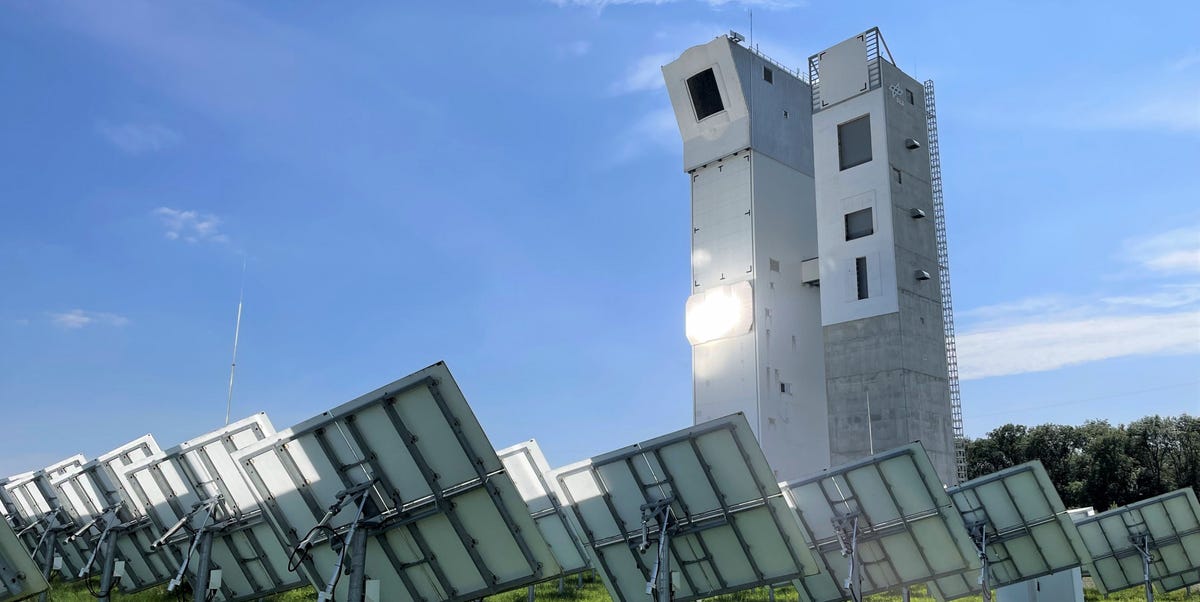
A field of sun-tracking mirrors, known as heliostats, reflects sunlight toward a receiver mounted on or near a tower. By concentrating the sunlight from a large area onto a relatively small target, the system produces extremely high temperatures. Instead of first converting sunlight into electricity, the tower uses solar energy directly as industrial process heat.
Concentrating solar-thermal systems can deliver temperatures ranging from a few hundred degrees Celsius to more than 1,000 degrees Celsius, depending on their design. That makes them useful not only for generating electricity but also for powering demanding chemical reactions. In this case, the heat helps break stable water and carbon dioxide molecules into more useful chemical building blocks.
How Air and Sunlight Become Jet Fuel
Step 1: Collect Carbon Dioxide and Water
The original ETH Zurich mini-refinery demonstrated a process that extracted both carbon dioxide and water directly from ambient air. Specialized filters captured carbon dioxide, while another stage collected water vapor.
This matters because synthetic hydrocarbon fuel requires two essential elements: carbon and hydrogen. Carbon dioxide supplies the carbon, while water supplies the hydrogen. The atmosphere therefore functions as a widely distributed raw-material reservoir, although capturing such diluted substances requires energy and equipment.
At commercial scale, the carbon source does not always have to come directly from ambient air. Industrial versions may use carbon dioxide from biogenic waste streams or raw biogas because these sources can be more concentrated and less expensive. The scientific achievement is that direct-air sourcing works; the commercial challenge is selecting the cleanest feedstock that also makes economic sense.
Step 2: Focus the Sun Like a Giant Magnifying Glass
The heliostats continually adjust their position as the sun travels across the sky. Each mirror reflects sunlight toward the tower’s receiver, combining thousands of ordinary rays into one extraordinarily intense stream of energy.
In the ETH solar tower experiment reported in 2022, the reactor received an average solar concentration equivalent to approximately 2,500 suns. The 50-kilowatt solar reactor contained a porous ceramic structure positioned directly in the concentrated radiation. This was not gentle tanning-bed warmth. It was chemistry-at-volcano-temperatures territory.
Step 3: Use Cerium Oxide as a Reusable Oxygen Shuttle
At the center of the original air-to-fuel process is a ceramic material called cerium oxide, or ceria. It performs a two-stage thermochemical redox cycle.
During the first stage, concentrated solar heat raises the ceria to a very high temperature. The material releases some of its oxygen atoms. During the second stage, the partially reduced ceria is exposed to carbon dioxide and water at a somewhat lower temperature.
The oxygen-hungry material then pulls oxygen from the carbon dioxide and water. That reaction produces carbon monoxide and hydrogen. The ceria returns to its original state and can begin another cycle, making it a reusable reaction material rather than a fuel that is consumed.
Carbon monoxide may sound like something a detector should yell aboutand indoors, it absolutely shouldbut in controlled chemical manufacturing it is a valuable feedstock. Mixed with hydrogen, it forms synthesis gas, commonly shortened to syngas.
Step 4: Turn Syngas Into Liquid Hydrocarbons
Syngas is the bridge between simple molecules and practical transportation fuel. Its hydrogen and carbon monoxide can be processed through established gas-to-liquid chemistry, including Fischer-Tropsch synthesis.
Catalysts encourage the small molecules to join into longer hydrocarbon chains. The resulting mixture can be separated and upgraded into synthetic kerosene, diesel, gasoline, waxes, or methanol.
The final aviation product still has to meet strict fuel specifications. Once properly refined and certified, however, synthetic kerosene can function as a drop-in fuel. It can be blended into the existing aviation fuel system and used without redesigning every airport tank, pipeline, aircraft engine, and fuel truck on Earthwhich would be a rather expensive group project.
Why Aviation Needs Energy-Dense Liquid Fuel
Battery-electric cars are already practical for many road trips, but long-distance aviation is a much tougher customer. Aircraft must carry their energy supply, and every extra pound requires additional lift and more energy.
Today’s liquid jet fuels contain a great deal of energy for their weight and volume. Batteries remain too heavy for many long-haul passenger and cargo flights, while hydrogen would require major changes to aircraft designs, airport infrastructure, storage systems, and operating procedures.
That does not mean electric and hydrogen aircraft have no future. They may become valuable for shorter routes or specialized operations. For the existing global fleet and long-distance travel, however, sustainable aviation fuel offers an important advantage: it works with much of the equipment already in service.
NASA has estimated that, without major changes in technology and operations, worldwide air traffic in 2050 could require more than 620 million metric tons of fuel and produce nearly two billion metric tons of carbon dioxide. The FAA therefore considers sustainable aviation fuel one of several critical tools, alongside more efficient aircraft and improved operations.
What the Researchers Have Demonstrated
The technology advanced through several important stages rather than appearing fully formed in one dramatic movie montage.
In 2019, ETH Zurich presented a rooftop solar mini-refinery that demonstrated the complete process chain under real outdoor conditions. It captured carbon dioxide and water from ambient air, converted them into syngas, and produced liquid hydrocarbon fuel. The small research plant made roughly one deciliter of fuel per daybarely enough to make an airplane look at the fuel gauge and sighbut it proved that the connected system could work.
Researchers subsequently operated the mini-refinery for two years. They reported stable performance under changing sunlight and demonstrated that the syngas composition could be adjusted for kerosene or methanol production.
A larger solar tower experiment near Madrid then used a 50-kilowatt reactor. Its ceria-based process converted water and carbon dioxide selectively into hydrogen and carbon monoxide before downstream equipment produced kerosene. The reported solar-to-syngas energy efficiency was 4.1 percent without heat recovery.
Is Solar Jet Fuel Really Carbon-Neutral?
When synthetic kerosene burns in an aircraft engine, it still releases carbon dioxide. The chemistry of combustion has not suddenly developed stage fright.
The climate argument is based on where the carbon came from. Fossil jet fuel releases carbon that was stored underground for millions of years, adding it to the active atmosphere. Air-derived fuel first removes carbon dioxide from the atmosphere and later returns approximately that carbon during combustion.
This creates the possibility of a circular carbon pathway rather than a one-way transfer from geological storage to the sky. However, calling any fuel completely carbon-neutral requires caution. The total result depends on the energy used for carbon capture, construction, transportation, refining, equipment manufacturing, and plant operation.
ETH researchers estimated that the demonstrated solar-fuel pathway could avoid around 80 percent of lifecycle greenhouse gas emissions compared with fossil jet fuel. They also stated that reductions could approach 100 percent if materials such as steel and glass were manufactured with renewable energy. Those figures represent modeled lifecycle potential, not a magical guarantee attached to every future gallon.
Solar kerosene also does not eliminate every climate effect of flying. Aircraft can produce nitrogen oxides, water vapor, particles, and contrails. Sustainable fuel may reduce some non-carbon emissions, especially when it contains fewer aromatic compounds, but fuel substitution should be combined with more efficient aircraft, smarter routes, cleaner airport operations, and responsible management of aviation demand.
The Biggest Advantages of Solar-Made Jet Fuel
It Can Use Existing Aviation Infrastructure
Once certified and blended appropriately, synthetic kerosene can travel through conventional fuel distribution networks and power existing turbine engines. This compatibility gives it a practical advantage over alternatives that require entirely new aircraft and airport systems.
It Stores Solar Energy in a Transportable Form
Sunlight is abundant but inconveniently committed to its own schedule. Liquid fuel stores solar energy in chemical bonds, allowing that energy to be transported, stockpiled, and used at night or thousands of miles from the production site.
It Does Not Depend on Food Crops
Some biofuel pathways compete for farmland, water, vegetable oil, or other limited biological feedstocks. A pathway using atmospheric carbon dioxide, water, and concentrated sunlight can reduce pressure on agricultural land.
Production Can Be Located in Sunny Regions
Large solar-fuel plants could be built in areas with intense direct sunlight, including parts of the southwestern United States, southern Europe, North Africa, Australia, the Middle East, and Chile.
ETH researchers calculated that satisfying 2019 global aviation kerosene demand with their projected system would require a land footprint of approximately 45,000 square kilometers, equal to roughly 0.5 percent of the Sahara Desert. The calculation illustrates theoretical resource potential, although real projects would still face ecological, political, transmission, transportation, and land-use constraints.
The Difficult Problems That Still Need Solving
Efficiency Must Improve
The experimental tower’s 4.1 percent solar-to-syngas efficiency is a milestone, but not yet an ideal commercial number. Much of the incoming energy is lost while repeatedly heating and cooling the reactor.
Heat recovery is therefore a major research priority. ETH researchers have suggested that transferring heat between stages could raise reactor efficiency above 20 percent. Better ceramic structures, insulation, reactor geometry, and mass transfer could also increase output.
Fuel Must Become Cheaper
Fossil refineries benefit from enormous scale, mature supply chains, existing infrastructure, and decades of investment. Early solar-fuel facilities cannot instantly match that advantage.
The equipment is capital-intensive, and direct air capture adds cost. Even when sunlight itself sends no invoice, mirror fields, towers, reactors, storage systems, maintenance crews, catalysts, pipelines, and financing certainly do.
Costs may fall as factories become larger, components become standardized, and investors gain confidence. Fuel mandates, production incentives, long-term purchase agreements, and carbon-accounting rules may also help early plants survive the awkward stage between “brilliant demonstration” and “ordinary commodity.”
Sunshine Is Intermittent
Clouds are lovely in postcards but less charming when they interrupt a high-temperature chemical reactor. Industrial facilities need steady operation to make good use of expensive equipment.
Thermal energy storage can preserve some of the collected heat, allowing production to continue when sunlight fades. Hybrid designs may also use renewable electric heating or other clean heat sources. The correct balance will depend on local weather, electricity prices, storage costs, and plant configuration.
Certification Takes Time
Aviation fuel is regulated with good reason. An airplane is a terrible place to discover that a new fuel behaves unpredictably at low temperatures or high altitudes.
Producers must prove that synthetic fuels meet requirements involving freezing point, energy density, stability, combustion behavior, lubricity, material compatibility, and contaminants. Early quantities may enter the system through approved blending and refinery routes while regulators and standards organizations evaluate broader use.
From Rooftop Experiment to Industrial Production
Synhelion, an ETH Zurich spin-off founded in 2016, has worked to commercialize high-temperature solar-fuel technology. In June 2024, the company inaugurated DAWN in Jülich, Germany, describing it as the first industrial-scale plant integrating its solar receiver, thermochemical reactor, thermal storage, and fuel-production chain.
The facility has a 20-meter solar tower and is designed to produce several thousand liters of fuel per year. Rather than delivering finished products directly from the tower, it produces synthetic crude oil that can be transported to a conventional refinery and upgraded into certified kerosene, gasoline, or diesel.
Commercialization has also changed parts of the feedstock strategy. While ETH’s original research demonstrated fuel made from carbon dioxide and water captured from ambient air, Synhelion’s industrial process can use biogenic carbon sources. This approach may lower capture costs while maintaining a renewable carbon cycle, provided the biomass and waste inputs meet credible sustainability standards.
In July 2025, Synhelion delivered a 190-liter barrel of synthetic crude from DAWN to a refinery in northern Germany. The material was processed into certified Jet A-1 and introduced into the fuel supply system at Hamburg Airport for use in SWISS flight operations. The volume was symbolic rather than commercially significant, but it showed that the product could move through a real refinery, airport, and airline supply chain.
What This Technology Could Mean for the United States
The American Southwest has excellent direct solar resources and substantial experience with concentrating solar power. Areas of Arizona, California, Nevada, New Mexico, Texas, and Utah could theoretically support solar-fuel production, subject to water availability, environmental review, transmission access, tribal consultation, land protections, and community support.
Domestic synthetic fuel could also strengthen energy security by producing aviation fuel from locally available renewable energy and recycled carbon. That possibility is particularly relevant for commercial aviation, cargo networks, remote operations, and defense applications that need energy-dense liquid fuels.
The United States has already established programs to support sustainable aviation fuel research, production, storage, blending, and airport infrastructure. Federal agencies are studying multiple pathways rather than betting on a single winner. Solar thermochemical fuel will therefore competeand possibly cooperatewith fuels made from agricultural residues, municipal waste, used oils, alcohol, renewable hydrogen, and captured industrial carbon.
A Visitor’s-Eye Experience: Watching Sunlight Become Fuel
The following is a composite, visitor-style perspective based on publicly documented solar-tower operations, not a claim of a personal visit.
From a distance, a solar fuel plant might look surprisingly calm. There are no oil derricks nodding at the ground and no tanker trucks arriving with crude. Instead, rows of mirrors stand across the site like an unusually disciplined audience waiting for the main performance.
As the sun rises, the heliostats begin to move. Their adjustments are slow and precise, almost too subtle to notice. Each mirror follows its own calculated angle, but every reflected beam has the same destination: the receiver on the tower.
The most striking feature is the brightness near the focal point. Concentrated sunlight is not something to stare at, even briefly. Proper eye protection, exclusion zones, sensors, and automated controls are essential. The tower may be quiet, but the light carries enough energy to drive reactions at temperatures associated with industrial furnaces.
The experience also corrects a common misunderstanding. The fuel does not pour directly from the tower after sunlight hits it. The tower supplies heat to a chemical process. Pipes, valves, heat exchangers, pumps, storage vessels, gas-cleaning equipment, and synthesis units do much of the less glamorous work.
That hidden complexity makes the achievement more impressive. Producing syngas in a laboratory is one challenge. Keeping carbon capture, solar concentration, thermochemical cycling, gas conditioning, and fuel synthesis operating together under real weather conditions is another. A cloud does not politely submit a maintenance request before blocking the sun.
Inside the control room, operators would watch temperatures, pressures, gas composition, mirror alignment, storage levels, and safety systems. A screen full of stable lines might look boring to a casual visitor, but for an engineer it is beautiful. Stable lines mean the plant is behaving itself.
The fuel itself would appear far less futuristic than the equipment that made it. Synthetic crude and finished kerosene look like ordinary hydrocarbon liquids. That is precisely the point. The goal is not to create neon-blue spaceship juice. It is to manufacture familiar molecules through a cleaner carbon pathway.
Holding a small container of solar-derived fuel would produce an odd shift in perspective. The liquid represents sunlight captured hours or days earlier, carbon that was recently circulating in the atmosphere or biosphere, and hydrogen originally bound inside water. Chemistry has packaged those ingredients into a portable energy source dense enough to help lift an aircraft.
The modest production volume would also be impossible to ignore. A modern passenger jet can consume thousands of gallons during a single long flight. A demonstration plant producing barrels rather than tanker loads is not yet transforming global aviation.
Still, every industrial technology begins with equipment that looks tiny compared with the market it hopes to serve. Early solar panels were expensive curiosities. Early wind turbines were small and temperamental. The first commercial solar-fuel plants are best viewed as learning machines: they reveal where heat escapes, which materials wear out, how often mirrors need cleaning, and how the chemistry behaves outside a carefully controlled laboratory.
The final impression would likely be a combination of optimism and realism. The tower proves that sunlight, water, and recycled carbon can become useful transportation fuel. It does not prove that the world can manufacture hundreds of billions of gallons cheaply next year. The gap between those statements is where engineering, policy, finance, and several heroic quantities of patience must go to work.
Conclusion: A Promising Tower, Not a Magic Wand
The solar tower represents one of the most compelling approaches to sustainable aviation fuel because it addresses a stubborn problem: aircraft need lightweight, energy-dense fuel, but continued dependence on newly extracted fossil carbon is incompatible with deep climate goals.
By combining concentrated sunlight, water, and recycled carbon, solar thermochemical systems can manufacture synthetic hydrocarbons compatible with existing engines and fuel infrastructure. Researchers have demonstrated the full chain outdoors, scaled the reactor into a tower configuration, and helped move the technology into industrial production and real airline fuel logistics.
Major obstacles remain. Efficiency must rise, costs must fall, certification must expand, and production must grow from barrels to millions of tons. Developers must also prove that carbon sources, land use, construction materials, and energy inputs meet strong lifecycle sustainability standards.
Even so, the basic accomplishment is extraordinary. For most of aviation history, jet fuel began underground. This technology suggests that some of tomorrow’s fuel could begin with a ray of sunlight and a breath of air.