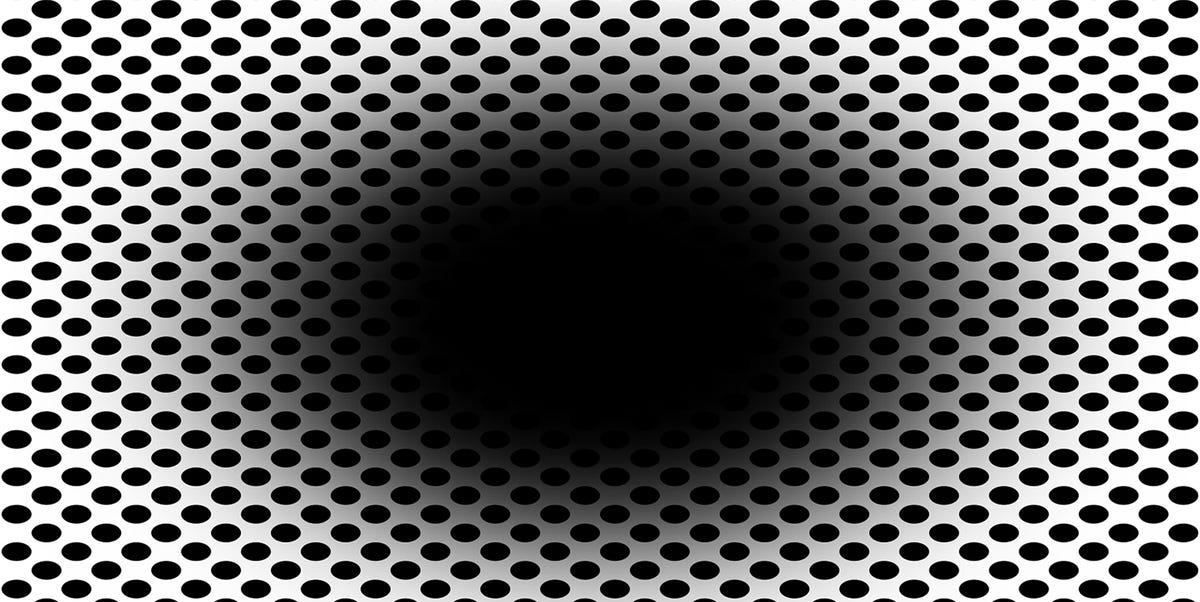
Some optical illusions politely confuse you. Others barge into your brain, rearrange the furniture, and leave your pupils wondering who authorized the remodel. The tunnel illusion, often called the “expanding hole” or “black hole” illusion, belongs firmly in the second category. It is a static image, yet many people see the dark center expanding, as if they are moving forward into a tunnel, cave, or mysterious hallway that probably contains either buried treasure or a very judgmental raccoon.
What makes this illusion so fascinating is not merely that it looks like motion. Plenty of optical illusions make still patterns appear to wiggle, rotate, shimmer, or breathe. This one goes deeper: it can trigger a measurable physical reaction in the eye. For many viewers, the pupil dilates as though the person is actually entering a darker space. In other words, your brain does not just “think” something is happening. It prepares your body for it.
That is why the tunnel illusion is more than internet eye candy. It is a tiny, hypnotic lesson in how vision works. Your eyes collect light, but your brain builds the scene. Sometimes it builds so quickly and confidently that it adds motion, depth, and danger where none exists. Welcome to the weirdly brilliant world of visual perception, where a flat picture can make your nervous system pack a flashlight.
What Is the Tunnel Illusion?
The illusion usually appears as a dark circular region surrounded by a pattern of dots, gradients, or soft shadow-like shapes. Look at the center, and the black area may seem to grow. The effect can feel like leaning into a tunnel, moving toward a hole, or watching darkness spread outward from the middle of the image.
The most famous version is associated with the expanding-hole illusion studied by psychologist Bruno Laeng, researcher Shoaib Nabil, and visual illusion expert Akiyoshi Kitaoka. In the image, nothing actually moves. There is no animation, no hidden video, and no browser trick. The apparent motion comes from how the visual system interprets contrast, gradients, and spatial arrangement.
Why It Feels Like You Are Moving Forward
The key idea is optic flow. In everyday life, when you walk, drive, bike, or sprint dramatically toward the refrigerator at midnight, the visual world expands outward from the direction you are moving. Objects appear to spread away from a central point. Your brain has learned this pattern very well because it helps you navigate through space without constantly bumping into tables, doors, or your own bad decisions.
The tunnel illusion imitates that expansion pattern. The dark center and surrounding elements suggest a scene where you are heading into a dim space. Your brain connects the dots, almost literally, and predicts forward motion. The result is the feeling that the hole is expanding even though the image is perfectly still.
The Science Behind the “Black Hole” Effect
Vision is not a simple camera system. A camera records light; the human brain interprets it. That interpretation is fast, predictive, and deeply influenced by past experience. When you see shadows, gradients, and a central dark area, your brain does not patiently ask, “Is this truly a tunnel?” It makes a quick best guess: “Dark opening ahead. Prepare accordingly.”
This is where the illusion becomes especially interesting. In studies of the expanding-hole illusion, many participants who perceived the center as growing also showed pupil dilation. The pupil is the opening in the eye that controls how much light enters. In dim conditions, pupils generally expand to let in more light. In bright conditions, they constrict to reduce exposure. The surprising part is that the pupil can respond not only to real brightness but also to perceived brightness or darkness.
Your Pupil Believes the Illusion Too
Think of the pupil as the eye’s automatic light-management system. It usually responds without your permission, which is polite because nobody wants to manually adjust their pupils before walking into a movie theater. With the tunnel illusion, the eye may behave as if the viewer is entering a darker environment. The image tricks perception, and perception nudges the body.
That does not mean everyone experiences the same thing. Some people see dramatic expansion. Others notice only a mild pulsing sensation. A smaller group sees nothing unusual at all. For them, the image remains a flat black spot with dots around it, which is scientifically valid but admittedly less fun at parties.
Why Some People See the Tunnel and Others Do Not
Optical illusions are not universal remote controls for the brain. Different people may experience the same illusion differently because perception depends on attention, eye movement, contrast sensitivity, viewing distance, screen brightness, and individual assumptions about depth.
If your brain interprets the picture as a three-dimensional scene, the tunnel effect may feel stronger. If your brain treats it as a two-dimensional design, the motion may be weaker or absent. Tiny eye movements can also influence the effect. Even when you think your gaze is steady, your eyes make small adjustments that help refresh visual information. In patterned illusions, these movements can amplify the sensation of motion.
Viewing Conditions Matter
The illusion may change depending on where and how you look at it. A bright phone screen in a dim room can make the contrast feel stronger. A larger image may increase the sense of depth. Looking slightly around the central area instead of staring with laser focus may make the dark center seem to breathe or swell. The background color can also matter. Some versions of the illusion produce stronger expansion depending on the surrounding colors and contrast gradients.
In short, the tunnel illusion is not just in the picture. It is in the meeting between picture, eye, brain, and environment. That meeting is where perception gets delightfully strange.
How the Brain Predicts What Happens Next
One of the most powerful explanations for illusions like this is that the brain is constantly predicting the near future. Vision takes time. Light must enter the eye, stimulate the retina, travel through neural pathways, and be processed by the brain. To keep you functioning in a fast-moving world, the brain does not simply report what arrived a moment ago. It predicts what is probably happening now or what is about to happen next.
Most of the time, this predictive system is incredibly useful. It helps you catch a ball, step off a curb, avoid a closing elevator door, and understand where your coffee mug will be after your hand reaches for it. But illusions exploit the same system. They present cues that normally mean one thing in real life, then remove the real-world event. The brain predicts motion, but the image remains still.
The Tunnel Illusion as a False Alarm
The expanding-hole illusion acts like a harmless false alarm. In nature, moving into darkness can matter. A dark tunnel, doorway, cave, or unlit room means less available visual information. Your visual system may prepare for that change by widening the pupil. The illusion borrows the visual ingredients of that experience: central darkness, surrounding pattern, and gradient-like cues. Your brain fills in the rest.
This is not a failure of intelligence. It is a sign that your visual system is doing what it evolved to do: interpret incomplete information quickly. The fact that a still image can fool it is not embarrassing. It is evidence that perception is active, not passive.
Why Optical Illusions Are Useful, Not Just Fun
Optical illusions often get treated as party tricks, but scientists value them because they reveal the rules of perception. When the brain makes a predictable mistake, researchers can study that mistake to understand how normal vision works. Illusions help show how the brain processes color, brightness, motion, edges, depth, and attention.
The tunnel illusion is especially useful because it connects a subjective experience with a measurable physical response. A person may report, “The center looks like it is expanding,” while an eye tracker records changes in pupil diameter. That combination gives researchers a bridge between what people say they experience and what the body does automatically.
Other Illusions That Help Explain This One
The tunnel illusion belongs to a larger family of motion and brightness illusions. The waterfall illusion, for example, occurs when you stare at moving water for a while and then look at a still surface; the still surface may appear to drift in the opposite direction. Brightness illusions can make identical shades appear different depending on surrounding context. The Asahi illusion can make a center appear brighter than it physically is, sometimes encouraging pupil constriction.
These examples show that the brain does not evaluate visual details in isolation. It compares, predicts, adapts, and interprets. The tunnel illusion simply happens to package those processes into one dramatic little “whoa” moment.
Design Lessons From the Tunnel Illusion
Artists, designers, filmmakers, game developers, and educators can learn a lot from this illusion. The effect demonstrates how strongly contrast and composition can guide attention. A central dark area naturally pulls the eye inward. Repeated surrounding elements create rhythm. Gradients suggest depth. Together, these features can make a flat design feel spatial and alive.
In user experience design, this is a useful reminder that visuals are never neutral. A button, background, animation, or loading screen can create a sense of movement or direction even without actual motion. In film and gaming, tunnel-like visual patterns can produce immersion, suspense, or speed. In museum exhibits and classrooms, illusions can turn abstract neuroscience into something people feel immediately.
Why the Effect Grabs Attention Online
The tunnel illusion is perfect for the internet because it invites instant participation. You do not need a laboratory, special training, or a philosophy degree. You simply look and ask, “Is it moving?” Then someone else looks and says, “Obviously.” Then a third person says, “No, it is just a blob.” Congratulations: you now have a lively discussion about neuroscience disguised as a comment section.
Its shareability comes from personal variation. People enjoy illusions because they reveal that perception is private. We assume others see the world the way we do, but illusions prove that reality can feel slightly different from one brain to another. That tiny crack in certainty is both unsettling and fun.
Experience Section: What It Feels Like to See the Tunnel Illusion
The first experience many people have with this illusion is a double take. At first glance, the image looks simple: a dark center, a patterned border, maybe a few dots arranged with suspicious confidence. Then, after a second or two, the center seems to expand. It does not leap outward like a movie effect. It creeps. It swells. It gives the strange impression that the screen has become less like a screen and more like a doorway.
That feeling can be surprisingly physical. Some viewers describe it as being pulled forward. Others say it feels as if the black center is breathing. A few feel mild unease, not because the image is frightening, but because it violates a basic expectation: still things should stay still. When the brain says “motion” and common sense says “no motion,” the result is a tiny perceptual argument happening behind your forehead.
Trying the illusion on different devices can make the experience even more interesting. On a phone, the image may feel compact and intense, especially when the screen is bright. On a laptop or desktop monitor, the larger size can make the tunnel sensation more immersive. In a dim room, the contrast between the glowing screen and the dark center can make the illusion feel stronger. In a bright room, the effect may become softer, as if the tunnel has lost some of its drama and decided to become a polite design pattern instead.
Distance also changes the experience. When viewed up close, the dots and gradients may become more noticeable as individual design elements. Step back slightly, and the whole pattern may blend into a stronger impression of depth. This is similar to how some artwork becomes clearer from across the room. The brain stops inspecting parts and starts interpreting the whole.
Another common experience is the urge to test the illusion repeatedly. People look away, look back, squint, tilt the screen, zoom in, zoom out, and recruit nearby humans as experimental subjects. “Do you see it moving?” becomes the official question. If the other person says yes, you feel validated. If they say no, you may briefly wonder whether they are immune to magic or simply being difficult.
The most memorable part is realizing that the illusion is not just a trick “out there.” It is happening inside the visual system. The image is motionless, but the experience is real. Your perception genuinely changes. Your attention shifts. Your eyes may even adjust. That is what makes the tunnel illusion so satisfying: it turns neuroscience into something you can feel in real time, without a textbook, lab coat, or suspiciously expensive equipment.
Can the Tunnel Illusion Be Dangerous?
For most people, the tunnel illusion is harmless. However, some visual patterns can cause discomfort, eye strain, dizziness, or mild nausea, especially in people who are sensitive to motion illusions, migraines, or high-contrast patterns. If an illusion makes you uncomfortable, the best strategy is simple: look away. The brain is impressive, but it does not award bonus points for staring bravely at a weird dot until your forehead files a complaint.
People with photosensitive epilepsy or strong visual sensitivity should be cautious with intense, flashing, or high-contrast illusions. The expanding-hole illusion is usually static, but individual comfort varies. Good lighting, moderate screen brightness, and short viewing times can make the experience easier.
Conclusion: A Small Image With a Big Lesson
The tunnel illusion works because the brain is not a passive recorder of the world. It is an active prediction machine, constantly interpreting light, shadow, pattern, and motion cues. When a static image resembles the visual pattern of moving into darkness, the brain may create the sensation of entering a tunnel. For many viewers, the body joins the illusion, and the pupil dilates as though darkness is truly increasing.
That is the magic of this illusion: it reveals how much of “seeing” is actually thinking, predicting, and preparing. The black center does not move, but your perception may move anyway. The tunnel is not real, but the experience of depth and motion can be. In a world full of visual noise, the expanding-hole illusion reminds us that the most powerful special effects are sometimes already built into the human brain.