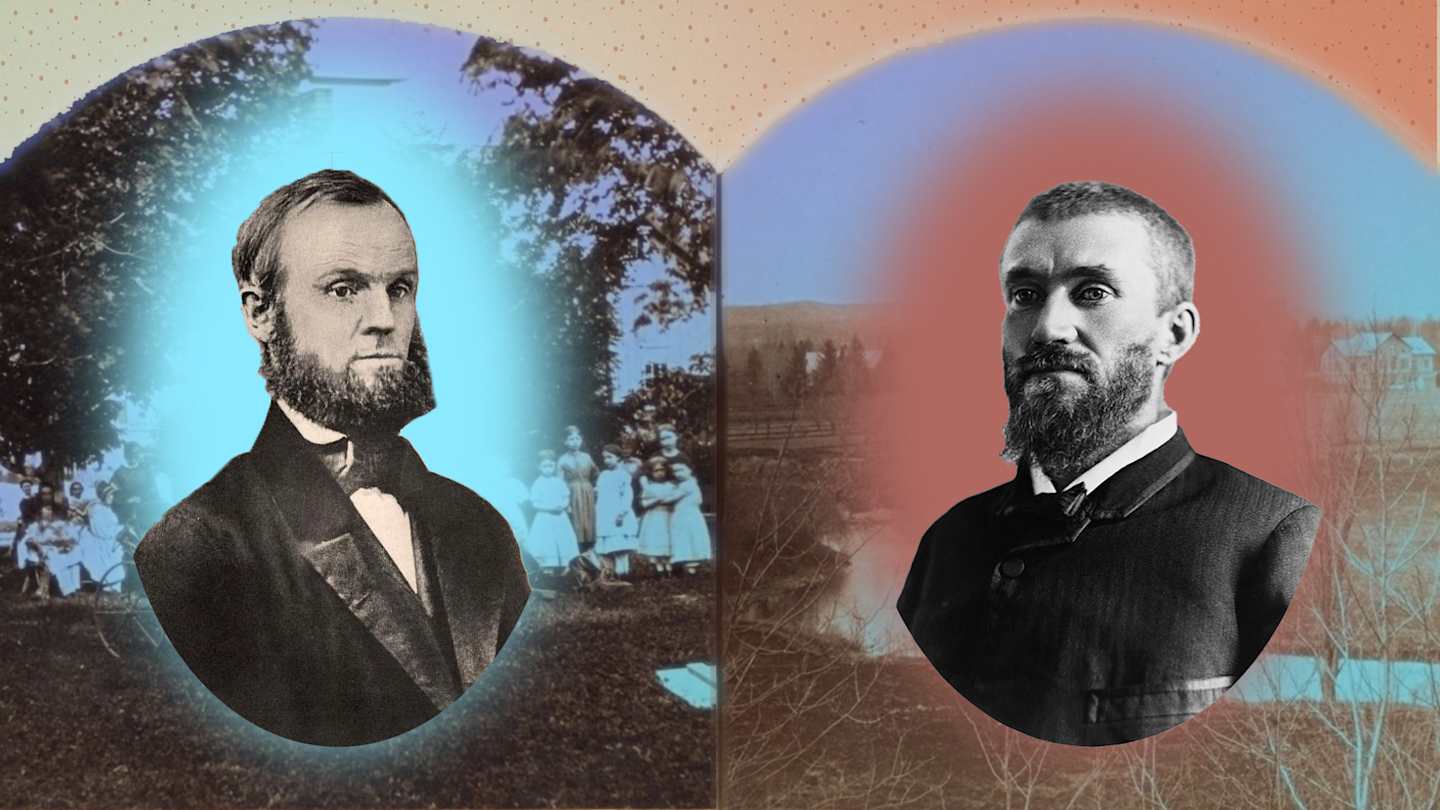
Note: This article uses the phrase “free love cult” as a modern, attention-grabbing shorthand. Historically, the group is more accurately known as the Oneida Community, a 19th-century religious utopian commune in New York. Its story is strange, influential, uncomfortable, and very real.
Introduction: When Utopia Met an Assassin
American history has a habit of hiding its weirdest chapters in plain sight. One moment you are eating dinner with a fork from a famous silverware brand; the next, you discover that the brand’s roots stretch back to a radical religious commune that practiced group marriage, communal parenting, public criticism sessions, selective breeding, and a form of “free love” that made Victorian America clutch its pearls so hard the pearls probably needed medical care.
That commune was the Oneida Community. Founded in 1848 in Central New York by John Humphrey Noyes, it promised nothing less than heaven on earth. Members believed they could live without sin, without private property, without traditional marriage, and without the boring old social rules that kept everyone else buttoned up and miserable. It was part religious experiment, part social laboratory, part business empire, and part awkward family meeting that somehow lasted three decades.
And yes, it also housed Charles J. Guiteau, the man who would later assassinate President James A. Garfield in 1881. Before Guiteau became one of the most infamous “disappointed office seekers” in American history, he was a young man drifting through the Oneida Community, hoping to find spiritual purpose, social status, and perhaps a little romantic success. Spoiler alert: he found none of those things. The women reportedly nicknamed him “Charles Gitout,” which is both cruel and, historically speaking, devastatingly efficient branding.
The story of the Oneida Community and Charles Guiteau is not simply a quirky historical footnote. It reveals the tension between idealism and control, freedom and hierarchy, religious certainty and personal delusion. It also shows how the 19th century produced experiments so bold that they still sound like rejected streaming-service pitches today.
What Was the Oneida Community?
The Oneida Community began in 1848 when John Humphrey Noyes led followers from Vermont to Oneida, New York. Noyes was a radical religious thinker shaped by the Second Great Awakening, a period when America was bubbling with revivals, reform movements, utopian experiments, and the occasional person declaring that society had been doing everything wrong since breakfast.
Noyes preached a doctrine called Perfectionism. In his view, Christ’s Second Coming had already occurred spiritually in the ancient past, and therefore true believers could become free from sin in the present world. This was not a “try to be nicer to your neighbors” kind of theology. Noyes believed perfection could be organized, managed, and lived collectively. His followers were not waiting for heaven; they were building it in upstate New York, brick by brick, sermon by sermon, and committee meeting by committee meeting.
The community shared property, labor, religious practice, and social responsibility. At its height, it had roughly 300 members living in and around the massive Oneida Community Mansion House. The building eventually reached about 93,000 square feet, making it less a cozy farmhouse and more a Victorian group project with bedrooms.
A Commune With Business Skills
Oneida was not just a dreamy spiritual retreat where people sat around discussing perfection over herbal tea. The community was economically sharp. Members produced animal traps, silk thread, canned goods, and later silverware. Their businesses helped finance the commune and gave it unusual staying power compared with many 19th-century utopian experiments, which often collapsed after discovering that ideals are inspiring but rent is persistent.
After the community dissolved, its business legacy continued through Oneida Community, Ltd., later known as Oneida Ltd. That means one of America’s best-known silverware names grew out of a religious commune famous for rejecting monogamy. History, as always, refuses to behave at dinner.
The “Free Love” System: Complex Marriage
The most notorious feature of the Oneida Community was “complex marriage.” Noyes rejected exclusive monogamous marriage because he believed it encouraged possessiveness, jealousy, and selfishness. Instead, he taught that every adult man and woman in the community was, spiritually speaking, married to every other adult member.
This did not mean romantic chaos in the modern sense of casual dating with worse lighting. The system was highly structured, socially monitored, and shaped by Noyes’s authority. Relationships were supposed to be guided by spiritual maturity and communal benefit. Members were discouraged from forming exclusive emotional bonds. In theory, love was to be shared broadly. In practice, it was managed by a religious leader and a community culture that did not exactly specialize in privacy.
Male Continence and Control
Another key Oneida practice was male continence, a sexual discipline in which men were expected to avoid ejaculation during intercourse. Noyes believed this separated the emotional or spiritual function of sex from reproduction. To his followers, it was a method of self-control and family planning. To outsiders, it was one more reason to whisper, stare, and write outraged newspaper commentary.
The community also developed a controlled reproduction program called stirpiculture. Beginning in the late 1860s, members who wanted children were expected to receive approval, with pairings selected according to physical, spiritual, and moral qualities. In plain English: Oneida experimented with selective breeding before the word “eugenics” became widely associated with later, darker movements. It is one of the more unsettling parts of the community’s history and a reminder that utopian thinking can become deeply invasive when human beings are treated like entries in a planning ledger.
Mutual Criticism: The Original Group Chat From Hell
If complex marriage was Oneida’s most famous practice, mutual criticism may have been its most psychologically intense. Members were brought before committees or groups and publicly evaluated for personal flaws. The stated goal was moral improvement. The lived experience probably varied from “helpful spiritual feedback” to “imagine your worst performance review, but with everyone you live with.”
Even Noyes submitted to criticism, at least in principle. But the system reinforced community discipline and social conformity. If someone was lazy, vain, selfish, flirtatious, proud, gloomy, or just irritating before coffee, there was a mechanism for addressing it in front of others.
To be fair, many Oneida members believed sincerely in the system. They saw it as a path toward self-improvement and spiritual refinement. But from a modern perspective, mutual criticism also looks like a powerful tool of social pressure. In a community where housing, work, faith, romance, reputation, and identity were all intertwined, criticism was not merely feedback. It was governance.
Enter Charles Guiteau: The Man Who Could Not Fit In Anywhere
Charles Julius Guiteau was born in Freeport, Illinois, in 1841. His early life was unstable, religiously intense, and emotionally difficult. His mother died when he was young, and his father was stern, devout, and deeply interested in religious reform movements. Guiteau grew up absorbing a volatile mix of spiritual ambition, insecurity, and grand expectations.
In 1860, after failing to establish himself academically, Guiteau joined the Oneida Community. His father admired Noyes’s ideas, and Guiteau hoped the commune would provide him with purpose. On paper, Oneida might have seemed perfect for a young man seeking spiritual significance. It promised belonging, discipline, and a cosmic mission. For Guiteau, however, it became another stage on which he failed to become important.
“Charles Gitout”
Guiteau’s time at Oneida was not a triumph. He reportedly disliked manual labor, annoyed other members, and failed to win the admiration he believed he deserved. In a community where “free love” was part of the social system, he was still unpopular with women. The nickname “Charles Gitout” says almost everything. When a free-love commune collectively tells you to leave, it may be time for deep self-reflection. Guiteau, unfortunately, was not famous for that skill.
He left, returned, left again, tried to launch a religious newspaper called The Daily Theocrat, and later pursued legal claims against Noyes and the community. The pattern was already visible: grand plans, poor execution, resentment, and the conviction that other people owed him recognition.
Oneida did not turn Guiteau into an assassin. That would be too simple and unfair. But his experience there fits the larger arc of his life: he entered institutions expecting destiny and left them feeling rejected. The community that promised spiritual family became one more place where he felt humiliated.
From Failed Utopian to Failed Everything Else
After Oneida, Guiteau drifted through a series of careers with remarkable consistency: he failed at nearly all of them. He tried law, bill collecting, preaching, publishing, insurance sales, and politics. He married Annie Bunn in 1869, but the marriage collapsed. He moved often, borrowed money, avoided bills, and cultivated the air of a man who believed greatness was just about to arrive if everyone would stop being so unfair.
By 1880, politics became his chosen road to fame. Guiteau attached himself to the Republican Party during the presidential campaign. He originally supported Ulysses S. Grant but shifted to James Garfield after Garfield unexpectedly became the Republican nominee. Guiteau wrote and printed a campaign speech that almost nobody heard and fewer people cared about. In Guiteau’s mind, however, the speech was a political thunderbolt that helped put Garfield in the White House.
This delusion mattered. Guiteau believed Garfield owed him a reward. Specifically, he wanted a diplomatic post, eventually fixing his imagination on the consulship in Paris. Never mind that he had no meaningful diplomatic experience. Never mind that speaking French was not exactly his superpower. In the theater of Guiteau’s mind, he had earned Paris. The administration, rudely attached to reality, disagreed.
The Spoils System and the Road to Violence
To understand why Guiteau’s obsession gained such destructive power, it helps to understand the spoils system. In the 19th century, government jobs were often distributed as political rewards. Support the winning faction, and you might receive a post. Lose favor, and your career could vanish. Merit mattered, but connections frequently mattered more.
Garfield entered the presidency amid Republican Party factional conflict. The Stalwarts, associated with Senator Roscoe Conkling and Vice President Chester A. Arthur, defended patronage politics. Reformers wanted a more professional civil service. Garfield’s resistance to Conkling’s control of New York appointments became a major political battle.
Guiteau interpreted this conflict through his own delusions. He imagined himself a loyal Stalwart and decided that Garfield was betraying the party by denying him office and challenging patronage power. When Secretary of State James G. Blaine finally told him to stop bothering the administration about the Paris job, Guiteau took rejection as cosmic instruction. He convinced himself that God wanted Garfield “removed” so Arthur could become president.
The Assassination of President Garfield
On July 2, 1881, Charles Guiteau followed President James A. Garfield to the Baltimore and Potomac Railroad Station in Washington, D.C. Garfield was preparing to travel, accompanied by Secretary of State Blaine and members of his family. Presidential security was minimal by modern standards. The assumption that presidents required constant protection had not yet fully taken hold, even after Abraham Lincoln’s assassination.
Guiteau shot Garfield twice. One bullet grazed him; the other lodged inside his body. Guiteau was quickly arrested. He reportedly believed Arthur would become president, the Republican Party would be saved, and he himself would be rewarded. It was not a plan so much as a hallucination wearing a political hat.
Garfield did not die immediately. In fact, modern medical observers have often argued that the gunshot itself might have been survivable. The real disaster came afterward. Doctors repeatedly probed Garfield’s wound with unsterilized fingers and instruments while searching for the bullet. Infection set in. Alexander Graham Bell even tried to locate the bullet with an experimental metal-detection device, but the effort failed. Garfield suffered for weeks before dying on September 19, 1881.
The Trial: Madness, Media, and a National Spectacle
Guiteau’s trial became one of the most sensational legal dramas of the Gilded Age. He pleaded not guilty, and insanity was central to the defense. Yet Guiteau repeatedly undermined his own lawyers with interruptions, speeches, insults, and self-important declarations. He insisted that the doctors, not he, had killed Garfield. Morally grotesque as that argument sounded, it contained a grim medical truth: the infection caused by treatment was a major factor in Garfield’s death.
The public was fascinated and horrified. Newspapers covered Guiteau’s outbursts eagerly. The trial forced Americans to confront difficult questions about mental illness, legal responsibility, and political violence. Guiteau claimed divine inspiration. The court and jury were not persuaded. He was convicted and executed by hanging on June 30, 1882.
How Oneida Fits Into the Story
The Oneida Community did not cause the Garfield assassination. But it helps explain the strange world that shaped Guiteau. Nineteenth-century America was crowded with reformers, prophets, communes, revivalists, political machines, traveling lecturers, self-made men, failed self-made men, and people who believed the universe had personally appointed them assistant manager of destiny.
Guiteau moved through that world like a man forever auditioning for greatness and forever rejected after the first scene. At Oneida, he encountered a community built on radical belonging but experienced exclusion. In politics, he encountered a system built on rewards and convinced himself he had been cheated of one. His life was a long argument between fantasy and reality. Reality kept winning. Guiteau kept appealing the verdict.
That is what makes the connection between Oneida and Garfield’s assassin so fascinating. The same century that produced America’s industrial rise and democratic expansion also produced radical communes, spiritual experiments, unstable patronage politics, and astonishingly weak presidential security. The Oneida Mansion House and the Baltimore and Potomac Railroad Station may seem worlds apart, but they were connected by one restless, resentful man.
The Collapse and Legacy of the Oneida Community
By the late 1870s, the Oneida Community faced internal conflict and external pressure. Noyes’s leadership, complex marriage, and sexual practices drew increasing scrutiny. In 1879, warned that he might face arrest, Noyes fled to Canada. Soon after, he advised the community to abandon complex marriage. The old religious commune dissolved, and by 1881 it had reorganized as a joint-stock company.
The shift from radical religious experiment to silverware business is one of the great plot twists in American commercial history. Oneida’s spiritual utopia ended, but its industrial and branding legacy endured. The group that once tried to reinvent love, labor, family, and reproduction became associated with forks, spoons, and middle-class dining rooms.
That legacy is complicated. Oneida promoted women’s participation in work and governance more than many conventional institutions of the era. It experimented with communal child care and economic cooperation. It also subjected members to intense social control, intrusive sexual regulation, and reproductive planning that feels deeply troubling today. Like many utopias, it shines brightest from a distance and becomes more complicated the closer you stand.
Experiences and Reflections: Visiting the Story Behind the Headline
Encountering the story of “the bizarre free love cult that housed a presidential assassin” is a bit like opening an old American attic and finding a silver spoon, a religious manifesto, a court transcript, and a loaded pistol in the same dusty trunk. The topic pulls readers in because it sounds outrageous, but the deeper experience is not simply shock. It is recognition. The Oneida Community and Charles Guiteau reveal how people search for belonging, status, certainty, and meaningand how dangerous those searches can become when humility goes missing.
Imagine walking through the Oneida Community Mansion House today. The building itself does not scream scandal. It looks dignified, historic, even peaceful. Its rooms suggest order, shared purpose, and Victorian confidence. Yet behind those walls, people attempted to redesign nearly every intimate part of life. Marriage, parenting, property, work, sex, criticism, reproductionnothing was too personal to become part of the communal experiment. For visitors, that creates a strange emotional double vision. You can admire the ambition and still feel uneasy about the control.
The most memorable experience related to this topic is realizing that history rarely divides neatly into heroes, villains, and background furniture. Noyes was not merely a cartoonish cult leader twirling a theological mustache. He was intelligent, persuasive, disciplined, and visionary. He also built a system in which his ideas shaped the private lives of hundreds of people. The Oneida members were not fools. Many were sincere believers who worked hard, raised children, built businesses, and created a functioning society. Yet sincerity does not erase harm, and idealism does not automatically protect people from manipulation.
Then there is Guiteau, who is almost too bizarre for fiction. If a novelist invented him, editors might complain that he was “a little much.” Failed student, failed communard, failed lawyer, failed preacher, failed husband, failed office seekerand then, catastrophically, successful assassin. His life shows the ugly side of wounded entitlement. He wanted to be chosen, admired, rewarded, and remembered. The tragedy is that he finally achieved remembrance through violence.
Modern readers may find the story uncomfortably familiar. Guiteau’s delusional belief that he alone understood the nation’s destiny sounds extreme, but the ingredients are not extinct: grievance, isolation, political obsession, spiritual certainty, and a hunger for fame. The technology has changed; the emotional machinery has not. Today, a man like Guiteau might not haunt hotel lobbies with printed speeches. He might post manifestos online, chase attention in comment sections, or mistake algorithmic visibility for divine confirmation.
The Oneida angle adds another layer because it reminds us that communities promising perfect freedom can still create new forms of pressure. A group may reject conventional rules while inventing rules of its own. It may denounce possessiveness while controlling relationships. It may preach equality while concentrating authority in a charismatic leader. That does not make every intentional community dangerous, but it does suggest a useful test: if a utopia cannot tolerate dissent, privacy, or ordinary human messiness, it may be less heavenly than advertised.
For writers, historians, and curious readers, this topic is a gold mine because it combines social history, political violence, religion, psychology, gender, medicine, and business. It begins with “free love” and ends with civil service reform. It moves from a commune bedroom to a presidential deathbed. It includes a mansion, a nickname, a failed newspaper, a disputed bullet, an insanity defense, and a silverware company. Honestly, if history had a writers’ room, this episode would be accused of overstuffing the plot.
The lasting experience is one of humility. The people of Oneida believed they could perfect human society. Guiteau believed he could redirect American politics with a gun. Both stories warn against certainty without self-knowledge. The Oneida Community asked how people might live better together. Guiteau showed what can happen when a person cannot live honestly with himself. Between those two poles lies one of the strangest, darkest, and most revealing stories in American history.
Conclusion: The Utopia, the Outcast, and the Bullet
The Oneida Community remains one of the most unusual social experiments in American history. It challenged marriage, property, gender roles, child rearing, religious authority, and economic life. It also exposed the dangers of allowing a single vision of perfection to govern human intimacy. Charles Guiteau’s time there was only one chapter in his troubled life, but it was an important one: a failed search for belonging inside a community that claimed to offer universal spiritual family.
Years later, Guiteau carried his resentments into the poisonous atmosphere of Gilded Age patronage politics. His assassination of President Garfield shocked the nation, exposed failures in presidential security and medicine, and helped accelerate civil service reform. In that sense, the story of Oneida and Guiteau is not just bizarre. It is a window into an America wrestling with faith, ambition, reform, delusion, and the high cost of confusing personal destiny with public good.