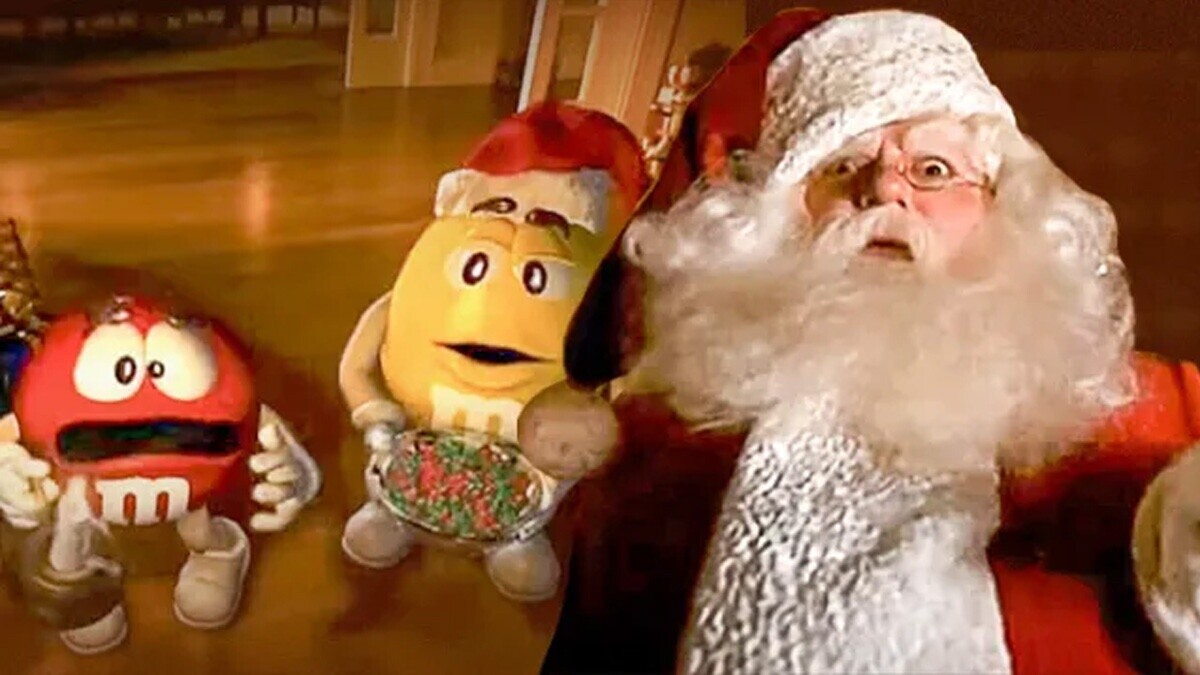
Every December, the same tiny holiday drama returns to television and the internet: Red and Yellow M&M wander into a Christmas living room, Santa Claus appears, everyone realizes everyone else is real, and thenboomSanta and Red collapse like two shoppers who just saw the price of overnight shipping on December 23.
The classic M&M’s Christmas commercial, often known as “Faint” or “They Do Exist,” has become one of those rare ads people do not merely tolerate. They expect it. They quote it. They use it as a seasonal starting pistol. For many Americans, Christmas does not officially begin when the tree goes up, the mall starts playing “Jingle Bell Rock,” or someone’s uncle begins debating whether eggnog is “basically breakfast.” It begins when Red squeals, “He does exist!” and Santa gasps back, “They do exist!”
But let us address the peppermint-striped elephant in the room: Santa hits the floor. Hard. The commercial never shows a medical evaluation, a North Pole injury report, or Mrs. Claus standing nearby with an ice pack and a look that says, “Again?” So naturally, the internet has done what the internet does best: turned a 15-second holiday ad into a forensic comedy case. Did the classic M&M’s commercial give Santa a concussion? Officially, no. Spiritually, comedically, and with great concern for workplace safety at the North Pole? Absolutely worth investigating.
The Commercial That Refuses to Retire
The M&M’s “Faint” commercial first appeared in the mid-1990s and has aired during holiday seasons for decades. That kind of longevity is advertising gold. Most commercials disappear faster than the last red M&M in a candy bowl. This one keeps coming back because it does three things perfectly: it is short, funny, and emotionally simple.
The setup is beautifully efficient. Yellow carries a bowl of red and green M&M’s, presumably as a snack offering for Santa. Red, being Red, is skeptical and sarcastic. He has never met Santa, so why assume the guy is real? Then Santa enters. Red and Santa lock eyes. Two myths collide in a living room lit like a department-store snow globe.
Red says the line. Santa says the line. Both faint. Yellow, left standing with the emotional burden of Christmas and possibly a liability lawsuit, mutters, “Santa?”
That is the entire ad. No overexplaining. No celebrity cameo. No 47-second voice-over about limited-time holiday flavors. Just character, timing, and one spectacular collapse from a beloved seasonal figure.
Why the “They Do Exist” Joke Works So Well
The genius of the commercial is that it reverses the usual Santa myth. Children wonder whether Santa exists. Adults perform elaborate cookie-and-stocking theater to keep the magic alive. But here, Santa is equally stunned to discover that talking candy mascots are real. The joke is not simply “Santa is real.” The joke is that Santa, a flying-reindeer logistics wizard, still has room in his worldview for disbelief.
That mutual shock gives the ad its charm. Red is not just surprised; he is forced to admit that his skepticism was wrong. Santa is not just surprised; he realizes that the candy he may have been eating for years has a face, a voice, and possibly opinions about being placed in trail mix.
It is a perfect holiday comedy equation: innocence plus absurdity plus excellent timing. The commercial does not ask viewers to understand a complicated brand message. It says, “M&M’s belong at Christmas, Santa knows it, and everyone is having a small crisis about it.”
So, About Santa’s Possible Concussion
Let us be clear: Santa is a fictional character in a candy commercial, not a patient in an urgent care waiting room. Still, the visual gag is built around sudden collapse, and that is why the “concussion” interpretation has become so funny. In the ad, Santa does not gently recline onto a supportive holiday ottoman. He drops out of frame with the dramatic energy of someone who has just learned that cookies are being replaced by kale chips.
In real life, a concussion is a type of traumatic brain injury that can happen after a blow, bump, or jolt to the head. Common signs can include confusion, dizziness, headache, feeling foggy, nausea, or temporary loss of consciousness. Again, Santa is not real and the commercial is slapstick, but the joke lands because the fall is so sudden that viewers instinctively think, “Is he okay?”
The answer, according to holiday advertising logic, is yes. Santa returns in later M&M’s storytelling, and the brand eventually created a sequel that addressed what happened after the famous faint. But in the court of public comedy, Santa absolutely needed observation, rest, and perhaps a stronger rug pad.
The North Pole Workplace Safety Problem
If we pretend for one ridiculous moment that this was a real workplace incident, the North Pole has questions to answer. Why was Santa entering a dim living room without announcing himself? Why were open candles present near walking chocolate? Why was Yellow the only conscious adult-equivalent in the room? And why, after two beings fainted, was there no elf emergency response team?
A modern safety report might read: “Employee Claus experienced sudden loss of balance after unexpected mascot encounter. Contributing factors include low lighting, high holiday pressure, and insufficient training on animated confectionery awareness.” Corrective action: install softer carpeting, require helmets during Christmas Eve deliveries, and brief Santa annually on all sentient snack brands.
The Role of Red and Yellow in M&M’s Brand Magic
Red and Yellow are the emotional engine of the commercial. Red is sharp, skeptical, and easily annoyed. Yellow is sweet, simple, and optimistic. Together, they form a classic comedy pair: the cynic and the golden retriever in candy form.
That dynamic matters because the commercial is not really about candy. It is about personality. Viewers remember the red and green holiday colors, yes, but they mostly remember the characters. Red gets the punchline because his disbelief collapses in real time. Yellow gets the final beat because his gentle “Santa?” turns a slapstick fall into a tiny cliffhanger.
This is why M&M’s spokescandies have lasted so long. They are not just mascots placed next to a product. They behave like sitcom characters who happen to be made of chocolate. The candy sells the season, but the characters sell the memory.
Why This 15-Second Ad Became a Holiday Tradition
Holiday commercials have a special advantage: repetition feels comforting instead of annoying when the timing is right. A random insurance jingle in July may make people reach for the mute button. A familiar Christmas commercial in December can feel like unpacking an ornament you forgot you loved.
The M&M’s Santa commercial sits in the same nostalgic category as other short seasonal ads that return year after year. It is not trying to reinvent the holiday. It is trying to become part of the ritual. And it succeeded because it leaves room for viewers to bring their own memories to it.
Some people remember seeing it as kids while sitting too close to the television. Some remember it playing during holiday movie marathons. Others associate it with baking cookies, wrapping gifts, or pretending not to eat half the candy meant for guests. The ad became less like a sales pitch and more like a tiny seasonal visitor.
The 2017 Sequel Finally Asked, “What Happened Next?”
For more than 20 years, the original commercial ended with Santa and Red unconscious and Yellow standing there in mild panic. That unresolved ending became part of the fun. Did Yellow save Christmas? Did Santa wake up? Did Red pretend the whole thing never happened? Did anyone check the structural integrity of Santa’s skull?
The brand eventually answered with “Faint 2: A Very Yellow Sequel,” a longer follow-up that expanded the story. In the sequel, Yellow tries to step in and save Christmas after Santa and Red faint. As expected, his helpfulness creates chaos. But the heart of the story remains consistent with the M&M’s holiday message: mistakes, generosity, and togetherness can still create something joyful.
The sequel worked because it did not erase the original. It honored the cliffhanger and gave fans a playful continuation. Most importantly, it confirmed what viewers always suspected: Yellow may not be the best emergency manager, but he has the purest holiday intentions.
What Marketers Can Learn From Santa’s Dramatic Collapse
The classic M&M’s Christmas commercial is a master class in compact storytelling. It proves that a memorable ad does not need to be loud, expensive-looking, or packed with information. It needs a clear setup, a surprising turn, and a line people want to repeat.
1. Keep the Story Simple
The ad does not explain the entire history of M&M’s. It does not list product features. It does not shout about a sale. It gives viewers one funny moment that connects the candy to Christmas. That is enough.
2. Use Characters People Already Like
Red and Yellow feel familiar, which allows the commercial to move quickly. Viewers understand their personalities almost instantly. Red doubts. Yellow believes. Santa appears. Comedy happens.
3. Create a Repeatable Line
“He does exist!” and “They do exist!” are short, symmetrical, and easy to quote. Great ad lines often sound like something a regular person might say in a silly situation. These lines work because they are both specific to the scene and flexible enough to become a holiday catchphrase.
4. Leave a Little Mystery
The original commercial ends before everything is resolved. That tiny unanswered question helped keep the spot alive in people’s minds. Sometimes the best storytelling choice is not to explain everything. Let the audience wonder. Let them joke. Let them ask why Santa’s medical team was apparently on a cocoa break.
Why We Still Laugh at the Same Joke
Comedy can age badly, especially in advertising. Jokes that once seemed clever can become awkward, dated, or just plain exhausting. The M&M’s Santa commercial still works because its humor is gentle. Nobody is insulted. Nobody is humiliated in a mean way. Santa and Red faint from wonder, not cruelty.
The physical comedy is cartoonish enough to be safe but surprising enough to be funny. The scene looks cozy, not chaotic. Even the fainting feels soft around the edges, despite our ongoing concern for Santa’s fictional head trauma.
There is also something comforting about seeing a powerful figure surprised. Santa knows who is naughty and nice. He navigates the entire world in one night. He has a reindeer with a built-in fog light. Yet even he can be stunned by the impossible. That little reversal makes him more lovable.
Experiences Related to “That Classic M&M’s Commercial Gave Santa a Concussion”
For many viewers, the experience of watching this commercial is less about discovering it and more about recognizing it. The first few notes of the music, the warm glow of the room, the bowl of red and green candy, and Yellow’s innocent question all trigger the same reaction: “Oh, this one.” It is the advertising equivalent of finding the good ornament in the storage binthe one wrapped badly in tissue paper but somehow still alive.
One common experience is the family rewatch. Someone sees the commercial during a holiday movie and immediately quotes the lines before the characters say them. Another person, usually from a different generation, asks why everyone is laughing at an ad they have seen a thousand times. Then the room performs the commercial like a tiny seasonal play: “He does exist!” “They do exist!” “Santa?” It is not sophisticated theater, but neither is eating cookie dough over the sink, and both are important traditions.
Another experience is the adult realization that the commercial is strangely efficient. As kids, people remember the funny fainting. As adults, they notice the structure. The ad builds an entire world in seconds. There is a house, a Christmas Eve mission, a snack for Santa, a skeptic, a believer, a supernatural reveal, and a cliffhanger. Meanwhile, most of us need three paragraphs just to explain why we are late to dinner.
Then there is the “Santa needs a doctor” viewing experience. Once someone points out that Santa collapses hard enough to raise questions, it becomes impossible not to see it. Every replay turns into a holiday safety audit. Did he hit the floor? Was there a thud? Did Red cushion the fall? Why did Yellow not call anyone? Is there a North Pole concussion protocol? The commercial remains sweet, but now it comes with imaginary paperwork.
Parents often experience the ad differently. The Santa question is already delicate in many households, and this commercial plays with belief in a clever way. It does not mock the magic; it expands it. Santa is real, the M&M’s are real, and everyone is equally overwhelmed. For children, that is funny. For adults, it is a reminder that wonder can still sneak up on people who think they have the whole world figured out.
There is also a strong nostalgia experience for people who grew up in the 1990s. The commercial’s standard-definition look, quick pacing, and uncluttered joke feel like a preserved holiday time capsule. It does not depend on social media trends, influencer cameos, or a cinematic universe of candy lore. It is just a living room, two candies, Santa Claus, and a fainting incident that would absolutely require a follow-up email from Human Resources.
Finally, the commercial creates a shared seasonal language. Saying “They do exist” can instantly summon the whole scene for people who know it. That is rare. Most ads ask for attention; this one earned affection. It became a small, repeatable holiday ritual that makes people smile before they even think about buying candy. And that may be the real magic: not that Santa survived a possible concussion, but that a 15-second commercial survived decades of changing media habits and still feels like Christmas.
Conclusion: Santa Fell, the Ad Rose
“That Classic M&M’s Commercial Gave Santa a Concussion” is a funny way to describe a commercial that has lived rent-free in America’s holiday brain for decades. Officially, Santa simply faints. Unofficially, he takes one of the most memorable tumbles in Christmas advertising history and somehow turns it into brand magic.
The ad endures because it understands the power of a tiny perfect moment. Red’s disbelief, Santa’s shock, Yellow’s concern, and the cozy holiday setting all work together without wasting a second. It is funny enough for kids, nostalgic enough for adults, and strange enough for the internet to keep lovingly overanalyzing it.
So yes, we can joke that Santa needed a concussion check. We can imagine elves filling out incident reports and Yellow trying to fly the sleigh with the confidence of someone who should not be trusted with heavy machinery. But the real takeaway is simpler: great holiday advertising does not just sell a product. It becomes part of how people remember the season.
And every year, when Santa whispers “They do exist” and drops out of frame, one truth remains clear: Christmas has arrived, Red was wrong, Yellow is concerned, and someone really should put pillows under that tree.