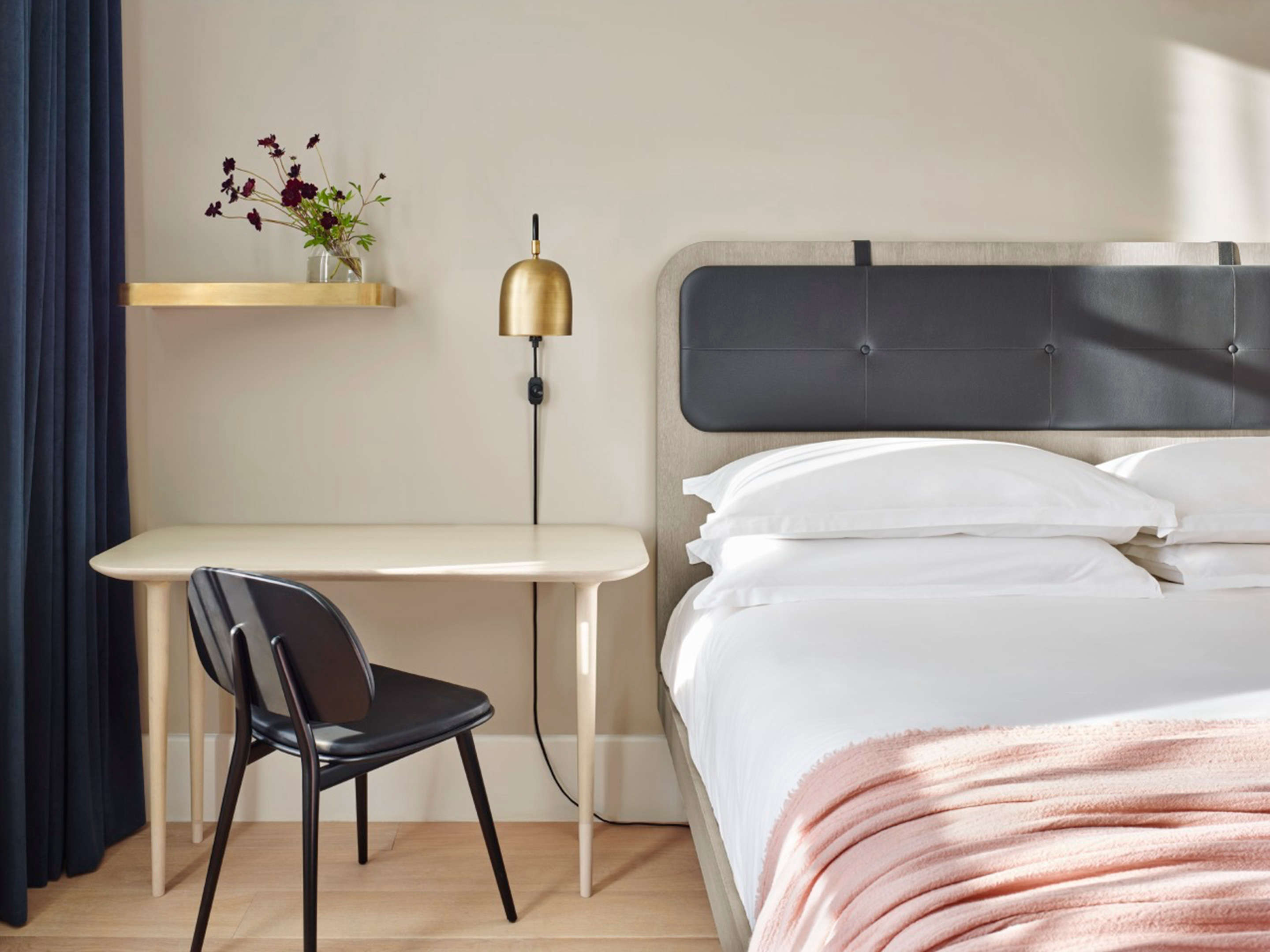
There is a particular kind of hotel room that makes you walk through the door, drop your bag, and immediately reconsider every decorating decision you have made since adulthood. The Scandinavian-inspid belong squarely in that dangerous category. Suddenly, your crowded nightstand looks suspicious. Your pile of decorative pillows feels like a small textile uprising. And why, exactly, do you own four mismatched lamps?
The appeal is not loud luxury. This is a Scandi bedroom built around quiet confidence: pale wood, tailored upholstery, smoky gray, deep navy, muted pink, and warm metal details. Remodelista’s original look at the rooms highlighted bleached wood, gray, navy, pink accents, brass elements, and an ingenious use of desks in place of ordinary bedside tables. The hotel’s own description continues to emphasize light oak floors, handcrafted furnishings, naturally dyed fabrics, and generous natural light. w do you steal this SoHo hotel bedroom look without stealing an actual hotel room? Let’s break down the design logic, the furniture strategy, and the small details that make Scandinavian style feel luxurious rather than like you simply forgot to decorate.
Why This Scandi Bedroom Look Works
Scandinavian interiors are commonly associated with functional furniture, clean lines, natural materials, restrained color, craftsmanship, and a strong relationship with daylight. The goal is not to empty a room until it echoes. It is to choose fewer things and make those things genuinely useful, comfortable, and attractive. istinction matters in a bedroom. Traditional luxury often announces itself with elaborate trim, dramatic chandeliers, shiny surfaces, and a headboard large enough to have its own ZIP code. A Scandinavian hotel bedroom takes the opposite route. Luxury comes from proportion, tactile materials, calm lighting, and the pleasing experience of everything being exactly where you need it.
11 Howard gives that philosophy a New York accent. Space Copenhagen’s hotel project brings Scandinavian design into SoHo, while the rooms retain an urban mood through dark blue, brass, black details, and dusty pink. Space Copenhagen identifies 11 Howard as one of its New York hotel projects, while contemporary coverage of the property has repeatedly emphasized its residential approach to guest-room design. With a Soft, Slightly Moody Color Palette
Build the room around quiet neutrals
Begin with warm white, chalky gray, mushroom, or pale greige. These shades create a calm background for wood furniture and darker accents. Scandinavian design is famous for neutral foundations, but that does not mean every room has to resemble a bowl of oatmeal.
Design guidance on Scandinavian interiors consistently favors pale neutrals and natural materials, while deeper earth-inspired blues, greens, grays, and browns can act as grounding accents. is SoHo hotel-inspired look, imagine the color formula as roughly 70 percent light neutral, 20 percent wood and dark blue, and 10 percent soft pink or warm metal. This is not a law. The interior design police will not arrive with paint swatches. It is simply an easy way to keep the room balanced.
Use navy as a sophisticated anchor
Navy curtains, a dark blue throw, or one upholstered chair can give the room architectural weight. The original inspiration benefits from the contrast between pale oak and deeper blue. Without a darker tone, a light Scandi bedroom can become visually weightless.
Choose one or two navy elements rather than spreading blue across every surface. A dark textile is more effective when the eye has somewhere to rest. One blue curtain panel has presence. Twelve nautical pillows suggest you may be expecting a lighthouse inspector.
Add pink, but choose the grown-up version
The unexpected pink in the 11 Howard palette is part of the room’s charm. Remodelista specifically noted pink alongside bleached wood, gray, and navy, including mauve-toned upholstery in the guest-room furniture. or dusty rose, clay pink, faded blush, or mauve. Avoid overly sugary pink unless that is genuinely your style. A single lumbar pillow, wool throw, ceramic vase, or occasional chair is enough to soften the room.
Let Light Oak Do the Heavy Lifting
Natural wood is one of the easiest ways to create warmth without adding visual clutter. Better Homes & Gardens notes that light natural woods, including white oak, are particularly compatible with airy interiors and neutral palettes. Scandinavian decorating sources similarly emphasize light woods as a defining material. hotel-inspired bedroom, consider a light oak bed frame, desk, dresser, or bench. You do not need every wooden object to match. In fact, a room can look more natural when pale oak sits beside a slightly darker chair or smoked-wood accent.
The secret is controlling the undertones. Woods with warm, yellow-red undertones can fight against cool gray walls. Pale oak, white oak, ash, and softly washed finishes tend to cooperate beautifully with gray, navy, and dusty pink.
If replacing furniture is not in the budget, introduce wood through a stool, picture frame, wall hooks, lamp base, or narrow shelf. Scandinavian style respects function, so bonus points go to anything that can hold your book, sweater, or glass of water instead of merely standing around looking photogenic.
Choose an Upholstered Bed That Looks Tailored, Not Puffy
The bed should feel soft without becoming marshmallow architecture. Look for an upholstered frame or headboard in gray, taupe, oatmeal, or a subtle woven texture. Straight edges and light tufting work particularly well.
A simple upholstered bed creates a visual bridge between crisp Scandinavian lines and the comfort expected from a high-end hotel. Bedroom design advice also frequently uses an upholstered headboard to add softness and a grounded focal point without requiring busy decoration. he silhouette relatively low. A giant wingback headboard with crystal buttons will immediately change the room’s language from Copenhagen-in-SoHo to enthusiastic suburban glam. Neither is wrong, but they are not saying the same thing.
Steal the Smartest Trick: Use a Desk Beside the Bed
Here is the move worth copying even if you ignore everything else: replace a conventional nightstand with a compact desk.
In the 11 Howard guest rooms, the designers used desks as bedside furniture to make better use of limited New York bedroom space. s excellent small-bedroom design because one surface performs several jobs. At night, it holds a glass of water, phone, and book. During the day, it becomes a laptop station, writing desk, or vanity. Add one beautifully shaped chair and you have created an entire functional zone without squeezing another piece of furniture into the room.
Choose a desk with slender legs and a shallow depth. Heavy executive furniture will swallow the space. A pale wood writing table around the visual weight of a console is ideal.
Apartment Therapy’s small-space guidance similarly points to compact, unconventional bedside surfaces and wall-mounted lighting as practical ways to preserve space around a bed. ale Wood With Black and Brass
A successful Scandi bedroom needs contrast. Otherwise, beige bedding, pale walls, and light oak can merge into one enormous cappuccino foam layer.
Black provides definition. Try a black leather chair, slim metal frame, dark vase, or small tray. Use it in controlled doses. You are outlining the room, not opening a nightclub.
Then add brass.
Brass lighting and shelving are important visual details in the original 11 Howard scheme. Remodelista’s product study of the room focused on shaded brass lights, a brass shelf, and a brass-based side table among the elements that echoed the hotel’s look. aged, brushed, or antique-style brass rather than highly reflective gold. A little patina feels warmer and sits naturally beside oak. The result is glamorous, but quietly so. Think excellent wristwatch rather than championship trophy.
Layer Lighting Like a Boutique Hotel
Do not ask one ceiling light to do everything
Hotels understand something many bedrooms forget: lighting changes how you experience a space. One bright ceiling fixture may technically illuminate the room, but so does the lighting in a pharmacy.
Use at least two lighting levels. Ambient light creates the overall glow. Task lighting serves the bed or desk. A third decorative light, such as a small floor lamp, can provide depth in a larger room.
Look for shaded brass pendants, wall sconces, or compact floor lamps with directional shades. Their sculptural shapes become decorative even when switched off.
Wall-mounted lights are especially useful in a narrow bedroom because they free the bedside surface. The desk can then hold an open book or laptop without performing an obstacle course around a lamp base.
Choose warm bulbs
A Scandi hotel atmosphere depends on warmth. Select warm-white light rather than cold blue-white illumination. Pale oak and dusty pink become richer under warm light, while gray upholstery feels softer.
This is one of the cheapest improvements in the entire makeover. Before buying a new chair, rug, bed, and possibly a small Danish island, change your bulbs and observe the room at night.
Make Texture the Decoration
Scandinavian minimalism avoids unnecessary clutter, but it is not supposed to feel sterile. Texture does much of the decorative work. HGTV and Better Homes & Gardens both emphasize combinations of wood, linen, wool, stone, upholstery, and metal as ways to give neutral rooms depth and warmth. with simple white or off-white sheets. Add a gray quilt or duvet, then fold a textured linen or wool throw across the lower third of the bed. Finish with two or three accent pillows.
Yes, two or three. You should be able to go to bed without conducting a nightly pillow relocation ceremony.
Choose fabrics that show their weave. Washed linen, brushed cotton, wool, bouclé, and softly textured upholstery all fit the look. The color palette may be quiet, but the surfaces should reward a closer look.
Use Velvet Curtains for a SoHo Twist
Classic Scandinavian interiors often maximize daylight and favor restrained window treatments. Elle Decor’s overview of Nordic design specifically highlights simple window treatments that allow natural light to enter. hotel, however, also has to deal with privacy and nighttime darkness. That is where rich navy curtains become interesting. Velvet or a heavy textured fabric creates contrast against light oak and pale walls while making the bedroom more cocoon-like after sunset.
For a home version, hang the curtain rod high and extend it beyond the window frame. Long panels visually stretch the wall and give the room a tailored hotel finish. During the day, pull them fully aside. At night, enjoy the immediate transformation from bright Scandinavian retreat to sophisticated Manhattan cave.
Decorate With Useful Objects
The accessories in this kind of room should look intentional. A stone tray can collect jewelry. A glass jug can hold water. A slim brass shelf can support a vase. A beautiful chair must also be comfortable enough to sit in.
This functional approach reflects a broader principle of Scandinavian design: furnishings and objects are valued for usefulness as well as form. simple bedside arrangement:
- A stone, marble, or ceramic tray
- A clear glass carafe
- One small vase with dark flowers or leafy branches
- A book you are actually reading
- A small black container or sculptural object
Notice what is missing: seven framed inspirational quotes, a fake typewriter, three wooden bead garlands, and a tiny decorative ladder with no known purpose.
How to Get the Scandi Hotel Look on a Realistic Budget
Spend on the large silhouette
If you are buying new furniture, prioritize the bed or desk. These pieces determine the room’s lines and proportions. Choose simple forms that can survive future decorating changes.
Save on accessories
Trays, glassware, pillow covers, and vases do not have to come from famous Scandinavian brands. Search secondhand shops for heavy glass, stone, simple brass objects, and dark ceramics.
Upgrade through material, not quantity
One linen throw can improve the room more than five inexpensive synthetic blankets. One nicely shaped wood stool may contribute more character than a matched bedroom suite.
The goal is not to purchase a catalog page. It is to understand the visual system behind the room: pale natural wood, muted upholstery, strategic dark color, warm metal, tactile fabric, and breathing space.
Common Mistakes That Can Ruin the Look
Making everything white
White walls plus white bedding plus white furniture can be peaceful, but without wood, texture, or contrast, the space risks feeling unfinished. Add gray, oak, navy, and one softer accent color.
Buying too many “Scandinavian” accessories
A shelf full of objects labeled Nordic is still a shelf full of clutter. The Spruce’s overview of Scandi rooms repeatedly returns to clean lines, restrained styling, natural wood, and functional layouts rather than decorative overload. ing comfort
A chair shaped like an elegant wooden question mark may look fantastic, but if sitting in it causes an immediate conversation with your lower back, reconsider. Scandinavian-inspired design should support daily life.
Using cold lighting
Nothing defeats a cozy gray-and-oak bedroom faster than a blue LED bulb with the emotional warmth of an office printer.
Copying every object exactly
The most convincing “steal this look” room is an interpretation. Copy the relationships between colors, shapes, and materials. Your desk can be vintage. Your chair can come from a flea market. Your vase can be an old glass bottle. The visual rhythm matters more than the label underneath the furniture.
Living With the Look: The Real Scandi Bedroom Experience
The first morning feels surprisingly different
Imagine waking up in a room rebuilt around this SoHo-meets-Scandinavia formula. The first thing you notice is not a decorative object. It is space. The nightstand clutter is gone because the bedside desk has enough surface area for essentials without forcing everything into a six-inch pile.
Morning light comes through the wide window and lands on pale wood. The oak does something that painted furniture rarely manages: it changes character during the day. In early light, it looks soft and almost blond. Later, warmer sunlight reveals more grain. That subtle variation becomes part of the decoration.
The navy curtain panels are pulled to the side, so the darker color forms two strong vertical lines. Gray bedding looks cooler in daylight, while the dusty pink pillow suddenly makes more sense. It is a small detail, but without it the room might feel slightly serious. The pink acts like the one funny person invited to a very tasteful dinner party.
The desk changes how a small bedroom behaves
By late morning, the most useful decision becomes obvious: the desk beside the bed is not just a styling trick.
A laptop opens where last night’s book was sitting. The same chair that looked sculptural from the doorway now has an actual job. A wall sconce leaves the workspace clear, and the narrow desk is deep enough for a notebook and coffee without turning the bedroom into a corporate headquarters.
This dual-purpose arrangement is particularly effective in a studio apartment, guest room, or older city bedroom. The room does not gain square footage, obviously. No Scandinavian chair possesses supernatural zoning powers. But the furniture makes the available area work harder.
There is also a psychological benefit to having fewer pieces. Instead of navigating around a nightstand, a desk, a chair, and an extra accent table, you have one compact workstation. The floor appears more open. Cleaning becomes easier. A robot vacuum, should you employ one, may finally stop sending distress signals from beneath three sets of furniture legs.
Evenings reveal the importance of lighting
After sunset, the bedroom becomes a different space. This is when the brass lights earn their place.
The warm glow picks up the metal finish without making it flashy. Navy becomes deeper. Gray upholstery looks softer. The oak shifts toward honey. You begin to understand why layered lighting is so important to hotel rooms: it gives you control over the mood.
Turn off the main ceiling fixture and use only the bedside sconce and floor lamp. Immediately, the corners become quieter. A simple glass jug throws a small reflection. The marble or stone tray catches a strip of light. None of these objects is particularly dramatic alone, yet together they create the impression of careful design.
This is where the room starts to feel luxurious. Not because it contains dozens of expensive things, but because every material responds differently to the light.
The minimalism requires a little discipline
After a few days, however, Scandinavian calm meets real life.
A sweater appears on the chair. Two water glasses gather on the desk. Charging cables begin their ancient migration across the floor. The beautiful linen throw somehow twists itself into a fabric croissant at the foot of the bed.
The room teaches an important lesson: minimalist interiors are not magically tidy. They simply reveal clutter faster.
Oddly, this can be helpful. Because the room contains fewer objects, resetting it takes only a few minutes. Fold the throw. Return the book to the desk. Put the cables in a small box. Hang the sweater. Suddenly the entire space looks intentional again.
Closed storage becomes essential. A dresser with plain drawer fronts is far more useful than another open shelf. The Instagram version of Scandinavian living may display three perfect ceramic cups. Real life owns receipts, spare batteries, medicine, mystery cables, and an instruction manual for an appliance that disappeared in 2022. Give those things a drawer.
The room feels personal when you stop copying the hotel
After living with the look, the final step is adding something that does not belong to the design formula.
Maybe it is a small painting from a local artist. Perhaps it is a battered book inherited from a grandparent, a ceramic vase made by a friend, or a photograph in a simple oak frame. One meaningful object can make the room feel more residential, which is fitting because the appeal of the 11 Howard interiors comes partly from their home-like character rather than a standardized hotel aesthetic. s the experience worth stealing. The best Scandi bedroom does not constantly demand that you admire it. It makes daily routines easier. Morning light feels better. Work has a place. The bed looks inviting without requiring twenty decorative cushions. Evening lighting encourages you to slow down.
And, perhaps most importantly, the room can be restored to magazine-level calm in roughly the time it takes to wonder why you ever bought that neon “GOOD VIBES” sign.
Conclusion: Steal the Design Logic, Not Just the Furniture
The enduring appeal of a Scandi bedroom in a SoHo hotel comes from contrast. Scandinavian simplicity meets Manhattan mood. Light oak sits beside navy velvet. Gray upholstery is softened by dusty pink. Brass warms clean furniture lines. Practical pieces are chosen carefully enough to feel luxurious.
To recreate the look, begin with a restrained neutral backdrop and natural wood. Add a tailored upholstered bed, one flexible desk, a comfortable chair, and layered warm lighting. Use navy to ground the palette, pink to soften it, and brass sparingly. Finish with linen, wool, glass, stone, and only a handful of useful accessories.
Most importantly, leave some room empty. In a world determined to sell us one more pillow, basket, vase, table, organizer, and decorative mushroom, breathing space might be the most luxurious bedroom feature of all.
Note: Hotel furnishings, room details, and individual product availability can change over time. Use the design principles and material combinations as inspiration when adapting the look to your own bedroom.