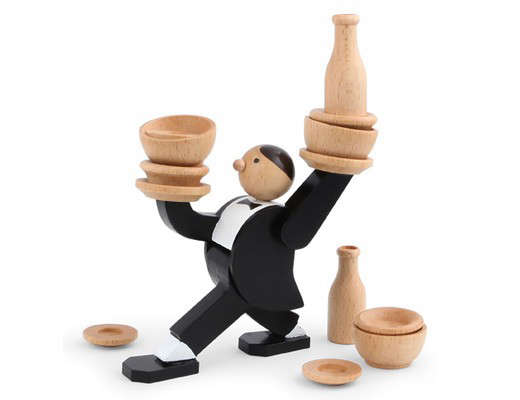
Some games enter the room quietly. Others arrive wearing a tuxedo, holding a tray, and daring everyone at the table to make one tiny mistake. Stacking Game Dont Tip The Waiter belongs proudly in the second category. It is a compact wooden balancing game built around a simple idea: stack the dishes, bottles, bowls, and plates onto the waiter’s hands without sending the whole restaurant into a tabletop disaster.
At first glance, it looks charming enough to sit on a coffee table as a quirky design object. Then someone places the first piece. The waiter wobbles. A plate leans. A bottle rolls slightly. Suddenly, the whole room is holding its breath like the fate of fine dining depends on a six-inch wooden server with heroic posture. That is the magic of a good stacking game: the rules are easy, the tension is instant, and the comedy is unavoidable.
This in-depth guide explores what makes Dont Tip The Waiter stacking game so appealing, how it works, why families enjoy it, what skills it encourages, and how to turn a tiny wooden balancing challenge into a surprisingly memorable game night experience.
What Is Stacking Game Dont Tip The Waiter?
Stacking Game Dont Tip The Waiter is a dexterity and balance game designed around a waiter figure and a set of small wooden serving pieces. Players take turns placing items onto the waiter’s hands or tray area, trying to keep everything balanced. The objective is simple: do not be the player who causes the waiter to tip over.
The game is commonly associated with Kikkerland and designer Chris Collicott. Product descriptions often highlight its wooden construction, compact size, and suitability for ages six and up. Depending on the version, the set may include small plates, bowls, bottles, or other restaurant-themed pieces. The visual joke is clear: this waiter is trying to carry far too much, and you are definitely not helping.
Unlike long strategy games with thick rulebooks, this wooden stacking game does not ask players to memorize complicated phases, resource systems, or the political economy of a fantasy kingdom. It asks one thing: can your hand stay steady when everyone is staring at you? That directness makes it excellent for families, casual parties, kids’ playrooms, classrooms, and anyone who thinks “just one more piece” is a perfectly reasonable plan right before disaster.
How the Game Works
The basic gameplay is easy to understand. Set up the waiter figure on a flat surface. Place the small wooden pieces nearby. Players then take turns adding one piece at a time. The more pieces added, the more unstable the structure becomes. Eventually, gravity makes a dramatic entrance, the waiter tips, and the guilty player receives the kind of judgment usually reserved for people who microwave fish in an office kitchen.
Basic Rules
Rules may vary slightly by version, but the core play pattern usually follows this structure:
- Place the waiter figure on a stable, level table.
- Players take turns adding one dish, plate, bowl, or bottle.
- Each piece must be placed carefully without holding the waiter in place.
- If the waiter tips or the stack collapses, that player loses the round.
- Players can reset and play again immediately.
That last point matters. Dont Tip The Waiter is fast. A round can be over in a minute, especially when someone gets ambitious and tries to place a bottle on top of a bowl balanced on a plate. Because the game resets quickly, losing feels funny rather than frustrating. It is less “I have failed” and more “the waiter has filed a formal complaint.”
Solo, Two-Player, and Group Play
Many product descriptions present the game as suitable for one or two players, but its appeal can easily stretch into group settings. Solo play works like a personal challenge: how high can you stack before the waiter gives up? Two-player play adds direct tension, since every move creates a worse problem for the next person. Group play turns the game into a social event, especially if players cheer, gasp, and deliver unnecessary restaurant commentary.
For example, one player might carefully place a tiny plate on the left hand. The next player counters with a bowl on the right. A third player adds a bottle, because apparently chaos needed seasoning. Within seconds, the table becomes a miniature physics lab disguised as a slapstick dining room.
Why This Wooden Stacking Game Works So Well
The best tabletop games often have a clean emotional hook. In Dont Tip The Waiter, the hook is balance under pressure. The game creates suspense without requiring complex strategy. Everyone understands the risk. Everyone can see the danger. The entire table knows when a move is bad, which naturally leads to laughter, teasing, and the classic phrase, “No, no, that’s totally stable,” spoken three seconds before collapse.
It Is Visually Funny
The waiter theme gives the game personality. A generic stacking tower can be fun, but a tiny waiter overloaded with dishes adds a story. Suddenly, every piece feels like another unreasonable customer request. A plate becomes a steak dinner. A bottle becomes sparkling water. A bowl becomes soup that absolutely should not be stacked sideways, but here we are.
It Has Instant Rules
Family games succeed when people can begin playing quickly. Dont Tip The Waiter does not require a 20-minute explanation. A child, parent, grandparent, or guest can understand the objective within seconds. Stack carefully. Do not tip the waiter. Try not to laugh when someone else does.
It Creates Real Suspense
Even though the game is small, the suspense feels surprisingly big. Each new piece changes the center of gravity. A safe-looking stack can become unstable with one tiny shift. Players start noticing weight, angle, symmetry, and pressure. Without turning into a lecture, the game quietly introduces basic ideas related to balance and cause and effect.
Educational Benefits of Stacking and Balancing Games
Dont Tip The Waiter is not marketed like a serious classroom tool, and that is part of its charm. Still, stacking games can support several useful developmental skills, especially for children. Play-based learning research often emphasizes that hands-on play helps kids practice planning, coordination, problem solving, patience, and social interaction.
Fine Motor Skills
To place a tiny wooden dish without knocking everything over, players must use controlled hand and finger movements. This kind of careful placement can support fine motor practice. Children learn to grip, lift, position, release, and adjust objects with intention. The game rewards gentle movement, which is excellent news for kids who normally approach toys with the energy of a tiny demolition crew.
Hand-Eye Coordination
Stacking requires players to connect what they see with how their hands move. The eye judges space and angle; the hand attempts to obey. Sometimes the hand succeeds. Sometimes the waiter faceplants into a pile of wooden dinnerware. Either way, the player receives immediate feedback.
Spatial Reasoning and Early STEM Thinking
Balance games encourage players to think about weight distribution, structure, height, and stability. A child may not use the phrase “center of gravity,” but they will quickly learn that placing every piece on one side is a bold strategy with poor long-term prospects. Through repeated rounds, players test predictions: Will this piece fit? Is the left side too heavy? Can a flat plate support a curved bowl? The table becomes a tiny experiment station.
Patience and Emotional Regulation
Good stacking games teach a very practical life lesson: rushing makes things fall over. Players must slow down, wait their turn, and accept that the stack may collapse despite their best effort. For children, this can be a gentle way to practice handling frustration. For adults, it can be a gentle reminder that confidence is not the same as balance.
Social Skills and Turn-Taking
Dont Tip The Waiter works well as a social game because turns are short and visible. Players watch one another, react together, and learn to wait. They also learn that playful failure can be funny. The collapse is not the end of the world; it is the punchline.
Who Is Dont Tip The Waiter Best For?
This stacking game is a good fit for families, casual gamers, design-minded gift shoppers, and people who enjoy tactile games more than screen-based entertainment. It is especially appealing for households that want games that are easy to set up, easy to store, and quick to replay.
Families With Kids
Because the game is simple and visual, it works nicely for family play. Children can understand the goal quickly, and adults can enjoy the challenge without pretending to be entertained. The recommended age is often listed around six and up, which makes sense because the game uses small pieces and requires controlled movements.
Adults Who Like Coffee Table Games
Some games are fun but visually chaotic. Dont Tip The Waiter has the advantage of looking attractive even when nobody is playing. The wooden pieces and small waiter figure give it a decorative quality. It can sit on a shelf, desk, or coffee table and quietly announce, “Yes, I am charming, but I will also expose your shaky hands.”
Teachers, Therapists, and Activity Leaders
While not a medical or therapeutic device, the game may be useful as a light activity for practicing turn-taking, concentration, and careful movement. In classrooms or activity groups, it can serve as a short warm-up game, a reward station, or a cooperative challenge where players try to beat their previous stacking record.
Gameplay Tips: How Not to Tip the Waiter Immediately
Winning at Dont Tip The Waiter is not just about having steady hands. It also involves observation, patience, and knowing when to avoid dramatic nonsense. Here are practical tips for better play.
Start With a Stable Foundation
Early pieces matter. Place flatter, broader pieces in positions that help distribute weight. If you create a crooked foundation, later players will have to build on your poor life choices. The waiter may forgive you. Physics will not.
Balance Both Sides
Try not to overload one side. If the left side has a plate and bowl, consider adding weight to the right side. A balanced waiter is a happier waiter, or at least a waiter less likely to collapse during dessert service.
Use Small Adjustments
Do not jab, shove, or drop pieces. Gentle placement is key. Lower each piece slowly, release carefully, and avoid bumping the existing stack. In this game, confidence should move at the speed of a sleepy snail.
Watch the Angle
A piece that looks stable from one side may be leaning dangerously from another. Before releasing, check the stack from the front and side. Even a tiny tilt can become a big problem after the next move.
Do Not Celebrate Too Early
The stack may remain upright for a second after a risky move, then slowly surrender. Wait before declaring yourself a genius. Many great empires have fallen after someone said, “See? Perfect.”
Why It Makes a Great Gift
Dont Tip The Waiter is a strong gift option because it checks several boxes at once. It is compact, playful, attractive, and easy to understand. It does not require batteries, Wi-Fi, app downloads, subscriptions, updates, chargers, or a password with one uppercase letter and a symbol. You open the box and play.
It is also flexible. It can be a birthday gift for a child, a stocking stuffer, a family game night addition, a desk toy for an office, or a novelty present for someone who enjoys clever design. Because it has a restaurant theme, it can also be fun for food lovers, hosts, servers, and anyone who has ever carried too many plates and instantly regretted it.
Comparison With Other Stacking Games
The toy and game world has many stacking and balancing games, from classic block towers to animal piles and wooden architectural sets. Dont Tip The Waiter stands out because of its theme and compact personality. Instead of simply stacking blocks, players are helpingor sabotaginga character. That small narrative twist makes the game feel more expressive.
Compared with a traditional block tower, this game is more whimsical. Compared with complex board games, it is faster and more approachable. Compared with digital games, it offers physical feedback: pieces wobble, hands tense, and the collapse happens in real space. That tactile quality is a major part of its appeal.
Experience Section: Playing Stacking Game Dont Tip The Waiter in Real Life
The first experience most people have with Dont Tip The Waiter begins with overconfidence. The game looks small. The pieces look harmless. The waiter looks polite. Someone at the table usually says, “This seems easy.” That person is often wrong in a highly entertaining way.
In a family setting, the game quickly becomes a shared performance. A child may place the first plate with surprising precision. A parent may attempt a clever move and immediately make things worse. A grandparent may quietly study the stack, then place a piece so perfectly that everyone suddenly respects their secret engineering career. The best part is that every turn feels important, even though the stakes are delightfully silly.
One memorable way to play is to turn each piece into an imaginary restaurant order. The first plate is pancakes. The second bowl is soup. The bottle is fancy sparkling lemonade. By the fifth or sixth piece, the waiter is carrying an entire brunch buffet for customers who apparently believe trays are optional. This storytelling layer makes the game even more fun for kids, because each move becomes part of a tiny comedy scene.
Another enjoyable version is the “silent round.” Players are not allowed to talk while placing pieces. This sounds calm until someone makes a risky move and everyone around the table starts communicating through wide eyes, dramatic eyebrows, and tiny squeaks. The silence usually breaks when the waiter tips, followed by the kind of laughter that proves simple games can still create excellent memories.
For adults, Dont Tip The Waiter works surprisingly well as a casual party game. It does not demand deep concentration for an hour, but it gives people something to gather around. Guests can join mid-game, watch a round, cheer for disaster, and take a turn without needing a tutorial. It is especially useful when people are waiting for dinner, dessert, or one friend who said they were “five minutes away” fifteen minutes ago.
The game also creates small lessons in patience. The winning move is rarely the fastest one. Players who rush tend to bump the stack, misjudge the angle, or release a piece too suddenly. Slower players often do better because they observe before acting. This makes the game satisfying for kids who enjoy careful challenges and useful for kids who are learning to slow down. The waiter, in his tiny formalwear, becomes an instructor in calm decision-making.
Storage and replay value are part of the experience too. Because the game is compact, it does not feel like a major commitment. You can bring it out for five minutes, play three rounds, and put it away. Or you can leave it on a table and watch people challenge themselves throughout the day. Many games require a scheduled event. Dont Tip The Waiter is more like a snack: small, satisfying, and somehow gone before you realize how many rounds you have played.
The funniest moments usually happen when the stack looks impossible but remains standing. Everyone freezes. Nobody wants to breathe. Then the next player touches one tiny piece, and the waiter collapses as if he has finally decided to pursue a less stressful career. Those moments are exactly why the game works. It transforms a few wooden pieces into suspense, laughter, and friendly blame.
Overall, the real-life experience of playing Dont Tip The Waiter is light, charming, and more engaging than its size suggests. It is not trying to be the biggest game on the shelf. It is trying to be the one that makes people lean closer, laugh louder, and say, “Okay, one more round.” That is a very good job for a very overworked waiter.
Conclusion
Stacking Game Dont Tip The Waiter is a clever wooden balancing game with a simple rule and a big personality. Its appeal comes from the combination of easy gameplay, visual humor, tactile challenge, and replayable suspense. Whether used as a family game, coffee table activity, classroom reward, or quirky gift, it delivers quick fun without complicated setup.
The game also has quiet educational value. Players practice fine motor control, hand-eye coordination, spatial reasoning, patience, and turn-taking. Best of all, they do it while trying not to overload a tiny waiter who clearly deserves a break.
If you are looking for a compact stacking game that is funny, attractive, and easy to play with kids or adults, Dont Tip The Waiter is a delightful choice. It proves that sometimes the best game night drama does not need dragons, dice, or digital screens. Sometimes all it takes is one waiter, too many dishes, and one person who thinks the top of a bottle is a perfectly reasonable place to put a bowl.
Note: This article is written as original web-publishing content based on current product information and general play-development knowledge. It avoids source-link markup inside the article body for cleaner publication.