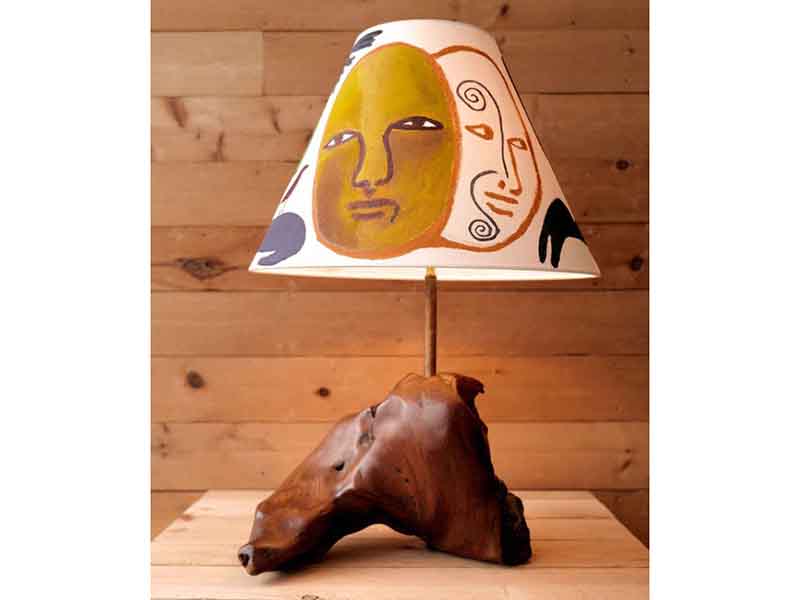
Slow Roads x Emma Kohlmann, Lamp 3 is the kind of object that quietly walks into a room and somehow becomes the most interesting person there. Technically, yes, it is a lamp. It provides light. It has a shade, a base, wiring, and a job description. But calling it “just a lamp” would be like calling a handmade ceramic vase “a water holder with opinions.” This piece belongs to the increasingly exciting world where collectible design, contemporary art, vintage furniture, and functional home decor all sit at the same dinner table.
Created through a collaboration between Slow Roads and artist Emma Kohlmann, Lamp 3 combines a one-of-a-kind hand-painted lampshade with a restored vintage wooden base. The result is sculptural, earthy, playful, and slightly mysterious. It feels less like something pulled from a catalog and more like something discovered in an artist’s studio, a wooded cabin, or a beautifully eccentric friend’s living roomthe friend who somehow owns great linen napkins, three unusual chairs, and a mushroom field guide.
For collectors, design lovers, and anyone who believes lighting should do more than prevent stubbed toes, Slow Roads x Emma Kohlmann, Lamp 3 offers a compelling example of how art can move beyond the wall. It is not merely decor; it is an atmosphere-maker.
What Is Slow Roads x Emma Kohlmann, Lamp 3?
Slow Roads x Emma Kohlmann, Lamp 3 is a handcrafted, one-of-a-kind table lamp made as part of a limited collaboration between the design studio and shop Slow Roads and the Massachusetts-based artist Emma Kohlmann. The lamp was listed at $2,250 and is described as a final-sale artwork. Its official specifications identify the materials as wood, brass, and cotton, with dimensions of approximately 29.5 inches high, 20 inches wide, and 12.75 inches deep.
The lamp features a hand-painted shade paired with a vintage wooden base. Slow Roads notes that the bases in the collaboration were crafted from tree roots and wood slices sourced from around the world, dating back to the 1960s and 1970s. In other words, the base did not wake up yesterday and decide to be trendy. It has history, age, quirks, and the sort of visual character that mass-produced furniture tries very hard to imitate but rarely nails.
The lamp has also been restored and rewired, with necessary updates made while preserving its vintage charm. That balance matters. A collectible lamp needs to be beautiful, but it should also behave responsibly when plugged into the wall. Romantic design is wonderful; electrical drama is not.
The Story Behind the Slow Roads and Emma Kohlmann Collaboration
The broader Slow Roads x Emma Kohlmann collection included only six lamps, each combining a painted custom canvas lampshade with a vintage tree-root or burl wood base. Slow Roads founders Catherine Costanza and Evan Dublin supplied the shades and paired them with vintage bases they found on road trips in places including Upstate New York, Seattle, and California. Each base was carefully restored, giving the finished works a layered identity: part vintage object, part contemporary artwork, part functional sculpture.
Emma Kohlmann painted the shades using watered-down acrylics, working in the spontaneous and intuitive style that has become central to her practice. Rather than relying on rigid preliminary sketches, Kohlmann often allows images to emerge through movement, color, line, and repetition. On the lampshades, that process becomes especially interesting because the surface is not flat. The artwork wraps around the shade, meaning the image changes as the viewer moves around the lamp. It is less a single picture than a small orbiting world.
Who Is Emma Kohlmann?
Emma Kohlmann is an American artist born in 1989 in New York and based in Western Massachusetts. Her work spans drawing, painting, zines, prints, digital art, writing, ceramics, and design. She studied at Hampshire College in Amherst, Massachusetts, and her artistic world often blends figuration, abstraction, mythology, nature, gender fluidity, dreams, and symbolic forms.
Kohlmann’s visual language is immediately recognizable: fluid bodies, floating faces, plants, animals, human-animal hybrids, soft washes of color, and an atmosphere that feels both ancient and freshly imagined. Her figures often resist fixed identity. They stretch, recline, merge, bloom, and float. They seem to come from folklore, cave painting, dreams, feminist theory, and a very productive afternoon with ink and watercolor.
Her career has included solo exhibitions at galleries such as Jack Hanley Gallery in New York, V1 Gallery in Copenhagen, Silke Lindner in New York, Cooper Cole in Toronto, and other international spaces. Her work has also reached design audiences through projects such as the La Pittura tableware collection for HAY. That crossover is important: Kohlmann’s images translate well onto objects because they are already alive with rhythm, pattern, and touch.
Why Lamp 3 Stands Out
Among the Slow Roads x Emma Kohlmann lamps, Lamp 3 stands out for its strong sculptural presence. Its burl-like wooden base gives the piece a grounded, organic personality. The base feels almost geological, as if it belongs equally to furniture history and forest mythology. Paired with Kohlmann’s painted shade, it creates a dialogue between nature and imagination.
The lamp’s size also helps it command attention. At nearly 30 inches tall and 20 inches wide, it is not a tiny bedside lamp trying to mind its business. It has presence. It would work well on a console table, sideboard, large nightstand, reading corner, or anywhere that needs both illumination and personality. In a neutral room, it can become the focal point. In a maximalist room, it can join the party without spilling punch on the rug.
Design Analysis: A Lamp That Behaves Like Sculpture
The Base: Vintage, Earthy, and Full of Character
The wooden base is central to the lamp’s appeal. Vintage tree-root and burl-style bases carry natural irregularities: knots, curves, weight, grain, and imperfections. These details make the lamp feel less manufactured and more discovered. In a home, that kind of material honesty adds warmth. It reminds the viewer that design does not always need to be polished into anonymity.
The Shade: Painting in the Round
Kohlmann’s lampshade turns the lamp into a moving artwork. A framed painting offers one front-facing experience. A painted lampshade gives the viewer multiple angles, changing compositions, and new details depending on where they stand. Add warm light from within, and the shade becomes both image and atmosphere.
The Materials: Wood, Brass, and Cotton
The material mix of wood, brass, and cotton keeps the piece tactile and warm. Wood gives it weight. Brass adds a subtle traditional lighting reference. Cotton softens the shade and allows the painting to sit naturally on the surface. Together, the materials avoid the coldness that sometimes appears in hyper-modern lighting.
How to Style Slow Roads x Emma Kohlmann, Lamp 3
Because Lamp 3 is visually expressive, the best styling approach is to give it room to breathe. Place it where its silhouette can be appreciated, not where it has to fight six picture frames, a stack of unopened mail, and a candle called “Rainy Library Feelings.”
In a minimalist space, Lamp 3 can add soul and irregularity. Pair it with linen curtains, a simple wood table, a neutral wall, and maybe one ceramic bowl. The lamp will bring color, story, and movement without overwhelming the room.
In an eclectic interior, it can sit comfortably among art books, vintage textiles, pottery, plants, and layered patterns. The key is balance. Let the painted shade echo colors already present in the room, or let the wooden base connect with other natural materials such as oak, walnut, rattan, jute, or stone.
In a bedroom, it can soften the mood and make the space feel more personal. In a living room, it can act as a conversation piece. In a study, it can bring warmth to shelves, books, and a writing desk. If your home has one corner that currently feels like it was decorated by a cautious spreadsheet, this lamp would know what to do.
Why Collectible Lighting Is Having a Moment
Collectible lighting has become increasingly appealing because people want homes that feel layered, personal, and less predictable. A lamp is one of the easiest ways to change the emotional tone of a room. Unlike a sofa, it does not require a team of friends, a measuring tape, and a mild identity crisis to move. Yet it can dramatically shift how a room feels.
Artist-made lighting adds another dimension. It brings art into daily use. Instead of hanging on a wall and waiting to be admired, the object becomes part of ordinary rituals: reading, hosting friends, drinking tea, writing emails, or staring into the middle distance while pretending to think deeply. That daily intimacy gives functional art a special power.
The Appeal of One-of-a-Kind Home Decor
One-of-a-kind home decor has a different emotional charge from mass-produced pieces. It carries the mark of a specific maker, moment, and material history. Lamp 3 is especially compelling because it combines two kinds of uniqueness: the vintage base and the hand-painted shade. Neither can be perfectly repeated.
This is not about buying something simply because nobody else has it. That can get a little tiresome, like bragging about owning a rare spoon. The deeper appeal is that the object feels alive. It has texture, decisions, accidents, restoration, color, and handwork. It has a before and after. It has a story worth telling.
Is Slow Roads x Emma Kohlmann, Lamp 3 Worth the Attention?
For the right collector or design enthusiast, yes. Slow Roads x Emma Kohlmann, Lamp 3 is worth attention because it sits at the intersection of art, design, craft, and vintage restoration. It is not a basic lighting purchase; it is a collectible artwork with a functional purpose.
The value lies in several elements: Emma Kohlmann’s growing reputation as a contemporary artist, the limited nature of the collaboration, the one-of-a-kind painted shade, the restored vintage base, and the overall sculptural quality of the piece. It appeals to people who appreciate interiors that feel collected rather than assembled from a single showroom display.
Of course, this kind of lamp is not for everyone. If someone wants a quiet, invisible light source, Lamp 3 may have too much personality. It does not whisper, “I am merely here to support your beige sectional.” It says, politely but firmly, “I brought a forest spirit and several painted figures. Where shall we sit?”
Experiences Inspired by Slow Roads x Emma Kohlmann, Lamp 3
Living with an object like Slow Roads x Emma Kohlmann, Lamp 3 would likely feel different from living with ordinary lighting. The experience would begin before the lamp is even turned on. During the day, the sculptural wooden base would anchor the room with a natural, vintage presence. It would invite close looking: the grain, the curves, the aged surface, the small irregularities that prove the object has lived a life before arriving in the present.
Then there is the lampshade. A hand-painted shade by Emma Kohlmann would reward repeated attention. One day, a viewer might notice a face. Another day, a plant-like form. Another time, the relationship between color and line. The design would not feel static because Kohlmann’s imagery has a drifting, dreamlike quality. It asks the eye to wander.
At night, the experience would change again. Turning on the lamp would transform the shade from painted surface into glowing atmosphere. The colors would soften. The forms would become warmer, more intimate, and perhaps a little stranger. That is one of the pleasures of artist-made lighting: it has two lives. In daylight, it is an object. In darkness, it becomes mood.
Imagine placing Lamp 3 on a low wooden table beside a reading chair. The room is quiet, the overhead light is off, and the lamp throws a warm circle across a book, a ceramic cup, and the edge of a woven rug. The painted figures on the shade become companions. They do not demand attention, but they are present. They make the space feel inhabited by imagination.
Or picture it in an entryway. Guests walk in, pause, and ask, “Where did you find that?” That question is exactly what great objects do. They interrupt autopilot. They invite stories. Suddenly, the entryway is not just a place for keys and shoes; it is the first chapter of the home’s personality.
There is also a slower, more personal experience involved. Objects like Lamp 3 encourage people to decorate less like consumers and more like collectors of feeling. Instead of asking, “Does this match?” the better question becomes, “Does this mean something in the room?” Lamp 3 would not need everything around it to coordinate perfectly. In fact, a little tension would make it better. Pair it with a modern chair, an old table, a stack of art books, or a rough ceramic vessel. Let the lamp create a bridge between eras, materials, and moods.
That is the charm of Slow Roads x Emma Kohlmann, Lamp 3: it makes lighting feel emotional. It turns a practical object into a small daily ceremony. You do not simply switch it on. You activate a piece of art, a restored vintage base, a collaboration between makers, and a pocket of atmosphere. For anyone who believes a home should contain humor, mystery, beauty, and at least one object that seems capable of starting a conversation after midnight, Lamp 3 makes perfect sense.
Conclusion
Slow Roads x Emma Kohlmann, Lamp 3 is more than a luxury lamp. It is a meeting point between contemporary art and vintage design, between hand-painted imagination and restored natural material. Its appeal comes from that layered identity. It is useful, yes, but usefulness is only the beginning. The lamp carries the spirit of Emma Kohlmann’s symbolic, dreamlike visual world and the Slow Roads commitment to artful, character-rich home goods.
For collectors, it offers rarity. For interior design lovers, it offers warmth and sculptural presence. For fans of Emma Kohlmann, it offers an unusual way to experience her imagery in daily life. And for anyone tired of interiors that look as if they were assembled by a very polite algorithm, Lamp 3 is a glowing reminder that the best homes need a little weirdness, a little history, and a little handmade magic.