Termites rarely announce themselves by marching across the kitchen counter and introducing the colony. Instead, they work behind walls, beneath floors, inside framing, and around foundationsquietly turning solid wood into something that may eventually resemble a stale wafer cookie.
That secretive behavior is why recognizing the early signs of termites matters. A few discarded wings near a window may look harmless. A narrow line of dried mud on the foundation may seem like an oddly ambitious dirt project. A door that suddenly sticks may be blamed on humidity. Individually, these clues are easy to dismiss. Together, they may point to an active termite infestation.
This guide explains how to identify termite damage, distinguish termites from flying ants and other wood-destroying pests, inspect common trouble spots, and decide when professional help is necessary.
Research basis: EPA identification guidance and university extension descriptions of termite activity.
Why Termite Damage Is Easy to Miss
Termites feed on cellulose, a material found in wood, paper, cardboard, drywall facing, and many plant-based products. In nature, their recycling work is useful. Inside a house, their enthusiasm becomes significantly less charming.
Subterranean termites usually live in soil and travel between their colony and a food source through underground passages or protective mud tubes. Drywood termites can establish colonies directly inside relatively dry pieces of wood, without maintaining a connection to the soil. Dampwood termites prefer wood with substantial moisture, decay, or both.
The insects generally avoid open air and light. Subterranean termites may consume the interior of a board while leaving a thin outer surface intact. As a result, wood can appear normal until someone presses it, taps it, removes trim, or discovers damage during a remodeling project.
Sources: USDA Forest Service and UF/IFAS explain hidden feeding, termite types, and gallery behavior.
What Do Termites Look Like?
The termites most homeowners see are usually swarmers, also called alates. These winged reproductive termites leave an established colony to pair up and attempt to create new colonies. Workers, which perform most of the feeding and wood damage, normally remain concealed in soil, wood, or shelter tubes.
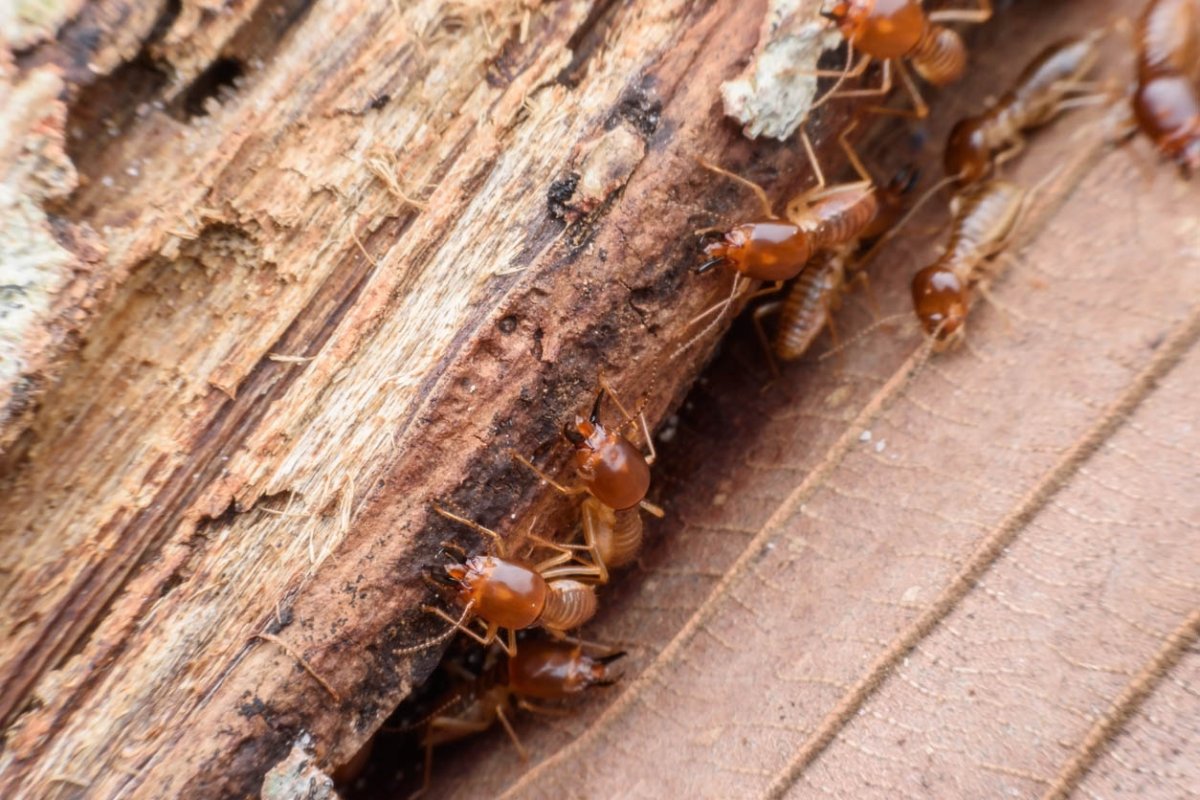
Worker termites are typically pale, soft-bodied, and small. Swarmers are darker and have two pairs of long wings. Because flying ants also swarm, homeowners frequently confuse the two insects.
Termites vs. Flying Ants
Use these physical differences to make a preliminary identification:
- Antennae: Termites have relatively straight antennae, while ants have bent or elbowed antennae.
- Waist: A termite has a broad, fairly uniform body. An ant has a noticeably pinched waist.
- Wings: A termite’s four wings are approximately equal in length. A flying ant’s front wings are longer than its rear wings.
Do not worry if the insects refuse to hold still for a detailed anatomical examination. Capture a few in a sealed container or take clear close-up photographs for a pest management professional.
Sources: University of Maryland, EPA, and National Wildlife Federation identification guidance.
10 Common Signs of Termites and Termite Damage
1. Mud Tubes Along the Foundation
Mud tubes are among the most recognizable signs of subterranean termites. They may appear as narrow, raised lines made from soil, saliva, and other material. Look for them on foundation walls, piers, sill plates, support posts, plumbing penetrations, crawl-space masonry, and other surfaces between soil and wood.
Termites build these tubes to maintain a protected, humid route while traveling. A tube may be straight, branching, pencil-thin, or wider where activity has continued for a long time. Even an abandoned tube shows that termites previously reached that area, so it should not be treated as decorative mud trim.
2. Winged Termites Indoors
A swarm outdoors does not automatically mean the house is infested; the colony could be in a stump, landscape timber, or nearby soil. Swarmers emerging from an interior wall, floor, vent, baseboard, window frame, or other part of the building are more concerning. They suggest that a mature colony may be associated with the structure.
Swarmers themselves do not eat structural wood. Workers cause the damage. However, an indoor swarm is an important warning sign and deserves a professional inspection rather than a heroic attack with a vacuum cleaner and positive thinking.
3. Discarded Wings Near Windows and Doors
After swarming, reproductive termites shed their wings. Homeowners may find small piles of nearly identical wings on windowsills, beside sliding doors, beneath light fixtures, near vents, or caught in spiderwebs.
The insects are attracted to light, so windows are common collection points. Vacuuming up the wings improves housekeeping, but it does not address the colony that produced them. Photograph the evidence before cleaning.
Sources: Kentucky and NC State explain swarming behavior, indoor swarms, and the role of workers.
4. Hollow-Sounding or Papery Wood
Termites often feed beneath the surface, leaving a thin shell around damaged galleries. Lightly tapping suspicious wood with the handle of a screwdriver may produce a hollow sound. Trim, baseboards, joists, subflooring, window frames, and door frames may feel thin, blistered, or unusually fragile.
Do not aggressively stab structural framing to prove a point. Gentle probing can reveal softness, but extensive testing should be left to an inspector or contractor who understands which components carry loads.
5. Wood That Breaks Along Layered Galleries
Subterranean termite damage often follows the softer portions of the wood grain. When damaged wood is opened, the interior may contain layered channels coated with soil or a gritty, mud-like material. Drywood termite galleries tend to be cleaner and may cross the grain.
The appearance differs from an ordinary crack. Termite galleries form an organized network of hollowed spaces, often with only a thin outer veneer remaining.
Sources: NC State and USDA describe hollow wood, easy probing, internal damage, and soil-lined galleries.
6. Drywood Termite Droppings, or Frass
Drywood termites remove waste from their galleries through tiny kick-out holes. The resulting piles of hard pellets are called frass. Depending on the wood and lighting, frass can resemble coarse sawdust, sand, pepper, salt, or coffee grounds.
Look closely rather than reaching immediately for the dustpan. Drywood termite pellets are uniform and distinctly shaped, often with six flattened sides. Fresh piles may reappear after cleaning because the colony is still pushing material from the wood above.
Common locations include floors beneath wooden furniture, windowsills, attic framing, baseboards, door frames, exposed beams, cabinets, and exterior trim.
Sources: Mississippi State, UC IPM, and UF/IFAS identify six-sided pellets and kick-out holes as drywood termite evidence.
7. Bubbling Paint or Blistered Surfaces
Paint that bubbles, wallpaper that loosens, or drywall that appears blistered can indicate moisture, poor adhesion, plumbing trouble, or termite activity. Termites traveling directly below a painted surface may leave it uneven or unusually delicate.
This sign is not proof by itself. A leaky pipe can produce similar symptoms, and moisture damage can also make a location more attractive to certain termites. Investigate the source instead of simply repainting the wall and hoping the problem becomes emotionally attached to another house.
8. Sticking Doors and Windows
Wood naturally expands with humidity, so one sticky door during a wet week is not a termite diagnosis. Concern rises when several doors or windows become difficult to operate, when the frames appear warped, or when sticking occurs alongside mud tubes, wings, soft trim, or visible gallery damage.
Termite feeding, trapped moisture, and weakened framing can alter the shape of surrounding wood. A professional can determine whether the cause is insect activity, water intrusion, normal settling, or another structural issue.
9. Sagging, Buckling, or Noisy Floors
Advanced termite damage can weaken subflooring, joists, or flooring supports. Floors may sag, feel unusually springy, develop blisters, separate, or squeak more than usual. Individual floorboards or laminate sections may appear raised or discolored.
Many flooring problems have causes unrelated to termites. Still, a soft area near a bathroom, exterior door, crawl space, or known moisture problem should receive prompt attention. Avoid placing heavy furniture over a seriously weakened section until it has been evaluated.
10. Clicking or Faint Activity Inside Wood
In a quiet room, a severe infestation may occasionally produce subtle rustling or tapping sounds. Termite soldiers can create vibrations by striking their heads against gallery walls when the colony is disturbed.
House noises are not famously cooperative diagnostic tools. Pipes tick, wood contracts, mice scratch, and refrigerators make sounds suggesting they are building a spacecraft. Treat unusual noise as a supporting clue, not a final verdict.
Where to Look for Termite Damage
A basic termite inspection should focus on locations where wood, soil, moisture, and hidden access points meet. Bring a flashlight, wear appropriate protective clothing, and avoid entering an unsafe crawl space or attic.
Inspect These Interior Areas
- Baseboards and flooring near exterior walls
- Window and door frames
- Cabinets beneath sinks
- Walls around tubs, showers, and laundry appliances
- Attic rafters near roof leaks
- Basement sill plates and support beams
- Crawl-space joists, piers, and plumbing lines
- Garage framing near slab edges
Inspect These Exterior Areas
- Foundation walls and expansion joints
- Wood siding close to soil or mulch
- Deck posts, porch supports, and wooden steps
- Leaking faucets, air-conditioning drains, and downspouts
- Firewood, cardboard, lumber, and scrap wood near the house
- Tree stumps, buried roots, and landscape timbers
- Fence posts or trellises attached directly to the structure
Document suspicious findings with photographs and note their locations. Do not tear open large sections of wall, spray household chemicals into galleries, or destroy every mud tube before an inspector sees the pattern of activity.
Sources: NC State prevention guidance emphasizes foundation cracks, crawl-space moisture, and vulnerable doors and windows.
Termite Damage vs. Other Household Problems
Termites vs. Carpenter Ants
Termites consume wood as food. Carpenter ants excavate wood to create nesting galleries but do not eat it. Carpenter ant galleries are generally smooth and clean, and the ants often push coarse wood shavings and insect debris from openings. Subterranean termite galleries commonly contain soil or mud. Drywood termite galleries may contain hard, seed-like fecal pellets.
Termite Damage vs. Wood Rot
Wood rot results from fungal activity supported by moisture. Rotten wood may appear darkened, cracked, stringy, crumbly, spongy, or mushy. It may also smell musty. Termite-damaged wood is often hollowed into galleries and may contain insects, mud, tubes, wings, or pellets.
The two problems can occur together. A leak may create decayed wood and favorable conditions for termites, meaning the homeowner must address both the infestation and the moisture source.
Termites vs. Wood-Boring Beetles
Wood-boring beetles frequently leave round or oval exit holes and powdery material beneath infested wood. The size, texture, and color of that powder vary by species. Drywood termite kick-out holes are tiny and are associated with distinctive hard pellets rather than soft flour-like dust.
Sources: NC State, UC IPM, and Clemson compare termite galleries with carpenter ant and beetle evidence.
What to Do When You Find Signs of Termites
Stay Calm, but Do Not Ignore the Evidence
Termite damage develops over time. Discovering a swarm or mud tube does not mean the floor will collapse before dinner. Homeowners generally have enough time to gather information, compare qualified companies, and choose a suitable treatment without accepting a high-pressure, same-minute sales pitch.
Arrange a Professional Termite Inspection
A licensed pest management professional can determine whether the evidence is active, identify the likely termite type, locate entry points, evaluate conditions around the structure, and recommend treatment. Ask the inspector to show you the evidence rather than providing only a dramatic description involving words such as “catastrophic” and “today only.”
Obtain a written report describing:
- The termite species or category suspected
- Locations of active termites and visible damage
- Conditions contributing to the infestation
- The treatment method and products proposed
- Areas that could not be inspected
- Warranty, renewal, monitoring, and retreatment terms
Have Structural Damage Evaluated Separately
Pest control stops or manages termite activity; it does not automatically restore weakened framing. Significant damage may require assessment by a qualified contractor, structural engineer, or other building professional. Treatment often comes before repairs so the colony is not simply disturbed and redirected into another hidden area.
Sources: EPA and UC IPM recommend appropriate professional expertise for termite management; university guidance notes homeowners have time to evaluate options.
How to Reduce the Risk of Future Termite Problems
No house can be made magically invisible to termites, but good maintenance can make access and survival more difficult.
- Correct leaks promptly. Repair dripping pipes, roof leaks, damaged flashing, and malfunctioning air-conditioning drains.
- Improve drainage. Direct downspouts away from the foundation and correct areas where water collects beside the house.
- Reduce crawl-space moisture. Address standing water, plumbing leaks, drainage failures, and inadequate moisture management.
- Limit wood-to-soil contact. Keep siding, framing, porch components, and untreated wood separated from soil whenever construction permits.
- Move firewood away from the structure. Store it off the ground and avoid leaning it against exterior walls.
- Remove cellulose debris. Discard buried boards, cardboard, stumps, wood scraps, and leftover construction materials near the foundation.
- Keep inspection zones visible. Avoid piling mulch or dense vegetation so high that the foundation edge disappears.
- Seal accessible gaps. Repair foundation cracks and openings around utility penetrations while recognizing that sealing alone is not termite treatment.
- Schedule periodic inspections. Inspection frequency should reflect the home’s location, construction, history, and termite pressure.
Sources: NC State, USDA, and UF/IFAS emphasize moisture correction, reduced wood-to-soil contact, and inspection.
Field Experiences: What Homeowners Often Learn the Hard Way
One of the most common homeowner experiences begins with a small pile that looks like sawdust. It appears beneath a window frame, gets vacuumed, and returns a week later. The homeowner assumes the window installer left debris behind or that an old piece of trim is crumbling. Only after the third cleanup does someone examine the particles closely and discover that they are uniform, gritty pellets. The lesson is simple: recurring debris deserves investigation, especially when it falls from a tiny hole in overhead wood.
Another familiar case involves a bathroom door that slowly becomes difficult to close. Because the problem worsens during humid weather, everyone blames seasonal swelling. Months later, a plumber repairs a slow leak behind the wall. When damaged trim is removed, workers find hollow wood and soil-lined termite galleries. In that situation, the leak did not merely imitate termite damage; it helped create conditions that supported it. Fixing the door alone would have treated the symptom while leaving two larger problems concealed.
Crawl spaces generate their own collection of cautionary stories. A homeowner may store cardboard boxes beneath the house, place leftover lumber directly on the soil, and ignore a downspout that empties beside the foundation. Each item seems minor. Together, they create moisture, cellulose food sources, and hidden termite pathways. During an inspection, the most obvious evidence may not be damaged flooring but a mud tube climbing a masonry pier behind the stored materials. Good housekeeping below a house is less glamorous than a kitchen renovation, but termites are notoriously unimpressed by granite countertops.
Indoor swarms cause the most dramatic reactions. Hundreds of winged insects suddenly gather at a window, leading the homeowner to spray the glass, vacuum the floor, and declare victory. By the next morning, only discarded wings remain. The swarmers are gone, but the colony that produced them may still be hidden. The practical response is to save specimens, photograph the emergence point, clean up afterward, and schedule an inspection. The insects at the window are evidence, not the entire infestation.
Home buyers also learn why a fresh coat of paint should not end an inspection. Newly painted baseboards can conceal old staining, patching, or a thin surface over damaged wood. During a careful walkthrough, lightly pressing a suspicious section may reveal that it flexes or breaks with little force. That does not prove active termites, but it justifies further evaluation before closing. Cosmetic repairs can improve appearance without answering when damage occurred, whether treatment was completed, or whether weakened components were replaced.
A final lesson comes from homeowners who obtain several estimates. One company may recommend a liquid soil treatment, another may propose a baiting program, and a third may discuss localized treatment for drywood termites. The recommendations can sound contradictory when they are actually responding to different termite types, construction details, access limitations, or warranty structures. Comparing written findingsnot merely priceshelps homeowners understand what each proposal is designed to accomplish.
The best experience is the uneventful one: a small tube is noticed early, the infestation is correctly identified, moisture and access problems are repaired, treatment is completed, and follow-up inspections show no renewed activity. Termite control is rarely a satisfying weekend project with a dramatic before-and-after reveal. It is closer to preventive dentistry for a houseunexciting, occasionally inconvenient, and far cheaper than waiting until something important becomes hollow.
Conclusion
The clearest signs of termites include mud tubes, indoor swarmers, discarded wings, drywood termite pellets, hollow-sounding wood, soil-lined galleries, blistered surfaces, and unexplained damage around moisture-prone areas. No single symptom confirms every infestation, but combinations of these clues should be taken seriously.
Inspect the foundation, crawl space, attic, plumbing areas, window frames, doors, flooring, and exterior wood regularly. Correct leaks and drainage problems, reduce wood-to-soil contact, and keep stored lumber and firewood away from the house. Most importantly, bring in a qualified termite professional when evidence is uncertain or activity appears to be inside the structure. Termites may be silent destroyers, but an observant homeowner does not have to be a silent bystander.
Note: This article provides general educational information. Termite identification, pesticide use, treatment design, and structural repairs should be handled by appropriately licensed or qualified professionals under applicable state and local requirements.