There is a particular kind of backyard engineering that begins with a soda bottle, a bicycle pump, and a suspiciously excited adult saying, “Trust me, this is educational.” Water rockets sit exactly in that glorious zone. They are simple enough for a school field day, powerful enough to make spectators take three steps backward, and technical enough to reward anyone who actually respects the physics.
That is why a robust water-rocket launcher is more than a stand with a tube sticking out of it. A good launcher has to hold pressure, grip the bottle securely, release cleanly, protect fingers, align the rocket, survive repeated wet launches, and make the whole operation feel controlled instead of chaotic. When the engineering is right, the launcher disappears into the background and the rocket gets all the applause. When the engineering is wrong, the launcher becomes the show, usually with a leak, a jammed release, or one very embarrassed operator wearing launch water as a hat.
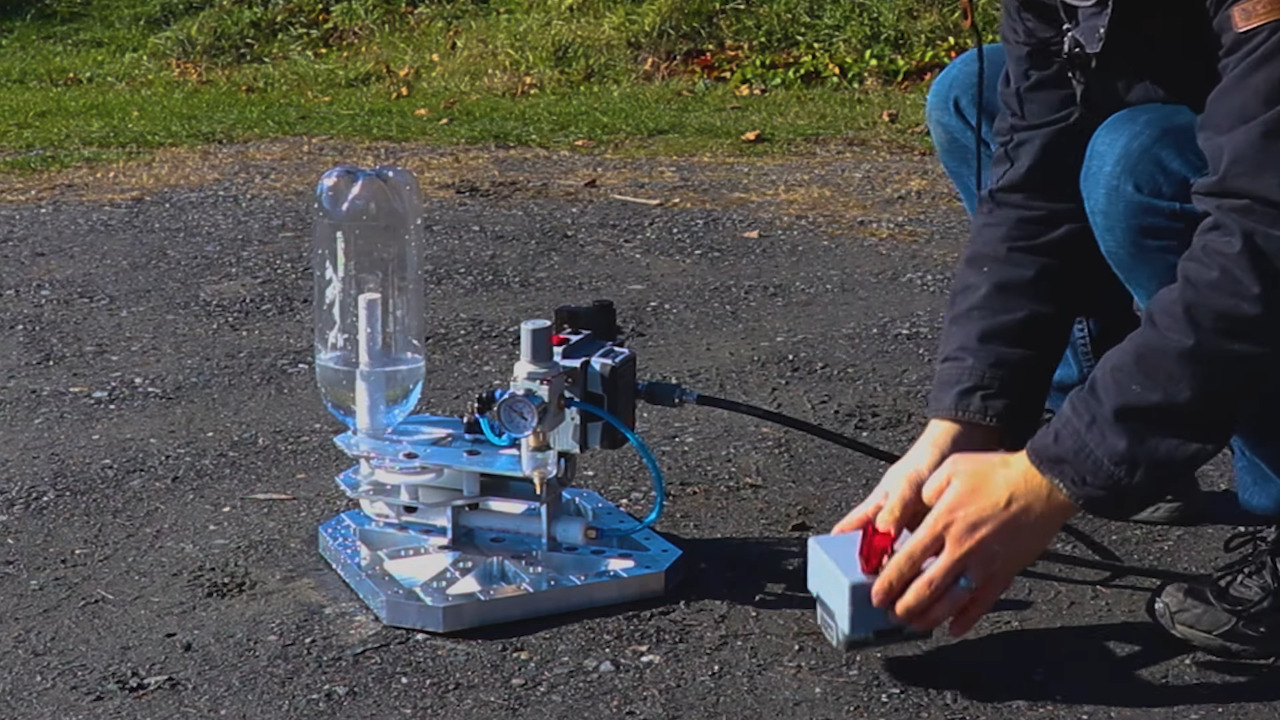
The project behind the title “Robust Water-Rocket Launcher Gets The Engineering Just Right” stands out because it treats the launcher as a real machine, not a disposable weekend contraption. The original build began with prototype parts, including 3D-printed components, then evolved into a more durable mechanism using machined aluminum and Delrin. That shift matters. It shows the classic engineering path: test the idea cheaply, find what flexes or binds, then rebuild the parts that carry load, friction, and risk.
Why Water Rockets Are Simple, But Not Silly
A water rocket works because compressed air stores energy inside a bottle, while water provides reaction mass. The bottle is partly filled with water, sealed on the launcher, and pressurized. When released, the air pushes the water out of the nozzle. The water shoots downward; the rocket shoots upward. Newton’s third law arrives wearing swim trunks.
NASA describes a typical water rocket system as two main parts: the rocket and the launcher. The rocket is often a two-liter soda bottle fitted with fins, a nose cone, and sometimes a recovery system. The launcher includes a base, a launch tube, an air line, and often a pressure gauge. Those sound like modest parts, but together they create a temporary pressure vessel and release system. That is not a toy problem. It is a real engineering problem with cheerful plastic packaging.
The “water” part is not just for comedy. Water is far denser than air, so when it is expelled, it creates far more thrust than compressed air alone. The rocket’s mass changes rapidly during launch as water leaves the bottle, which makes the flight more complex than a simple thrown object. The best water rockets are not lucky; they are balanced, aligned, tested, and launched from equipment that behaves predictably.
The Launcher Is The Real Star
Most beginners focus on the rocket: fins, nose cone, paint job, maybe a logo that says something like “Aqua Thunder 3000.” But experienced builders know the launcher determines whether the flight begins smoothly or starts with a sideways burp. A reliable water-rocket launcher must do four jobs well: support the rocket, seal the pressure, manage air input, and release instantly.
The Hackaday-featured launcher is interesting because it was not merely “strong.” It was thoughtful. The design gripped the flange around the neck of a two-liter soda bottle, the same feature many commercial and homemade launchers use as a mechanical locking point. The prototype helped verify geometry and movement before the builder upgraded critical parts to machined materials. That is a very grown-up move for a project involving flying soda bottles.
In many homemade launchers, the release mechanism is the weak link. If it drags, the rocket wastes energy. If it opens unevenly, the bottle can kick or tilt. If it is too close to the operator, everyone suddenly remembers that compressed air deserves respect. A clean release should be firm while pressurized and quick when triggered. It should not require the operator to hover over the rocket like a nervous raccoon inspecting a trash can.
Good Engineering Starts With The Bottle Neck
The neck of a soda bottle is small, but it is the center of the launch universe. It must seal, hold pressure, and release without damaging the bottle. A robust launcher often uses the bottle’s molded flange as the gripping surface because it is consistent across many standard bottles and gives the mechanism something solid to hold.
That grip must be strong enough to resist upward force when the bottle is pressurized. At the same time, it must avoid crushing or gouging the plastic. This is where materials matter. 3D-printed parts are excellent for proving geometry, but repeated high-force clamping can expose weaknesses such as layer separation, wear, or small dimensional changes. Aluminum brings strength and stiffness. Delrin, an engineering plastic, is valued for its low friction and wear resistance. Together, those materials turn a clever prototype into a launcher that can handle repeated use without becoming a repair hobby disguised as rocketry.
The best part of this design philosophy is restraint. The launcher does not need to look like a launchpad for a Mars mission. It needs the right surfaces, the right clearances, and the right actuation. Great engineering is often invisible. It looks obvious after someone else has done the hard thinking.
Pressure Control: The Difference Between Fun And Foolish
Water rockets are fun because pressure makes them leap. They are safe only when pressure is respected. NASA safety guidance warns that bottle rockets take off with significant force and should not be pointed at people, animals, or objects. Eye protection is recommended for the person pumping air, and operators should never stand over a pressurized rocket, especially after a failed launch.
A good launcher should make safe behavior easy. A pressure gauge helps the operator know what is happening inside the system instead of guessing by pump-handle drama. A long hose or remote trigger keeps people away from the pressurized bottle. A stable base keeps the rocket aimed where intended. A release that can be operated from a safe distance is not a luxury; it is part of the design brief.
Water-rocket safety codes also emphasize open outdoor launch areas, safe distances, lightweight materials, and non-metal rocket bodies and fins. That matters because the bottle is not just a container. During pressurization, it is a pressure chamber. Reusing old, scratched, sun-weakened, or heavily modified bottles is asking a thin piece of plastic to do a job it may no longer be qualified for. Plastic, unlike optimism, has fatigue limits.
Launch Tube Alignment And Stability
The launch tube does more than deliver air. It supports the rocket at the exact moment when force builds and alignment matters most. If the tube is crooked, loose, or wobbly, the rocket begins its flight with an attitude problem. A solid base and straight launch tube help the bottle leave cleanly along the intended path.
Rocket stability depends on the relationship between center of mass and center of pressure. In plain English, the heavier balance point should sit closer to the nose than the aerodynamic pressure point. Fins move the center of pressure backward. Nose weight can move the center of mass forward. When those two points are arranged correctly, the rocket self-corrects in flight instead of tumbling like a plastic dolphin.
This is why a great launcher and a stable rocket work as a pair. The launcher gives the rocket a clean start; the rocket’s fins and mass distribution keep it flying straight afterward. A perfectly stable rocket launched from a sloppy base may still wobble. A perfect launcher cannot save a rocket with crooked fins, poor balance, or a nose cone installed with the precision of a sleepy squirrel.
Why Iteration Beats Guesswork
The strongest lesson from the robust water-rocket launcher is not “use expensive materials.” It is “prototype before you commit.” The builder began with a functional version, tested the geometry, observed how the release interacted with the bottle flange, and then improved the parts that deserved improvement. That is exactly how good engineering happens.
Iteration is especially important with water rockets because the system combines pressure, water, friction, flexible plastic, and human handling. CAD may say a jaw closes perfectly. Reality may say it binds when wet. A printed latch may look beefy on a desk and flex under launch pressure. A seal may work for five launches and start leaking on the sixth. Testing reveals the truth, usually while spraying your shoes.
A practical design process might include dry fitting, low-pressure tests, leak checks, repeated release cycles, and inspection of wear surfaces. None of that is glamorous. All of it prevents failure. The most satisfying launch is not the one where everything barely survives. It is the one where the system behaves exactly as expected.
Engineering Details That Make A Launcher Feel Professional
1. A Wide, Stable Base
A launcher should resist tipping before, during, and after release. Water rockets can produce a sudden upward force, and operators may tug on hoses or trigger lines. A wide base keeps the launch angle consistent and reduces surprises.
2. A Reliable Seal
The seal between bottle and launch tube must hold pressure without requiring heroic force. O-rings, properly sized fittings, and smooth surfaces all help. A small leak is not just inefficient; it can encourage people to fiddle with a pressurized rocket, which is exactly the wrong moment for hands-on curiosity.
3. A Positive Lock
The rocket should be obviously locked before pressurization. Ambiguous mechanisms create nervous operators. A positive lock gives confidence that the bottle will stay put until the release is activated.
4. Remote Operation
Distance is safety’s best friend. A remote release allows everyone to stand clear during countdown. It also makes the launch feel more official, which is half the joy. Every good water rocket deserves a countdown delivered with unnecessary seriousness.
5. Easy Reset And Inspection
A launcher that resets quickly encourages repeated experiments. A launcher that exposes its wear points encourages inspection. Both features matter when students or hobbyists are changing variables such as water volume, fin shape, nose weight, or launch angle.
Educational Value: A STEM Lesson With Splash Damage
Water rockets are popular in STEM education because they compress several big ideas into one unforgettable launch. Students can see Newton’s laws, pressure, thrust, drag, stability, impulse, center of mass, center of pressure, and experimental design in a single afternoon. They also learn that “more pressure” is not the same as “better engineering,” which is a useful lesson for rockets and, frankly, group projects.
Science Buddies encourages students to test features like fins, nose cones, and parachutes to see how design affects flight. TeachEngineering emphasizes center of drag, center of mass, momentum, and impulse. TryEngineering frames water rockets as a team-based aerospace engineering activity. The common thread is design, test, revise, and test again.
A robust launcher enhances that learning because it reduces random failure. If the launcher leaks or misfires, students cannot tell whether their rocket design worked. A dependable launch platform makes experiments more meaningful. It lets the rocket be the variable instead of the equipment.
Common Mistakes In Homemade Water-Rocket Launchers
The first mistake is underestimating pressure. A bottle that feels harmless in your hand can become dangerous when pressurized. The second mistake is placing the operator too close to the rocket. The third is relying on a release mechanism that was “good enough” in one test and never inspected again.
Another common issue is poor alignment. A slightly tilted launch tube may not seem serious, but it can send the rocket into a low, fast arc. Wind also matters. Even a stable rocket can drift, and large fins can increase sensitivity to gusts. Launching outdoors in a clear area is not just polite; it is necessary.
Finally, many builders forget recovery. A stable rocket flies nose-first, which is efficient on the way up and less charming on the way down. Parachutes, streamers, soft landing zones, and conservative launch pressures all help manage descent risk. Gravity is patient. It always asks for its rocket back.
Experiences From The Field: What A Good Launcher Teaches You
After spending time around water-rocket projects, one lesson becomes obvious: the launcher sets the mood. When the launcher is flimsy, everyone crowds around, adjusts things too much, and develops a dangerous relationship with the phrase “just one more pump.” When the launcher is solid, the group relaxes. People follow the countdown. The rocket launches cleanly. Data collection becomes possible. Shoes still get wet, but in a dignified way.
The best launch sessions often start modestly. A team fills the bottle with a conservative amount of water, checks the fins, confirms the nose cone is attached, locks the bottle onto the launcher, and pressurizes carefully. The first launch is not about breaking altitude records. It is about proving the system. Did the seal hold? Did the release work smoothly? Did the rocket leave straight? Did everyone stay behind the safety line? If the answer is yes, that is already a successful engineering test.
One memorable pattern is how quickly students and hobbyists become data-minded once the launcher behaves. At first, they cheer for height. Then someone asks whether one-third water is better than one-half. Someone else wonders whether larger fins add stability or too much drag. A third person suggests adding nose weight, and suddenly the field has become a laboratory with grass stains. That transformation happens because the equipment is repeatable.
A robust launcher also teaches humility. Water rockets look simple, but small details matter. A crooked fin can ruin a flight. A damp seal can change performance. A bottle from one brand may fit slightly differently from another. A trigger that worked beautifully indoors may feel different under pressure and water spray. Engineering is not the art of assuming ideal conditions. It is the art of surviving real ones.
There is also a social benefit. A well-designed launcher naturally creates roles: pump operator, range officer, countdown leader, data recorder, rocket recovery crew, and the person whose only job is to shout “That was awesome!” These roles keep people organized and away from the pressurized rocket. The project becomes safer because the process is clearer.
For anyone building or evaluating a water-rocket launcher, the practical experience is this: prioritize control over spectacle. A launcher that releases cleanly at moderate pressure is better than one that barely holds at extreme pressure. A system that can be inspected easily is better than one that hides its failure points. A base that looks boring but never tips is better than a flashy contraption with questionable balance. The goal is not to scare the neighborhood. The goal is to make physics visible, repeatable, and just a little ridiculous.
The robust launcher highlighted by Hackaday earns attention because it respects those priorities. It is not merely a device that makes a bottle fly. It is a carefully developed mechanism that understands load paths, wear, gripping geometry, release timing, and operator distance. That is why the engineering feels “just right.” It takes a playful project seriously enough to make it safer, stronger, and more satisfying.
Conclusion: The Best Launchers Make The Rocket Look Easy
A water rocket is one of the most accessible ways to experience rocketry, but accessibility should never be confused with carelessness. Behind every clean launch is a chain of good decisions: a stable base, a straight launch tube, a dependable seal, a positive locking mechanism, a remote release, safe pressure practices, and a rocket designed for stability.
The robust water-rocket launcher gets the engineering right because it focuses on the unglamorous parts that make the glamorous moment possible. It proves that even a soda-bottle rocket deserves proper mechanical design. And honestly, that is the charm of the whole thing. It is backyard aerospace with a garden-hose personality: serious physics, wet grass, and just enough danger to make everyone listen during the countdown.
Note: This article is written for educational and editorial purposes. Water rockets use compressed air and should be launched only outdoors, with eye protection, safe distances, responsible supervision, and careful inspection of all bottles and launcher components.