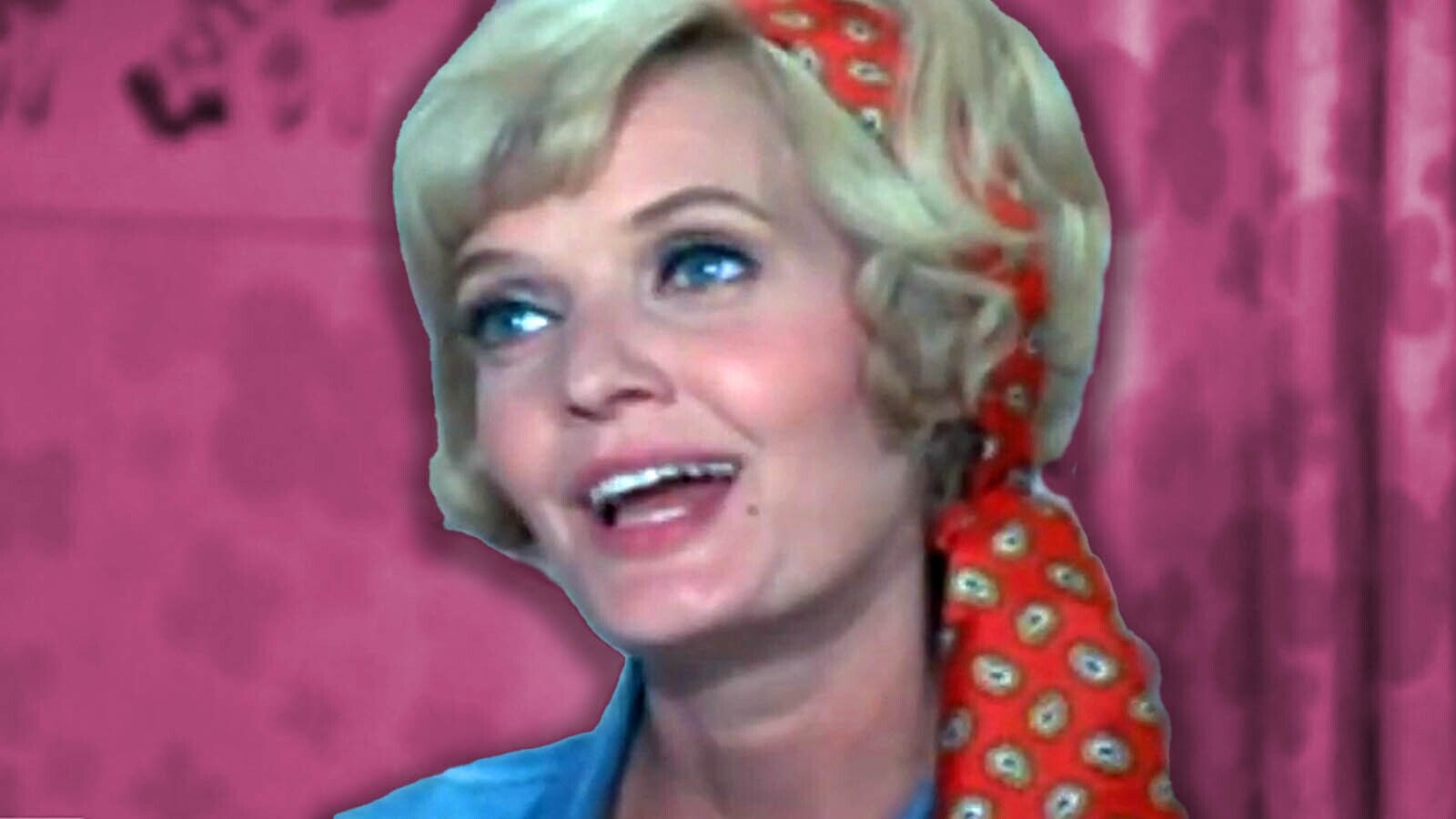
Before Florence Henderson became America’s famously cheerful television mom, the search for Carol Brady reportedly involved hundreds of child auditions, unavailable stars, swimsuit photographs, indecent proposals, and several encounters that would make even a seasoned Hollywood producer reconsider holding auditions without a witness.
The Surprisingly Wild Search for Television’s Nicest Mom
Carol Brady is remembered as the calm center of The Brady Bunch. She offered patient advice, settled sibling disputes, supported Mike, and somehow remained cheerful while six children treated the house like a laboratory for bad decisions. She was wholesome without being humorless, glamorous without appearing distant, and dependable enough to make viewers believe every problem could be solved before the closing credits.
The process of finding the actress who would play her was apparently much less wholesome.
According to series creator and producer Sherwood Schwartz’s later recollections, several women auditioning for Carol tried unconventional methods of attracting his attention. One reportedly presented nude professional photographs. Another suggested that she and Schwartz continue practicing the script privately at his home. The boldest candidate allegedly greeted him with intimate physical contact rather than an ordinary handshake.
None of these strategies worked. Hollywood can occasionally reward confidence, but there is apparently a point at which confidence drives straight past the audition, jumps the curb, and lands in the producer’s memoir.
The sensational details come primarily from Schwartz’s own published account and were later summarized in entertainment reporting. Because the actresses were not identified and the incidents were not independently documented, they are best understood as Schwartz’s recollections rather than courtroom-tested facts. Even with that qualification, the story provides a fascinating look at the chaotic casting process behind one of television’s most carefully controlled families.
Why Sherwood Schwartz Was Already Behind Schedule
Schwartz had been developing the idea behind The Brady Bunch for years. In the mid-1960s, he read a newspaper statistic indicating that a significant share of American marriages involved children from previous relationships. Television already featured traditional married couples, widows, widowers, magical housewives, talking horses, and at least one suburban Martian. A comedy centered on two existing families merging into one household, however, remained unusual.
Schwartz wrote a pilot about a widowed father with three sons marrying a mother with three daughters. He originally envisioned Carol as divorced, a choice that reflected the changing structure of American families. Network executives considered that background too controversial and worried that an ex-husband would create questions about custody and visitation. The series ultimately avoided explaining exactly what had happened to Carol’s first marriage.
ABC did not immediately purchase the project. Schwartz continued promoting it until the success of the 1968 movie Yours, Mine and Ours, starring Lucille Ball and Henry Fonda, demonstrated the audience appeal of a large blended family. ABC then became considerably more interested in Schwartz’s concept, which he had registered years before the movie appeared.
Six Children Had to Be Cast as a Believable Family
Once the pilot moved toward production, Schwartz faced a casting puzzle that would have made a family reunion seating chart look easy. He needed three boys and three girls who could act, take direction, appear related, and function comfortably as an ensemble.
Accounts from Schwartz and cast member Barry Williams describe more than 1,200 children being considered, followed by hundreds of personal interviews or callbacks. The production kept possible combinations of blonde and brunette children available because the final hair-color arrangement depended on which adults were selected as their biological parents.
That enormous search consumed much of the summer. By the time Schwartz focused fully on casting Carol Brady, many established actresses were already committed to other television projects. Some recognized performers declined to audition, perhaps because sharing scenes with six children did not sound like the easiest route to peaceful working days.
Schwartz therefore encountered a mixture of respected professionals, promising comedy actresses, hopeful newcomers, and a few applicants whose audition strategies were considerably more memorable than their readings.
The Auditions That Went Completely Off Script
Actors commonly bring headshots and résumés to auditions. In Schwartz’s telling, some Carol Brady candidates expanded the definition of promotional material until it could no longer be shown safely at the Brady family dinner table.
The Portfolio With Nothing Left to the Imagination
One attractive actress reportedly opened her portfolio and revealed a full-page nude photograph. Schwartz believed she hoped the imageand whatever possibilities he might associate with itwould improve her chances of being cast.
It did not.
The incident is especially striking because Carol was not written as a seductress or glamorous troublemaker. She was the nurturing mother at the center of a family comedy. Showing the producer a nude photograph during the audition was roughly equivalent to applying for a position as a kindergarten teacher by arriving on a motorcycle through the classroom window. It demonstrated commitment, certainly, but not necessarily to the job being offered.
The Private Rehearsal Proposal
Another applicant apparently explained that she was uncomfortable reading unfamiliar material in an audition room. That concern was reasonable; cold readings can be nerve-racking even for experienced performers. Her proposed solution was less conventional. She suggested that she and Schwartz go to his home, where they could review the lines privately.
Schwartz interpreted the invitation as an attempt to transform the audition into a personal encounter. Whatever the actress intended, the proposal did not lead to a second reading, a chemistry test, or a station wagon parked in the fictional Brady driveway.
The Handshake That Was Not a Handshake
The most aggressive encounter reportedly began when Schwartz approached another candidate and extended his hand in greeting. Instead of accepting the handshake, the woman reached below his waist and grabbed him intimately while expressing her pleasure at meeting him.
Schwartz remembered the moment decades later, which is understandable. Most producers expect actors to shake hands, read a scene, and perhaps ask whether parking will be validated. Surprise sexual contact is not normally included in the appointment notes.
The actress was not cast. The incident also reads differently today than it may have in older entertainment anecdotes. Regardless of gender, unwanted sexual touching is inappropriate. Reversing the traditional Hollywood power arrangement does not make the behavior harmless; it merely changes who is placed in the uncomfortable position.
Joyce Bulifant Nearly Became Carol Brady
The candidates who relied on acting and comedy rather than sexual provocation had much greater success. Schwartz eventually selected Joyce Bulifant, an experienced performer known for her light comic energy. She participated in screen tests, and members of the production even helped choose clothing she might wear as Carol.
Bulifant’s interpretation would probably have made Mrs. Brady more playful and eccentric. The production was preparing to build the show around that version when another possibility unexpectedly became available.
Florence Henderson had initially resisted auditioning. She lived in New York, had a successful stage and singing career, was raising four children, and did not particularly want to move her life into a weekly Los Angeles television series. Her representatives persuaded her to meet Schwartz and pilot director John Rich while she was performing in California.
Henderson arrived at Paramount under severe time pressure. She had to complete the test and return to a singing engagement in Texas. After traffic delays, she rushed to find someone who could prepare her for the camera and reportedly received makeup assistance near the production of Star Trek. She disliked the result and joked about it during the test. Rather than hurting her chances, the humor demonstrated exactly the relaxed comic timing Schwartz needed.
One Screen Test Changed the Entire Family
Henderson tested with Robert Reed, who had been chosen to play Mike Brady. Their chemistry persuaded Schwartz and Paramount to reverse course and cast Henderson instead of Bulifant.
It was a painful professional decision. Bulifant had done nothing wrong and had progressed far enough to believe the role was hers. Television Academy retrospectives confirm that she had effectively been selected before Henderson became available. The change also affected the show’s comic balance. Because Henderson played Carol as a steadier and more grounded mother, the production could give more of the broad comedy to Alice, the housekeeper. That contributed to the casting of Emmy-winning comedian Ann B. Davis.
In other words, Florence Henderson’s arrival did not merely replace one actress. It helped reshape the tone of the entire adult cast.
Why Florence Henderson Was the Right Carol Brady
Henderson possessed qualities that could not be communicated through an attention-grabbing portfolio. She had extensive Broadway experience, musical ability, comic timing, camera confidence, and firsthand knowledge of being a working mother.
She also understood that Carol needed warmth without becoming bland. Henderson gave the character affectionate chemistry with Reed’s Mike, creating a married couple who appeared genuinely interested in each other. Carol could be romantic, stylish, amused, frustrated, or firm while remaining the dependable parent audiences expected.
Henderson later pushed producers to give Carol greater substance. She wanted the character to have interests and responsibilities beyond appearing in the kitchen whenever a child needed advice. Although the original series largely kept Carol at home, later Brady productions made her a real estate agent. Henderson’s concerns reflected her own experience balancing a career with raising children.
She was also known privately for a mischievous, adult sense of humor, proving that the woman who played Carol Brady was not trapped inside Carol’s pastel wardrobe. The difference was that Henderson brought personality and humor to the audition without crossing professional boundaries.
From Modest Ratings to an American Television Institution
The Brady Bunch premiered on ABC on September 26, 1969. It ran for five seasons and ended in 1974. During its original broadcast, the series was not a dominant ratings champion and rarely received much respect from television critics.
Syndication changed everything.
Children discovered the show in afternoon reruns, then grew up and introduced it to another generation. The checkerboard opening credits, shag carpeting, split-level house, family vacations, sibling rivalries, and endlessly reusable lines became part of American pop culture. Reunions, variety shows, television movies, stage productions, parodies, feature films, podcasts, and renovation programs kept returning to the Brady universe.
The show’s central idea also became less unusual over time. A blended family was considered sufficiently unconventional in the 1960s that executives objected to describing Carol as divorced. Decades later, the Brady household could be recognized as an early, if highly polished, representation of a family structure familiar to millions of viewers.
Its influence became so durable that the Studio City house used for exterior shots was eventually recognized for its place in Los Angeles cultural history. The interior seen on television had been created on a soundstage, but the outside of the home became visual shorthand for the entire Brady ideal.
What the Mrs. Brady Auditions Reveal About Old Hollywood
The audition anecdotes are funny because they clash dramatically with the character being cast. Yet beneath the comedy is a complicated portrait of Hollywood employment.
Performers often compete for a tiny number of life-changing opportunities. A single television role can provide years of work, financial security, publicity, and access to future projects. That pressure can encourage applicants to believe they must be unforgettable at any cost.
At the same time, Hollywood historically operated through informal meetings, personal favors, private rehearsals, and poorly defined professional boundaries. Such an environment made exploitation easier and could also lead desperate applicants to mistake sexual attention for a legitimate career strategy.
Schwartz’s story reverses the familiar casting-couch narrative by placing the producer on the receiving end of the advances. That reversal makes the anecdote unusual, but the appropriate lesson remains the same: employment should be based on ability, preparation, suitability, and professional conductnot sexual access.
The women who reportedly crossed those boundaries were not rewarded. The role ultimately went to a performer who arrived rushed, disliked her makeup, made jokes about the situation, and delivered a convincing screen test. That outcome is less scandalous, but far more useful to anyone hoping to build a lasting career.
Conclusion: The Lovely Lady Won the Role the Professional Way
The casting of Carol Brady began late and wandered through one of the strangest audition stories associated with classic television. According to Sherwood Schwartz, some candidates attempted to attract him with nude photographs, private invitations, and unwanted physical contact. Their efforts produced no contract, although they did provide Hollywood with an anecdote that survived for decades.
Joyce Bulifant came far closer because she could genuinely play the part. Florence Henderson ultimately won because her screen test revealed the combination the series needed: warmth, maturity, humor, musical polish, and believable chemistry with Robert Reed.
That casting choice helped define The Brady Bunch. Henderson became the emotional anchor of a television family that outlived its original ratings, its network run, and nearly every fashion choice visible in the Brady living room.
Hollywood loves a scandalous story, but the final result offers a reassuring punch line. After all the outrageous attempts to influence the producer, the actress who became Mrs. Brady got the job by being funny, talented, prepared, and right for the role.