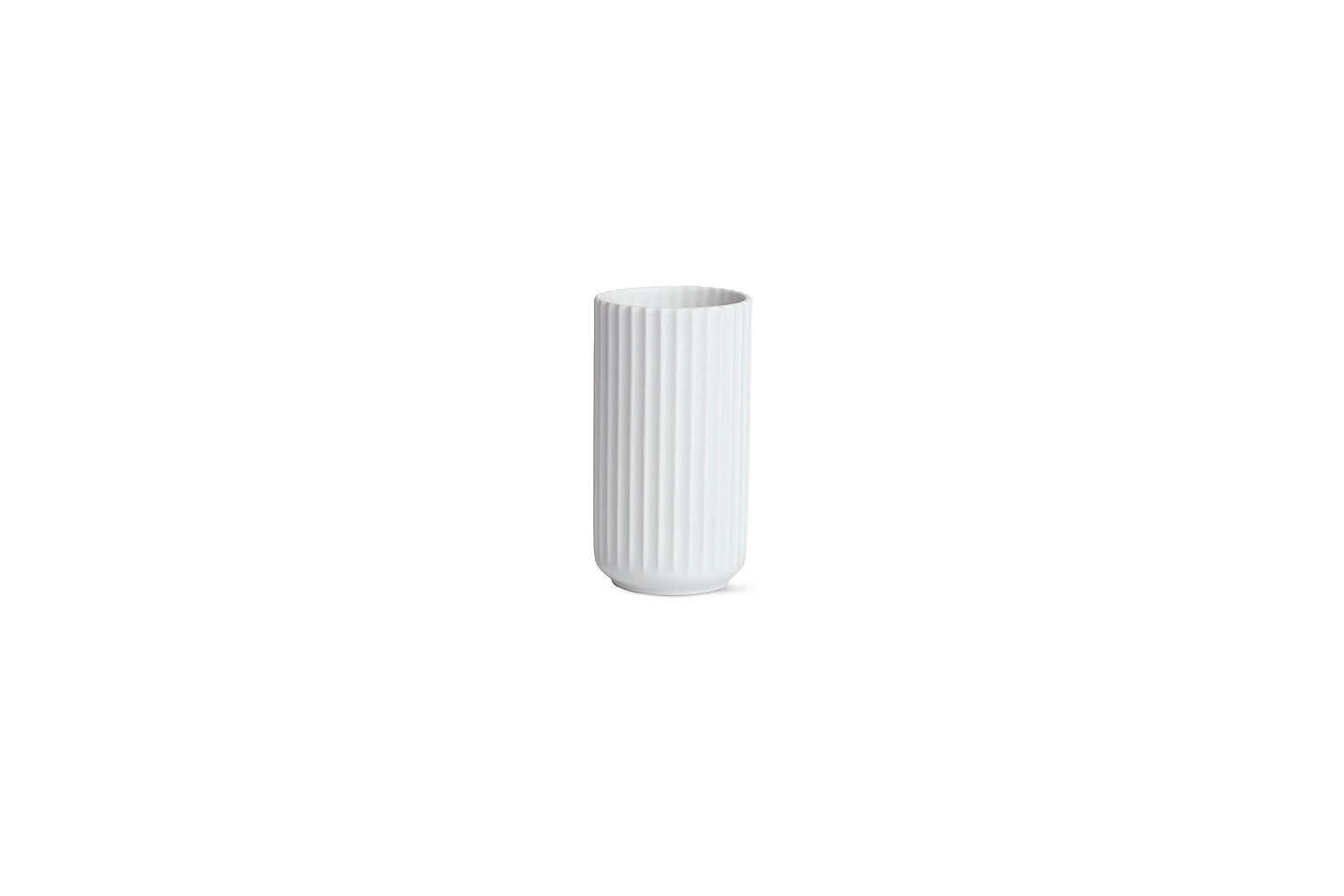
A Lyngby vase is what happens when a simple cylinder puts on a beautifully tailored pinstripe suit. Recognizable by its clean silhouette and precise vertical grooves, this Danish design icon manages to look architectural, elegant, and surprisingly welcoming at the same time. It can hold a dramatic bouquet, support one lonely tulip, or sit completely empty without appearing to have forgotten its job.
The original Lyngby vase emerged in Denmark in 1936, when decorative porcelain was commonly covered with painted flowers, borders, and elaborate ornaments. Its restrained form represented a striking change of direction. Instead of placing decoration on the surface, the designers made the shape and ribbed texture the decoration. Nearly a century later, that decision still feels modern.
Today, Lyngby vases are available in multiple sizes, colors, shapes, and materials, including glazed porcelain and mouth-blown glass. This guide explores their history, design, collections, styling possibilities, care requirements, and the practical experience of living with one.
What Is a Lyngby Vase?
The classic Lyngby vase is a cylindrical flower vase distinguished by evenly spaced vertical grooves running from its base to its rim. It originated at Porcelænsfabrikken Danmark, commonly known today as Lyngby Porcelæn, in Kongens Lyngby north of Copenhagen.
The traditional white porcelain version is the model most closely associated with the name. Its glossy surface emphasizes every ridge and shadow, giving a seemingly plain object considerable depth. As daylight changes, the vase changes with it. One side can appear bright and crisp while the opposite side develops soft gray lines between the flutes.
Modern collections have expanded the idea beyond white porcelain. Shoppers can find colored porcelain, transparent glass, smoke-colored glass, amber tones, and sculptural variations inspired by the company’s archives. Although these pieces differ in personality, they retain the disciplined geometry and material-focused approach associated with Danish modern design.
The History Behind Lyngby Porcelæn
A Danish Factory Founded in 1936
Lyngby Porcelæn was established in 1936 by the Danish wholesale company Holst & Knudsen. The founders had previously acquired Kjøbenhavns Porcellains Maleri, a porcelain-decorating business, before creating a factory capable of manufacturing tableware, vases, and decorative objects.
The new facility employed advanced production technology for its era. That technical foundation allowed the company to experiment with forms that differed from the heavily decorated porcelain traditionally found in European homes.
The timing was significant. Functionalism and the Bauhaus movement were influencing architecture, furniture, and household products throughout Europe. Designers increasingly believed that useful objects should be honest about their materials and purpose. A vase did not need a painted rose garden when its proportions, texture, and craftsmanship could provide the visual interest.
A Bold Alternative to Traditional Porcelain
Introduced during the factory’s founding period, the original Lyngby vase was unusually restrained. Its straight body, repeated fluting, and lack of painted decoration challenged conventional ideas about luxury porcelain.
The design was practical as well as attractive. Its stable base supported flower arrangements, while the narrow cylindrical profile guided stems upward. The ribs strengthened its visual presence without interfering with its function. In other words, the vase was minimalist, but it was not trying so hard to be minimalist that it became uselessan achievement some modern furniture could study.
Closure, Collectibility, and Revival
Porcelænsfabrikken Danmark operated until 1969. After the factory closed, original Lyngby pieces were no longer produced, and surviving examples gradually became desirable collectibles. Vintage vases appeared at flea markets, antique stores, and auctions, where enthusiasts hunted for recognizable factory marks and well-preserved surfaces.
The Lyngby Porcelæn brand returned in 2012, bringing the classic vase back into production alongside other historical and contemporary designs. Rosendahl Design Group acquired the revived brand in 2016. Current production combines the company’s design heritage with modern manufacturing methods, making the ribbed vase accessible without requiring shoppers to spend every weekend interrogating suspicious pottery at a flea market.
Why the Lyngby Vase Became a Design Icon
The Shape Is the Decoration
The vase’s vertical relief is its defining feature. These grooves create rhythm, texture, and alternating bands of light and shadow. Because the ornament is built into the form, the piece remains visually interesting without patterns, pictures, or gilded details.
The ribs also give the vase an architectural quality. Depending on the viewer, they may recall classical columns, Art Deco skyscrapers, pleated fabric, or the fluting on finely made furniture. That ambiguity helps the design work in rooms from different periods.
It Looks Complete Without Flowers
Many flower vases look slightly unemployed when empty. A Lyngby vase does not have this problem. Its sculptural profile allows it to function as a decorative object between bouquets. A small version can anchor a bookshelf, while a larger model can provide height on a console or dining table.
This dual function is especially valuable in compact homes. The vase earns its shelf space every day rather than becoming an awkward container stored above the refrigerator for eleven months of the year.
It Balances Simplicity and Character
Minimalist objects sometimes disappear into a room. Statement objects can dominate one. The classic Lyngby design sits comfortably between those extremes. Its silhouette is quiet, but its texture prevents it from becoming anonymous.
This balance explains why Lyngby vases complement Scandinavian interiors while also fitting into mid-century modern, contemporary, transitional, industrial, and carefully edited traditional spaces.
Porcelain or Glass: Which Lyngby Vase Should You Choose?
Classic Porcelain Lyngby Vases
Porcelain provides an opaque, polished appearance that makes the grooves particularly clear. White is the most historically recognizable choice and one of the most versatile. It pairs naturally with pale wood, dark walnut, marble, stone, painted cabinetry, and nearly every flower color.
Colored porcelain creates a stronger decorative statement. Deep blue, green, soft purple, and other glazed finishes can connect the vase with nearby textiles, artwork, or dinnerware. Because the surface is solid rather than transparent, stems and water remain hidden, producing a clean presentation even when the bouquet’s lower half resembles botanical spaghetti.
Mouth-Blown Glass Lyngby Vases
Glass versions retain the familiar fluted profile but feel lighter and more luminous. Clear glass is ideal when the arrangement itself should command attention. Colored glass introduces another visual layer as light passes through the walls, water, and stems.
Mouth-blown production may result in subtle variations between pieces. Small differences are part of the material’s character rather than evidence that the vase had a difficult journey in the delivery truck.
Transparent models require slightly more visual housekeeping because water lines and tangled stems remain visible. Regular cleaning and carefully trimmed flowers make a noticeable difference.
Understanding Lyngby Vase Sizes
The classic series has been produced in a range of heights, from compact bud-vase proportions to large statement pieces around 15 inches tall. Availability varies by material, color, market, and season, so buyers should confirm current product dimensions rather than relying only on photographs.
Small Vases
Models around five or six inches tall work well with a few short stems, garden clippings, or a single flower. They are suitable for bedside tables, bathroom shelves, desks, and breakfast nooks where a large arrangement would obstruct conversation or stage a hostile takeover of the surface.
Medium Vases
An eight-inch Lyngby vase is a versatile everyday size. It can accommodate tulips, roses, ranunculus, anemones, and moderate mixed bouquets without becoming visually heavy. This scale is often a sensible first purchase because it can move easily between a dining table, entryway, mantel, or kitchen counter.
Large Vases
Taller versions create an architectural focal point and can support long branches, lilies, delphiniums, or generous arrangements. Check both height and diameter before ordering. A tall vase with a broad body needs more surface areaand more flowersthan a product image photographed against an endless white background may suggest.
Beyond the Classic Cylinder
Lyngby Porcelæn now offers several vase families that develop its historical design language in different directions.
Rhombe Vases
Rhombe vases incorporate a geometric relief pattern drawn from the company’s design archives. Some versions widen toward the top in a tulip-like profile. Transparent colored glazes allow the raised pattern to remain visible, creating a livelier alternative to the disciplined vertical lines of the original Lyngby vase.
Tura Vases
The Tura collection, designed by Philip Bro Ludvigsen, takes a more sculptural approach. Rounded sections and architectural transitions give these pieces a bold silhouette while maintaining a strong connection to the brand’s porcelain heritage. Tura works particularly well as an empty art object or with a deliberately restrained arrangement.
Contemporary Archive-Inspired Designs
Additional collections reinterpret historical forms through twisted relief, botanical modeling, new proportions, and modern glazes. These designs show that the brand’s identity extends beyond one famous cylinder. The connecting idea is respect for material, structured silhouettes, and surface texture.
How to Style Lyngby Vases
Let One Vase Stand Alone
A medium or large Lyngby vase can serve as a complete centerpiece without extra accessories. Place it slightly off-center on a console, credenza, or mantel and allow some open space around it. The negative space helps the ribbed profile register clearly.
Create a Group with Varied Heights
Combine two or three related vases in different sizes. Repeating the fluted texture creates unity, while varying height and material prevents the display from looking like a ceramic choir standing at attention.
A useful arrangement might pair a tall white porcelain vase with a smaller clear-glass version and one colored accent piece. Keep one or two vessels empty so the composition does not become crowded.
Use Flowers with Simple Silhouettes
Tulips are a natural match because their curved stems soften the vase’s rigid geometry. Peonies and hydrangeas create a fuller contrast, while eucalyptus and olive branches emphasize Scandinavian simplicity. Bare branches can turn a large vase into a dramatic seasonal display.
For a modern arrangement, select one flower variety rather than mixing many colors and textures. Repetition in the bouquet echoes the repeated grooves on the vase.
Build a Seasonal Display
In spring, use tulips, daffodils, or flowering branches. Summer invites loose garden flowers and greenery. Rust-colored leaves or berry branches complement amber glass in fall, while evergreen clippings make a white porcelain vase feel crisp and festive in winter.
Dried grasses may also work, but avoid oversized plumes in a very small vase. The goal is Scandinavian elegance, not a vase wearing a feathered carnival hat.
How to Buy an Authentic Lyngby Vase
Purchase new pieces from Lyngby Porcelæn, its parent company’s official storefront, or an established design retailer. Confirm the stated material, dimensions, product series, and manufacturer before ordering. “Lyngby-style” generally describes a similar ribbed appearance and does not necessarily indicate an authentic product.
Vintage examples require additional research. The factory used different markings during its original operating period, while revived products carry contemporary branding. Examine photographs of the base, dimensions, glaze, condition, and provenance. A modern “Est. 1936” mark should not be presented as proof that an object was manufactured in 1936.
For a high-value vintage purchase, consult a knowledgeable dealer or specialist reference. Chips, hairline cracks, repairs, and staining can affect both value and usability. A rare collectible may be wonderful to own, but it is not always the best candidate for a heavy bouquet and a curious cat.
Cleaning and Caring for Lyngby Vases
Care instructions differ between collections, finishes, and production periods. Current product information for many porcelain and mouth-blown glass models permits dishwasher cleaning at temperatures no higher than 130 degrees Fahrenheit. Always check the instructions supplied with the exact vase before placing it in a dishwasher.
Hand washing is the gentlest option for vintage pieces, large vases, delicate finishes, and any model with uncertain care guidance. Use lukewarm water, mild dish soap, and a soft cloth or nonabrasive bottle brush. Avoid steel wool and harsh scouring powders, which can scratch glossy surfaces.
Change flower water every day or two and remove leaves below the waterline. Clean the vessel promptly after discarding a bouquet so residue does not dry inside it. For narrow interiors, a soft bottle brush is safer than forcing a sponge through the opening and later discovering that the sponge has become a permanent resident.
Lift the vase with both hands when it is full. Place felt pads beneath large porcelain pieces on delicate wood, stone, or lacquered furniture, and keep tall arrangements away from unstable edges and busy walkways.
Living With Lyngby Vases: Practical Experiences and Lessons
The first practical surprise of a Lyngby vase is how frequently it works without requiring a carefully designed bouquet. A handful of grocery-store tulips can look intentional because the structured vessel supplies order below the loose stems. Trim the flowers at slightly different lengths, remove the submerged leaves, and allow the tulips to lean naturally. The result looks relaxed rather than neglected.
A medium white porcelain model is particularly forgiving in everyday rooms. On a wooden dining table, it provides a clean visual pause between warm grain patterns, dishes, and textiles. On a bookshelf, the grooves remain visible from across the room, even when the vase is empty. Moving the same piece from the dining area to an entryway can make it feel new without purchasing additional decor.
Placement changes its personality. Strong side light exaggerates the ribs and makes white porcelain appear almost architectural. Diffused light produces a softer, calmer effect. Clear or amber glass performs best near a window, where the fluting bends reflections and adds a subtle glow. Direct, intense sunlight should still be considered carefully when nearby flowers, furniture finishes, or delicate objects could fade.
The most common styling mistake is overfilling the vase. Its narrow, upright design generally benefits from arrangements that preserve some breathing room. Twelve tightly packed flower varieties can conceal the rim and compete with the texture. Five to nine well-chosen stems often make a stronger display, although the correct number depends on the vase’s diameter and the size of each bloom.
Large models teach a different lesson: measure first. A 15-inch vase can look elegantly moderate online but feel monumental on a small kitchen table. It usually performs better on a wide console, substantial dining table, floor-level plinth, or deep mantel. Long branches also shift the center of gravity, so stability deserves as much consideration as style.
Cleaning is easiest when it becomes part of the flower routine. Refreshing the water regularly prevents cloudy residue, particularly in clear glass. Once an arrangement is finished, a quick rinse with mild soap is far less work than removing a dried ring a week later. The exterior grooves may collect dust, but a soft damp cloth follows the ridges easily.
Mixing sizes can become addictive. One vase looks disciplined; three begin to resemble a collection. The best groupings typically share one feature while varying another. For example, combine different heights in white porcelain, or use the same height in clear, amber, and colored glass. Changing every variable at once can make the display feel more like a showroom clearance shelf than a considered arrangement.
The vase also succeeds as a gift because it does not demand a particular decorating style. White porcelain is the safest choice for weddings, housewarmings, anniversaries, and design-minded hosts. Colored glass feels more personal and should be selected with the recipient’s palette in mind. Including flowers is thoughtful, but the vase will continue looking finished after the bouquet has retired to the compost bin.
Ultimately, the everyday appeal of Lyngby vases comes from reliability. They can be formal or casual, empty or filled, vintage or newly made. The design does not rely on a passing color trend or novelty shape. It simply uses proportion, texture, and material very welland then has the good manners to let the rest of the room speak.
Conclusion
Lyngby vases demonstrate how a household object can become iconic without becoming complicated. The original fluted cylinder challenged decorative porcelain conventions in the 1930s, survived decades out of production, and returned as a relevant piece of modern home decor.
Whether chosen in classic white porcelain, luminous mouth-blown glass, or a newer sculptural form, a Lyngby vase offers more than a container for flowers. It provides texture, architectural character, and practical versatility. Choose a size that suits the intended surface, follow the care guidance for the specific model, and resist the urge to hide every groove behind an enormous bouquet. The vase has waited since 1936 to show off those ribs.
Note: Product dimensions, colors, availability, and care directions can vary by collection and market. Confirm the specifications of the exact Lyngby vase before purchasing or cleaning it.