A LoRa repeater that lives inside a PVC pipe and runs for years on D cells sounds like something assembled by a radio engineer, a prepper, and a plumber during one very productive weekend. Yet the idea is surprisingly practical: take long-range, low-power LoRa communication, remove the fragile solar panel, skip the expensive lithium battery system, seal everything in a cheap tube, and let a stack of alkaline D cells do the heavy lifting.
The project that inspired this discussion is known as LoRaTube, a compact outdoor LoRa repeater concept built around simple materials: PVC pipe, D-size alkaline batteries, a low-power radio module, supercapacitor buffering, and careful firmware design. Its headline promise is bold: multi-year off-grid operation, with five years as the design target. That does not mean every PVC tube with batteries suddenly becomes a wilderness telecom tower. It means the project asks a very good engineering question: what happens if we stop overcomplicating remote IoT infrastructure?
The answer is more interesting than expected. A long-life LoRa repeater can make sense for farms, forests, hiking areas, emergency communication paths, remote sensors, amateur radio experiments, and rural IoT deployments where Wi-Fi gives up, cellular coverage gets dramatic, and nobody wants to hike up a hill every month carrying a charger.
What Is a LoRa Repeater?
LoRa stands for “Long Range,” and it is a wireless modulation technique designed for sending small packets of data across long distances with very low power consumption. Unlike Wi-Fi, which is fast but thirsty, LoRa is slow, patient, and excellent at whispering tiny messages across fields, hills, warehouses, and awkward rural geography.
A LoRa repeater listens for incoming LoRa messages and retransmits them so they can travel farther or reach around obstacles. Think of it as a polite radio relay standing on a hill saying, “I heard that. Let me shout it from up here.”
This is especially useful when the original device is low to the ground, hidden behind terrain, installed inside a structure, or operating with limited transmit power. Instead of increasing power illegally or draining batteries faster, a repeater improves the location of the radio link. Height, line of sight, antenna tuning, and placement often matter more than brute force.
Why PVC Pipe and D Cells?
The genius of this design is not that PVC pipe is exotic. It is the opposite. PVC is cheap, widely available, easy to cut, weather resistant, and conveniently tube-shaped. D cells are also ordinary, available in supermarkets and hardware stores, and physically large enough to store meaningful energy. The design uses these boring materials in a clever way.
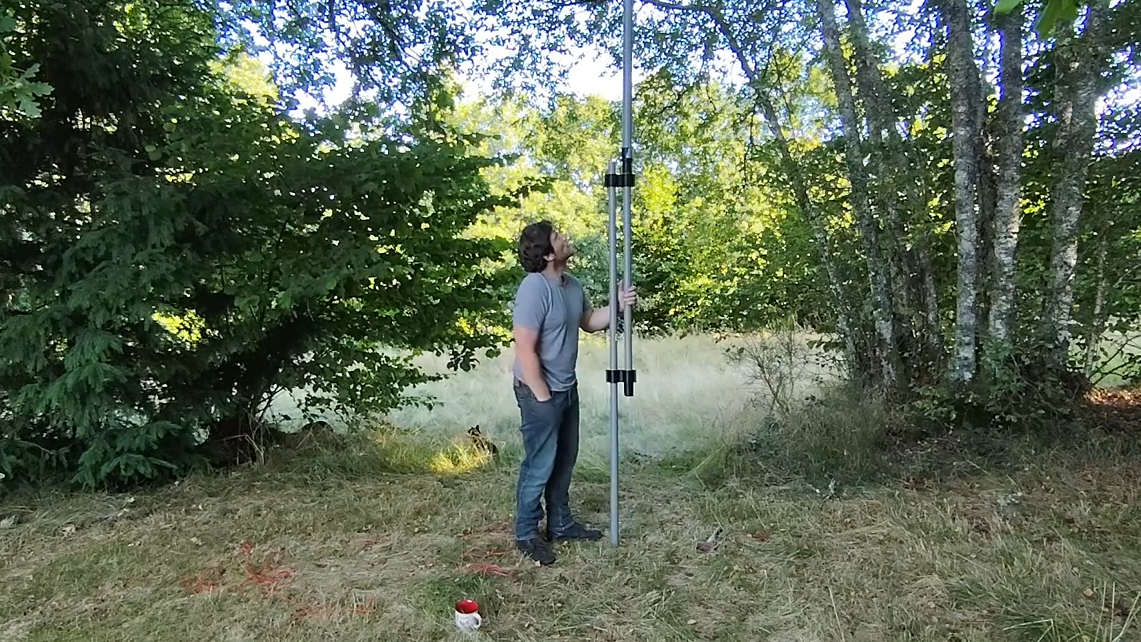
A vertical PVC tube can become both the enclosure and structural support. Inside it, D cells can be stacked neatly. Above the battery compartment, the electronics can be separated from the cells to reduce the risk of damage if a battery leaks. At the top, the antenna can emerge into a better position for radio propagation.
This approach avoids several common problems found in remote repeaters. Solar panels add cost, visibility, mounting complexity, cable entry points, charge controllers, and rechargeable battery management. Lithium batteries are powerful but need protection circuitry and can dislike temperature extremes. A simple alkaline-powered repeater is not glamorous, but it can be rugged, discreet, cheap, and surprisingly serviceable.
The Five-Year Battery Claim: Possible, But Not Magic
A five-year LoRa repeater depends on one brutal fact: average current must be extremely low. Not “kind of low.” Not “my microcontroller has a sleep mode somewhere in the datasheet” low. We mean microamp-level standby, carefully scheduled wakeups, minimal transmit time, efficient power conversion, and no sneaky LEDs glowing like tiny battery vampires.
The LoRaTube concept uses a large stack of alkaline D cells to provide a high-energy reservoir. D cells can deliver far more energy than AA or AAA cells, and alkaline chemistry has low self-discharge when stored properly. In a low-duty-cycle LoRa system, most of the time should be spent waiting. The radio wakes, checks for activity or transmits a packet, then returns to sleep. The device survives by doing almost nothing very efficiently.
However, the five-year figure should be understood as an engineering target, not a universal guarantee. Real-world life depends on temperature, moisture, packet traffic, battery brand, leakage risk, regulator efficiency, firmware bugs, antenna mismatch, and how often the repeater is forced to transmit. A repeater serving a quiet sensor network may last dramatically longer than one handling constant messages from chatty devices.
How Supercapacitors Help the Design
One of the most practical ideas in the LoRaTube-style architecture is the use of supercapacitors. Radio transmitters often draw short bursts of high current, especially at higher output power. Batteries, particularly alkaline cells in cold weather or late in life, do not always love sudden current spikes. Their internal resistance rises, voltage sags, and electronics may brown out at exactly the moment they are supposed to send a packet.
A supercapacitor acts like a small energy shock absorber. It charges slowly from the battery pack, then supplies burst current during transmission. This lets the battery see a gentler load while the radio gets the current it needs. In plain English: the battery walks, the supercap sprints.
This is one reason a low-power repeater can be more reliable than its simple bill of materials suggests. The hardware is not merely a battery connected to a radio. It is a power system designed around patience, buffering, and very short bursts of work.
Why LoRa Is a Good Match for Off-Grid Repeaters
LoRa’s strengths are exactly what a remote PVC-pipe repeater needs. It supports long range, performs well at low data rates, tolerates weak signals, and can operate in unlicensed spectrum when configured according to regional rules. In the United States, LoRa devices commonly use the 902–928 MHz band under applicable FCC Part 15 requirements. In Europe and other regions, different frequency plans and power limits apply.
This matters because radio projects are not “build once, deploy anywhere” gadgets. A legal LoRa setup in France may not be legal in the United States. A 433 MHz device might be fine in one region and inappropriate in another. Anyone building a repeater should choose modules, antennas, firmware settings, and transmit power based on the country where the device will operate.
The technical sweet spot for LoRa is not streaming video, voice, or high-speed internet. It is small messages: sensor readings, position beacons, alerts, status packets, environmental data, water level reports, temperature logs, gate sensors, and emergency pings. If Wi-Fi is a fire hose, LoRa is a carrier pigeon with excellent endurance.
Outdoor Design: The Pipe Is Only the Beginning
PVC pipe solves part of the enclosure problem, but outdoor electronics are picky guests. They complain about water, condensation, heat, UV exposure, insects, corrosion, vibration, and the one drop of rain that somehow finds the only unsealed seam.
A good PVC LoRa repeater needs physical separation between the battery compartment and electronics. If alkaline cells leak, the electrolyte should not be able to crawl onto the PCB and begin its villain arc. The electronics should sit above the batteries, with a barrier between the two sections. Contacts should maintain pressure over time, even as the pipe expands, contracts, and gets bumped by weather or wildlife.
UV exposure is another consideration. PVC can discolor and lose impact strength after long sun exposure. A light-colored, water-based exterior paint or UV-resistant coating can help protect the pipe while keeping heat buildup lower. Dark paint may look tactical, but it can also turn the enclosure into a summer toaster. Electronics generally prefer not to be baked.
Battery Leakage: The Awkward Reality
Alkaline D cells are cheap and energy-dense for the price, but they are not perfect. Over long periods, especially in series strings, cells can age unevenly. If one weak cell becomes deeply discharged while the rest continue pushing current through it, reverse polarity stress may occur. That can lead to gas generation, seal failure, and leakage.
This is why a long battery stack is both brilliant and risky. Eighteen D cells in series can provide a useful voltage and energy reserve, but one bad cell can become the weakest link. A more resilient architecture can divide cells into smaller series packs and combine them with diode ORing or other protection methods. That way, one failing pack does not necessarily kill the whole repeater.
For real deployments, battery access matters. If the tube must be destroyed to remove swollen or leaking cells, that might be acceptable when the pipe costs very little. Still, the PCB should be protected, and the design should assume that someday, somewhere, a battery will behave badly. Good engineering is not believing parts will never fail. Good engineering is making failure boring.
Where a PVC LoRa Repeater Makes Sense
A repeater like this is most useful where infrastructure is sparse and the data rate is low. On a farm, it could extend coverage for soil moisture sensors, water tank monitors, livestock trackers, or gate alarms. In a forest, it could relay environmental data from remote sensor nodes. For amateur radio and maker communities, it can serve as a field experiment in propagation, antenna placement, and ultra-low-power design.
Emergency preparedness is another obvious application. A hidden, battery-powered repeater placed on high ground could support simple status messages when normal communication is unavailable. It will not replace cellular networks or satellite messengers, but it can help bridge small data packets across difficult terrain.
The project also fits educational use. Students can learn about link budget, voltage regulation, sleep current, antenna matching, waterproofing, and battery chemistry in one build. That is a lot more memorable than staring at a datasheet while pretending not to check your phone.
Design Lessons from LoRaTube
1. Placement Beats Power
Raising transmit power is not always legal, efficient, or necessary. A repeater placed on a hill, pole, barn roof, or tree line can dramatically improve coverage by improving line of sight. Radio waves enjoy a good view.
2. Low Standby Current Is Everything
A five-year device is won or lost while it is asleep. Microcontrollers, regulators, sensors, pull-up resistors, voltage dividers, and status LEDs all matter. A design that draws milliamps in idle mode is not a five-year repeater. It is a short-term science project with ambition.
3. Simple Materials Can Be Excellent
Cheap does not automatically mean bad. PVC pipe, alkaline cells, printed brackets, and off-the-shelf modules can be effective when the design respects their limits. The trick is not pretending they are aerospace-grade parts. The trick is designing around their behavior.
4. Outdoor Builds Need Mechanical Iteration
Plastic parts deform. Springs relax. Caps crack. Moisture appears. Sunlight ages materials. A real outdoor device should be tested outside, not just celebrated on a workbench under flattering LED lighting.
5. Firmware Is Part of the Battery
Firmware decisions directly affect runtime. Wake intervals, receive windows, retransmission logic, watchdog behavior, and failure recovery all determine how often the hardware consumes power. In long-life IoT, code quality becomes battery chemistry by another name.
Experience Notes: What Building a Long-Life LoRa Repeater Teaches You
The first experience lesson from a project like “LoRa Repeater Lasts 5 Years On PVC Pipe And D Cells” is humility. On paper, low-power design looks tidy. You calculate watt-hours, estimate current draw, divide one number by another, and proudly announce that your device will still be blinking when your future self has new hobbies. Then the real world arrives wearing muddy boots. Cold weather increases battery resistance. Moisture sneaks into connectors. A firmware loop wakes too often. A regulator wastes more energy than expected. Suddenly the five-year dream starts negotiating.
The second lesson is that measuring sleep current is not optional. Many makers test only active current because it is easy to see on a meter. But for a long-life repeater, the sleep state dominates. A device that transmits for two seconds and sleeps for ten minutes spends almost its entire life asleep. If sleep current is 500 microamps instead of 20 microamps, the battery math changes completely. The boring measurement is the important one.
Third, antennas deserve respect. A LoRa module with a poor antenna is like a sports car on shopping-cart wheels. PVC can detune antennas, metal hardware can affect radiation patterns, and nearby trees or wet surfaces can change results. A simple field test comparing RSSI and SNR at different heights can teach more than an afternoon of guessing. Better still, use a nanoVNA or antenna analyzer to tune the antenna in its actual enclosure.
Fourth, accessibility matters. A repeater hidden in a pipe may be wonderfully discreet, but someone eventually has to open it. Build in a way to inspect contacts, check battery voltage, replace cells, and verify seals. A device that lasts five years but requires destroying the enclosure to service it may still be acceptable, but that should be a design choice, not an unpleasant surprise.
Fifth, environmental protection is a system, not a cap. Weatherproofing includes drip loops, venting strategy, conformal coating, gasket selection, cable strain relief, and condensation management. A perfectly sealed tube can still develop internal moisture from trapped humid air and temperature cycling. Sometimes a controlled vent is better than pretending water vapor has signed a non-entry agreement.
Finally, the best experience a builder can gain is from staged deployment. Start on the bench. Then move to a porch. Then place the repeater outdoors for a week. Then a month. Log voltage, temperature, packet counts, failed wakeups, and radio noise. Do not wait five years to learn that one spring contact was too weak. The beauty of this project is that it turns inexpensive parts into a serious engineering exercise. It proves that low-cost hardware can be powerful when paired with careful measurement, honest assumptions, and the patience to iterate.
Conclusion
“LoRa Repeater Lasts 5 Years On PVC Pipe And D Cells” is more than a catchy maker headline. It is a reminder that robust IoT design often comes from matching the technology to the job. LoRa is excellent for long-range, low-power packets. D cells offer cheap stored energy. PVC pipe provides a practical enclosure. Supercapacitors tame transmit bursts. Careful firmware keeps the whole system asleep until needed.
The result is not a universal product recipe, and it is not free from trade-offs. Alkaline leakage, UV exposure, condensation, regulatory compliance, and antenna tuning all matter. But the concept is strong because it embraces simplicity. In a world full of overbuilt gadgets, sometimes the cleverest repeater is the one hiding inside a pipe, sipping power like it has nowhere to be for the next five years.