Note: This article is written for web publication and is based on publicly available information about Warren Buffett’s former Laguna Beach vacation home, its renovation, and broader coastal design principles. Source links are intentionally not included in the body, as requested.
Some beach houses try very hard to look expensive. They announce themselves with polished stone, enormous chandeliers, and rooms so white you start worrying about sitting down with iced coffee. Warren Buffett’s former beach home in Laguna Beach tells a different story. It is valuable, yes. It sits in one of Southern California’s most coveted coastal communities. It has ocean views, history, and the kind of real estate backstory that makes investors do mental math before breakfast. But its newest chapter is not about showing off. It is about warmth, memory, craft, and the kind of lived-in character that makes a house feel less like a trophy and more like a place where sandy feet are allowed.
The home, located in the Emerald Bay area of Laguna Beach, was long known as a family getaway for Buffett, who bought the property in 1971 for $150,000. Decades later, it entered the market with an asking price of $11 million before eventually selling for about $7.5 million in 2018. That is a very Buffett-style real estate story: patient purchase, long holding period, and a return that would make even a calculator blush. Yet the most interesting part of the house today is not the profit. It is the fresh start given to the interiors by Studio Gutow, the Southern California design firm associated with Melissa Rohani and Lisa Berman.
This renovation matters because it challenges the common assumption that coastal luxury must look brand new. Instead of erasing the home’s past, the redesign leans into it. The result is a relaxed, layered, family-friendly beach house that celebrates imperfections, vintage pieces, textured materials, woodwork, soft colors, and personal history. In other words: it has a soul. And in modern design, soul is the rarest amenity of all.
A Beach House With a Billionaire Backstory
Before the makeover, the house already had a story worth telling. The property began as a modest coastal cottage built in the 1930s, long before Laguna Beach became shorthand for high-end ocean living. Buffett later expanded and renovated the home over the years, turning it into a larger multi-level retreat for family vacations. Reports describe it as a home used for summers, holidays, and quiet time near the Pacific rather than a flashy billionaire playground.
That distinction is important. Buffett’s public image has always been tied to restraint, practicality, and long-term thinking. He is famously associated with his Omaha home, simple routines, and an investment philosophy built on value rather than impulse. His Laguna Beach home was an exception in location, but not necessarily in spirit. It was expensive by ordinary standards, of course, but modest compared with many ultra-luxury coastal estates. Think less “marble palace with a yacht named Tax Strategy” and more “family beach house that happened to belong to one of the richest people on Earth.”
The house reportedly included multiple bedrooms, ocean-facing decks, and spaces that made the most of its coastal setting. Its position in Emerald Bay gave it privacy, access to a prized seaside community, and the breezy appeal of Laguna Beach living. But by the time the property changed hands, its interiors carried marks of many different eras. Some features were charming, some dated, and some were simply tired from decades of use and remodeling. For many buyers, the temptation would have been to gut everything and start with a spotless luxury template. Fortunately, that did not happen.
Why “Lived-In Character” Is the Real Luxury
The phrase “lived-in character” sounds casual, but it is actually one of the hardest design effects to achieve. Anyone can buy a new sofa. Anyone can paint walls white. Anyone can order coastal décor that includes exactly one rope mirror, three pale blue pillows, and a ceramic seagull with commitment issues. But a home that feels collected, relaxed, and natural requires restraint. It must look as though it evolved over time, not as though everything arrived from the same warehouse on the same Tuesday.
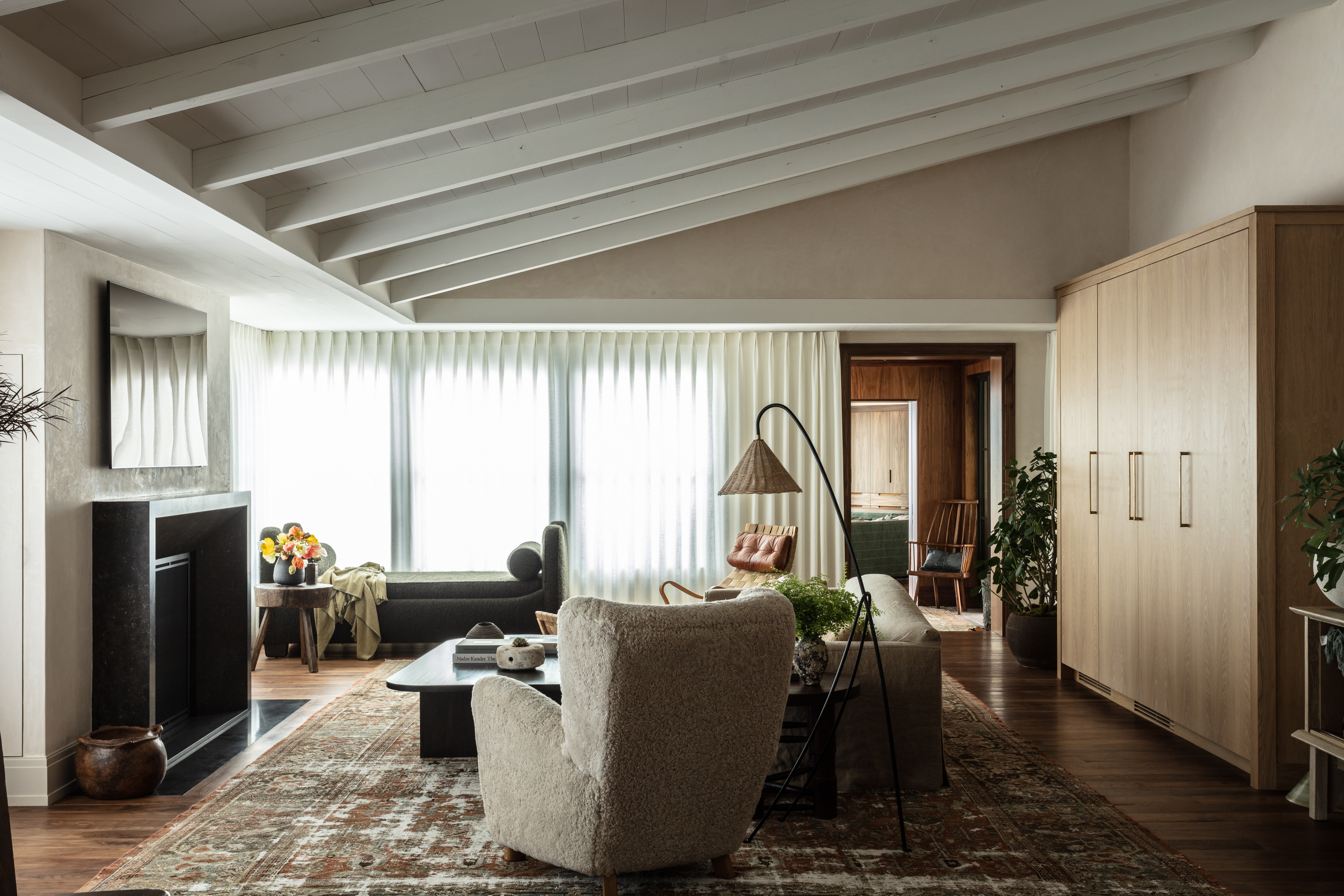
Studio Gutow’s refresh of Buffett’s former beach home works because it does not fight the building’s age. Instead, it builds on it. Rougher textures, vintage furnishings, natural materials, custom woodwork, antique rugs, and warm colors help the home feel grounded. There is a sense that the house has been edited rather than erased. That is a major lesson for anyone interested in coastal renovation: the best beach homes are not always the shiniest ones. Sometimes they are the ones that know how to keep a few wrinkles.
In design terms, patina matters. A slightly imperfect wood plank, a hand-finished wall, or a vintage chair can bring more emotional depth than a room full of flawless new pieces. Coastal homes especially benefit from this approach because the ocean itself is never sterile. It is windy, salty, glowing, moody, and constantly changing. A beach house that feels too perfect can seem oddly disconnected from the environment outside. A lived-in beach home, by contrast, makes room for sand, sunlight, damp towels, children, guests, and the occasional snack crumb that mysteriously appears five minutes after vacuuming.
The Studio Gutow Approach: Warm, Collected, and Family-Friendly
The renovation is closely tied to Melissa Rohani, who did not originally set out to buy Warren Buffett’s former home. She was looking for a family house in Laguna Beach and found many available properties too polished, too flipped, or too stripped of personality. Buffett’s former beach house offered something different: history, warmth, and a positive feeling that could be preserved.
Studio Gutow’s design language favors comfort and layering. Rather than creating a one-note coastal interior, the home mixes materials, periods, and moods. Wood paneling gives rooms texture. Antique rugs add age and richness. Soft upholstery keeps the spaces usable. Vintage accents prevent the interior from becoming predictable. The palette avoids the cliché of all-blue-everything beach décor and instead moves through warm neutrals, earthy tones, olive, taupe, cognac, and natural finishes.
This is especially smart for a family home. A house with young children cannot behave like a museum unless everyone inside agrees not to breathe too aggressively. Durable materials, forgiving textures, and comfortable seating make the rooms feel realistic. The home can host daily life without losing its design integrity. That balance is not easy. Too much polish becomes cold; too much casualness becomes clutter. The sweet spot is a house that says, “Yes, this room is beautiful, and yes, you may sit down.”
Ocean Views Without the Coastal Clichés
One of the biggest risks in beach house design is leaning too hard into the obvious. Shells, anchors, navy stripes, driftwood signs, and “Life’s a Beach” plaques can quickly turn a sophisticated coastal home into a souvenir shop with a mortgage. Buffett’s former beach home takes a more mature route. The design respects the ocean without constantly pointing at it.
Large windows, decks, terraces, and sightlines already connect the house to the Pacific. That means the interiors do not need to shout “beach.” They can whisper it through linen, wood, aged surfaces, woven textures, sun-washed tones, and relaxed furniture arrangements. The ocean becomes the main artwork. Everything inside simply supports the view.
This is a useful principle for homeowners anywhere: let the location do some of the decorating. If a room has a great garden view, a dramatic skyline, or a beautiful patch of afternoon light, do not bury it under visual noise. In a coastal home, the best design move is often subtraction. Fewer gimmicks. Better materials. More breathing room.
Preserving the Past Without Getting Stuck in It
A successful renovation must answer a tricky question: what should stay, and what should go? Keep too much, and a home can feel frozen. Remove too much, and it loses the very thing that made it special. In this project, the fresh start comes from respecting the home’s old energy while making it practical for modern life.
The house had roots in the 1930s, layers from the 1970s, and later updates from decades of ownership. Studio Gutow did not turn it into a period museum. Instead, the team translated the home’s history into a current design vocabulary. Tongue-and-groove wood, custom millwork, layered textiles, antique rugs, and vintage furniture create a sense of continuity. The rooms feel refreshed, but not scrubbed clean of personality.
That is an increasingly important idea in American interior design. After years of ultra-minimal white rooms and fast flips, many homeowners are craving warmth, story, and individuality. A home with patina feels more human. It allows for signs of age, travel, craft, and use. It does not panic at a scuffed floorboard. It understands that perfection is not the same as beauty.
The Real Estate Lesson Hidden in the Walls
It is impossible to discuss this home without mentioning its investment story. Buffett bought the Laguna Beach property in 1971 for $150,000. When it came to market in 2017, the asking price was $11 million. It later sold for around $7.5 million in 2018 after price reductions. Even at the lower sale price, the long-term appreciation was enormous.
But the deeper lesson is not simply “buy beach property and wait,” because that advice is about as useful as saying “invent a time machine and purchase Apple stock early.” The more practical lesson is that location, patience, and usability matter. Laguna Beach grew into one of Southern California’s most desirable coastal markets. Emerald Bay remained exclusive. The home’s ocean proximity, privacy, and family-friendly layout helped preserve its appeal even when the interiors needed work.
The renovation adds another layer of value: emotional value. A house can be expensive because of its land, square footage, and address. But it becomes memorable because of how it feels. In a luxury market full of polished sameness, character can become a differentiator. Buyers and design lovers remember homes that feel personal. They remember a cozy low-ceiling family room, a warm wood-paneled bedroom, a courtyard made for gatherings, and a living room that invites conversation instead of silent admiration.
Design Details That Make the Home Feel Alive
1. Custom Woodwork
Wood is one of the most powerful tools in coastal interiors. In this home, custom millwork and paneling help create warmth and texture. Wood softens the architecture and adds a handcrafted feeling that glossy surfaces rarely achieve. The best part is that wood can age beautifully, especially when treated as a natural material rather than forced into perfection.
2. Vintage and Antique Pieces
Vintage furniture brings instant depth. It also prevents the dreaded showroom effect, where every room looks like a catalog page that has never met a human being. Antique rugs, older chairs, and collected objects give the home a sense of time. They suggest that the rooms were built through life, not just purchased in one design sprint.
3. Soft, Durable Fabrics
A beach house needs fabrics that can handle real use. Linen, wool blends, textured upholstery, and performance materials can all contribute to comfort while standing up to family living. The key is choosing fabrics that look better relaxed, not worse. If a pillow must be karate-chopped every 12 minutes to look acceptable, it may not belong in a laid-back coastal home.
4. Warm Neutrals Instead of Cold Whites
White can be beautiful by the ocean, but too much harsh white can make a room feel sterile. Warmer neutrals, sandy tones, taupe, cream, muted green, and wood finishes bring softness. They also work beautifully with natural light, especially in a home where sunlight changes throughout the day.
5. Rooms Built for Gathering
The best beach homes are social. They make it easy to cook, lounge, talk, read, rinse off, return from the beach, and gather again. Buffett’s former beach home now feels designed around real family rhythms. That is why the renovation succeeds. It does not simply photograph well; it appears to live well.
Why This Renovation Feels So Current
The timing of this design story is perfect. Across the home design world, there is a noticeable shift away from sterile minimalism and toward layered, personal interiors. Homeowners want rooms that feel comfortable, not staged. They want houses that can absorb everyday life without losing charm. They want design with a memory.
This is especially true after years when many people rethought what home should do. A great home is no longer just a backdrop for entertaining. It is an office, retreat, playground, dining room, recovery zone, creative space, and sometimes a snack distribution center with walls. The best interiors now balance beauty and usefulness.
Buffett’s former beach home captures that change. It is refined but not rigid. It is coastal but not cartoonish. It is historical but not dusty. It is luxurious but not loud. That combination gives the house staying power. Trends will come and go, but warmth, quality, comfort, and a sense of place rarely go out of style.
What Homeowners Can Learn From Warren Buffett’s Former Beach Home
You do not need an Emerald Bay address or a billionaire backstory to borrow ideas from this renovation. The most valuable lessons are surprisingly practical. First, preserve what gives your home personality. Original wood, unusual windows, old tile, quirky built-ins, and imperfect surfaces may be worth saving. Second, invest in materials that improve with age. Natural fibers, real wood, stone, plaster, and quality upholstery tend to develop character rather than simply wearing out.
Third, mix old and new. A room full of new furniture can feel flat. A room full of antiques can feel heavy. But together, they create tension and charm. Fourth, design for the life you actually live. If you have children, pets, guests, hobbies, or a habit of eating toast while walking around the house, plan accordingly. Beauty should not require constant fear.
Finally, do not confuse luxury with shine. The most inviting homes often have texture, softness, and ease. They welcome you in. They make you want to stay. They do not look offended when someone puts a book on the coffee table.
Experience Notes: What This Ocean Home Teaches About Living With Character
There is something deeply instructive about a house that has been loved by more than one family. Warren Buffett’s former beach home is not compelling only because of its famous previous owner. It is compelling because it proves that homes are living records. Every renovation, every holiday, every guest room, every deck facing the sea adds another layer. When a new owner approaches that kind of property with respect, the result can feel richer than anything built from scratch.
Imagine walking into an older beach house for the first time. The rooms may not be perfect. The ceiling might be lower than expected. The floor plan may wander a bit, as though the house made decisions slowly over several decades. Some finishes may look dated. But if the bones are good, there is often a feeling that cannot be installed later. You sense where people gathered, where light enters in the afternoon, where the best reading chair should go, and where everyone will drop towels no matter how many hooks you install.
That is the experience this renovation celebrates. Instead of forcing the home to pretend it was brand new, the designers allowed it to feel seasoned. The use of wood paneling, vintage furniture, antique rugs, and warm colors creates a home that feels emotionally available. It does not demand perfect posture. It invites bare feet, family dinners, card games, quiet mornings, and the kind of casual conversation that happens when people are comfortable enough to forget about the room and enjoy each other.
For anyone renovating near the ocean, the experience also offers a practical reminder: coastal living is beautiful, but it is not delicate. Salt air, sun, humidity, sand, and wind all leave their mark. A home by the sea should be designed with materials that can handle that reality. That does not mean everything must be rugged or plain. It means finishes should be honest. Wood can show grain. Fabrics can have texture. Stone can be honed rather than polished. Outdoor areas can be planned for actual use, not just dramatic listing photos.
The most memorable coastal homes understand rhythm. Morning light in the kitchen. Breezes in the living room. A shaded place to sit after the beach. A family room that feels cozy when the marine layer rolls in. A bedroom that makes waking up feel slower. Buffett’s former beach home, in its refreshed form, appears to understand those rhythms. Its value is not just in the ocean view, but in the way the interior supports life around that view.
There is also an emotional lesson here for modern homeowners: do not rush to erase age. A scratch, a knot in wood, an old footprint in the layout, or a slightly eccentric architectural decision may be the thing that makes a home memorable. Fresh paint and new furniture can improve a house, but personality comes from contrast. Old with new. Refined with relaxed. Ocean air with warm rugs. Family practicality with beautiful craft.
In that sense, Warren Buffett’s former beach home gets a fresh start without losing its past. It becomes a model for thoughtful renovation: keep the good energy, edit the awkward parts, improve function, and let the house continue telling its story. That is lived-in character by the ocean. And frankly, it beats another all-white beach mansion that looks terrified of sunscreen.
Conclusion
Warren Buffett’s former Laguna Beach home is more than a celebrity real estate footnote. It is a case study in how history, restraint, and thoughtful design can transform a coastal property without stripping away its soul. From its 1930s cottage roots to its decades as a Buffett family getaway, the home carried a rare sense of continuity. Studio Gutow’s renovation honored that continuity while making the house warmer, richer, and more livable for a modern family.
The result is a beach home that feels collected rather than decorated, comfortable rather than precious, and luxurious without yelling about it from the deck. Its best lesson is simple: a beautiful home does not need to be perfect. It needs to feel alive. By preserving patina, layering materials, and respecting the setting, this oceanfront refresh proves that character may be the most valuable feature a house can have.