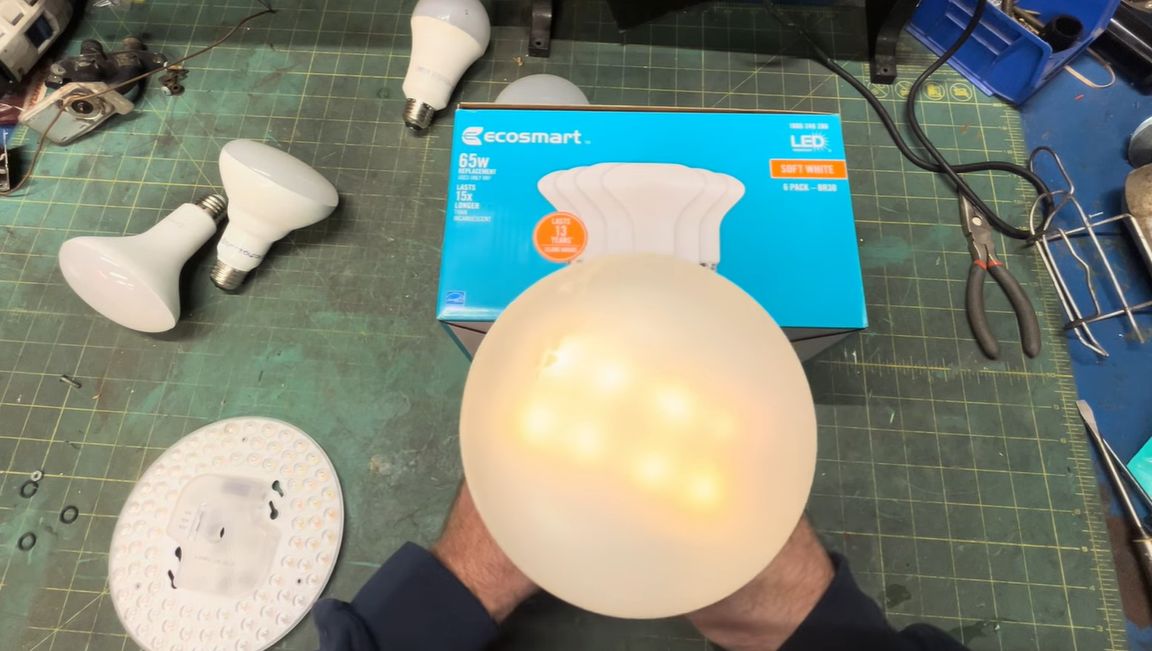
LED lightbulbs arrived with the swagger of a superhero. They were going to save electricity, lower bills, rescue us from ladders, and glow faithfully for 15, 20, even 25 years. The packaging sounded almost romantic: “lasts 22 years,” “25,000-hour life,” “up to 25 times longer.” For anyone who has replaced an LED bulb after two winters, that promise can feel less like engineering and more like a magic trick performed with a receipt you already threw away.
Here is the truth: LED bulbs are genuinely efficient, genuinely useful, and often genuinely long-lasting. The lie is usually not that LEDs are bad. The lie is the way LED lightbulb lifespan promises are presented as simple household destiny. A number like 25,000 hours does not mean your bulb is guaranteed to shine perfectly for 25,000 hours in your hot porch fixture, on your old dimmer, inside a sealed glass globe, while surviving voltage spikes like a tiny electronic gladiator.
To understand the gap between the promise and the pantry-light reality, we need to look at what “life” means, how LED bulbs fail, and why the fine print matters more than the big number on the front of the box.
What LED Bulb Lifespan Claims Really Mean
When a package says an LED bulb lasts 15,000 or 25,000 hours, most shoppers naturally imagine the bulb will keep working until that exact moment, then politely retire. That is not how LED life ratings work. Unlike old incandescent bulbs, LEDs usually do not fail because a filament snaps. They tend to fade over time. In lighting language, the common benchmark is called lumen maintenance. A widely used standard is L70, meaning the bulb has reached the end of its useful life when it produces about 70% of its original light output.
That means a bulb can be considered “done” even if it still glows. If it started at 800 lumens and gradually sinks to 560 lumens, the bulb may technically be at the end of its rated useful life. It may still turn on, but your kitchen suddenly feels like it is being lit by a cautious moon.
The Famous “Years” Claim Is Based on Assumptions
Many packages convert hours into years using a typical-use assumption, often around three hours per day. Under that math, a 25,000-hour bulb can become a “22-year” bulb. But if you use that bulb eight hours per day in a home office, the same rating becomes about eight and a half years. In a porch light left on all night, the number shrinks again. The bulb did not lie mathematically. The marketing simply chose the most flattering outfit for the number.
This is why LED lightbulb lifespan claims can feel slippery. The claim may be technically defensible, yet still create an expectation that does not match real use. It is the lighting equivalent of saying a bag of chips contains “about eight servings.” Sure, if everyone eats like a museum curator handling ancient pottery.
LEDs Are Efficient, But They Are Not Immortal
LEDs use much less energy than incandescent bulbs, and that advantage is real. A good LED can deliver the same useful brightness while consuming a fraction of the power. Less wasted heat means lower operating cost, and for many households, replacing frequently used incandescent bulbs with LEDs is one of the easiest energy-saving upgrades available.
But “efficient” does not mean “unbreakable.” An LED bulb is not just a diode. It is a small electronic system. Inside the plastic or glass shell are LED chips, a driver circuit, solder joints, capacitors, thermal materials, and sometimes wireless components if it is a smart bulb. Any of those parts can become the weak link.
The Driver Is Often the Drama Queen
The LED chips themselves may be capable of long life under controlled conditions. The driver, however, has the less glamorous job of converting household current into something the LEDs can use. Cheap drivers, weak capacitors, poor surge protection, and sloppy thermal design can make a bulb fail long before the LED chips fade to L70. This is why two bulbs with the same wattage, brightness, and “25,000-hour” claim can behave very differently in the real world.
Think of the LED chip as a marathon runner and the driver as the person driving the support van. If the van breaks down at mile nine, nobody cares that the runner had excellent shoes.
Heat: The Silent Killer of LED Lifespan
LEDs run cooler than incandescent bulbs, but they still produce heat. More importantly, they are sensitive to heat in a different way. An incandescent bulb was basically a controlled heat monster that happened to glow. LEDs are semiconductors, and high temperatures can reduce light output, stress electronic parts, and shorten useful life.
This is why enclosed fixtures matter. A standard LED bulb installed in a sealed ceiling globe, recessed can, or tight outdoor lantern may trap heat around the electronics. If the bulb is not rated for enclosed fixtures, the promised lifespan can collapse faster than a cheap folding chair at a barbecue.
Base-Up, Base-Down, and Other Sneaky Details
Some LED designs handle heat better in certain positions. In a base-up fixture, heat can rise toward the driver electronics in the base of the bulb. In a base-down lamp, heat may move differently. Good bulbs are designed and tested for common orientations, but bargain bulbs may be less forgiving. The package may not shout about these limitations, so the consumer finds out through the ancient scientific method known as “why is this thing dead already?”
Outdoor fixtures add another layer. Cold generally is not the enemy of LEDs the way it can be for some older lighting technologies, but moisture, poor sealing, corrosion, heat cycling, and cheap housings can all shorten performance. A bulb rated for damp locations is not the same as one rated for wet exposure. Those little words matter.
Dimmer Switches: Where Good Bulbs Go to Flicker
One of the most common reasons LED bulbs disappoint is dimmer incompatibility. Many homes still have dimmers designed for incandescent loads. Incandescent bulbs were simple: push electricity through a filament and let physics roast dinner. LED bulbs need electronics to interpret the dimmer’s chopped-up power signal. If the bulb and dimmer are not compatible, the result may be flickering, buzzing, limited dimming range, random shutoff, or early failure.
A bulb labeled “dimmable” is not automatically compatible with every dimmer on Earth. The better manufacturers publish compatibility lists. That may sound boring, but it is exactly the kind of boring that keeps your dining room from turning into a haunted lighthouse.
Why “Up To” Is Doing Heavy Lifting
Whenever you see “up to” on a package, imagine the phrase wearing a tiny lawyer suit. “Up to 25,000 hours” does not mean every bulb will reach 25,000 hours. It means the product is rated or projected under certain conditions to reach that figure. It leaves room for variation, installation differences, product batches, and real-world abuse.
There is nothing inherently wrong with “up to” language. The problem begins when the marketing headline turns a conditional projection into a consumer expectation. A homeowner does not buy a bulb thinking, “I hope this product achieves acceptable lumen maintenance under lab-derived assumptions.” They buy it thinking, “Great, I will not touch this fixture again until my children are old enough to complain about the Wi-Fi.”
Lighting Facts Labels Help, But They Do Not Tell the Whole Story
The Lighting Facts label gives shoppers useful information: brightness in lumens, estimated yearly energy cost, light appearance, wattage, and life based on typical daily use. This is much better than the old days when shoppers had to guess brightness by wattage, as if buying lightbulbs required a family oral tradition.
Still, the label is not a crystal ball. It does not know your fixture temperature, your dimmer model, your power quality, how long the bulb stays on each day, or whether it will live inside a sealed porch lantern that doubles as a summer sauna. The label is a standardized comparison tool, not a personal guarantee from the bulb fairy.
Lumens Matter More Than Watts
One practical lesson from modern lighting guidance is simple: buy brightness by lumens, not watts. Watts measure power use. Lumens measure light output. A traditional 60-watt incandescent replacement LED may use around 8 to 10 watts while producing roughly the brightness people expect from the old 60-watt bulb. If you shop by watts alone, you may end up with a bulb that is efficient but too dim, which is like buying a fuel-saving car with no seats.
ENERGY STAR Certification Is Worth Paying Attention To
ENERGY STAR certified LED products are not automatically perfect, but certification adds useful guardrails. Certified bulbs and fixtures must meet performance requirements for efficiency, light output, color, testing, and warranty standards. Many certified LED products also carry minimum warranty requirements, which gives consumers more leverage than a vague promise printed in cheerful blue ink.
For shoppers, certification is a signal that the product has been evaluated against recognized criteria. It does not guarantee that every bulb will live for decades in every fixture, but it reduces the odds of buying a bargain-bin science experiment.
When Lifespan Claims Cross the Line
LED marketing has not always behaved nobly. Regulators have taken action against companies accused of exaggerating brightness and life expectancy claims. In one well-known case, claims about long LED lamp life were challenged because testing did not support the advertised numbers. The lesson is not that every LED label is fake. The lesson is that lifespan claims should be supported by real testing, and consumers should be skeptical when the promise sounds too grand for the price.
A bulb sold for a suspiciously low price with a huge lifespan claim, no recognizable certification, no clear warranty, no dimmer information, and no enclosed-fixture rating is not a bargain. It is a tiny audition for disappointment.
How to Buy LED Bulbs Without Getting Played
First, choose the right brightness. Look for lumens, not old-fashioned watt comparisons. Around 800 lumens is commonly used as a 60-watt incandescent replacement, while higher-lumen bulbs are better for task lighting, garages, and work areas.
Second, match the bulb to the fixture. If the fixture is enclosed, buy a bulb specifically rated for enclosed fixtures. If the fixture is outdoors, check whether the bulb is rated for damp or wet locations. If it will be installed in a recessed can, choose a bulb designed for that application.
Third, check dimmer compatibility. Do not assume “dimmable” means universal. If the lights flicker, buzz, or refuse to dim smoothly, the problem may be the dimmer, not the bulb alone.
Fourth, save receipts and warranty information. This sounds painfully practical, but it matters. A bulb that promises 15,000 or 25,000 hours and fails in six months should not simply be mourned in silence. Many reputable manufacturers provide replacement options if you can document the purchase.
Finally, buy quality where replacement is difficult. For a table lamp, a cheap bulb may be a tolerable risk. For a vaulted ceiling, stairwell, outdoor security light, or commercial fixture, spending more for a certified, properly rated product can save labor, time, and ladder-related muttering.
The Honest Verdict on LED Lightbulb Lifespan Promises
LED bulbs are still a smart choice for most homes. They save energy, reduce heat compared with incandescents, offer many color temperatures, and can last a long time when installed correctly. The problem is not LED technology. The problem is oversimplified marketing.
A lifespan promise is not a prophecy. It is an estimate built on test conditions, lumen maintenance, usage assumptions, and product design. The biggest lies are not always printed in bold. Sometimes they hide in what the package does not explain: heat, drivers, dimmers, fixture ratings, warranties, and the difference between “still glowing” and “still useful.”
Real-Life Experiences: The Bulbs That Taught Us to Read the Fine Print
Anyone who has lived through the LED transition probably has a small museum of lighting opinions. There is the first expensive LED bulb purchased with great ceremony, the one that cost more than lunch and promised to last until retirement. There is the cheap multipack that seemed like a bargain until two bulbs started flickering like they were sending Morse code to the basement. There is the smart bulb that worked beautifully until the app updated, the router changed, or the bulb apparently decided it was now a decorative paperweight.
One common experience is the bathroom vanity surprise. A homeowner replaces six hot incandescent bulbs with LEDs and feels instantly brilliant. The room is cooler, the mirror is brighter, and the electric bill gets a tiny haircut. Then, a year later, one bulb begins to strobe. Another turns a slightly different shade of white. The package promised years of life, so the failure feels personal. In many cases, the culprit is heat buildup inside small decorative fixtures, mixed with long daily use and modest-quality electronics.
Another frequent example is the porch light. The box says the bulb can last for decades based on three hours a day. But the porch light is on from dusk until dawn, sometimes 10 or 12 hours a night. Add a semi-enclosed fixture, summer heat, insects, moisture, and occasional power surges, and the lifespan math changes quickly. The bulb may still outperform an incandescent, but it will not necessarily deliver the fairy-tale number on the package.
Garage lights teach a different lesson. Many people install LED bulbs in cold garages and love the instant brightness. That part is a win. But if those bulbs are inside old fixtures with poor ventilation or connected to motion sensors that do not play nicely with the driver electronics, failures can show up early. The experience is confusing because LEDs are supposed to handle frequent switching better than older fluorescents. Often they do, but the complete system still matters.
The best personal rule is simple: judge LED promises by the installation, not just the package. A quality bulb in an open table lamp may last impressively long. The same type of bulb, trapped in a hot enclosed ceiling fixture, may age like milk in a parked car. A certified dimmable bulb on a compatible LED dimmer may perform smoothly for years. A random dimmable bulb on a 20-year-old incandescent dimmer may buzz, flicker, and make everyone at dinner feel like they are being interrogated.
Over time, smart shoppers develop habits. They keep one warm-white bulb and one daylight bulb on hand to test color before buying a dozen. They read the fixture rating. They avoid mystery brands for hard-to-reach places. They save receipts for expensive bulbs. They stop believing that a 25,000-hour claim is a promise of domestic immortality. Most importantly, they understand that LED lighting is still worth using, just not worth worshiping.
Note: This article is written for publication using clean HTML body content only. It is synthesized from reputable U.S. government, consumer, and lighting-industry information, with no source-link markup inserted into the article body.
Conclusion
LED lightbulb lifespan promises are not useless, but they are easy to misunderstand. A rating such as 15,000 or 25,000 hours is a controlled estimate, not a personal guarantee for every fixture, dimmer, room, climate, or electrical system. The smartest approach is to buy by lumens, match the bulb to the fixture, check dimmer compatibility, choose certified products when possible, and keep warranty information. LEDs can absolutely save money and reduce maintenance. Just do not let a giant number on a package convince you that physics has retired.