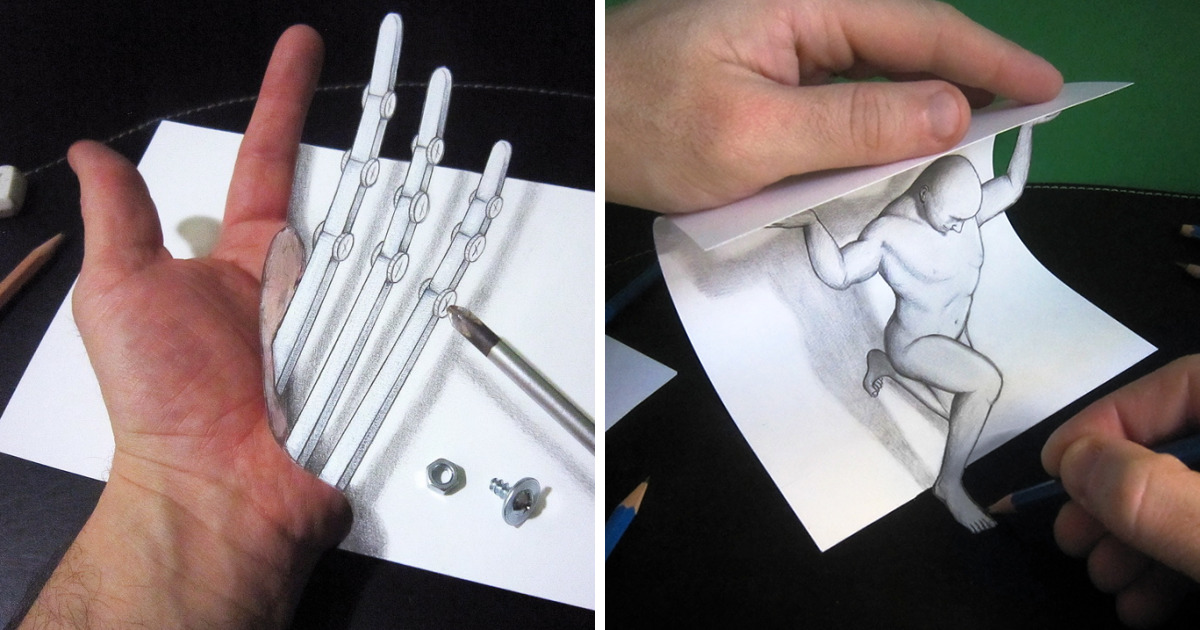
Some artists need marble, bronze, oil paint, studio lighting, and a dramatic scarf that says, “I understand shadows emotionally.” Italian artist Alessandro Diddi needs far less: a pencil, a sheet of paper, a clever eye for perspective, and just enough visual mischief to make your brain file a formal complaint.
Diddi is known for creating 3D drawings that appear to leap, twist, crawl, or reach out from the page. At first glance, his works look like magical paper tricks. A hand seems to break through the surface. A pencil appears to pierce a drawing. A small object seems to stand upright, even though it is mostly graphite and illusion. The secret is not digital editing or sorcery, although your eyes may strongly vote for sorcery. It is anamorphic art: a technique that distorts a flat image so it looks correct, realistic, or three-dimensional from one carefully chosen viewing angle.
In a world overflowing with filters, AI images, and glossy digital effects, Diddi’s 3D pencil art feels refreshingly human. It reminds us that a simple drawing can still stop the scroll, surprise the eye, and make a viewer lean closer while whispering, “Wait… how is that flat?”
Who Is Alessandro Diddi?
Alessandro Diddi is an Italian artist and illustrator widely recognized for his anamorphic pencil drawings. His work became popular online because it has the perfect recipe for viral visual art: it is easy to understand, instantly surprising, and nearly impossible to ignore. You do not need a museum degree to enjoy it. You only need eyes, curiosity, and maybe a few seconds to recover after realizing the “object” popping off the page is actually a carefully distorted drawing.
What makes Diddi’s artwork especially memorable is his use of everyday tools and props. He often combines pencil drawings with real objects such as his hands, pencils, paper folds, or small accessories. These physical elements help sell the illusion. The viewer sees a real hand near a drawn hand, or a real pencil next to a sketched pencil, and the brain starts blending the two worlds together. That is where the magic happens: not on the paper alone, but in the space between the paper and the viewer’s perception.
What Makes His 3D Drawings Look So Real?
Diddi’s work belongs to a long tradition of optical illusion art, but his style feels playful rather than stiff or academic. The basic concept is simple: an image is drawn in a stretched or distorted way so that it appears normal only when seen from a specific angle. From the wrong angle, the drawing may look oddly long, warped, or broken. From the right angle, it suddenly snaps into place like a visual puzzle finally solving itself.
1. Anamorphic Perspective
Anamorphic perspective is the engine behind the illusion. Instead of drawing an object as it would look from a straight-on view, the artist calculates how that object must be stretched across the page to appear three-dimensional from a chosen viewpoint. This is why some 3D drawings look strange when photographed from above but become shockingly realistic from a low side angle.
Think of it like writing a message on a road so it looks normal to a driver approaching from far away. Up close, the letters may look stretched beyond reason. From the driver’s viewpoint, they look perfectly proportioned. Diddi uses a similar principle, only with pencil, paper, and much more charm.
2. Shading and Shadows
Perspective sets the stage, but shading gives the drawing its heartbeat. Diddi uses shadows to tell the viewer where the imaginary object sits in space. A darker area under a drawn form suggests weight. A soft edge suggests distance from the page. A sharp shadow suggests contact. These small choices are what turn a flat sketch into something that appears to have volume.
The human eye is highly sensitive to light and shadow. When a shadow behaves the way we expect, our brain accepts the illusion surprisingly quickly. It is the visual equivalent of someone wearing a fake mustache with total confidence. Suspicious? Yes. Effective? Also yes.
3. Real Props That Blur the Line
One of Diddi’s cleverest moves is placing real objects beside or inside the drawing. A pencil may look like it is interacting with a sketched figure. A hand may appear to hold, pull, or press part of the image. Paper itself may be folded or positioned to enhance the scene.
This combination of real and drawn elements creates a visual handshake between two worlds. The viewer knows one object is real, so when the drawing seems to share the same light, angle, or shadow, the illusion becomes stronger. It is not just a drawing anymore. It becomes a tiny stage performance.
Why Anamorphic Art Feels So Satisfying
Part of the joy of 3D drawing is that it gives the viewer two experiences at once. First, there is the “wow” moment: the drawing seems to rise from the paper. Then comes the second moment: the viewer realizes the trick and appreciates the skill behind it. Good illusion art does not become less impressive when explained. If anything, it becomes more impressive because the viewer understands how much planning hides behind the simplicity.
Diddi’s art also works because it invites participation. The viewer is not passive. To understand the image fully, you have to stand in the right place, look from the right angle, or study the relationship between drawing and reality. In that sense, the artwork is not complete until someone sees it correctly. The audience becomes part of the illusion.
The Beauty of Pencil in a Digital World
One reason Alessandro Diddi’s 3D pencil drawings continue to fascinate people is their simplicity. The materials are familiar. Pencil and paper are not intimidating. Most of us used them in school, usually to draw questionable dinosaurs in the margins of math homework. Seeing those same basic materials used to create sophisticated optical illusions makes the work feel accessible and extraordinary at the same time.
Unlike polished digital art, pencil keeps the artist’s hand visible. You can often see the texture, the pressure, the construction, and the decisions. The slight roughness is part of the appeal. It tells the viewer that this illusion was built manually, line by line, shadow by shadow. That human quality gives the work warmth.
Digital tools can create spectacular 3D effects, but Diddi’s drawings remind us that wonder does not always require advanced software. Sometimes the most effective special effect is a well-placed shadow and a viewpoint chosen with surgical precision.
Famous Themes in Diddi’s 3D Drawing Style
Diddi’s works often feature playful subjects that look as though they are escaping their paper prison. Hands reach out. Figures interact with real objects. Everyday items appear to bend the rules of space. These subjects work well because they are familiar. The viewer already knows how a hand, pencil, ring, or small object should behave in real space, so when the drawing imitates that behavior, the illusion lands immediately.
Hands Reaching From the Page
Hands are especially powerful in illusion drawing because they are expressive and instantly recognizable. A drawn hand that seems to push against the surface of the paper creates a physical tension. It feels like the artwork is trying to enter our world. The idea is simple, but the emotional effect is strong.
Objects That Appear to Pierce or Lift
Another common effect in 3D pencil drawing is the illusion of contact. A drawn object may appear to rest on the paper, rise above it, or interact with a real pencil. These scenes depend on carefully matching the perspective of the drawing with the camera angle. When done well, the flat page suddenly looks like a miniature sculpture.
Paper as Part of the Trick
Sometimes the paper itself becomes more than a surface. It can be folded, tilted, or photographed in a way that strengthens the effect. This approach makes the artwork feel less like a static image and more like a small installation. The page becomes a stage, the drawing becomes a performer, and the viewer becomes the delighted person in the front row.
How 3D Drawings Trick the Brain
Our brains are excellent at making quick visual guesses. Most of the time, this is helpful. It lets us understand depth, distance, light, and shape without doing conscious math every time we look at a coffee mug. But optical illusion artists take advantage of those shortcuts.
When we see a shadow under an object, we assume the object has height. When lines narrow toward a point, we read depth. When one form overlaps another, we understand position. Diddi’s art arranges these clues in ways that mimic reality. The brain receives familiar signals and makes a confident conclusion: “Ah yes, that drawing is standing up.” Then reality taps the brain on the shoulder and says, “Actually, it is graphite.”
This is why 3D drawings are so shareable. They create a tiny moment of visual conflict. The viewer sees something impossible, then immediately wants someone else to see it too. Optical illusions are basically social media snacks for the eyeballs.
What Artists Can Learn From Alessandro Diddi
Diddi’s work offers useful lessons for artists, designers, illustrators, and even content creators. The first lesson is that constraints can be powerful. Working with pencil and paper may seem limiting, but those limits make the illusion more impressive. The viewer understands the simplicity of the tools, so the final effect feels even more surprising.
The second lesson is that perspective is not just a technical skill. It is storytelling. A good 3D drawing does not simply say, “Look, I understand geometry.” It says, “Look, this little world is trying to escape the page.” That sense of action makes the image memorable.
The third lesson is that presentation matters. Many anamorphic drawings depend on photography because the camera locks the viewer into the correct angle. The drawing, the lighting, the props, and the camera position all work together. A weak photo can flatten a strong illusion. A strong photo can make a clever drawing unforgettable.
Why His Art Works So Well Online
Alessandro Diddi’s 3D drawings are perfectly suited for the internet because they communicate instantly. You do not need a long explanation before enjoying them. The image delivers the hook: something flat appears three-dimensional. That immediate visual payoff makes people stop scrolling.
At the same time, the art rewards closer attention. After the first surprise, viewers begin looking for clues. Where is the shadow? Which part is real? How is the paper positioned? What angle makes the illusion work? This second layer keeps people engaged longer, which is exactly why illusion art performs so well on visual platforms.
There is also a universal quality to the work. A clever optical illusion does not depend heavily on language. It can travel across countries, cultures, and age groups. Everyone understands the delight of being fooled in a harmless, creative way. It is like a magic trick, except the rabbit is made of graphite and nobody has to worry about feeding it.
The Connection Between 3D Drawing and Classic Art History
Although Diddi’s work feels modern, anamorphic art has deep historical roots. Artists have experimented with distorted perspective for centuries, especially during and after the Renaissance, when painters became fascinated with optics, geometry, and the science of seeing. Anamorphosis has appeared in paintings, architecture, stage design, street art, photography, sculpture, and advertising.
Diddi’s pencil drawings fit into this larger tradition while keeping the mood light and contemporary. He does not need a cathedral ceiling or a massive city wall. He can create a convincing spatial illusion on a desk. That small scale makes the technique feel personal, almost like the viewer has discovered a secret hiding in an ordinary sketchbook.
Why “Leap Off the Paper” Is More Than a Phrase
When people say Diddi’s drawings “leap off the paper,” they are describing more than a visual effect. They are describing energy. His best illusions feel active. They do not merely sit on the page; they push, pull, bend, poke, reach, and perform. The artwork seems to challenge the boundary between the imagined and the real.
That is the emotional power of his 3D drawings. They make paper feel less like a flat surface and more like a doorway. The viewer knows the doorway is fake, but for one delightful second, the eye believes it anyway.
Experiences Inspired by 3D Drawings That Leap Off the Paper
Anyone who has tried to make a 3D drawing quickly learns that the technique is both exciting and humbling. It looks simple when a skilled artist does it. Then you try it yourself and discover that your “realistic floating cube” looks more like a tired cracker having an identity crisis. That is part of the fun.
The first experience most beginners have is the shock of perspective. A normal drawing asks you to make an object look correct on the page. An anamorphic drawing asks you to make the object look wrong on the page so it appears right from the camera angle. This feels backward at first. Your artistic instincts may shout, “Stop stretching the shape!” But the illusion needs that distortion. You are not drawing the object as it is. You are drawing how the object must be warped to fool the eye from one viewpoint.
A useful beginner exercise is drawing a simple ladder, hole, or floating letter. Place the paper on a table, choose a low viewing angle, and lightly sketch the shape while checking it through your phone camera. The camera helps because it shows the final viewpoint. What looks strange from above may look surprisingly convincing through the lens. This is when the process becomes addictive. One successful shadow and suddenly you feel like you have unlocked a tiny cheat code in reality.
Lighting is another lesson that arrives quickly. Even a well-planned drawing can fail if the shadow points in the wrong direction. Real objects in the scene must share the same light logic as the drawn object. If a real pencil casts a shadow to the left, but the drawn object casts its imaginary shadow to the right, the brain notices. It may not know exactly what is wrong, but it will feel the illusion wobble. Matching light direction is like keeping the story straight.
Another experience connected to this topic is learning patience. 3D drawing rewards careful adjustment. A line may need to be longer than expected. A shadow may need to be softer. A paper edge may need to align with a drawn edge. Tiny changes can make a big difference. This is why Diddi’s work is impressive: the final image feels effortless, but the planning behind it is precise.
There is also a social pleasure in 3D drawing. Show someone the artwork from the wrong angle first, and they may politely nod, trying to be supportive. Then move them to the correct angle or show the camera view, and the drawing suddenly comes alive. That reveal is satisfying. It turns the artwork into an event. The viewer experiences surprise, then curiosity, then appreciation.
For students, hobby artists, and creative professionals, 3D drawing is a wonderful way to understand perspective without making it feel like homework wearing a fake mustache. It teaches geometry, observation, shadow, composition, and photography all at once. More importantly, it teaches artists to think about the viewer’s position. The artwork changes depending on where the audience stands, which is a powerful idea for any visual creator.
The biggest takeaway from exploring this style is that art does not need expensive tools to feel magical. A pencil can become architecture. A shadow can become weight. A flat sheet of paper can become a stage. Alessandro Diddi’s work proves that imagination, when paired with skill and perspective, can make even the simplest materials behave as if they have secretly been practicing acrobatics after midnight.
Conclusion
Alessandro Diddi’s 3D drawings remind us why optical illusion art never gets old. It plays with perception, challenges expectation, and turns ordinary paper into a place where impossible things seem temporarily reasonable. His anamorphic pencil drawings are not just technical exercises; they are small acts of visual theater.
By combining distorted perspective, convincing shadows, real props, and precise photography, Diddi makes drawings appear to leap off the paper. The result is charming, surprising, and deeply human. In an age of digital spectacle, his work proves that a pencil can still make the internet pause, blink twice, and happily admit defeat.