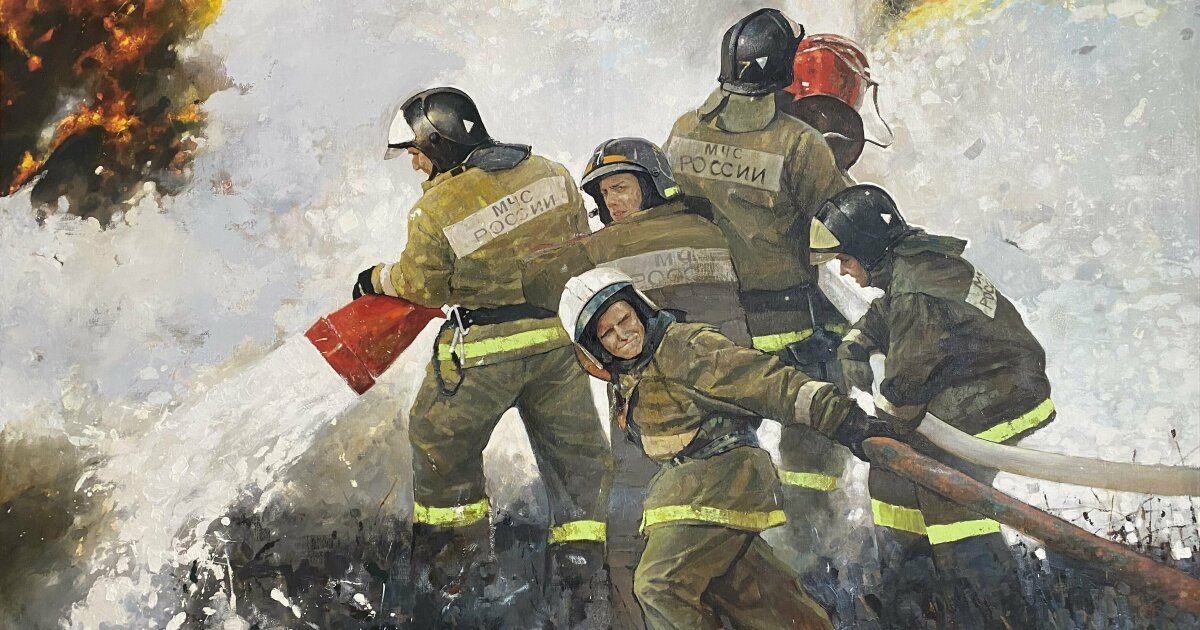
When I was young, I had a very practical life plan: become a firefighter, save people, slide down a pole with heroic urgency, and look extremely cool doing it. I imagined myself running toward danger while everyone else ran away, probably with dramatic music playing in the background. In my mind, the job came with bravery, teamwork, and the kind of uniform that made even grocery shopping look like a public service announcement.
Then life did what life does best: it grabbed my neat little plan, shook it like a snow globe, and scattered glitter everywhere. Instead of becoming a firefighter, I became an artist. No firetruck. No siren. No helmet. Just paint, deadlines, blank canvases, rejected sketches, coffee, and the occasional emotional crisis over whether a shade of red looked “confident” or “tomato soup.”
At first, that change felt like a detour. Later, I realized it was not a detour at all. It was the same calling wearing different boots. Firefighters protect people from flames. Artists help people understand the flames inside them. One works with hoses, ladders, and emergency response. The other works with color, story, and imagination. Both require courage. Both serve the community. And both involve cleaning up a surprising amount of mess.
The Childhood Dream: Why Firefighting Felt Like Destiny
Wanting to become a firefighter is not unusual. The profession carries a rare mix of action, purpose, discipline, and public trust. Firefighters respond to fires, medical emergencies, crashes, hazardous situations, natural disasters, and public safety calls. In the United States, many firefighters also train in emergency medical services, which means the job is not just about fire. It is about being useful when someone’s ordinary day suddenly turns upside down.
That sense of usefulness was what attracted me. I wanted a job that mattered. Not “my spreadsheet has changed history” mattered, but “someone is safer because I showed up” mattered. Firefighters train hard, work in teams, stay physically prepared, and follow procedures because hesitation can cost precious time. There was something beautiful about that discipline. It looked like bravery with a calendar, a checklist, and very heavy equipment.
As a kid, I did not understand the full reality of firefighting. I saw the shiny truck, not the training. I saw the rescue, not the long night shifts. I saw the heroic moment, not the emotional weight. Real firefighters face physical strain, safety risks, smoke exposure, heat, fatigue, and the pressure of making fast decisions. Agencies such as the U.S. Fire Administration and NIOSH focus heavily on firefighter health, safety, training, protective equipment, and prevention because this work is demanding in ways outsiders rarely see.
The First Spark of Art
Before I ever called myself an artist, I was just someone who liked making things. I drew in notebook margins. I decorated school projects with more enthusiasm than the assignment required. I paid attention to shadows, faces, signs, posters, colors, and the dramatic sadness of a broken crayon. Art was not a career plan at first. It was more like a quiet friend who kept showing up.
Firefighting felt bold and public. Art felt private and strange. One had a clear path: training, fitness, exams, certifications, department applications. The other sounded like something adults smiled at politely before asking, “But what is your real job going to be?” Becoming an artist can look uncertain from the outside because it often is. Many craft and fine artists build careers through a mix of studio practice, commissions, exhibitions, teaching, freelance work, design projects, online sales, and side jobs. It is not always a straight ladder. Sometimes it is a ladder, a trampoline, and a suspicious rope bridge.
Still, art kept calling. Not loudly, like a siren, but steadily, like a light left on in another room. I began to understand that creativity was not just decoration. It was communication. A painting could say what a speech could not. A photograph could hold memory. A mural could give a neighborhood a new face. A simple illustration could make a complicated idea feel human.
Firefighters and Artists Have More in Common Than People Think
At first glance, firefighting and art seem like opposite worlds. One deals with emergencies; the other with expression. One wears turnout gear; the other may wear paint-stained jeans that should have been retired three years ago. But the deeper I went into art, the more I noticed unexpected similarities.
Both Require Courage
Firefighters need physical courage. Artists need emotional courage. No, showing someone your sketchbook is not the same as entering a dangerous building, and let us not get dramatic enough to embarrass ourselves. But vulnerability is real. Putting your work into the world means accepting judgment, misunderstanding, silence, criticism, and the horrifying possibility that your mother will say, “Interesting,” in that tone.
Making art asks you to stand near uncertainty. You rarely know whether an idea will work. You try, fail, revise, ruin it, rescue it, and occasionally create something that feels alive. Courage is not always loud. Sometimes courage is returning to the canvas after yesterday’s version looked like a raccoon designed a billboard during a power outage.
Both Serve the Community
Firefighters protect communities through emergency response, prevention, education, and preparedness. Artists serve communities by shaping public spaces, preserving stories, challenging assumptions, and creating shared experiences. The National Endowment for the Arts has long emphasized that arts participation reaches communities of all sizes across the country, while economic data from the arts and cultural sector shows that creative work is not merely decorative; it is part of civic and economic life.
A fire station can become a symbol of safety. A community mural can become a symbol of belonging. A firefighter teaches families how to prevent danger. An artist helps people see the place they live with fresh eyes. Different tools, similar heartbeat.
Both Depend on Training
People often imagine artists as mysterious creatures who wake up inspired, whisper “muse,” and produce a masterpiece before breakfast. This is mostly false. Many artists spend years learning composition, color theory, anatomy, software, materials, storytelling, marketing, pricing, client communication, and how not to panic when a printer jams ten minutes before delivery.
Firefighters train because lives may depend on skill. Artists train because meaning depends on skill. Talent helps, but practice builds the hands. Whether you are handling a hose line or a paintbrush, romantic ideas collapse quickly without technique.
The Moment I Realized I Was Choosing Art
The shift did not happen in one cinematic moment. There was no thunderclap, no slow-motion scene where I dropped a firefighter helmet and picked up a paintbrush while an eagle nodded approvingly. It happened gradually. I noticed where my attention went when nobody was forcing it. I noticed what I practiced even when I was tired. I noticed what made time disappear.
Firefighting still inspired me, but art absorbed me. I could spend hours adjusting a sketch, studying a face, planning a composition, or wondering why blue can feel peaceful in one image and lonely in another. I became fascinated by visual language. I wanted to know why certain images stay with us. Why does a poster move people to act? Why does a portrait feel honest? Why can a single line carry personality?
Eventually, I had to admit something inconvenient: I did not only like art. I needed it. Art was how I processed fear, hope, grief, humor, ambition, and the awkward middle space between childhood dreams and adult decisions. It gave me a way to be useful without pretending to be someone else.
The Practical Side of Becoming an Artist
Let us be honest: choosing art as a career is not like finding a golden ticket inside a chocolate bar. It requires strategy. The U.S. Bureau of Labor Statistics notes that many craft and fine artists create work for sale or exhibition, but many also hold other jobs because income from art alone can be unpredictable. That is not a failure; it is part of the ecosystem. Artists often build layered careers.
An artist may sell original work, take commissions, design merchandise, create digital illustrations, teach workshops, work with galleries, license images, paint murals, design for brands, build a social media audience, collaborate with nonprofits, or work in animation, publishing, games, advertising, public art, or education. Some become full-time independent artists. Others combine creative practice with steady employment. The modern artist is often part creator, part entrepreneur, part project manager, and part person trying to remember where the good scissors went.
The arts economy is also larger than many people assume. National arts and culture data has shown that arts and cultural industries contribute significantly to the U.S. economy, while nonprofit arts and culture organizations support jobs, tourism, local spending, and community engagement. In plain English: art is not just something hanging quietly on a wall. It moves money, gathers people, tells stories, and gives cities their personality.
What Firefighting Taught Me Even Though I Never Became a Firefighter
Even though I chose art, the dream of firefighting left fingerprints on my life. It taught me values I still use every day.
Preparation Matters
Firefighters do not wait for an emergency to learn what to do. They drill, study, maintain equipment, and prepare. Artists need the same mindset. You prepare by sketching regularly, saving reference material, learning your tools, updating your portfolio, backing up your files, and building habits before opportunity knocks. Opportunity is rude like that. It rarely waits until your desk is clean.
Teamwork Makes the Work Stronger
Firefighting is built on trust. Nobody handles a serious call alone. Art can look solitary, but creative careers also depend on collaboration. You work with clients, curators, editors, printers, photographers, teachers, collectors, community leaders, and other artists. Even a solo exhibition may involve a small army of people who install, promote, frame, light, document, and support the work.
Service Gives Work Meaning
The most important lesson was service. Firefighting appealed to me because it was useful. I did not want a life built only around myself. Art became meaningful when I realized it could serve too. A children’s book illustration can comfort a reader. A memorial portrait can honor a loved one. A public mural can make a neglected wall feel seen. A design can help a good organization explain its mission. A comic can make someone laugh on a terrible day. That counts.
Why Changing Dreams Is Not the Same as Giving Up
Many people treat a changed dream like a broken promise. I disagree. Changing direction can be a sign of honesty. The dream you had at eight years old may reveal something true, but it may not reveal the whole truth. Maybe you wanted to be a firefighter because you wanted courage. Maybe you wanted to be a doctor because you wanted to heal. Maybe you wanted to be an astronaut because Earth seemed poorly managed and space had better branding.
The job title may change, but the deeper desire can remain. My firefighter dream was never only about fire. It was about bravery, usefulness, and showing up for people. Art gave me another way to live those values. Once I understood that, I stopped seeing my path as a compromise.
That is a powerful lesson for anyone standing at the crossroads between a childhood dream and a new identity. You are allowed to revise your life. You are allowed to discover that your first plan was a clue, not a contract. You are allowed to become someone your younger self did not predict but might still admire.
Lessons for Anyone Choosing Between a Safe Path and a Creative One
If you are trying to choose between a practical career and a creative calling, do not reduce the question to “money versus passion.” That is too simple, and frankly, life is already complicated enough without turning it into a motivational poster.
Ask better questions. What kind of problems do you want to solve? What kind of discomfort are you willing to tolerate? What skills are you ready to practice for years? What lifestyle do you want? What does service mean to you? Can your dream exist as a career, a side practice, a volunteer role, or a lifelong passion?
Some people should absolutely become firefighters. Some should become artists. Some should become firefighter-artists who paint station murals, design safety posters, or sketch fire engines with alarming accuracy. The point is not to choose the most impressive title. The point is to build a life that fits your values, abilities, and willingness to grow.
The Beauty of Becoming the Unexpected Version of Yourself
I still admire firefighters. I admire their discipline, teamwork, and commitment to public safety. I admire the way departments educate communities about prevention and preparedness. I admire the volunteers and professionals who give their time, bodies, and focus to difficult work.
But I no longer feel like I failed by not joining them. I became an artist, and art has its own emergencies. A blank canvas can be an emergency. A community without beauty can be an emergency. A story that has never been told can be an emergency. A person who feels invisible may need an image, a song, a poem, or a mural to remind them they exist.
That may sound grand, but I mean it in the most grounded way. Art will not replace emergency services. A watercolor cannot put out a kitchen fire, and believe me, I do not recommend testing that theory. But art can help people imagine safer futures, remember who they are, and feel connected to one another. That matters.
Personal Experiences: How the Firefighter Dream Still Lives in My Art
The funny thing about old dreams is that they do not always disappear. Sometimes they move into the basement of your personality and start quietly reorganizing the furniture. My childhood dream of becoming a firefighter still shows up in my art in ways I did not expect.
For example, I am drawn to images of light cutting through darkness. That sounds poetic, but it is also very firefighter-coded. A flashlight in smoke, a window glowing at night, a bright orange shape against deep blue shadowsthese visual contrasts fascinate me. I like scenes where something intense is happening but there is still control, still hope, still a path through. Maybe that comes from years of imagining emergency crews stepping into chaos with purpose.
I also learned to respect tools. Firefighters maintain equipment because tools must work when needed. Artists should treat their tools with the same seriousness, even if our equipment includes brushes, tablets, pens, cameras, editing software, and that one pencil we swear is luckier than the others. When I clean brushes, organize files, label materials, or prepare a workspace, I feel a tiny echo of the firehouse mentality: be ready before the call comes.
Another experience that shaped me was learning how much emotion people attach to visual work. A client once asked for an illustration based on a family memory. It was not dramatic in the Hollywood sense. No explosions, no chase scene, no heroic dog wearing sunglasses. It was just a quiet image connected to someone they loved. But when they saw it, they became still. That moment taught me that art can rescue feelings from being forgotten. It can pull memory out of the smoke.
I have also worked on creative projects where teamwork mattered as much as talent. Early on, I thought being an artist meant doing everything alone in a studio while looking mysterious and possibly under-caffeinated. In reality, some of the best projects required communication, compromise, planning, and trust. A mural project, for instance, can involve community input, sketches, approvals, surface preparation, scheduling, weather problems, budget limits, and the exciting discovery that ladders are still terrifying even when no fire is involved.
The firefighter dream also helped me handle criticism. Emergency work requires calm under pressure. Art criticism is obviously different, but it can still feel intense when someone questions your choices or rejects your proposal. Over time, I learned to breathe, listen, sort useful feedback from noise, and keep working. Not every comment is a five-alarm fire. Some are just toast burning in the kitchen.
Most importantly, that old dream kept me connected to service. I do not want to make art only to impress other artists. I want to make work that reaches people. Sometimes that means beauty. Sometimes humor. Sometimes clarity. Sometimes a piece that helps a local business, a nonprofit, a classroom, or a neighborhood communicate something important. The firefighter part of me still wants to show up when people need help. The artist part of me simply arrives carrying sketchbooks instead of hoses.
Looking back, I am grateful I wanted to become a firefighter. That dream gave me a strong idea of courage before I knew what my own courage would look like. It taught me that meaningful work often involves risk, preparation, and responsibility. It taught me to admire people who serve quietly and consistently. And it gave my creative life a backbone.
I did not become the person I pictured as a child. I became someone stranger, softer, more colorful, and probably more likely to spend twenty minutes discussing the emotional temperature of yellow. But I think younger me would understand. He wanted to run toward the fire. In a way, I still do. I just learned that not every fire burns down a building. Some burn inside an idea, a memory, a question, or a dream waiting for shape.
Conclusion: The Dream Changed, the Purpose Stayed
I wanted to become a firefighter, but I became an artist instead. At first, those lives seemed far apart. Now I see them as connected by courage, discipline, service, and the desire to bring light into difficult places. Firefighters answer urgent calls. Artists answer quieter ones. Both matter.
A changed dream is not always a lost dream. Sometimes it is a more honest version of the same desire. My childhood self wanted to help people. My adult self still does. The uniform changed. The tools changed. The mission, somehow, survived.