Beach volleyball looks simple from a distance: two players, one ball, a net, and enough sand to make your calves file a formal complaint. But once you step onto the court, you quickly discover that this sport is a clever mix of athleticism, strategy, communication, and weather management. A gentle breeze can turn a perfect set into a beach souvenir. A deep serve can make you run like your flip-flops owe someone money. And a smart shot placed softly into open sand can be just as deadly as a thunderous spike.
This guide breaks down how to play beach volleyball in 13 practical steps, from learning the rules and serving correctly to passing, setting, attacking, blocking, defending, and building real game sense. Whether you are playing at a local beach, joining a casual league, or trying to stop looking confused every time someone yells “mine,” these beach volleyball tips will help you start strong and improve faster.
What Is Beach Volleyball?
Beach volleyball is usually played by two teams of two players on a sand court. Unlike indoor volleyball, there are no substitutes in standard doubles play, and each player must handle every part of the game: serving, passing, setting, attacking, blocking, and defending. That is part of what makes beach volleyball so addictive. You are never just “the passer” or “the hitter.” You are the whole department, including customer support.
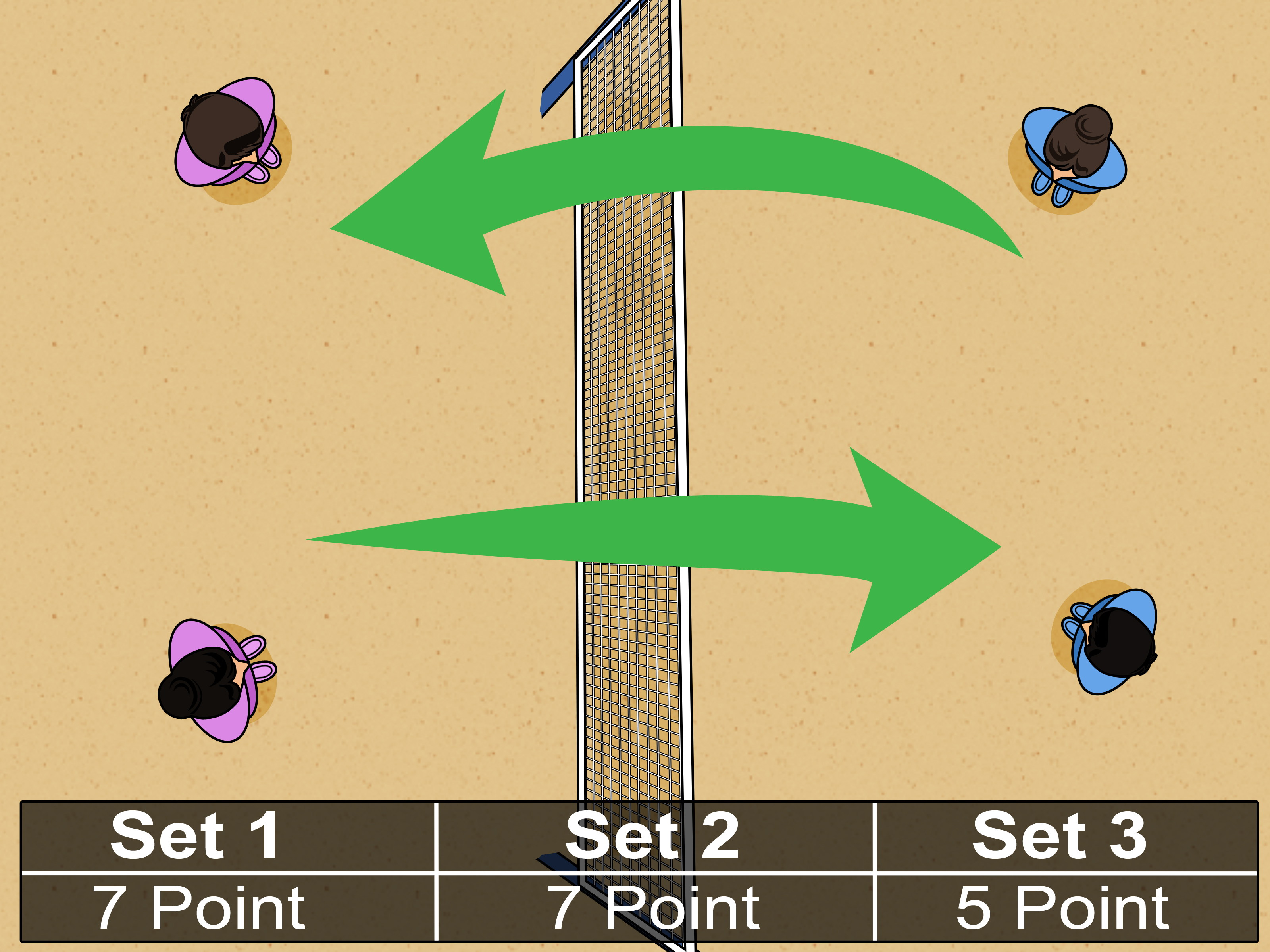
A regulation doubles beach volleyball court measures 16 meters by 8 meters, or about 52 feet 6 inches by 26 feet 3 inches. Matches are commonly played as best two out of three sets. The first two sets usually go to 21 points, while a deciding third set goes to 15. A team must win by two points, so yes, a close match can continue until everyone involved starts negotiating with the sun.
How to Play Beach Volleyball: 13 Steps
1. Learn the Basic Objective
The goal of beach volleyball is to send the ball over the net and land it inside the opponent’s court while preventing the other team from doing the same. A rally ends when the ball touches the sand, goes out of bounds, a team commits a fault, or a team fails to return the ball legally.
Beach volleyball uses rally scoring, which means either team can win a point on any rally, whether or not they served. If your team wins the rally, your team gets the point and serves next. This keeps the game moving quickly and makes every touch matter.
2. Understand the Court, Lines, and Net
The beach volleyball court is divided into two equal halves by a net. The boundary lines are part of the court, so a ball that touches a line is considered in. A ball that lands completely outside the lines is out. This is why players often stare at the sand after close points like they are reading ancient beach hieroglyphics.
The net height is generally the same as indoor volleyball: about 7 feet 11 5/8 inches for men and 7 feet 4 1/8 inches for women in standard competitive play. Recreational games can adjust the net depending on age, skill level, or how ambitious the group feels after lunch.
3. Know the Team Format
Standard beach volleyball is played two-on-two. Each team has one player on the right side and one on the left side when receiving serve, but there are no fixed front-row or back-row positions like indoor volleyball. Players can move freely around their side of the court.
Because there are only two players, communication is essential. Before every serve, teammates should quickly decide who will pass balls in the middle, who will block, who will defend angle, and who will cover line. Quiet teams do not stay quiet for long. The sand will teach them.
4. Start with a Legal Serve
Every rally begins with a serve from behind the end line. The server may stand anywhere behind the line but cannot step on or over it before contacting the ball. The ball must be served with one hand or arm. Beginners often start with an underhand serve because it is easier to control. As you improve, you can use a standing float serve or jump serve.
A good beach volleyball serve does not always need to be powerful. Placement matters. Serving deep, short, toward the sideline, into the wind, or between two players can create confusion. Your goal is not just to start the rally; your goal is to make the other team’s first touch uncomfortable. In beach volleyball, discomfort is a strategy.
5. Master Serve Receive
Serve receive is the first contact after the opponent serves. Most players use a forearm pass, also called a bump. To pass well, start in a low athletic stance with your knees bent, weight slightly forward, and arms relaxed. Move your feet before creating your platform. Then angle your forearms toward your target.
A common beginner mistake is swinging the arms like a baseball bat. Instead, keep the platform steady and use your legs to guide the ball. Your goal is to pass the ball high enough and close enough to your partner so they can set comfortably. A perfect pass is wonderful, but a playable pass is often enough to win points at beginner and intermediate levels.
6. Use the Three-Contact Pattern
Each team is allowed up to three contacts to send the ball back over the net. The traditional pattern is pass, set, and attack. The first contact controls the opponent’s serve or attack. The second contact sets up the hitter. The third contact sends the ball over the net with purpose.
In beach volleyball, a block counts as one of the team’s contacts. That means if your teammate blocks the ball and it stays on your side, your team has two contacts left. This rule surprises many indoor players at first, but it is central to beach volleyball strategy.
7. Learn to Set the Ball Cleanly
The set is usually the second contact. It gives your teammate a ball they can attack. You can hand set or bump set. Hand setting on the beach is judged more strictly than in many casual indoor games, so beginners should practice clean contact and avoid catching, lifting, or spinning the ball excessively.
A bump set is often safer in windy conditions. To bump set, use your forearms to guide the ball upward and toward your hitter. Keep the ball off the net enough so your partner has room to swing. A great set does not need to be fancy. It needs to be hittable. Fancy sets that drift into the net are just sand-flavored apologies.
8. Attack with Smart Shots, Not Just Power
An attack is any ball sent toward the opponent, except a serve or block. Many beginners think attacking means hitting as hard as possible. Power helps, but beach volleyball rewards variety. You can hit hard, roll the ball deep, shoot it to the corner, poke it with firm fingertips or knuckles, or place it into open sand.
Open-hand tipping with soft fingers is generally not legal in beach volleyball, so players often use a pokey shot, knuckle shot, cobra-style contact, or controlled roll shot instead. The best attackers read the defender before swinging. If the defender camps deep, shoot short. If the defender creeps short, hit deep. If nobody is covering the line, thank them politely and put the ball there.
9. Practice Blocking at the Net
Blocking is the first line of defense. The blocker jumps near the net to stop or slow the opponent’s attack. A blocker may reach over the net after the opponent attacks, as long as they do not interfere before or during the opponent’s play on the ball.
Beach volleyball blockers often use hand signals behind their back before the serve. One finger usually means the blocker will take away line. Two fingers usually means the blocker will take away angle. These signals help the defender know where to stand. Even in casual games, simple blocking plans can make your team look suspiciously organized.
10. Defend the Court with Purpose
The defender works behind the blocker to cover the rest of the court. If the blocker takes line, the defender usually guards angle. If the blocker takes angle, the defender usually guards line. The defender must read the hitter’s approach, shoulder position, arm swing, and the quality of the set.
Good defense starts before the attack. Watch the pass. A bad pass may force an easy free ball. A tight set may lead to a joust or blocked attack. A perfect set means the defender must be ready for heat. Stay low, keep your feet active, and expect the ball to come to you. Beach volleyball punishes spectators who happen to be standing inside the court.
11. Communicate Before, During, and After Each Rally
Communication is not optional in beach volleyball. Call “mine” or “yours” on serve receive. Call “line,” “angle,” “short,” or “deep” during attacking plays. Let your partner know if the blocker is moving, if the defender is cheating, or if a soft shot is available.
After the rally, keep feedback short and useful. “Next one” is better than a five-minute courtroom drama about who should have taken the middle ball. Great partners solve problems quickly. They do not write emotional novels in the sand between points.
12. Adjust to Sun, Wind, and Sand
Beach volleyball is played outdoors, which means the environment is part of the game. Wind affects serves, sets, and shots. Sun can make it difficult to track the ball. Hot sand can drain your legs faster than expected. Smart players adapt instead of complaining, although a little dramatic sighing is allowed for tradition.
When playing into the wind, use higher-percentage shots and avoid over-setting the ball too close to the net. When serving with the wind, add float and depth. Wear sunglasses or a hat when needed, use sunscreen, hydrate, and take heat seriously. On very hot days, play during cooler hours when possible and rest when your body tells you it is not interested in becoming a beach potato.
13. Play Points, Review, and Improve
The fastest way to learn beach volleyball is to play real points, then review what happened. Start with controlled games to 11 or 15. Focus on one skill at a time: consistent serving, clean passing, smarter shots, or better defensive positioning.
After each game, ask simple questions. Did we miss too many serves? Were our passes too close to the net? Did we communicate on middle balls? Did we hit directly at the defender? Improvement comes from noticing patterns. Beach volleyball is honest. The sand keeps receipts.
Essential Beach Volleyball Rules for Beginners
Scoring Rules
Most beach volleyball matches are best two out of three sets. The first two sets are played to 21 points, and the third set, if needed, is played to 15. A team must win each set by at least two points. There is usually no scoring cap in competitive play.
Side Changes
Teams switch sides regularly to keep conditions fair, especially because wind and sun can affect play. In many formats, teams switch every seven total points in sets to 21 and every five total points in a third set to 15.
Common Faults
Common beach volleyball faults include touching the net during play, catching or throwing the ball, hitting the ball out of bounds, taking more than three contacts, serving illegally, or making consecutive contacts except in limited blocking situations. Players may cross under the net only if they do not interfere with the opponent.
Beginner Beach Volleyball Skills to Practice
Serving Drill
Place targets in different areas of the court: deep left, deep right, short middle, and sideline. Serve ten balls to each target. Track how many land in. Accuracy builds pressure without needing a cannon arm.
Passing Drill
Have a partner toss or serve balls from across the net. Focus on moving your feet first, forming a quiet platform, and passing to a target area. Start slow, then increase difficulty with deeper serves, short serves, and windy conditions.
Set-and-Attack Drill
One player passes to a setter, then approaches for an attack. The setter gives a controlled ball, and the hitter practices hitting line, angle, deep corner, and short shots. Rotate roles often because beach players must do everything.
Defense Drill
Have one player attack controlled balls while the defender reads and digs. Practice starting in different positions based on the blocker’s call. Focus on getting the ball up, not making it perfect. In beach volleyball, a dig that stays alive is a small miracle with sunscreen on it.
Strategy Tips for Winning More Beach Volleyball Games
First, serve with intention. Do not simply put the ball in play. Serve the weaker passer, serve into the wind, or serve between players to force communication. Second, attack open space. Look before you swing. A soft shot to empty sand can be more effective than a hard hit directly at the defender.
Third, simplify your defense. Decide who blocks and who pulls off the net. Decide whether the blocker takes line or angle. A basic plan executed clearly is better than an advanced plan nobody remembers once the ball is served.
Fourth, protect your energy. Sand movement is tiring. Use efficient footwork, avoid unnecessary jumps, and choose smart shots when tired. Beach volleyball is not just about explosive plays; it is about making good decisions while your legs are quietly sending resignation letters.
Common Mistakes New Players Make
New players often miss serves by trying to hit too hard. A missed serve gives away a free point, so consistency should come before power. Another common mistake is passing while standing upright. Stay low and move your feet. The ball rarely travels exactly where optimism predicted.
Beginners also tend to set too tight to the net. This makes attacking difficult and gives the blocker an easy chance. Keep sets slightly off the net, especially when learning. Finally, many players forget to call the ball. Silence creates collisions, confusion, and the classic two-player stare as the ball lands untouched between them. Speak early, speak clearly, and save the awkward staring for family photos.
Extra Experience: What Playing Beach Volleyball Really Teaches You
One of the best experiences in beach volleyball is realizing that the game rewards patience. At first, most beginners want every rally to end with a highlight-reel spike. That is understandable. Spiking feels powerful, looks cool, and makes you briefly believe you should have your own sports documentary. But after a few games, you learn that control wins more points than drama. A clean serve, a steady pass, and a smart shot to open sand can beat pure power all day.
Another real lesson is that beach volleyball exposes your habits quickly. Indoors, teammates can sometimes cover mistakes. On the beach, there are only two of you. If your serve receive is shaky, you will know. If your communication disappears under pressure, the ball will land exactly where both players assumed the other person would be. This is not a bad thing. It is actually one of the best parts of the sport. Every game gives clear feedback.
Playing in wind is a separate education. A set that looks perfect indoors may drift three feet outside on the beach. A float serve can dance like it has weekend plans. The trick is to stop fighting the weather and start using it. Serve into the wind to make the ball drop. Set a little lower when gusts are strong. Choose safer attacks when conditions are messy. The players who adapt fastest usually look calm, while everyone else looks personally betrayed by air.
Beach volleyball also teaches partnership. You and your teammate will make mistakes. Lots of them. The best teams do not avoid errors; they recover from them quickly. A good partner says, “We’re fine,” then gets ready for the next serve. A great partner notices patterns and offers useful help: “They’re serving short,” “I’ll take middle,” or “Line is open.” The difference between helpful communication and complaining is enormous. One builds trust. The other makes the next rally feel like a group project with bad Wi-Fi.
Physically, the sport improves balance, footwork, jumping, and endurance. Moving in sand strengthens muscles that flat courts do not challenge as much. Even a short game can feel like a full workout because every sprint, jump, and recovery step costs extra energy. That is why beginners should pace themselves. Bring water, rest between games, and do not underestimate the sun. Beach volleyball is fun, but heat exhaustion is not a personality-building exercise.
The most satisfying moment comes when the game slows down in your mind. You begin to read the server’s body position. You notice the blocker’s hands. You see the defender cheating deep, so you place a soft shot short. You stop reacting randomly and start making choices. That is when beach volleyball becomes more than a sunny workout. It becomes a conversation between four players, one ball, and a patch of sand that somehow knows all your weaknesses.
If you are just starting, do not worry about playing perfectly. Focus on serving in, passing high, setting playable balls, and communicating every point. Learn the rules, respect your opponents, and laugh when the wind turns your perfect shot into modern art. The beach has a way of humbling everyone. Fortunately, it also has a way of making the learning process ridiculously fun.
Conclusion
Learning how to play beach volleyball starts with the basics: understand the court, serve legally, pass with control, set your partner, attack open space, defend with purpose, and communicate constantly. From there, improvement comes through repetition and smart adjustments. The more you play, the more you learn how sand, wind, sun, and teamwork shape every rally.
Beach volleyball is challenging, but that is exactly why it is so rewarding. You touch the ball often, make decisions constantly, and learn quickly from every point. Start with these 13 steps, practice one skill at a time, and keep your sense of humor nearby. You will need it the first time the wind steals your serve and returns it emotionally damaged.