Giving back correct change sounds simple until the line is long, the customer is digging for three pennies, the register is beeping like a microwave, and your brain suddenly forgets whether a dime is ten cents or “the tiny silver one with attitude.” The good news? Making change is a skill, not a magic trick. With a clear process, a little mental math, and calm customer service, anyone can learn how to count change accurately and confidently.
Whether you are a new cashier, a small business owner, a student practicing real-world money skills, or someone who wants to stop staring at coins like they are ancient artifacts, this guide breaks the process into 11 practical steps. You will learn how to calculate change, count it back, avoid common register mistakes, handle cash safely, and keep customers happy without turning every transaction into a math quiz show.
Why Learning to Give Back Correct Change Still Matters
Even in a world filled with cards, mobile wallets, QR codes, and tap-to-pay terminals, cash is still used every day in restaurants, grocery stores, farmers markets, gas stations, convenience stores, school events, yard sales, and small businesses. Knowing how to give back correct change protects the customer, protects the business, and protects the cashier from those dreaded “my drawer is short” moments.
Correct change also builds trust. A customer may not remember your perfect scanning speed, but they will remember if you shorted them two dollars or accidentally handed them a quarter when they deserved a dollar coin. Accuracy says, “You can trust this place.” Sloppy change says, “Good luck, brave shopper.”
How to Give Back Correct Change: 11 Steps
1. Confirm the Total Before Taking Cash
Start by clearly reading or repeating the total. For example, say, “Your total is $13.47.” This simple habit prevents confusion before it starts. If the customer did not hear the total, they may hand you the wrong amount or ask questions after you have already opened the drawer.
Do not rush this step. A calm, clear total helps both sides understand the transaction. It is especially useful in noisy stores, drive-thru windows, busy cafés, or any place where people are ordering coffee with the seriousness of a legal negotiation.
2. Say the Amount the Customer Gives You
When the customer hands you money, say the amount out loud: “Out of twenty,” “Out of fifty,” or “You gave me $15.” This protects everyone. It reduces honest mistakes and helps prevent disputes such as, “I gave you a fifty,” when the customer actually gave you a twenty.
Keep the customer’s bill visible until the change is counted. Many experienced cashiers place the bill across the register drawer instead of dropping it in immediately. Once the transaction is complete, the bill goes into the correct slot. This tiny habit can save a big headache.
3. Enter the Cash Amount Carefully
If you are using a POS system or cash register, enter the tendered amount accurately. If the customer gives you $20 for a $13.47 purchase, type $20.00, not $200.00 unless you want the register to recommend a change amount large enough to buy a sofa.
Modern registers calculate change automatically, but do not let the machine do all your thinking. Glance at the amount and ask yourself whether it makes sense. If a $13.47 purchase paid with a $20 bill shows $86.53 in change, something went wrong. The register is not haunted; it was probably a typing mistake.
4. Understand the Basic Change Formula
The basic formula is simple:
Amount paid minus total cost equals change due.
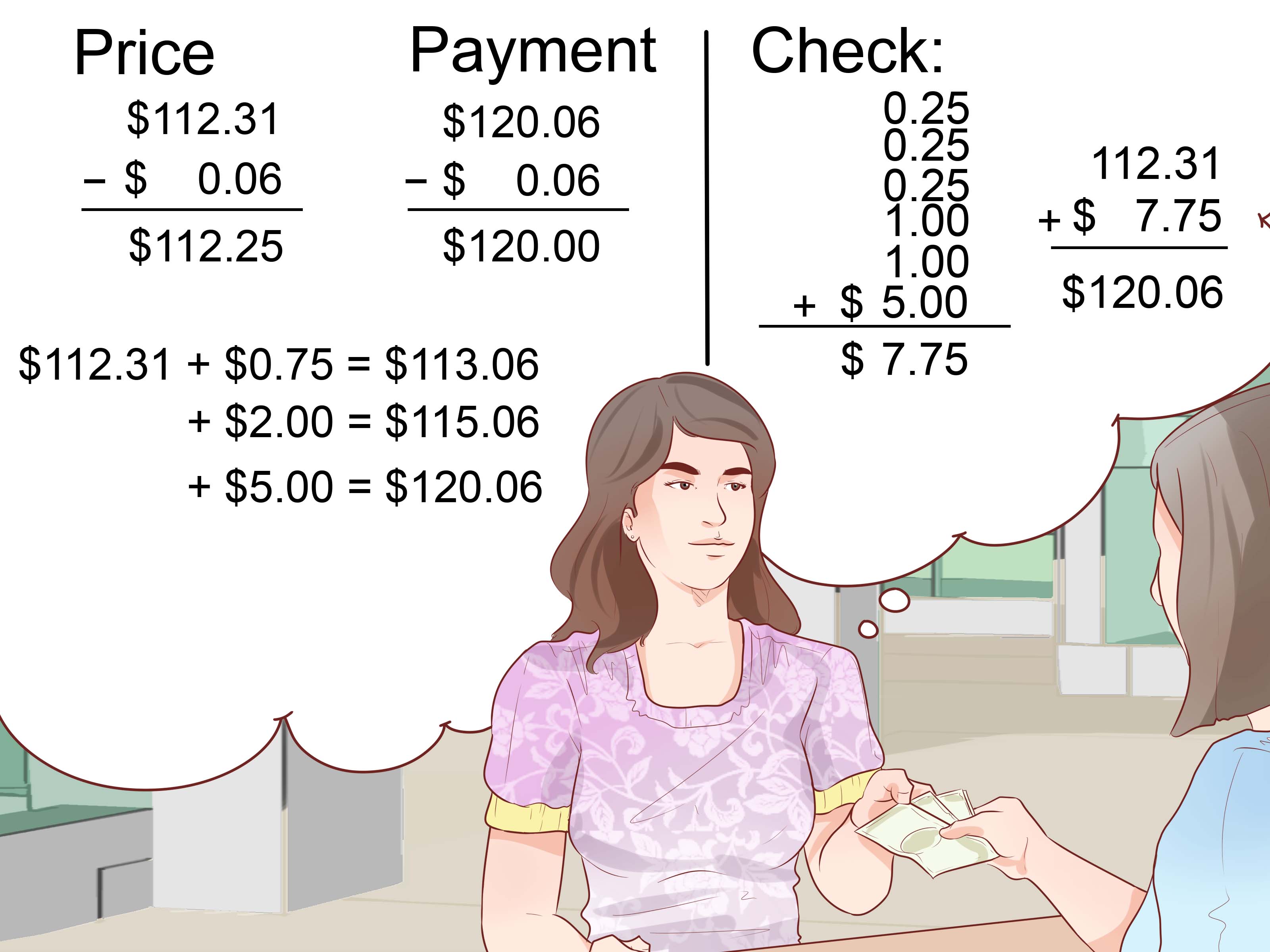
For example, if the purchase is $13.47 and the customer pays $20.00, the change is $6.53. You can calculate it by subtraction or by counting up from the price to the amount paid. Counting up is often easier for cashiers because it mirrors the way change is handed back.
For example:
$13.47 to $13.50 is 3 cents. $13.50 to $14.00 is 50 cents. $14.00 to $20.00 is $6.00. Total change: $6.53.
5. Start With Coins, Then Bills
When giving back change, start with coins and work toward bills. This keeps the count organized and prevents coins from sliding off a stack of paper money. The usual order is pennies, nickels, dimes, quarters, then dollar bills and larger bills.
For a $13.47 total paid with $20.00, you would hand back:
3 pennies to reach $13.50, 2 quarters to reach $14.00, then $6.00 in bills to reach $20.00.
That is much easier than grabbing random coins and hoping arithmetic feels generous today.
6. Count Up From the Purchase Total
Counting up is one of the most reliable ways to give back correct change. Instead of subtracting in your head, you build from the total to the amount paid.
Example: The total is $8.68, and the customer pays $10.00.
You count:
“Two pennies makes $8.70, a nickel makes $8.75, a quarter makes $9.00, and one dollar makes $10.00.”
The customer receives $1.32. More importantly, both you and the customer hear the logic. Counting up turns the transaction into a mini receipt spoken out loud.
7. Use the Fewest Practical Coins and Bills
Correct change should also be convenient change. If someone is owed 75 cents, give three quarters instead of seven dimes and a nickel unless your coin drawer is having an existential crisis. If someone is owed $5, give a five-dollar bill instead of five singles when possible.
This keeps your drawer organized, speeds up the line, and makes customers less likely to walk away sounding like a pocketful of wind chimes. Of course, sometimes your drawer runs low on certain denominations. In that case, use the best available combination while keeping the amount accurate.
8. Keep the Cash Drawer Organized
A messy cash drawer is where mistakes go to throw a party. Keep bills facing the same direction and in the correct slots. Keep coins in their proper compartments. Do not mix coupons, receipts, sticky notes, and loose coins into one chaotic pile.
An organized drawer helps you move faster and reduces the chance of giving someone a $10 bill when you meant to give a $1 bill. In many businesses, cashiers are responsible for balancing their drawer at the end of a shift, so organization is not just neatit is financial self-defense.
9. Count the Change Back to the Customer
Counting change back is the classic cashier skill, and it still works beautifully. Instead of silently placing money in the customer’s hand, say the count as you give it back.
Example: The total is $23.62, and the customer pays $30.00.
You can say:
“Thirty-eight cents makes $24.00, and six dollars makes $30.00. Your change is $6.38.”
This does three things at once: confirms the amount, reassures the customer, and gives you one final accuracy check. It is like proofreading your math, but with coins.
10. Handle Special Situations Calmly
Customers sometimes hand you extra coins after you have entered the payment. For example, the total is $9.76, the customer gives you $10.00, and then says, “Oh, wait, I have a penny.” Now the change becomes 25 cents instead of 24 cents.
Do not panic. Pause, recalculate, and speak clearly. You can say, “Great, with the extra penny, your change is a quarter.” If the customer gives extra money in a confusing way, it is okay to slow down and confirm: “Let me make sure I have this right.” Accuracy beats speed every time.
11. Double-Check Before Closing the Drawer
Before the customer walks away, glance once more at the receipt, the total, the amount paid, and the change in your hand. This final check takes only a second, but it catches many mistakes.
Once the customer has the change and the bill is placed in the drawer, close the register. Do not leave the cash drawer open longer than necessary. Open drawers invite errors, distractions, and security problems. A closed drawer is a happy drawer.
Common Mistakes When Giving Back Change
Dropping the Customer’s Bill Too Soon
If you immediately put the customer’s bill into the drawer, it becomes harder to settle disputes. Keep it visible until the change is complete. This is one of the easiest habits to build and one of the most useful.
Trusting the Register Without Thinking
Registers are helpful, but they are not immune to human input errors. If you enter the wrong amount paid, the register will confidently give you the wrong change. Machines are very talented at being precisely incorrect.
Mixing Up Coin Values
In U.S. currency, pennies are 1 cent, nickels are 5 cents, dimes are 10 cents, and quarters are 25 cents. Dimes are smaller than nickels but worth more, because apparently coins enjoy keeping beginners humble.
Rushing During Busy Periods
Speed matters in customer service, but accuracy matters more. A fast wrong transaction still has to be fixed, which usually takes longer than doing it correctly the first time.
Helpful Examples for Practicing Correct Change
Example 1: Total $4.37, Paid $5.00
Count up from $4.37. Add 3 pennies to reach $4.40. Add a dime to reach $4.50. Add 2 quarters to reach $5.00. The change is 63 cents.
Example 2: Total $18.26, Paid $20.00
Add 4 pennies to reach $18.30. Add 2 dimes to reach $18.50. Add 2 quarters to reach $19.00. Add 1 dollar to reach $20.00. The change is $1.74.
Example 3: Total $31.82, Paid $40.00
Add 3 pennies to reach $31.85. Add a dime and a nickel to reach $32.00. Add 8 dollars to reach $40.00. The change is $8.18.
Tips for Cashiers Who Want Fewer Mistakes
Practice during slow periods. Use fake transactions, training mode, or simple written examples. The more you practice, the less intimidating cash becomes.
Stay focused during the payment step. Many mistakes happen when the cashier is chatting, answering a question, bagging items, listening to a coworker, and handling money all at once. Multitasking is impressive until it costs the drawer $10.
Use a consistent routine every time: announce the total, confirm the amount received, enter the payment, count the change, hand it back, and close the drawer. Routine reduces mental load and makes mistakes easier to spot.
Ask for help when needed. If a customer challenges the change or you feel uncertain, call a supervisor or manager. That is not failure; that is responsible cash handling.
Experiences and Real-World Lessons About Giving Back Correct Change
Anyone who has worked a register for more than five minutes knows that giving back correct change is not just about math. It is about rhythm, attention, confidence, and the ability to remain calm while a customer searches for exact change in a coin purse that appears to contain every penny minted since 1987.
One of the most useful real-world lessons is that customers appreciate being included in the count. When you count change out loud, people relax. They can follow along, and the transaction feels transparent. Even if they are in a hurry, hearing “that makes ten” gives them confidence that the exchange was handled correctly. Silence, on the other hand, can make people suspicious, especially when the amount of change is large.
Another experience many cashiers share is that mistakes often happen right after an interruption. A coworker asks a question, the phone rings, the receipt printer jams, or another customer jumps in with, “Can I just ask one quick thing?” That “quick thing” can break your focus. The best response is to pause and restart the count from the beginning. It may feel awkward for two seconds, but it is much better than discovering later that the drawer is short.
Small business owners also learn quickly that a good change-making process keeps the whole operation smoother. At a farmers market, craft fair, food truck, or school fundraiser, there may not be a fancy POS system. You might be working from a cash box with a calculator and a handwritten price list. In those settings, starting with a strong cash bank matters. Bring plenty of ones, fives, quarters, dimes, nickels, and pennies if prices are not rounded. If everything costs whole dollars, life becomes much easier, and your coin tray gets to enjoy retirement.
A common beginner mistake is trying to calculate everything silently in one step. For example, a customer pays $50 for a $27.43 purchase, and the cashier tries to subtract the entire amount mentally while the customer watches. That can feel like doing algebra on a stage. Counting up is less stressful. Start at $27.43 and climb to $50.00 in logical pieces. The method gives your brain a path instead of asking it to leap over a canyon.
Another valuable lesson is to respect the cash drawer setup. If the drawer is messy at the beginning of the shift, fix it before the rush. Face the bills the same way, separate denominations, and make sure coins are not mixed together. When the lunch rush hits or the evening crowd appears, you will not have time to wonder why nickels are hiding in the quarter slot like tiny impostors.
Cashiers also learn that confidence matters, but overconfidence can be expensive. The best cash handlers are not the ones who never double-check. They are the ones who double-check naturally. They glance at the receipt, verify the payment, count the change, and move on. It is not dramatic. It is professional.
When a customer says they received the wrong change, stay polite. Do not argue from memory. Memories are not cash-control systems. Instead, explain that you can review the transaction or have the drawer counted according to store policy. Most customers calm down when they see a fair process. If the business uses cameras, POS reports, or drawer audits, those tools can help resolve the issue without turning the checkout lane into a courtroom drama.
Finally, giving correct change teaches a broader lesson: small details build trust. A cashier who handles money carefully shows respect for the customer’s time and wallet. A business that trains employees to count change properly reduces errors, protects revenue, and creates a more professional experience. Correct change may seem like a tiny part of the day, but in retail and service work, tiny things add upsometimes literally.
Conclusion
Learning how to give back correct change is a practical skill that combines basic math, clear communication, organized cash handling, and steady customer service. The easiest method is to count up from the purchase total to the amount paid, starting with coins and moving to bills. Say the amount received, keep the customer’s bill visible until the transaction is complete, and count the change back clearly.
With practice, making change becomes fast, natural, and almost automatic. You do not need to be a math genius. You just need a reliable routine, an organized drawer, and the courage to pause when something feels off. Even in the age of digital payments, knowing how to handle cash correctly is still a valuable skilland yes, it may finally make pennies feel useful again.
Note: This article was created from synthesized best practices in U.S. cash handling, cashier training, currency education, retail register management, and counterfeit-awareness guidance from reputable government, retail, financial, and business-training resources.