Rectangles are everywhere: phone screens, notebook pages, doors, windows, soccer fields, chocolate bars, and that mysteriously rectangular slice of leftover pizza box taking up half the fridge. Learning how to find the area and perimeter of a rectangle is one of the most useful geometry skills because it helps you measure space, plan materials, solve word problems, and avoid buying a rug that looks heroic online but turns out to be the size of a placemat.
The good news? Rectangle math is friendly. No dramatic plot twists. No secret trapdoors. You only need two measurements: length and width. Once you know those, you can calculate both the amount of space inside the rectangle and the distance around it.
In this guide, you will learn how to find the area and perimeter of a rectangle in 8 steps, with formulas, examples, mistakes to avoid, and practical tips that make the concept easier to remember. By the end, you will be able to look at a rectangle and think, “I know exactly what you are hiding, four-sided friend.”
What Are Area and Perimeter?
Before jumping into formulas, it helps to understand what you are actually measuring. Area tells you how much flat space is inside a shape. For a rectangle, that means the surface covered by the rectangle. Area is measured in square units, such as square inches, square feet, square centimeters, or square meters.
Perimeter tells you the total distance around the outside of a shape. Imagine walking around the edge of a rectangular garden, or putting a frame around a rectangular photo. That outside distance is the perimeter. Perimeter is measured in regular linear units, such as inches, feet, centimeters, or meters.
Area vs. Perimeter in Plain English
Think of area as “covering” and perimeter as “bordering.” If you are laying carpet, painting a wall, or covering a tabletop, you care about area. If you are installing fencing, adding trim, or wrapping ribbon around a box, you care about perimeter.
- Area: How much space is inside?
- Perimeter: How far is it around the outside?
That difference matters. A rectangle can have the same perimeter as another rectangle but a different area. Geometry likes to keep things interesting, but fortunately, not too spicy.
The Two Rectangle Formulas You Need
For a rectangle with length l and width w, use these formulas:
Area of a rectangle: A = l × w
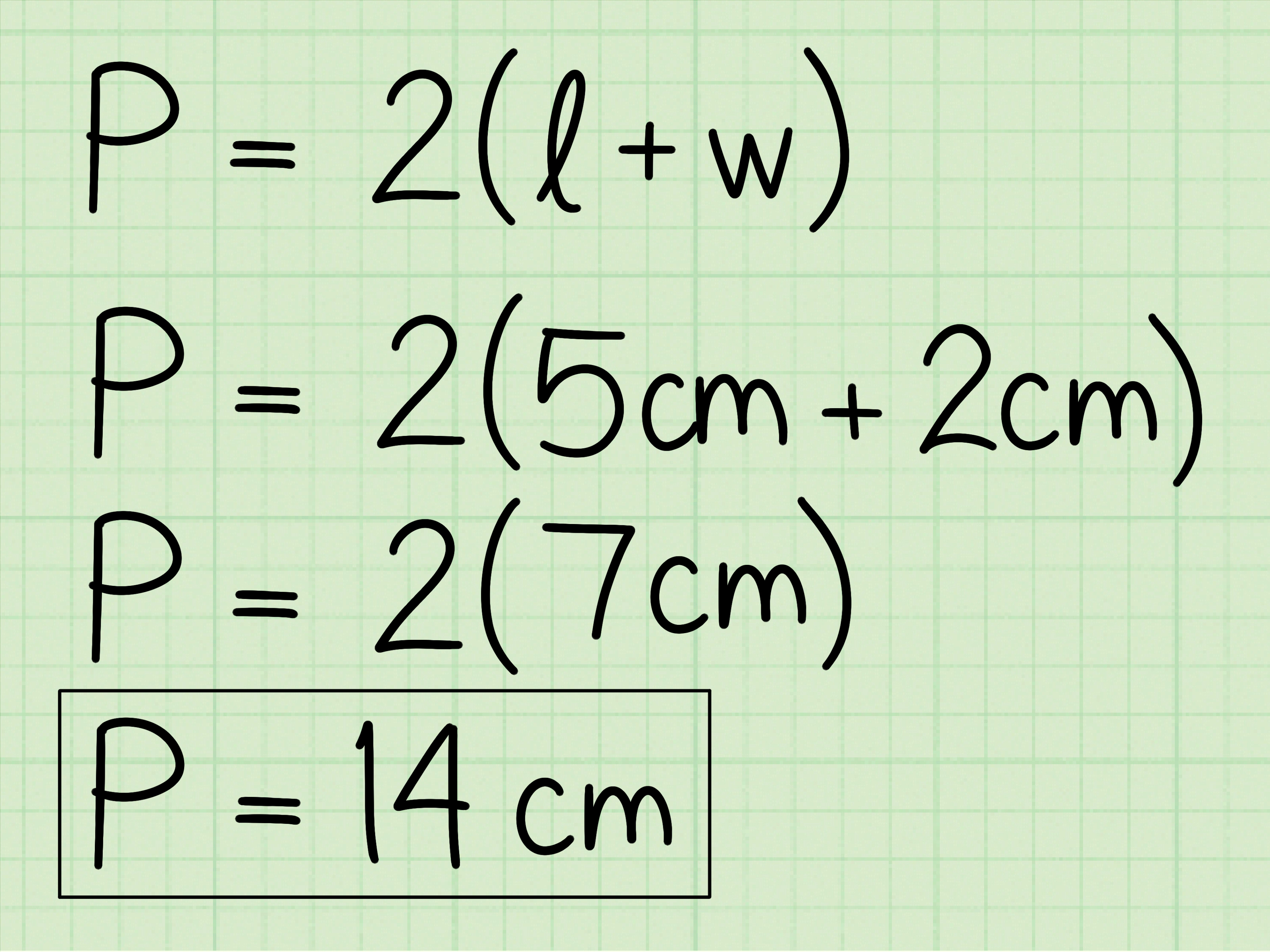
Perimeter of a rectangle: P = 2l + 2w
You may also see the perimeter formula written as:
P = 2(l + w)
Both versions mean the same thing. A rectangle has two equal lengths and two equal widths, so you add the length twice and the width twice. Basically, rectangles are very organized. If only backpacks worked the same way.
How to Find the Area and Perimeter of a Rectangle: 8 Steps
Step 1: Identify the Rectangle
First, make sure the shape is actually a rectangle. A rectangle is a four-sided shape with opposite sides equal and four right angles. In other words, each corner is a neat 90-degree angle.
This step sounds obvious, but it matters in word problems and diagrams. Sometimes a shape may look rectangular but include missing parts, slanted sides, or extra sections. If it is not a true rectangle, you may need a different strategy, such as breaking the shape into smaller rectangles.
Step 2: Find the Length and Width
Next, identify the two key measurements: length and width. The length is usually the longer side, while the width is usually the shorter side. However, the formula works either way as long as you multiply one side by the other.
For example, suppose a rectangle is 10 inches long and 4 inches wide. Here:
- Length = 10 inches
- Width = 4 inches
Do not overthink the labels. Whether you call one side “base” and the other “height,” the key idea is that a rectangle’s area comes from multiplying the two perpendicular side lengths.
Step 3: Make Sure the Units Match
Before calculating, check the units. This is where many math mistakes sneak in wearing tiny disguises. If the length is measured in feet and the width is measured in inches, you cannot simply multiply them without converting first.
For example, if a poster is 3 feet long and 18 inches wide, convert one unit so both measurements match. Since 3 feet equals 36 inches, the rectangle is 36 inches by 18 inches. Now the calculation is clean.
Keeping units consistent is especially important in real-world tasks like measuring flooring, wallpaper, garden beds, fabric, or fencing. A unit mismatch can turn a simple rectangle problem into a comedy of errors, and not the fun kind.
Step 4: Write the Area Formula
Now write the area formula:
A = l × w
This formula works because the rectangle can be thought of as rows and columns of square units. If a rectangle is 6 units long and 3 units wide, it can hold 3 rows of 6 square units, or 18 square units total.
That is why area is written in square units. You are not just measuring a line; you are measuring a two-dimensional surface.
Step 5: Multiply Length by Width
Use the formula and multiply the two measurements.
Example: Find the area of a rectangle that is 12 feet long and 5 feet wide.
A = l × w
A = 12 × 5
A = 60
The area is 60 square feet.
Notice that the answer is not just 60 feet. It is 60 square feet because you are measuring the space inside the rectangle. Leaving off “square” is like ordering a sandwich and forgetting the bread. Technically, something is there, but the structure has collapsed.
Step 6: Write the Perimeter Formula
To find the perimeter, write:
P = 2l + 2w
Or:
P = 2(l + w)
Both formulas add all four sides of the rectangle. Since opposite sides are equal, you can double the length and double the width instead of adding each side separately.
If the rectangle is small and simple, you may also use:
P = l + w + l + w
This version is especially helpful for beginners because it shows exactly what perimeter means: the total distance around the shape.
Step 7: Add the Side Lengths
Now calculate the perimeter.
Example: Find the perimeter of a rectangle that is 12 feet long and 5 feet wide.
P = 2l + 2w
P = 2(12) + 2(5)
P = 24 + 10
P = 34
The perimeter is 34 feet.
Unlike area, perimeter uses regular units because you are measuring a one-dimensional distance around the rectangle. So the answer is feet, not square feet.
Step 8: Check Your Answer
The final step is to check whether your answer makes sense. This is the step that separates careful problem-solvers from people who accidentally buy 600 square feet of tile for a bathroom the size of a cereal box.
Ask yourself:
- Did I use the correct formula?
- Are the units the same?
- Did I label area with square units?
- Did I label perimeter with regular units?
- Does the answer seem reasonable?
For example, if a rectangle is 10 inches by 2 inches, an area of 20 square inches makes sense. But if you somehow get 200 square inches, it is time to check your multiplication before the rectangle calls for backup.
Complete Example: Finding Both Area and Perimeter
Let’s solve a full problem from start to finish.
Problem: A rectangular garden is 18 feet long and 7 feet wide. Find its area and perimeter.
Find the Area
A = l × w
A = 18 × 7
A = 126
The area is 126 square feet. This tells you how much ground space the garden covers.
Find the Perimeter
P = 2l + 2w
P = 2(18) + 2(7)
P = 36 + 14
P = 50
The perimeter is 50 feet. This tells you how much fencing you would need to go around the garden.
Same rectangle, two different measurements, two different jobs. Area handles the inside. Perimeter patrols the border like a very responsible security guard.
How to Solve Missing Side Problems
Sometimes a problem gives you the area or perimeter and asks you to find a missing side. The trick is to work backward.
Missing Width When Area Is Known
Problem: A rectangle has an area of 48 square inches and a length of 8 inches. What is the width?
Use the area formula:
A = l × w
48 = 8 × w
w = 48 ÷ 8
w = 6
The width is 6 inches.
Missing Width When Perimeter Is Known
Problem: A rectangle has a perimeter of 30 meters and a length of 10 meters. What is the width?
Use the perimeter formula:
P = 2l + 2w
30 = 2(10) + 2w
30 = 20 + 2w
10 = 2w
w = 5
The width is 5 meters.
When solving backward, slow down and keep the formula visible. The formula is your map. Without it, you are just wandering through numbers with a calculator and hope.
Common Mistakes to Avoid
Mixing Up Area and Perimeter
The most common mistake is using the area formula when the problem asks for perimeter, or using the perimeter formula when the problem asks for area. Look for clue words. If the problem mentions covering, painting, tiling, carpeting, or surface space, it likely asks for area. If it mentions fencing, framing, edging, or distance around, it likely asks for perimeter.
Forgetting Square Units
Area must be written in square units. If a rectangle measures 9 centimeters by 4 centimeters, the area is 36 square centimeters, not 36 centimeters. The tiny word “square” does a big job.
Using Different Units
Always convert units before calculating. Multiplying feet by inches without conversion can create a misleading answer. Math is powerful, but it is not psychic.
Adding Instead of Multiplying for Area
Area requires multiplication, not addition. A rectangle that is 8 inches by 3 inches has an area of 24 square inches, not 11 square inches.
Multiplying All Four Sides for Perimeter
Perimeter is the sum of the sides, not the product. For a 6-by-4 rectangle, the perimeter is 6 + 4 + 6 + 4 = 20, not 6 × 4 × 6 × 4. That second number belongs in a math horror movie.
Real-Life Uses for Rectangle Area and Perimeter
Understanding rectangle area and perimeter is not just for homework. These formulas show up constantly in everyday life.
Home Improvement
If you are painting a rectangular wall, you need the wall’s area to estimate how much paint to buy. If you are adding trim around a window, you need the perimeter. This is why geometry quietly hangs out at every hardware store.
Gardening and Landscaping
Garden beds, lawns, patios, and walkways are often rectangular. Area helps you estimate soil, sod, mulch, or paving stones. Perimeter helps you plan fencing, edging, or border stones.
School and Office Projects
Poster boards, bulletin boards, whiteboards, desks, notebooks, and classroom layouts often involve rectangles. Knowing area and perimeter makes planning faster and more accurate.
Design and Decorating
Buying rugs, curtains, wallpaper, tablecloths, shelves, or picture frames often requires rectangle measurements. A little geometry can save money, time, and the emotional damage of ordering the wrong size rug twice.
Quick Practice Problems
Try these problems to test your understanding.
Practice Problem 1
A rectangle is 14 inches long and 6 inches wide. Find the area and perimeter.
Answer: Area = 14 × 6 = 84 square inches. Perimeter = 2(14) + 2(6) = 40 inches.
Practice Problem 2
A rectangular field is 30 yards long and 12 yards wide. Find the area.
Answer: Area = 30 × 12 = 360 square yards.
Practice Problem 3
A rectangular picture frame is 16 inches long and 10 inches wide. Find the perimeter.
Answer: Perimeter = 2(16) + 2(10) = 52 inches.
Practice Problem 4
A rectangle has an area of 72 square feet and a width of 8 feet. Find the length.
Answer: 72 = l × 8, so l = 72 ÷ 8 = 9 feet.
Experience Notes: What Makes Rectangle Problems Easier
In practical learning situations, the students and problem-solvers who master rectangle area and perimeter fastest usually do one thing well: they connect the formula to a real object. Memorizing A = l × w and P = 2l + 2w is useful, but understanding why those formulas work makes the knowledge stick much longer.
One helpful experience is using grid paper. Draw a rectangle that is 5 squares long and 3 squares wide. Instead of immediately using the formula, count every little square inside. You will get 15 squares. Then multiply 5 × 3 and notice that the answer is also 15. That moment is small, but powerful. It shows that the area formula is not magic; it is just a faster way to count square units without spending all afternoon pointing at boxes like a very tired robot.
Another useful experience is measuring objects around the room. A desk, book cover, phone screen, door, or window can become a quick geometry lesson. Measure the length and width, calculate the area, then calculate the perimeter. This makes the difference between the two concepts much clearer. The area describes the flat surface. The perimeter describes the edge around it. When learners physically trace the outside of an object with a finger or measuring tape, perimeter becomes easier to remember.
Word problems also become easier when you identify the real-world action. If someone is buying carpet, tile, paint, wrapping paper, or fabric, the problem is probably about area. If someone is buying fencing, ribbon, border trim, baseboard, or a frame, the problem is probably about perimeter. This one habit can prevent many formula mix-ups.
A good trick is to write the units before solving. If the answer should be in square feet, you are probably finding area. If the answer should be in feet, you are probably finding perimeter. Units are like tiny road signs. They quietly tell you where the problem is going.
In real projects, checking reasonableness is just as important as calculating. Suppose you measure a small rectangular table and get an area of 4,800 square feet. That is not a table; that is a shopping mall with legs. When an answer looks too large or too small, go back and check the units, formula, and multiplication. Most rectangle mistakes are not caused by difficult math. They are caused by rushing.
The best way to gain confidence is to practice with simple numbers first, then move to more realistic examples. Start with rectangles like 4 by 5, 6 by 8, and 10 by 12. Then try problems involving feet and inches, missing sides, and real-life situations. Over time, the formulas become automatic, and rectangle problems start to feel less like math homework and more like a useful measuring tool.
Another experience-based tip is to draw the rectangle every time, even if the problem does not provide a picture. Label the length and width directly on the drawing. This simple sketch can prevent confusion, especially in multi-step problems. The drawing does not need to win an art contest. It only needs to keep your numbers organized. Stick-figure rectangles are welcome here.
Finally, remember that rectangle math rewards patience. The steps are simple, but accuracy matters. Read the problem, label the sides, choose the correct formula, calculate carefully, and check the units. Do that, and you can solve almost any basic rectangle area and perimeter problem without panic, drama, or emergency snacks.
Conclusion
Finding the area and perimeter of a rectangle is one of the most practical skills in geometry. Area measures the space inside the rectangle and uses square units. Perimeter measures the distance around the rectangle and uses regular units. Once you know the length and width, the formulas are simple: A = l × w for area and P = 2l + 2w for perimeter.
The key is knowing which formula fits the situation. Covering a surface? Use area. Going around the edge? Use perimeter. Keep your units consistent, label your answers correctly, and check whether the result makes sense. With these habits, rectangle problems become much easierand much less likely to ambush you on a math quiz.
Note: This article synthesizes standard geometry instruction used in American math education, including common classroom explanations of rectangle area, perimeter, units, formulas, examples, and real-world applications.