Note: This article is provided in body-only HTML format for easy web publishing and copying.
Every basketball player has that moment. You try a between-the-legs dribble, the ball clips your knee, ricochets into another zip code, and suddenly you look less like Kyrie Irving and more like someone being betrayed by a pumpkin. The good news? That is completely normal.
Learning how to dribble a basketball between the legs is not about magic, swagger, or being born with elite handles. It is about stance, timing, hand position, rhythm, and repetition. Once you understand those pieces, the move starts to feel less like a circus trick and more like a real basketball weapon.
This guide breaks down exactly how to do the between-the-legs dribble, why players use it, what beginners usually mess up, and how to practice it until it becomes smooth enough to use in a game. Whether you are a beginner trying to build confidence or a developing guard who wants tighter ball handling, this move belongs in your bag.
What Is a Between-the-Legs Dribble?
A between-the-legs dribble is a change-of-direction move where the ball bounces through the space between your legs from one hand to the other. It is often used to protect the ball from defenders, change direction without exposing the ball out front, and set up another move such as a drive, hesitation, crossover, or pull-up jumper.
In plain English, it is a safer cousin of the crossover. Instead of swinging the ball in front of your body where a defender can swipe it, you thread it through your legs and keep your frame between the defender and the ball. Fancy? Yes. Useful? Also yes.
Why Players Use the Between-the-Legs Move
There is a reason skilled guards love this dribble. It is not just for mixtapes and highlight clips. It solves real problems on the court.
1. It protects the ball
Because the ball travels under your body instead of across your chest, defenders have a harder time poking it away. Your legs and hips act like built-in security guards.
2. It changes direction smoothly
If you are driving right and want to go left, the between-the-legs dribble lets you shift the ball and your body at the same time. That makes the change feel quicker and more natural.
3. It helps you stay balanced
A wild crossover can pull your shoulders too far forward or too wide. A controlled between-the-legs dribble often keeps your base stronger, which matters when a defender is crowding you.
4. It opens up counters
Once a defender expects one move, you can chain it into another. Between the legs into a drive. Between the legs into a step-back. Between the legs into a hesitation. Basketball is basically a series of lies told with your feet and shoulders.
The Fundamentals You Need First
Before you start whipping the ball around like you are auditioning for a skills camp commercial, you need a few basic dribbling habits.
Keep a low stance
Bend your knees. Drop your hips. Stay athletic. If you are standing tall and stiff, the move becomes slow, high, and clumsy. A lower stance gives you more room to dribble sharply and explode after the move.
Use your fingers, not your palm
The ball should be controlled mainly by your fingers and finger pads. That gives you better touch, quicker control, and a more precise bounce angle. Palming the ball during a dribble usually leads to sloppy rhythm and less control.
Keep your eyes up
You are not practicing to become best friends with the floor. You are practicing to see defenders, teammates, help defense, and open space. Looking up is not optional if you want the move to work in a game.
Stay on balance
Your chest should stay centered and your feet should stay ready to push in either direction. If you lean too far forward or rock backward, the dribble may technically happen, but your next move will be late.
How to Dribble a Basketball Between the Legs: Step by Step
Here is the simplest way to learn the move.
Step 1: Start in a split stance
Place one foot slightly in front of the other. If the ball is in your right hand and you want to dribble to your left hand, put your left foot slightly forward. Keep your knees bent and your hips low.
This stance creates a lane for the ball to travel through. It also helps you load your weight so you can push off after the move.
Step 2: Pound the ball with your lead hand
Start with a controlled dribble in the hand you are using first. Do not tap the ball lazily. Push it firmly into the floor. The between-the-legs dribble works best when the ball is snapped, not floated.
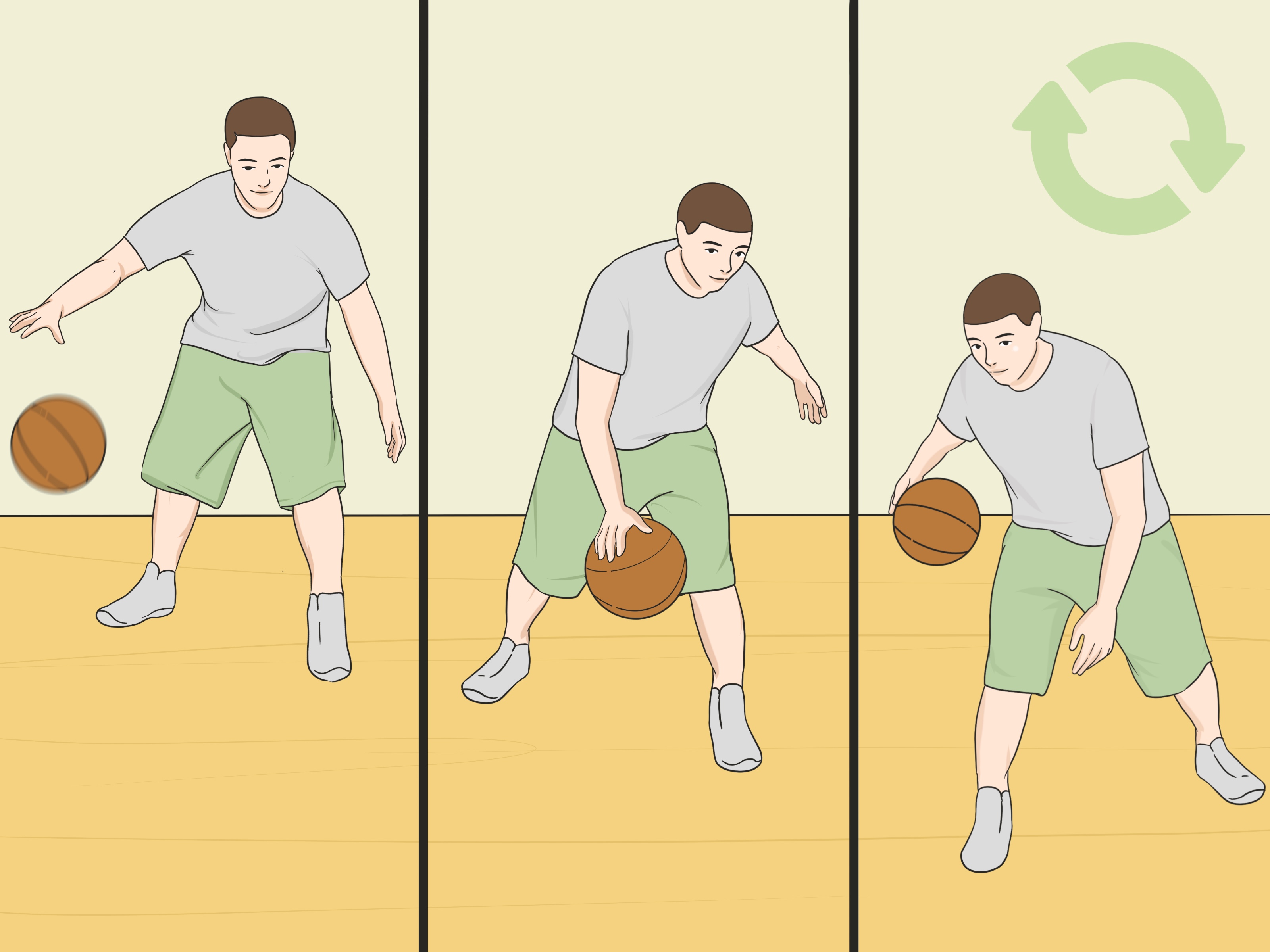
Step 3: Bounce the ball diagonally through your legs
Push the ball from front to back through the open space between your legs. The bounce should travel at a diagonal angle toward your opposite hand, not straight down and not wildly sideways.
Imagine drawing a small V-shape under your body. That mental picture helps a lot.
Step 4: Receive the ball with the opposite hand
Catch the ball cleanly with your other hand as it comes through. Do not slap at it. Meet it softly, then continue the dribble naturally.
Step 5: Switch your feet and shoulders
As the ball changes hands, your body should shift too. If you started with the left foot forward, you will often end with the right foot ready to lead. Your shoulders and hips should turn just enough to support the new direction.
Step 6: Explode into the next action
This is where the move becomes basketball instead of just ball handling. After the dribble, attack. Drive. Hesitate. Pull up. Retreat. Pass. The move is useful because of what comes after it.
A Simple Example
Let’s say you are dribbling with your right hand on the wing. A defender shades your right side and tries to cut off the drive. You plant your left foot slightly ahead, snap the ball between your legs to your left hand, shift your shoulders left, and push off into open space. That is the move working exactly as intended.
You did not just dribble between your legs for style points. You used the move to protect the ball, change direction, and create an angle. That is real skill.
Common Mistakes That Make the Move Fall Apart
Dribbling too high
If the ball is bouncing near your waist or chest, it takes too long to travel. Defenders love that. Keep the dribble lower and tighter.
Feet too close together
No space between your legs means no lane for the ball. Then the ball hits your shoe, your shin, or your dignity.
Standing straight up
A tall stance reduces control and makes the dribble slower. Bend your knees like you actually plan to move afterward.
Looking down the whole time
Beginners often stare at the ball because they do not trust their hands yet. That is normal at first, but you should quickly work toward eyes-up dribbling.
Pushing the ball straight down
The ball has to travel to your opposite hand. If you bounce it straight into the floor, it will not magically teleport across your body. Angles matter.
Trying to go full speed too early
You do not need to train like a highlight reel on day one. Learn the path, then add pace. Slow is smooth. Smooth becomes fast.
Best Drills to Learn the Between-the-Legs Dribble
Stationary split-stance reps
Stand still in a split stance and repeat the move 25 to 50 times on each side. Focus on clean angles, soft catches, and low dribbles. This is your foundation.
Scissors dribble
Continuously dribble between your legs while switching your feet. This drill helps build rhythm, timing, and coordination. At first it feels like your arms and legs are arguing. Stay with it.
Walking between-the-legs drill
Take slow steps forward while threading the ball through your legs. This connects the move to real movement and makes the transition from stationary practice much easier.
Figure-eight drill
Move the ball around and through your legs in a figure-eight pattern. This builds hand quickness, touch, and comfort with the ball around your lower body.
One-dribble into attack
Take one normal dribble, go between the legs, then explode one or two hard dribbles in the new direction. This teaches you not to admire the move. Finish the play.
Eyes-up reaction drill
Have a partner hold up fingers or point in a direction while you perform the move. Call out the number or react to the cue. This helps turn mechanical practice into game-like ball handling.
How to Practice It the Right Way
If you want faster improvement, organize your work instead of just freestyling for ten minutes and hoping basketball miracles happen.
Start with control
Spend your first few sessions focusing only on the clean bounce path. Make every rep look similar. Consistency comes before creativity.
Train both directions
Do not become the player who can go right-to-left beautifully but left-to-right looks like a shopping cart with one broken wheel. Practice both sides equally.
Use time sets
Try 3 rounds of 30 seconds per side for stationary work, then 3 rounds of movement drills. Timed sets keep the workout focused and measurable.
Add weak-hand work
Your non-dominant hand needs attention. A between-the-legs dribble is only as good as the hand receiving the ball. If that hand is late or weak, the whole move collapses.
Practice game speed after technique improves
Once the motion feels reliable, increase pace gradually. Then add a cone, a chair, or a live defender. That is where the skill starts turning into performance.
When to Use the Move in a Game
Against a defender pressuring your front side
If a defender is reaching at your crossover lane, the between-the-legs dribble can move the ball safely while you change direction.
To set up a drive
Use the move after a hesitation or a jab step, then burst into space. The defender often reacts to your shoulders before they react to the ball.
To retreat and reset
You do not always have to attack downhill. Sometimes the move helps you shift the ball away from pressure and reset your angle.
To flow into a combo move
Between the legs into crossover. Between the legs into behind the back. Between the legs into pull-up. The move becomes even more effective when defenders know you have counters.
Can Beginners Learn It?
Absolutely. In fact, beginners should learn it once they understand the basics of control dribbling. You do not need to be an elite guard. You need patience, a basketball, and the willingness to look a little awkward for a while.
The biggest difference between players who learn this move and players who do not is not talent. It is reps. Lots of reps. Calm reps. Reps where you pay attention instead of randomly bouncing the ball and calling it training.
How Long Does It Take to Get Good?
That depends on your current coordination, how often you practice, and whether you are actually practicing with purpose. Some players feel comfortable with the basic motion in a few sessions. For others, it takes a few weeks to make it consistent.
Using it confidently in a real game takes longer. That is normal. Skill development in basketball usually goes in stages: ugly, better, reliable, then useful. Most players quit in the ugly stage. Do not be most players.
Real-Court Experiences: What Learning This Move Usually Feels Like
One of the most honest experiences players have while learning how to dribble a basketball between the legs is discovering that the move looks much easier than it actually feels. Watching it in a game, it seems smooth and effortless. Doing it yourself is different. At first, the timing feels off. Your feet do not cooperate, the ball takes strange angles, and your brain seems to process the move one beat too late. That early frustration is not proof that you are bad. It is proof that you are learning coordination.
Many players go through a funny progression. In the first stage, they can barely get the ball through their legs without hitting something important, and unfortunately that “something important” is often their own foot. In the second stage, they can complete the move while standing still, but the second they try to move forward, everything falls apart. In the third stage, they can do it while walking, but only if nobody is watching. In the fourth stage, they finally try it in a game and use it either way too early, way too late, or directly into a defender who has been waiting all day for that exact mistake.
That is still progress.
Another common experience is realizing that confidence changes the move almost as much as technique does. Players who hesitate halfway through the dribble usually lose rhythm. The ball ends up floating instead of snapping. The body freezes instead of shifting. Once players commit to the bounce and trust the receiving hand, the move begins to look sharper. It is almost like the between-the-legs dribble can sense fear and immediately becomes uncooperative.
Players also notice that the move improves fastest when it becomes part of a routine instead of a random experiment. Five focused minutes a day often beats one giant workout once a week. Repeating the move in a split stance, then in scissors, then while walking, then into a live attack builds familiarity. The ball starts to feel less like an object you are chasing and more like something you are directing.
Perhaps the best experience comes when the move finally works in a real basketball moment. Maybe it is not on a packed court with dramatic music playing in your head. Maybe it is just a pickup game at the park. A defender slides one way, you go between the legs, turn the corner, and suddenly there is space. That moment feels great not because it looks flashy, but because the practice becomes real. You see the purpose of every boring rep.
Over time, players usually stop thinking of the between-the-legs dribble as “that cool move” and start thinking of it as “that useful move.” That is a major shift. Once the move becomes practical, your decision-making gets better. You use it to protect the ball, create angles, and keep a defender guessing. And yes, it still looks cool. Basketball allows both things to be true.
Final Thoughts
If you want to learn how to dribble a basketball between the legs, do not chase flash before function. Start low. Stay balanced. Use your fingers. Keep your eyes up. Learn the bounce path. Then repeat it until it feels natural.
The move is not reserved for superstars, social media clips, or the most stylish player in the gym. It is a teachable skill. And once you own it, your ball handling becomes more controlled, more deceptive, and more useful in real games.
So yes, your first few reps may look messy. The ball may attack your shoe. Your rhythm may disappear. That is fine. Every good handle begins with a few ugly dribbles. Keep working. One day the move that once felt impossible will become part of your regular game, and that is when basketball gets really fun.