There is a particular kind of household object that Germany seems to do exceptionally well: the tool that looks almost too handsome to use, then quietly works for years while cheaper replacements come and go. A beechwood brush. A precisely shaped dustpan. A steel waste bin with no unnecessary drama. A vacuum built less like a gadget and more like a compact piece of machinery.
That is the appeal of German-made cleaning staples. They are rarely about turning Saturday chores into a laser show. Instead, the best examples focus on materials, ergonomics, repairability, and giving one object one clear job. The result is a cleaning cupboard that feels less like a plastic avalanche and more like a practical toolkit.
The classic inspiration for this collection featured traditional German brushes, brooms, cleaning cloths, a Wesco waste bin, and a Miele canister vacuum. Some individual models and retail listings have naturally changed over time, so the smarter way to approach the idea today is to focus on the enduring product types and the qualities that made them useful in the first place.
Note: Product availability, manufacturing locations, finishes, and model names can change. Check the current manufacturer description before buying when “Made in Germany” is an important purchasing requirement.
Why German-Made Cleaning Tools Still Stand Out
Not every broom from Germany is automatically superior, of course. A passport is not a performance specification. The real attraction is a design tradition visible in many established German household brands: durable materials, specialized shapes, restrained styling, and an expectation that an everyday object should earn the space it occupies.
This philosophy feels especially relevant now. Modern households are surrounded by highly specialized cleaners, disposable pads, battery-powered gadgets, refill cartridges, and enough plastic attachments to equip a small moon mission. Yet cleaning professionals and home-care publications repeatedly return to a relatively modest core kit: good cloths, brushes, a broom and dustpan, appropriate scrubbers, and a capable vacuum. In other words, the humble tools never actually left.
The following ten pieces build on that idea.
1. A Beechwood Dustpan and Horsehair Hand Brush
The small cleaning set you will actually reach for
A good hand brush and dustpan may be the most underrated cleaning duo in the house. It handles breakfast crumbs, tracked-in grit, potting soil, fireplace debris, and the mysterious collection of particles that appears under a kitchen table five minutes after you cleaned it.
German brushmakers such as Redecker have helped make the natural-material version of this tool especially recognizable. Beechwood gives the handle warmth and rigidity, while soft horsehair is useful for gathering fine dust without turning every crumb into a projectile. A metal dustpan adds a thin, firm edge that can sit close to the floor.
The beauty of the set is speed. For a teaspoon of coffee grounds, dragging out a full-size vacuum feels like calling a tow truck because your bicycle fell over. The hand brush is already there, requires no charging, and finishes the job in seconds.
2. A Full-Size Horsehair Broom
Quiet, simple, and surprisingly satisfying
Robot vacuums may map your living room, avoid chair legs, and occasionally become emotionally attached to a sock. A traditional broom has fewer software updates.
For hard floors, a well-made horsehair broom can be an elegant everyday tool. Soft natural bristles are particularly suited to collecting fine indoor dust and crumbs. The broom works best as a maintenance tool rather than a substitute for deep vacuuming, especially in homes with carpets, pets, or allergy concerns.
Handle length matters more than shoppers sometimes realize. A broom that forces you to bend at the waist becomes irritating quickly. Look for a comfortable reach, a securely attached head, and bristles suited to your flooring. Then maintain it: remove tangled hair and debris regularly instead of allowing the broom to become a mobile dust museum. Cleaning experts also recommend washing appropriate broom heads periodically and allowing them to dry thoroughly.
3. A Traditional Rice-Straw Broom
Old-world utility for quick sweeping
The rice-straw broom is visually striking because it looks almost agricultural, as though it wandered in from a farmhouse and decided your kitchen floor needed standards.
Traditional straw brooms are useful for brisk sweeping of dry debris and can work well in utility rooms, entryways, workshops, or other spaces where a delicate indoor broom is unnecessary. Their appeal lies in directness: bundled plant material, a handle, and very little else.
They do require sensible care. Natural fibers should not remain wet for long periods, and a straw broom should be shaken free of debris and stored where air can circulate. Used for the right tasks, it becomes a reminder that a cleaning tool does not need an app, subscription, or proprietary replacement head to be effective.
4. A Long-Handled Natural-Fiber Scrubbing Brush
For grime that has mistaken your home for permanent housing
Every cleaning kit needs at least one brush with enough backbone to confront stubborn buildup. A handled scrub brush provides leverage while keeping knuckles farther from dirty water, soap residue, and whatever biological civilization has formed around the edge of the utility sink.
Natural plant fibers are commonly used for firmer scrubbing tasks, while softer horsehair is better suited to gentler surfaces. German brush specialists have long produced task-specific designs rather than pretending one brush should clean everything from wine glasses to patio stones. That distinction matters. A brush aggressive enough for baked-on grime may be completely wrong for a delicate finish.
Before attacking a visible area, test any abrasive tool on an inconspicuous spot. The most powerful cleaning technique is occasionally knowing when not to scrub harder.
5. A Beechwood Dish Brush
A small upgrade that changes the sink area
A wood-handled dish brush looks better beside a sink than most neon plastic alternatives, but appearance alone would not earn it a place on this list. The practical advantage is the handle: it gives you reach into bowls, pans, and glasses while keeping your hand out of hot, greasy water.
Bristle choice again matters. Softer natural fibers suit plates, glasses, and lightly soiled cookware; firmer plant fibers provide more mechanical scrubbing power for pots and pans. Current U.S. retailers still carry German-made or German-brand natural-fiber dish brushes, showing that this very old-fashioned format has not been rendered obsolete by the sponge.
Let the brush dry between uses. A beautiful wooden cleaning tool left permanently face-down in a swampy sink caddy will eventually become a biology lesson.
6. A Copper Cleaning Cloth
Serious scrubbing power, with an important caution
Copper cleaning cloths occupy a useful space between a soft sponge and an aggressively abrasive scouring pad. They are designed for stubborn residue on compatible hard surfaces such as certain stainless-steel cookware, glass, or enamel.
Redecker, one of the best-known German household-brush companies, continues to offer copper cleaning products for removing burned-on residue. The attraction is mechanical cleaning power: you may be able to loosen grime with less reliance on a heavy chemical formula.
However, “copper” does not mean “safe on absolutely everything.” Always follow the manufacturer’s surface guidance and test first. Avoid using abrasive metal cloths on delicate coatings, polished surfaces, or materials that can scratch.
The broader lesson is useful: choose the least aggressive tool that can do the job. Cleaning is not a contest to see which object in the room surrenders first.
7. A Rattan Carpet Beater
Part cleaning tool, part stress-management device
The traditional carpet beater has one of the simplest operating manuals in domestic history: take a removable rug outside, hang it securely, and beat out loose dust.
For delicate or valuable rugs, professional cleaning guidance should always take priority, and a carpet beater is not a replacement for routine vacuuming. But for suitable small rugs, mats, and some cushions, the tool offers a satisfying form of mechanical dust removal.
It also reveals something important about older cleaning traditions. Before every household task acquired a chemical product, people relied heavily on air, sunlight, brushing, shaking, sweeping, and physical agitation. Modern equipment is often more efficient, but the fundamental principle remains: loosen the soil, remove it, and use the correct method for the material.
8. A Woven Cotton Dishcloth
The least glamorous item may work the hardest
A good woven dishcloth does not photograph as dramatically as a sculptural broom, but it may be used twenty times before breakfast. Honeycomb or waffle-style textures create additional surface area, helping a cloth absorb spills and pick up residue while remaining relatively light and quick to dry.
Reusable cloths also fit a broader minimalist approach to cleaning. Instead of keeping a separate disposable wipe for every imaginable surface, washable cloths can handle routine wiping, drying, and polishing when paired with an appropriate cleaning method.
Keep enough on hand to rotate them frequently. Once a cloth is dirty, continuing to wipe the entire kitchen with it is less “cleaning” and more “strategic redistribution.” Wash reusable cleaning textiles according to their care instructions and let them dry completely before storage.
9. A Compact Wesco-Style Steel Pedal Bin
Because waste management is part of keeping a room clean
A trash can is not technically a cleaning tool in the same way a brush is, but a well-designed bin affects how clean a room feels and how easy it is to maintain.
The classic German-made Wesco Singleboy became a design favorite because it combined a compact footprint, powder-coated steel body, and foot-pedal operation. The original model has moved in and out of different retail channels over the years, while Wesco continues to be associated with colorful metal household bins and kitchen accessories.
For a current purchase, focus on the features rather than chasing one historical SKU: a removable inner container, a stable pedal, a lid that closes reliably, and a size appropriate to the room. Smaller bins can encourage more frequent emptying, which is often preferable in bathrooms and compact kitchens.
10. A German-Made Miele Canister Vacuum
The power tool of the collection
The broom handles crumbs. The hand brush handles small messes. Then there are the baseboards, upholstery, rugs, pet hair, stairs, corners, and dust hiding under furniture with the confidence of a tenant who has signed a twelve-month lease.
This is where a capable canister vacuum earns its space. Miele’s older S6270 model appeared in the original German cleaning-staples collection, but vacuum lines evolve. Current Miele U.S. offerings include newer canister families, and selected Guard models are explicitly described by the company as made in Germany. Features vary by model, but current canister designs emphasize strong suction, filtration, multiple floorheads or accessories, and broad cleaning reach.
A premium vacuum is the expensive item in an otherwise low-tech collection, so buy for your actual flooring and household. Pet owners may need different filtration and brush systems than someone living in a small apartment with mostly wood floors. The most impressive specification is useless when it does not match the mess.
How to Build a Better Cleaning Kit Without Buying Everything
The strongest lesson from these German-made cleaning staples is not that your house needs ten imported objects immediately. In fact, that would miss the point.
Start with the jobs you perform most often. A small apartment with hard flooring may benefit enormously from a quality broom, dustpan set, dish brush, washable cloths, and compact vacuum. A larger home with pets may place far more value on filtration and powerful floor care. Someone who cooks daily might use a copper cloth and firm pot brush constantly, while another household would leave them untouched.
Choose tools by function, material compatibility, comfort, and expected lifespan. Then take care of them. Brooms, brushes, cloths, scrubbers, and vacuum components all lose effectiveness when they themselves become clogged with dirt. Routine maintenance can extend useful life and prevent a cleaning tool from spreading yesterday’s mess into tomorrow’s room.
For chemical cleaning products used alongside these tools, read labels, follow surface instructions, and never assume that combining products creates a stronger solution. The U.S. Environmental Protection Agency’s Safer Choice program is one resource for identifying products that meet its criteria for safer chemical ingredients and performance.
The Real Appeal: Fewer Objects, Better Objects
The charm of German-made cleaning tools is partly visual. Beechwood ages more gracefully than fluorescent plastic. Steel feels substantial. Natural fibers make an ordinary utility object look at home in a well-designed kitchen.
But good looks are only the beginning. The deeper appeal is specialization without complication. A hand brush sweeps. A scrub brush scrubs. A woven cloth wipes. A vacuum removes the dust that simpler tools cannot reach. Nothing needs to pretend it can perform seventeen unrelated jobs while also charging your phone.
That simplicity can make cleaning feel less overwhelming. When tools are easy to grab, pleasant to hold, and suited to specific tasks, small messes are more likely to be handled before they become large projects.
Experience: What Living With This Kind of Cleaning Toolkit Feels Like
The most noticeable change when moving toward a small collection of well-made cleaning tools is not that the house suddenly becomes spotless. Sadly, the crumbs remain committed to their career goals. The difference is that cleaning begins to require less negotiation.
Imagine the kitchen after a rushed breakfast. There is coffee near the grinder, toast debris under a chair, and something sticky on the counter that nobody remembers spilling. With a hand brush hanging nearby, the floor mess disappears in under a minute. A woven cotton cloth handles the counter. The tools go back to their places, and there is no need to pull a machine from a closet or open a package of disposable wipes.
Over several days, that convenience matters. The best cleaning tools reduce friction. A long-handled dish brush makes it easier to clean a pan immediately instead of leaving it “to soak,” a phrase that has rescued many people from responsibility for approximately eight hours. A sturdy scrub brush makes the weekly sink cleanup faster because the bristles are shaped for applying pressure. A broom handles the visible debris that would otherwise remain until the next full vacuuming session.
There is also an unexpected sensory difference. Wood handles feel warmer than hollow plastic. Natural bristles move differently across a floor. A steel dustpan makes a clean little sound when it is hung back on a hook. These are small details, but repetitive household tasks are made almost entirely of small details.
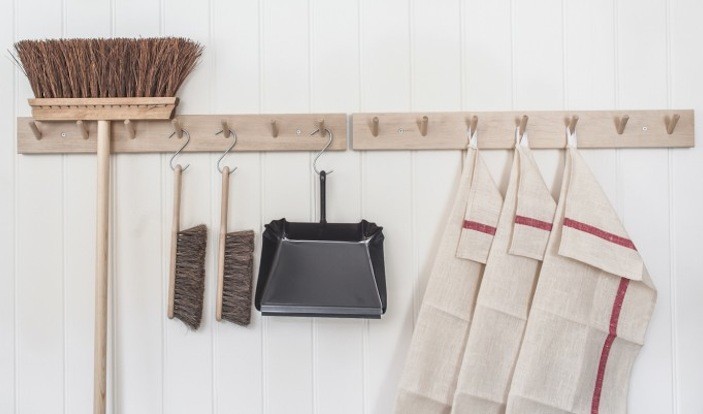
The tools also encourage a different relationship with storage. Attractive objects do not always need to disappear behind a utility-room door. A beechwood brush can hang beside the sink. A well-proportioned broom can live on a wall hook. That visibility improves access, and access often improves habits. The broom you can reach in two seconds is more likely to be used than the vacuum trapped behind a folding chair, three reusable shopping bags, and the box containing the holiday decorations you swore you would organize last January.
Of course, natural materials bring responsibilities. Wooden brushes need to dry. Cloths need washing. Broom bristles need occasional cleaning. Copper scrubbers need careful matching to the right surfaces. A premium vacuum needs bags, filters, or other routine maintenance depending on the model. “Long-lasting” does not mean “immune to neglect.”
Cost can also be a reality check. A beautifully made imported broom or German canister vacuum may cost substantially more than a basic supermarket alternative. The practical question is therefore not whether the premium object is prettier. It is whether you will use it frequently enough, maintain it properly, and keep it long enough for the purchase to make sense.
That is where the experience becomes genuinely minimalist. The goal is not to own the fanciest version of every cleaning accessory. It is to identify the few tools that repeatedly solve real problems in your home. For one person, the hero may be the Miele vacuum. For another, it may be a ten-inch wooden dish brush that quietly saves their hands from greasy water every night.
After the novelty wears off, the best pieces almost disappear into the routine. They are simply there when needed, doing an ordinary job well. And that may be the highest compliment for any household tool: not that it transforms your life, but that it stops making a necessary part of life more difficult than it needs to be.
Conclusion
German-made cleaning staples offer a persuasive alternative to the endlessly expanding cleaning aisle. The strongest examples combine durable materials, purposeful shapes, restrained design, and a willingness to let simple tools remain simple.
A natural-fiber brush will not replace a powerful vacuum, and a premium vacuum will not make a tiny hand broom obsolete. The smartest cleaning kit is a layered one: quick manual tools for everyday messes, specialized scrubbers for stubborn jobs, reusable textiles for wiping, and reliable machinery for deeper floor and upholstery care.
Choose carefully, maintain what you own, and resist buying five tools when one well-designed piece will do. Your home may not become magically self-cleaning, but your utility closet will look considerably less like it lost an argument with a big-box store.