Say the words “quantum teleportation,” and most people immediately picture a person stepping into a glowing sci-fi booth, vanishing in a dramatic shimmer, and reappearing across the galaxy with perfect hair. Wonderful cinema. Terrible physics.
Quantum teleportation is real, but it does not move people, cats, coffee mugs, or your missing TV remote. What it transfers is far stranger and, in many ways, more useful: the quantum state of a particle. In other words, quantum teleportation moves information about a quantum system from one place to another without physically sending that original particle across the distance.
That may sound like science fiction wearing a lab coat, but it is a serious pillar of quantum information science. Quantum teleportation helps explain how future quantum computers may communicate, how quantum networks may be built, and why entanglement is not just a spooky party trick from the universe’s magic drawer.
To understand how quantum teleportation actually works, we need to unpack three big ideas: qubits, entanglement, and classical communication. Do not worry. No one will be asked to solve a chalkboard full of equations while a professor whispers, “Obviously.”
What Is Quantum Teleportation?
Quantum teleportation is a protocol for transferring an unknown quantum state from one quantum system to another. The state disappears from the original system and is reconstructed in the receiving system. The original particle is not packed into a tiny quantum suitcase and shipped across space. Instead, its state is transferred using a combination of shared entanglement and ordinary classical information.
The most common explanation uses three characters: Alice, Bob, and a qubit. Alice has a qubit whose state she wants to send to Bob. A qubit is the quantum version of a bit, but unlike a classical bit, which is either 0 or 1, a qubit can exist in a superposition of both possibilities. This does not mean it is “confused.” It means quantum systems can carry information in ways classical systems cannot neatly imitate.
The challenge is that Alice cannot simply measure the qubit, write down everything about it, and email Bob the instructions. Measuring a quantum state usually disturbs it. Also, the no-cloning theorem says an unknown quantum state cannot be copied perfectly. Quantum mechanics is basically telling us, “No screenshots allowed.”
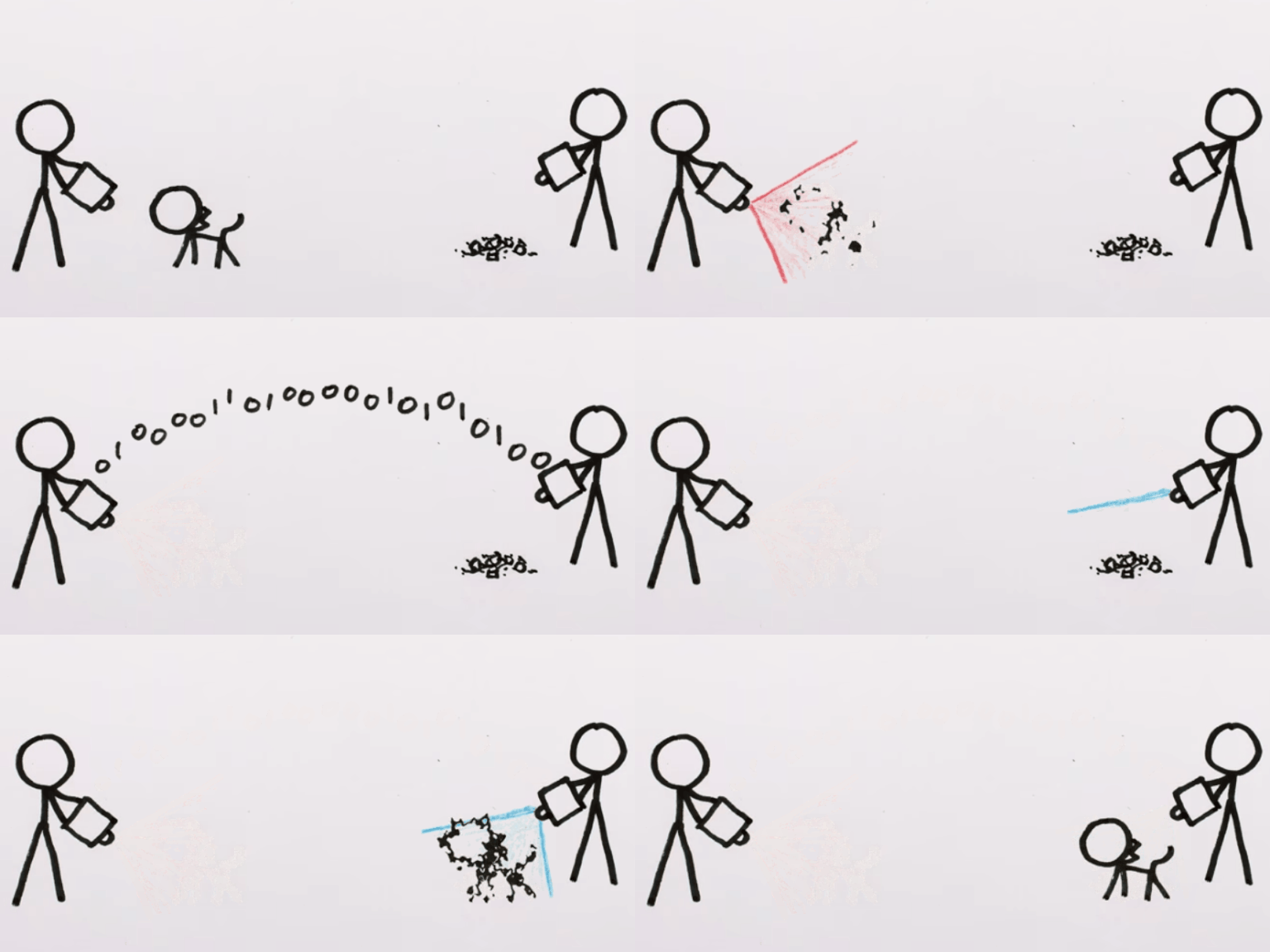
Teleportation solves this problem in a clever way. Alice and Bob first share an entangled pair of particles. Alice performs a special joint measurement on her unknown qubit and her half of the entangled pair. That measurement produces two classical bits of information. She sends those two bits to Bob through an ordinary communication channel. Once Bob receives them, he applies the correct operation to his half of the entangled pair. The result is that Bob’s particle now has the original quantum state Alice wanted to transfer.
The Three Ingredients Quantum Teleportation Needs
1. A Qubit to Teleport
The first ingredient is the quantum state that needs to be transferred. This state might be encoded in the polarization of a photon, the energy levels of an atom, the spin of an electron, or another physical quantum system. The state can be unknown to Alice, which is important. Quantum teleportation does not require someone to peek inside the qubit and ruin the whole operation.
A qubit can be described as a blend of possible outcomes. When measured, it produces a definite result, but before measurement, its state contains probability amplitudes that behave according to quantum rules. These amplitudes are the delicate information quantum teleportation is designed to preserve.
2. Entanglement Between Alice and Bob
The second ingredient is entanglement. Entangled particles share a joint quantum state even when separated by distance. When scientists say entangled particles are correlated, they do not mean they are texting each other faster than light. They mean the pair must be treated as one connected quantum system until measurement reveals outcomes.
In teleportation, entanglement acts like a pre-shared quantum resource. Alice and Bob must already possess the two halves of an entangled pair before the teleportation protocol is completed. This is why quantum teleportation is not a magic shortcut around the laws of physics. Preparation matters. The quantum “bridge” has to exist first.
3. Classical Communication
The third ingredient is ordinary communication. After Alice performs her measurement, she must send Bob two classical bits. These bits tell Bob which correction to apply to his particle. Without this message, Bob cannot reconstruct the teleported quantum state.
This detail is crucial because it means quantum teleportation cannot send usable information faster than light. Entanglement supplies the quantum link, but the final instruction still travels through a normal communication channel. No matter how dramatic the word “teleportation” sounds, relativity remains undefeated.
Step-by-Step: How Quantum Teleportation Works
Let’s walk through the process using Alice and Bob. Imagine Alice has a mysterious qubit. She wants Bob to receive its exact quantum state, but she cannot measure it directly without disturbing it. Fortunately, Alice and Bob share an entangled pair.
Step 1: Alice and Bob Share an Entangled Pair
Before teleportation begins, a pair of particles is prepared in an entangled state. Alice keeps one particle, and Bob receives the other. These two particles are now linked by quantum correlations.
This entangled pair is not the message itself. Think of it more like a strange quantum coupon that Alice and Bob must spend during the teleportation process. Once used, it cannot be reused for the same teleportation event.
Step 2: Alice Performs a Bell Measurement
Alice now has two particles: the original qubit she wants to teleport and her half of the entangled pair. She performs a Bell measurement on them. This is a special kind of joint quantum measurement that compares the two particles in an entangled basis.
The Bell measurement does two things at once. First, it destroys the original standalone version of the unknown state. Second, it produces one of four possible classical outcomes. These outcomes can be represented using two classical bits: 00, 01, 10, or 11.
This is where quantum teleportation becomes wonderfully weird. Alice’s measurement does not reveal the full quantum state. Instead, it changes the relationship between the systems so that Bob’s particle can become the new carrier of the original state after the right correction is applied.
Step 3: Alice Sends Bob Two Classical Bits
Alice sends the two-bit result of her Bell measurement to Bob. This can happen by fiber optic cable, radio signal, internet message, or any ordinary communication method. The channel does not need to be quantum.
Bob now has his particle, but it is not necessarily in the correct state yet. It is like receiving a locked box with the right object inside, except the box has been rotated in one of four possible ways. Alice’s two bits tell Bob how to rotate it back.
Step 4: Bob Applies the Correct Quantum Operation
Depending on Alice’s two-bit message, Bob applies one of a small set of quantum operations to his particle. These operations are often described as identity, bit flip, phase flip, or both. Once Bob applies the correct operation, his particle takes on the original quantum state Alice started with.
The state has been teleported. The original was destroyed during Alice’s measurement, and Bob’s particle now carries the state. No cloning occurred. No matter moved across the gap. No one’s atoms were disassembled by a suspiciously humming machine. Physics can be dramatic without becoming a movie franchise.
Why Quantum Teleportation Does Not Break the Speed of Light
One of the biggest misunderstandings about quantum teleportation is the idea that it allows instant communication. It does not. Entanglement creates correlations that appear instantly connected, but those correlations alone cannot transmit a useful message.
Bob cannot know which correction to apply until Alice sends her two classical bits. That message is limited by the speed of light. If Alice is on Earth and Bob is on Mars, Bob still has to wait for the classical information to arrive before the teleportation is complete in any useful sense.
This is why quantum teleportation is compatible with Einstein’s relativity. It is spooky, yes. It is powerful, absolutely. But it is not a cosmic loophole for sending tomorrow’s lottery numbers into yesterday.
Why the Original Quantum State Must Be Destroyed
Quantum teleportation works because it transfers a state, not because it copies one. This matters because quantum mechanics forbids perfect copying of an arbitrary unknown quantum state. That rule is called the no-cloning theorem.
During Alice’s Bell measurement, the original quantum state is no longer available as an independent state. It is effectively consumed by the protocol. Bob receives the state only after applying the right correction. This protects quantum mechanics from contradictions. If perfect copying were allowed, many foundations of quantum theory would collapse faster than a cheap lawn chair.
The destruction of the original state is also why the word “teleportation” is somewhat reasonable. A state disappears from one system and appears in another. Still, it is not teleportation in the science-fiction sense. It is information transfer at the quantum level.
What Has Actually Been Teleported in Real Experiments?
Scientists have demonstrated quantum teleportation in several physical systems. Experiments have teleported quantum states of photons, ions, atoms, and other quantum platforms. In photonic systems, the state may be encoded in light polarization. In trapped ion systems, the state may be encoded in internal atomic energy levels.
Early demonstrations proved that the protocol was not just a clever theory. Later experiments improved distance, fidelity, stability, and compatibility with real-world infrastructure. Researchers have tested teleportation over optical fibers, across laboratory networks, and in setups designed to resemble future quantum internet nodes.
Modern research is especially interested in teleportation across fiber optic networks because photons are excellent carriers of quantum information. They move fast, interact weakly with the environment, and already travel through the communication cables that support today’s internet. The hard part is that quantum states are delicate. Noise, loss, temperature shifts, and imperfect equipment can degrade them.
What Is Teleportation Fidelity?
Teleportation fidelity measures how close the received quantum state is to the original state. Perfect fidelity would mean the transfer was flawless. Real experiments aim to beat the best possible classical strategy. If the result is above the classical limit, researchers can show that genuine quantum teleportation has occurred.
This is important because not every noisy transfer deserves the word “teleportation.” If Bob receives a badly scrambled state, the experiment may be less “quantum breakthrough” and more “expensive static.” High fidelity means the protocol preserved the delicate quantum information well enough to prove the quantum advantage.
Why Quantum Teleportation Matters
Quantum Computing
Quantum teleportation could help connect parts of a quantum computer. Large quantum computers may eventually be modular, with separate processors linked together. Teleportation offers a way to move quantum states between modules without directly moving fragile physical qubits through messy hardware.
This matters because quantum computers are extremely sensitive. Qubits can lose coherence when disturbed by heat, vibration, stray electromagnetic fields, or measurement. Teleportation may help engineers design systems where quantum information moves more flexibly and reliably.
Quantum Internet
A future quantum internet would not simply be a faster version of today’s web. It would connect quantum devices using entanglement and quantum communication protocols. Quantum teleportation is one of the central tools that could make such a network possible.
In a quantum network, teleportation could move quantum states between distant nodes. Quantum repeaters may use related ideas to extend communication over long distances. Without repeaters, photons are lost in fiber after enough distance. Since unknown quantum states cannot be copied and amplified like classical signals, quantum networks need new tricks. Teleportation is one of the best tricks in the box.
Secure Communication
Quantum communication can support new approaches to security. Quantum key distribution, for example, uses quantum principles to detect eavesdropping. Teleportation itself is not a magic encryption wand, but it belongs to the same family of quantum networking tools that could improve secure communication.
The main idea is that quantum information cannot be observed casually without consequences. A measurement changes the system. That makes quantum communication attractive for security applications, although real-world systems still require careful engineering and cannot rely on slogans like “unhackable” without fine print.
Common Myths About Quantum Teleportation
Myth 1: It Teleports People
No. Quantum teleportation transfers quantum states. It does not transport bodies, brains, socks, sandwiches, or office chairs. Teleporting a person would require capturing and reconstructing an impossible amount of quantum information while dealing with biological, ethical, and practical nightmares. Also, nobody wants their morning commute to include “reassembled incorrectly.”
Myth 2: It Sends Messages Faster Than Light
No. Bob needs Alice’s classical message before he can complete the reconstruction. Since that message cannot travel faster than light, quantum teleportation cannot be used for faster-than-light communication.
Myth 3: Entanglement Is a Secret Wireless Signal
No. Entanglement is not a hidden radio connection. It is a quantum correlation between systems. The particles do not carry on a tiny conversation. They behave as parts of a shared quantum state until measurement outcomes are compared.
Myth 4: Teleportation Copies a Qubit
No. The original state is destroyed during the protocol. Bob receives the state only after Alice’s measurement and classical message. This keeps the process consistent with the no-cloning theorem.
A Simple Analogy: The Locked Recipe
Imagine Alice has a secret recipe written in ink that vanishes if anyone reads it directly. She cannot photocopy it, because the recipe refuses to be copied. Bob wants to recreate the recipe in his kitchen.
Beforehand, Alice and Bob share a strange pair of linked recipe cards. Alice performs a special action using her secret recipe and her linked card. The original recipe vanishes, but Alice gets two ordinary instruction marks. She sends those marks to Bob. Bob uses them to adjust his linked card, and suddenly his card contains the original recipe.
This analogy is imperfect, as all analogies are. Quantum mechanics tends to glare at analogies over its spectacles. But it captures the core idea: the original is not copied, the shared resource is consumed, and a classical message is required to finish the transfer.
The Real Challenge: Making It Practical
The basic protocol is elegant. The engineering is brutal. Real quantum systems are fragile, and teleportation experiments require careful control. Researchers must generate high-quality entanglement, preserve it long enough to use it, perform accurate Bell measurements, reduce noise, and verify that the final state matches the original.
In optical fiber, photons can be absorbed or scattered. In city networks, temperature changes, vibrations, and ordinary telecom signals can introduce noise. In quantum processors, qubits can decohere before operations finish. Every platform has trade-offs.
That is why recent progress in quantum networks is so exciting. Demonstrations using existing fiber infrastructure suggest that quantum communication may eventually share some physical pathways with classical networks. This does not mean a global quantum internet is arriving next Tuesday. It means the pieces are moving from pure laboratory curiosity toward deployable technology.
What Quantum Teleportation Teaches Us About Reality
Quantum teleportation is useful, but it is also philosophically delightful. It shows that information in quantum mechanics is not just a passive description of things. Quantum information behaves like a physical resource. It can be protected, transferred, consumed, and transformed.
The protocol also reveals how different quantum information is from classical information. If you want to send a classical file, you can copy it, compress it, duplicate it, and back it up on six hard drives because you once lost a vacation folder in 2014 and never emotionally recovered. Quantum information is not so cooperative. You cannot simply inspect and duplicate it. You must work with the rules of measurement, entanglement, and probability.
That is what makes quantum teleportation such a beautiful idea. It does not defeat quantum weirdness. It uses quantum weirdness as the operating manual.
Conclusion: Teleportation Is Real, Just Not the Movie Version
Quantum teleportation actually works by transferring a quantum state from one system to another using shared entanglement and two bits of classical communication. Alice measures her unknown qubit together with her half of an entangled pair, sends Bob the measurement result, and Bob applies the proper correction to reconstruct the state.
The process does not move matter. It does not copy the original. It does not allow faster-than-light messaging. What it does is much more subtle: it moves quantum information in a way that classical physics could never achieve on its own.
As quantum computers, quantum sensors, and quantum networks mature, teleportation may become one of the essential techniques behind the scenes. It may help link processors, extend quantum communication, and build the foundations of a future quantum internet. Not bad for a concept that sounds like it escaped from a spaceship manual.
So the next time someone says quantum teleportation is real, you can confidently say, “Yes, but keep your shoes on. Your atoms are staying right here.”
Experience Notes: What It Feels Like to Understand Quantum Teleportation
Learning how quantum teleportation works can feel like trying to assemble furniture from another dimension. At first, the pieces seem familiar: information, communication, measurement, particles. Then you notice the instructions say things like “do not observe directly” and “use entanglement prepared earlier,” and suddenly the universe is asking you to tighten a screw that may also be a probability cloud.
The first useful experience is letting go of the science-fiction image. Many people get stuck because the word “teleportation” creates the wrong mental picture. Once you stop imagining matter being beamed across a room, the concept becomes easier. The real subject is not transportation. It is state transfer. That small wording shift changes everything.
A helpful way to experience the idea is to compare it with sending a password you are not allowed to read. In normal life, you would copy the password and send it. In quantum life, copying is forbidden, and reading it ruins the original. Quantum teleportation feels clever because it solves a communication problem under rules that seem almost designed to make communication impossible.
Another memorable experience is realizing that entanglement alone is not enough. Popular explanations often make entanglement sound like instant cosmic Wi-Fi. It is not. The classical message is the humble but essential finishing step. Without Alice’s two bits, Bob has a particle with no usable reconstruction instructions. This makes quantum teleportation less mystical and more interesting. It is not magic. It is a carefully choreographed protocol.
Students, readers, and curious science fans often have an “aha” moment when they see why the original state must be destroyed. At first, that sounds like a downside. Then it becomes the key to the whole process. If the original remained intact while Bob also received a perfect version, quantum teleportation would become cloning, and quantum mechanics would start throwing furniture. The destruction of the original is not a bug. It is what keeps the protocol legal under quantum rules.
In real-world discussions, quantum teleportation also teaches patience. Headlines can make it sound as though tomorrow’s internet will be powered by entangled photons and guarded by physics itself. The reality is more careful. Experiments are improving, but quantum networks must overcome photon loss, noise, synchronization problems, imperfect memories, and difficult hardware. The progress is real, but it is not a superhero landing. It is engineering, one hard-won improvement at a time.
The most rewarding experience is realizing that quantum teleportation is both practical and poetic. It may help future quantum computers communicate, but it also changes how we think about information. In the classical world, information feels like something we write down. In the quantum world, information is physical, fragile, and deeply connected to how reality behaves when measured.
That is why quantum teleportation remains one of the best gateways into quantum science. It is strange enough to be exciting, structured enough to be understandable, and important enough to matter beyond trivia night. It reminds us that the universe is not obligated to match everyday intuition. Sometimes it follows rules so odd that the only reasonable response is to study them carefully, build better experiments, and maybe keep a sense of humor nearby.