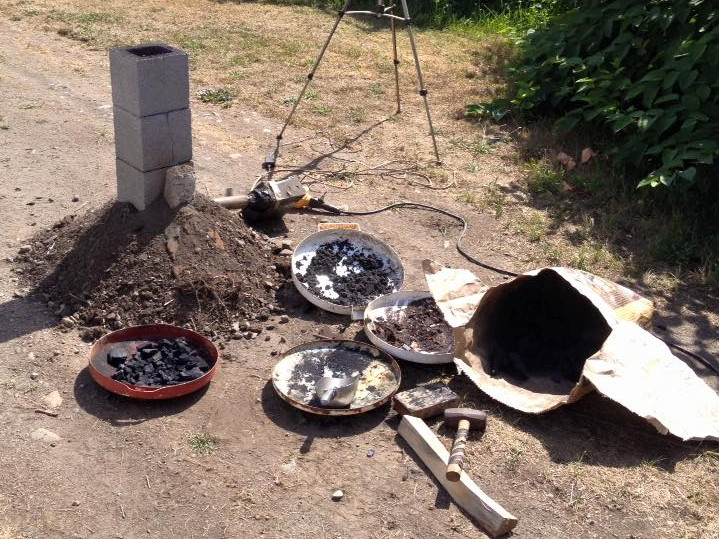
Most people see the gray-black sweepings beneath a grinder and think, “Trash.” A blacksmith sees the same pile and wonders whether it might still contain tomorrow’s knife, chisel, or gloriously lumpy paperweight. That question inspired a memorable workshop experiment: collect ferrous dust from the floor, separate it from ordinary dirt, heat it with carbon fuel, hammer the result, and find out whether usable steel can be coaxed from the mess.
The project is part recycling lesson, part metallurgy demonstration, and part reminder that fire has a wicked sense of humor. It also reveals something modern manufacturing sometimes hides behind polished coils and tidy specification sheets: steel begins as chemistry, heat, impurities, and controlled violence.
The Treasure Hiding in Shop Floor Dust
A metalworking floor collects a strange industrial soup. Grinding throws off tiny fragments of steel and abrasive-wheel material. Filing produces curls and particles. Forging sheds iron scale. Drilling contributes chips, while ordinary foot traffic adds sand, wood fibers, paint flakes, coal fines, and whatever mysterious substance has been living under the workbench since 2009.
The useful fraction is ferrous material: particles containing enough iron to respond to a magnet. In the original experiment behind “From Shop Floor Dust To Carbon Steel,” the sweepings were washed in a bucket and separated magnetically, almost like panning for goldexcept the prize was gray, sharp, and considerably less likely to finance a vacation.
“`
Why Magnetic Separation Works
Iron and many common carbon steels are strongly attracted to magnets. Sand, slag, grit, and most household dirt are not. Passing a magnet beneath or through wet material can therefore concentrate the metal-rich portion. Water helps fine particles move apart, although it does not make the recovered material pure. Abrasive grains, rust, alloy fragments, and nonmetallic debris can remain trapped in the concentrate.
That distinction matters. A magnet can answer, “Is there iron here?” It cannot answer, “Is this a clean, predictable grade of steel?” Those are very different questions, and metallurgy enjoys punishing anyone who confuses them.
“`
From Ferrous Powder to a Rough Bloom
The recovered dust was charged into a small coal-fired furnace assembled from cinder blocks. After hours of heating and repeated additions of fuel and material, the experiment produced irregular magnetic lumps. They were not neat ingots. They looked more like rocks that had lost an argument with a volcano.
Calling this simply “melting dirt” misses the interesting part. In a small solid-fuel furnace, iron-rich particles may sinter, partially melt, absorb carbon, oxidize, reduce, and weld together while liquid slag moves around them. The result can resemble a primitive bloom: a porous mass of metallic iron or steel mixed with glassy slag and unreduced contaminants.
“`
Why the Furnace Atmosphere Matters
Heat alone does not determine the outcome. Oxygen supply, fuel ratio, temperature, residence time, and the position of the material in the furnace all influence the chemistry. Too much oxygen can burn iron back into oxide. A strongly carbon-rich environment can add carbon to the metal. Uneven airflow creates hot and cool zones, so one side of a lump may differ significantly from the other.
This explains why a home-built bloom can be inconsistent. Industrial steelmakers control charge chemistry, furnace temperature, slag composition, oxygen injection, and refining with extraordinary precision. A backyard furnace controls these variables with a blower, observation, experience, and occasionally optimistic shouting.
Cinder Blocks Are Not Furnace Refractory
The blocks in the experiment cracked under heat, which should surprise no one familiar with refractory design. Ordinary concrete masonry can contain moisture and aggregates that behave badly during intense heating. Purpose-made refractory brick and castable refractory are engineered for high-temperature service; common construction block is engineered to hold up a wall.
This project is fascinating as documentation, not as a build plan. Molten material, carbon monoxide, flying scale, collapsing masonry, hot slag, and metal fumes can cause catastrophic injuries. Serious furnace work requires appropriate refractory materials, ventilation, protective equipment, fire controls, training, and a location designed for hot work.
“`
How Carbon Turns Iron Into Steel
Steel is fundamentally an iron-based alloy containing a controlled amount of carbon, often with manganese, silicon, and other elements. Carbon has an outsized effect. In broad terms, very low-carbon iron is soft and easily shaped; increasing carbon can improve hardness and strength, but excessive carbon can reduce ductility and make the material brittle.
Inside a coal or coke fire, carbon monoxide and hot carbon-rich gases interact with the iron. Depending on temperature and atmosphere, carbon can enter the metal, while oxygen exposure can remove it. Because fine particles have a large surface area, they can react quickly. That is useful for consolidation but terrible for consistency.
“`
Why One Side May Behave Differently
The recovered lump reportedly produced different spark patterns when ground on opposite sides. That is a clue that the material was chemically or structurally uneven. One region may have absorbed more carbon. Another may have contained more slag, oxides, or lower-carbon iron. Local cooling rates may also have created different microstructures.
In commercial carbon steel, composition is measured and adjusted before casting. In improvised steel, the maker often works backward from clues: hardness, fracture appearance, forge behavior, sparks, and etched structure. It is less like ordering a known alloy and more like interviewing a suspect who communicates through orange fireworks.
“`
Hammering, Folding, and Driving Out Slag
The rough mass was reheated and hammered to make it denser and more uniform. This is the essential next step for bloom-like material. A fresh bloom can contain voids and veins of slag. Hot working closes pores, squeezes out some nonmetallic material, and forge-welds metallic regions together.
Folding can help redistribute carbon and inclusions, but it is not a magical quality multiplier. Popular culture sometimes treats every fold as if the steel earns experience points. In reality, repeated heating can also cause scale loss, decarburization, cracking, and contamination. The goal is not a theatrical number of folds; it is sufficient consolidation with the least unnecessary damage.
“`
What Slag Does
Slag is the nonmetallic phase formed from oxides, ash, abrasive material, flux, and other impurities. In an ironmaking process, slag can be helpful because it captures unwanted compounds and separates them from the metal. Inside a crude bloom, however, trapped slag becomes a structural defect. Long inclusions may create weak paths, especially if the material is later loaded across them.
Careful forging can elongate and expel slag, but it rarely produces the cleanliness of modern vacuum-degassed or tightly refined steel. Homemade material may still be perfectly interesting for experiments, decorative objects, or low-risk tools. It should not be trusted for critical parts without professional chemical and mechanical testing.
“`
Reading Steel Through Sparks and Etching
Before portable analyzers became common, craftspeople often used spark testing as a rapid identification method. When steel touches a grinding wheel, hot particles oxidize in the air and form characteristic streams. Low-carbon steel tends to produce longer, simpler sparks. Higher-carbon steel generally creates more branching and bursting. Alloying elements can alter the color and pattern.
Spark testing is useful for comparison, not certification. Wheel speed, pressure, lighting, surface contamination, and operator experience affect the result. The best approach is to compare an unknown sample with known reference steels under the same conditions.
“`
What Etching Reveals
Polishing and etching a cross-section can reveal boundaries between different structures and expose slag lines, weld seams, carbon variation, or other irregularities. Metallographic etchants attack phases at different rates, creating contrast that the naked eye or a microscope can see.
In plain carbon steel, cooling history helps determine whether the structure contains ferrite, pearlite, martensite, or mixtures of these phases. A rough furnace product may show dramatic variation across a single piece. That patchwork is not merely cosmetic; it helps explain why one edge may file easily while another feels glass-hard or crumbles under the hammer.
“`
A Tiny Version of the Modern Steel Recycling Story
The shop-floor experiment mirrors a major industrial idea: steel can be recycled repeatedly. In U.S. minimills, electric arc furnaces melt large charges of scrap, refine the chemistry, remove impurities through slag, and produce new steel. The equipment is vastly more sophisticated, but the underlying instinct is recognizabledo not discard useful iron when heat can return it to the manufacturing cycle.
Steel recycling conserves raw materials, energy, and landfill space. Yet the process is not as simple as tossing every metallic object into one enormous glowing pot. Scrap must be sorted and managed. Copper, coatings, oils, galvanized layers, stainless alloys, sealed containers, and hazardous contaminants can affect product quality, worker safety, and emissions.
“`
Why Clean Scrap Beats Mystery Dust
Known offcuts and segregated machining chips have more predictable chemistry than floor sweepings. Once steel dust mixes with grinding media, soil, aluminum particles, paint, stainless steel, and oily residue, recovery becomes harder. Good shop organization therefore supports both safety and recycling value.
A practical waste hierarchy is straightforward: prevent unnecessary loss, keep alloys separated, collect clean chips at the machine, send suitable scrap to qualified recyclers, and treat contaminated dust according to applicable rules. Turning floor dirt into steel is a brilliant demonstration. Keeping valuable metal off the floor in the first place is usually the better production system.
“`
The Safety Lesson Is Bigger Than the Steel
Metal dust should never be treated as harmless because it happens to stick to a magnet. Grinding and welding can create respirable particles and fumes containing iron, manganese, chromium, nickel, or substances from coatings and consumables. Some metal dusts are combustible, and mixed dust can behave unpredictably.
Effective controls start with source capture and ventilation rather than a heroic attempt to hold one’s breath. Housekeeping should avoid dispersing fine dust into the air. Hot work must be separated from combustibles, and unknown coated or plated metals should not be heated casually. Safety glasses, face protection, suitable gloves, protective clothing, hearing protection, and properly selected respiratory protection may all be required depending on the process.
There is also a crucial difference between a compelling video and a repeatable procedure. A video shows what happened once. A procedure identifies hazards, defines controls, specifies materials, sets acceptance criteria, and anticipates failure. The sparks are the entertaining part; the risk assessment is the part that lets everyone go home with the same number of eyebrows.
Workshop Experiences: What This Project Teaches in Practice
The most useful experience connected with a project like this begins before the furnace is lit. Sweep a busy fabrication area and spread the debris on a tray. At first glance, everything appears uniformly gray. Move a magnet beneath the tray, however, and the surface begins to crawl. Fine steel particles gather into dark ridges while sand and abrasive grit stay behind. It is a simple demonstration, but it permanently changes how a person sees “waste.” The floor is no longer covered with one material. It holds a badly sorted inventory.
The second lesson arrives when recovered material is heated. Clean bar stock behaves politely because its composition and shape are known. Dust does not. It may flare, smoke, oxidize, clump, or disappear into slag. A beginner expects enough temperature to solve the problem. Experience teaches that temperature is only one control among many. Airflow that is slightly too aggressive can consume metal. A cold zone can preserve unreduced particles. A carbon-rich pocket can create a hard region beside a soft one. The furnace becomes a chemistry classroom with no pause button.
Then comes consolidation. The first blow on a porous bloom is often less majestic than expected. Instead of ringing like a finished billet, the mass may spit scale, shed fragments, or deform around hidden slag. Gentle, controlled blows are more effective than trying to impress the anvil. The piece must be kept hot enough to weld but not heated so carelessly that it burns. Each cycle of reheating and hammering reveals whether the material is becoming coherent or merely becoming a smaller pile of problems.
Grinding offers another memorable experience. A known mild-steel sample produces a familiar stream of sparks. The homemade sample may answer with two personalities: quiet streaks from one region and busy branching bursts from another. That contrast makes carbon migration and furnace nonuniformity visible without a laboratory instrument. It also teaches humility. A surface can look solid while concealing a complicated internal history.
Etching completes the story. After cutting, grinding, and polishing a sample, the polished face can appear featureless. Apply an appropriate metallographic etchant under controlled conditions and boundaries emerge: darker areas, pale zones, slag threads, and weld lines. Suddenly the material is not just a lump. It is a frozen map of heat, oxygen, carbon, hammering, and cooling.
Perhaps the best practical lesson is that success should be defined carefully. Producing a magnetic, forgeable piece from dirty sweepings is a remarkable proof of concept. Producing certified, homogeneous carbon steel suitable for a spring, pressure vessel, lifting hook, or impact tool is an entirely different achievement. Experienced metalworkers respect that boundary. They celebrate the experiment, study the sample, and reserve safety-critical work for verified material.
Finally, the project changes ordinary shop habits. After watching useful iron emerge from sweepings, it becomes difficult to ignore the value of clean chip collection, alloy segregation, local exhaust, and disciplined housekeeping. The romantic conclusion is that almost anything can become steel again. The professional conclusion is even better: thoughtful material handling makes recovery safer, cleaner, and far more predictable.
Conclusion: Steel Is a Process, Not Just a Material
“From Shop Floor Dust To Carbon Steel” works because it compresses thousands of years of ironmaking into one wonderfully stubborn workshop question: can discarded iron be brought back? The answer is yesbut not neatly, not automatically, and certainly not without risk.
Magnetic separation recovers the iron-rich fraction. A carbon-fueled furnace creates the heat and chemistry needed to bind particles into a rough bloom. Hammering consolidates the mass and removes some slag. Spark testing and etching expose the uneven carbon content and internal structure. Every step demonstrates why modern steelmaking depends on controlled chemistry, reliable furnaces, careful refining, and rigorous testing.
The finished lump may not be ready to become an aircraft bolt, but it succeeds as something equally valuable: a physical lesson in recycling, metallurgy, and respect for hot metal. Sometimes the most educational steel in the shop is the steel that began as dirt.