Space is already dramatic enough. Stars explode, black holes collide, galaxies crash into each other like cosmic shopping carts, and the universe keeps expanding with the confidence of a thing that absolutely refuses to calm down. But for all that action, a lot of the cosmos has stayed strangely quiet to us. We have been looking at the universe mostly through light. LISA aims to change that by helping scientists listen to space-time itself.
ESA’s LISA, short for Laser Interferometer Space Antenna, is a space-based gravitational wave observatory designed to detect ripples in the fabric of space-time. Yes, the title says “gravity wave detector,” which is the phrase many readers search for, but physicists usually say gravitational waves. That is partly because “gravity waves” is already busy doing another job in atmospheric science. Science loves precision almost as much as it loves confusing terminology.
What makes the ESA LISA mission so exciting is not just that it will work in space. It is that it will hear a part of the universe that ground-based detectors cannot easily reach. LISA is built to detect low-frequency, millihertz gravitational waves, opening a new window on giant cosmic events, deep-time astronomy, and some of the biggest questions in physics.
What Is LISA, Exactly?
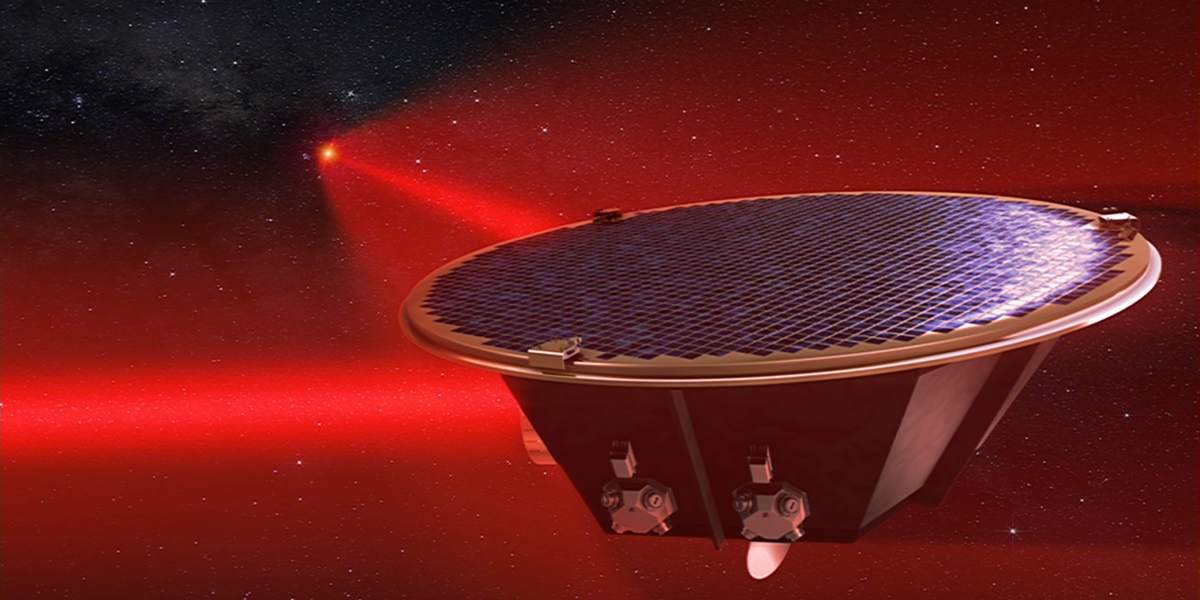
LISA is an ESA-led mission with NASA as a major partner. Instead of one big observatory sitting on Earth, LISA will operate as a trio of spacecraft flying in a giant triangular formation in space. Each side of that triangle will span about 2.5 million kilometers, which is so large that the Sun could fit inside the formation with room to spare. If that sounds excessive, welcome to gravitational-wave astronomy, where “subtle signal” often requires “absurdly huge instrument.”
The mission is currently planned for a 2035 launch. Once deployed, the three spacecraft will trail Earth in its orbit around the Sun. By using lasers to measure tiny changes in the distances between free-floating test masses inside the spacecraft, LISA will detect passing gravitational waves. These waves stretch and squeeze space-time itself by unbelievably small amounts, and LISA’s job is to notice that cosmic whisper without being fooled by ordinary noise.
Why Put a Gravitational Wave Detector in Space?
Ground-based observatories such as LIGO changed astronomy by detecting gravitational waves from stellar-mass black hole mergers and neutron star collisions. That was a historic breakthrough, but Earth is a noisy place. Seismic activity, thermal effects, and environmental vibrations make it hard to measure lower-frequency gravitational waves from the ground.
That is where LISA comes in. A gravity wave detector in space can escape much of Earth’s noise and stretch its measuring arms to mind-bending distances. That allows it to detect waves from different kinds of sources, especially massive systems that evolve more slowly. In other words, LIGO is fantastic at hearing the universe’s sharp, sudden cymbal crashes. LISA is designed to catch the deep bass notes.
How LISA Works Without Losing Its Mind
Each LISA spacecraft carries carefully shielded gold-platinum test masses, slightly smaller than Rubik’s cubes. These masses are meant to float in near-perfect free fall, protected from non-gravitational forces as much as possible. When a gravitational wave passes through the system, it changes the distances between these masses by a tiny amount. LISA measures that change using laser interferometry.
This is where the mission becomes equal parts astrophysics and engineering magic trick. The spacecraft do not simply lock onto each other and call it a day. They must exchange laser beams across millions of kilometers while maintaining extraordinary stability. NASA is contributing key hardware, including the mission’s six telescopes, along with science and data-system support that will help turn those raw measurements into actual discoveries.
The required precision is staggering. We are talking about detecting shifts measured in picometers, or trillionths of a meter. That is the sort of measurement challenge that makes regular tape measures feel deeply unqualified.
The Big Engineering Problem: Keeping Things Truly Quiet
Detecting gravitational waves is not just about building sensitive instruments. It is about building instruments that can ignore almost everything else. Solar radiation pressure, tiny residual gas molecules, electrical charge, spacecraft motion, and even minute forces from onboard systems can muddy the signal.
So LISA uses drag-free control. The test masses are allowed to follow gravity alone as closely as possible, while the spacecraft effectively chases them using microthrusters. Instead of the masses moving with the spacecraft, the spacecraft adjusts itself around the masses. It is a little like trying to build a luxury car whose suspension is so good the road has to apologize.
LISA Pathfinder Proved This Was Not Just a Very Fancy Daydream
Before anyone committed to the full LISA observatory, scientists needed proof that this precision could work in space. That was the purpose of LISA Pathfinder, the technology demonstration mission launched by ESA in 2015.
LISA Pathfinder did not detect gravitational waves itself. Its job was to test the technologies needed for a future observatory. And it delivered. The mission showed that two test masses could be kept in astonishingly quiet free fall, with performance that met or exceeded key requirements for a full-scale space-based gravitational-wave mission. In plain English: the hardest part of the idea turned out to be possible.
That success mattered enormously. Space missions of this scale do not move forward because people say, “Trust us, it’ll probably work.” They move forward because the hardware proves it can survive reality. Pathfinder gave LISA credibility, momentum, and a much stronger engineering foundation.
What Will LISA Actually Discover?
The most exciting part of the LISA gravitational wave detector is not the hardware, although the hardware is objectively cool. It is the science. LISA is expected to detect sources that are inaccessible or difficult for ground-based observatories, giving astronomers a richer, more complete view of the gravitational-wave universe.
1. Merging Supermassive Black Holes
When galaxies merge, their central black holes can spiral toward each other and eventually collide. These events involve black holes millions of times more massive than the Sun and produce low-frequency gravitational waves that LISA should be able to detect. This matters because it helps scientists trace how black holes grow and how galaxies evolve over cosmic time.
Instead of seeing only the aftermath through light, astronomers would be able to follow the long gravitational dance leading up to the merger. That turns black hole history from a blurry old photo into something closer to a documentary series.
2. Compact Binary Systems in Our Galaxy
LISA is also expected to observe large numbers of compact binaries, including binary white dwarfs. These stellar remnants orbit each other rapidly and emit steady gravitational-wave signals. NASA and ESA materials point to tens of thousands of compact binary systems as valuable targets for the mission.
These detections are not just statistical trophies. They can improve our understanding of how stars live, die, and leave behind dense remnants like white dwarfs, neutron stars, and stellar-mass black holes. In short, LISA can help take a census of the Milky Way’s stellar graveyard, which is a phrase that sounds spooky but is scientifically useful.
3. New Tests of Gravity
Einstein’s general relativity has passed every major test thrown at it so far, which is impressive and probably a little smug. But physicists still know it is incomplete because it does not neatly fit with quantum theory, and it leaves major mysteries about dark matter, dark energy, and the earliest universe unresolved.
LISA will test gravity in extreme environments and over enormous scales. By measuring gravitational waves from massive, complex systems, it may reveal subtle effects that sharpen or challenge current theory. Even if Einstein remains undefeated, the measurements themselves will help define the boundaries of what our best theory of gravity can explain.
4. Clues About the Early Universe
One of LISA’s most ambitious goals is to search for gravitational-wave backgrounds that could carry information from very early cosmic history, potentially even from processes that happened shortly after the Big Bang. Light cannot show us everything from those eras because the early universe was once too hot and dense for photons to travel freely. Gravitational waves, however, can carry information from conditions that light cannot escape.
If LISA detects signatures from the early universe, the mission would not just add another chapter to astronomy. It could help rewrite the opening pages.
Why LISA Matters Beyond Astronomy Headlines
It is easy to file LISA under “cool space thing” and move on, but the mission matters for deeper reasons. First, it expands astronomy itself. Observing the universe through light alone is like trying to understand an orchestra while wearing noise-canceling headphones. You may see a lot, but you miss the music.
Second, LISA is a milestone in precision engineering and international cooperation. The mission depends on ESA, NASA, research institutes, instrument teams, and decades of accumulated work. It is not a splashy gadget built for a single press release. It is the result of long scientific patience, which is less flashy but often more impressive.
Third, it shows how one breakthrough leads to another. LIGO proved gravitational waves are detectable. LISA extends that revolution into space and into a different frequency band. Together, these observatories do not compete; they complement each other. One hears one part of the cosmic soundtrack, and the other catches notes that would otherwise go missing.
Challenges LISA Still Has to Beat
Even with adoption, construction progress, and strong international support, LISA remains a difficult mission. Flying three spacecraft in precise formation across millions of kilometers is not exactly routine. The optics must remain stable. The lasers must remain exquisitely controlled. The spacecraft must protect the test masses from external disturbances. Data analysis must separate real signals from instrument noise and overlapping astrophysical sources.
There is also the simple reality that groundbreaking missions are hard because they are groundbreaking. If this were easy, space agencies would be launching gravitational-wave observatories every other Tuesday.
Still, the key difference now is that LISA is no longer just a beautiful scientific concept. It is an adopted mission with real hardware progress, real engineering milestones, and real institutional commitment. That changes the conversation from “Could this happen?” to “How much will it transform our view of the universe when it does?”
The Experience of Waiting for LISA, Imagining LISA, and Eventually Living in the LISA Era
There is a particular kind of excitement around LISA that feels different from many other space missions. With a Mars rover, you can picture wheels on red dust. With a space telescope, you imagine breathtaking images. With LISA, the experience is more abstract at first, which somehow makes it even more thrilling. You are waiting for humanity to build an ear large enough and quiet enough to hear the shape of invisible events happening across the universe.
For scientists, the experience has been long and layered. It includes decades of design studies, canceled versions, revived concepts, hardware tests, and the slow grind of turning a physically outrageous idea into an engineering plan. There is something deeply human in that persistence. LISA is not a mission born from impatience. It is a mission born from the stubborn belief that if the universe is sending out signals, we should eventually learn how to catch them.
For students and space fans, following LISA can feel like standing at the edge of a new scientific language. Many people first met gravitational waves through the 2015 LIGO detection, often described as a chirp. That was a revelation: the universe was not only visible, it was audible in a scientific sense. LISA expands that emotional experience. Instead of hearing only quick, high-energy events, researchers expect to track slower, deeper signals that unfold over months, years, or longer. The mission promises not just surprise discoveries, but anticipation. Astronomers may know a major event is coming before the final merger happens, giving other observatories time to prepare.
There is also a strange beauty in the scale of it. Three spacecraft flying in formation millions of kilometers apart, quietly exchanging laser beams while trailing Earth around the Sun, sounds less like a machine and more like a piece of minimalist science-fiction poetry. Yet it is real. It is being built from mirrors, telescopes, thrusters, algorithms, and the accumulated patience of international teams who know that tiny measurements can answer enormous questions.
When LISA finally begins science operations, the experience for the public may be subtle at first. There may not be instant blockbuster images to plaster across every screen. But what will arrive instead could be even richer: maps of invisible systems, measurements of black hole histories, catalogs of compact binaries, and perhaps signals from processes tied to the early universe. It will be the feeling of discovering that the cosmos has been humming the whole time and that we have finally built an instrument sensitive enough to notice.
That is the real emotional center of LISA. It reminds us that progress in science is not only about seeing farther. Sometimes it is about learning to sense reality in a completely new way. And once that happens, the universe is never quite silent again.
Conclusion
ESA’s LISA is much more than a clever piece of space hardware. It is the first full-scale attempt to build a gravitational wave detector in space, designed to explore the low-frequency universe in ways Earth-based detectors cannot. By combining a giant triangular constellation, free-falling test masses, laser interferometry, and decades of research, LISA promises to reveal mergers of supermassive black holes, thousands of compact binary systems, new tests of gravity, and maybe even clues from the early universe.
If it succeeds, LISA will not simply add another instrument to astronomy. It will change the way astronomy listens. And for a universe that has clearly had a lot to say all along, that seems overdue.