Blank walls have a peculiar talent for making an otherwise lovely room feel unfinished. You can have a cozy sofa, a thriving houseplant, and a coffee table styled like it belongs in a magazine, but one empty wall can still whisper, “So… are we moving in or what?” The good news is that upgrading your space does not require an art dealer, a second mortgage, or a heroic level of crafting skill.
Printable wall art is one of the easiest ways to add personality to a room without spending a small fortune. Whether you love botanical sketches, abstract shapes, vintage maps, cheerful typography, family photos, or moody landscapes, digital art downloads make it possible to refresh your home decor quickly and affordably. Add a budget-friendly frame, choose the right paper, and suddenly your $5 printable can look far more expensive than its receipt suggests.
This guide walks through how to choose, print, frame, arrange, and enjoy easy wall art printables. It also covers a few common mistakes, because no one wants their beautiful new print to look like it escaped from a middle-school printer tray.
Why Printable Wall Art Is a Smart Budget Decor Choice
Printable wall art gives you flexibility that traditional store-bought decor often cannot. Instead of buying a framed print in one fixed size, color, and style, you can choose a design that suits your room and print it in the dimensions that work best for your wall.
That flexibility is especially useful when decorating apartments, dorm rooms, rental homes, home offices, nurseries, or guest bedrooms. You can use one large printable as a focal point above a console table, create a gallery wall with several smaller pieces, or swap seasonal art without feeling guilty about storing a giant canvas in the garage next to a box of mystery cables.
Digital downloads also work well for people who like to change their home decor often. A bright citrus print might feel perfect for summer, while a warm landscape or vintage botanical image can make a space feel cozier in fall. The frame can stay on the wall; only the artwork needs to change. That tiny detail can make decorating feel less permanent and much more fun.
Choosing Printable Wall Art That Actually Fits Your Space
The easiest printable wall art projects start with one simple question: what does the room need? Do not start by downloading every cute quote, watercolor flower, and retro travel poster you see. That is how a perfectly calm bedroom ends up looking like a very polite flea market.
Start With the Mood You Want
Think about how you want the room to feel. Bedrooms usually benefit from calming art, such as soft landscapes, muted abstract prints, coastal photography, or simple line drawings. A home office may need a little more energy, making graphic typography, bold color blocks, or architectural photography a better fit.
For living rooms, consider art that reflects your interests. Vintage city maps, music-themed prints, family photographs, illustrations, travel photography, or museum-style artwork can all create conversation without making the room feel like a waiting area at a dentist’s office.
Use Existing Colors as a Guide
You do not need to match every color in your room exactly. In fact, that can make the space look overly coordinated in a “furniture showroom at 9 a.m.” kind of way. Instead, choose one or two colors already found in your rug, pillows, curtains, furniture, or bedding.
For example, a room with navy pillows and warm wood furniture could look great with a printable that includes muted blue, cream, terracotta, or olive green. A mostly neutral room can handle a bolder print because the artwork becomes the visual spark instead of competing with twelve other loud design choices.
Think About Scale Before Downloading
One of the biggest wall decor mistakes is choosing art that is too small for the wall or the furniture below it. A tiny 8-by-10 print floating above a large sofa can look like it is trying very hard not to bother anyone.
As a general decorating guideline, wall art above furniture should take up a meaningful amount of that furniture’s width. A single print, a pair of prints, or a grouped gallery wall can all work, but the overall arrangement should feel proportional. Larger furniture usually needs larger art, a bigger mat, or several coordinated frames.
Before printing, use painter’s tape or scrap paper to outline the intended frame size on the wall. It is not glamorous, but it is much cheaper than realizing your gorgeous printable is the size of a lunch menu once it is hanging over an eight-foot couch.
Where to Find Printable Wall Art Safely
There are plenty of places to find printable art, from independent artists selling digital downloads to museum collections and public-domain archives. The key is knowing what you are allowed to use.
Paid Digital Downloads
Purchasing a digital download from an artist or marketplace can be an excellent choice when you want something distinctive. You may find hand-painted florals, custom family-name prints, modern abstract art, nursery illustrations, local skyline prints, or personalized designs.
Read the listing carefully before buying. Some downloads are for personal use only, which means you can print and display them in your home but cannot resell the design, use it for products, or share the file publicly. Buying a file does not automatically mean you own the copyright. Think of it like buying a movie ticket: you get to enjoy the experience, but you do not get to remake the sequel.
Public-Domain and Open-Access Art
Public-domain and open-access collections can be treasure chests for budget wall decor. Historical posters, botanical illustrations, maps, portraits, antique scientific drawings, and classic paintings can work beautifully in modern homes.
Look for collections that clearly label images as public domain, rights-free, or available for reuse. Major cultural institutions and libraries often provide high-resolution downloads for works that are no longer protected by copyright or are shared under open-access terms.
Still, check the rights statement attached to each image. “Old” does not always mean “free to use,” and a photograph of an old painting may have its own restrictions. When in doubt, choose a source that clearly states the file can be downloaded and reused.
Free Stock Photos and Your Own Photography
High-quality stock photography can make excellent printable wall art, especially for minimalist spaces. Nature scenes, close-up florals, architecture, travel landscapes, ocean views, and black-and-white city photography are all easy to style.
Your own photos can be even better. A favorite vacation photo, a close-up of a garden flower, a family pet looking unusually majestic, or an image of your hometown can become meaningful artwork. Crop it thoughtfully, increase brightness only when needed, and print it at a size that gives it room to breathe.
How to Print Wall Art Without Making It Look Cheap
The printable itself matters, but the printing choices often determine whether your art looks polished or painfully homemade. Fortunately, a few small upgrades make a big difference.
Use a High-Resolution File
For sharp printed artwork, use a file designed for the size you plan to print. A small web image may look fine on your phone but appear blurry when enlarged. Many digital art sellers provide multiple ratios or file sizes, such as 2:3, 3:4, 4:5, 5:7, and standard sizes like 8-by-10 or 11-by-14 inches.
For professional-looking posters, aim for high-resolution artwork suitable for printing, often around 300 DPI at the final print size. If the file is low resolution, do not try to stretch it into a huge poster. It will not become “artistic texture.” It will become pixels wearing a trench coat.
Choose Better Paper
Regular printer paper can work for temporary decor, kids’ rooms, party signs, or quick seasonal updates. For wall art you want to keep, choose heavier paper. Matte photo paper, premium presentation paper, cardstock, or fine-art paper usually gives prints more depth and makes colors look richer.
Matte paper is ideal for art prints because it reduces glare and gives the image a softer, more gallery-like appearance. Glossy paper can work well for vivid photography, but it may reflect light and show fingerprints more easily. If your wall receives direct sunlight, a matte finish is often less distracting.
Print at Home or Use a Print Shop?
Home printing is convenient for smaller prints, quick updates, and simple black-and-white designs. However, local print shops and office supply stores can be worth the extra cost for larger prints, vibrant colors, or a more professional finish.
If you use a print service, upload a PDF, JPG, or PNG in the correct dimensions. Double-check the preview before ordering. Make sure important details are not too close to the edge, and avoid selecting “fit to page” when it will crop your artwork unexpectedly.
Affordable Framing Tricks That Make Printable Art Look Expensive
Frames are the secret sauce of budget wall art. A beautiful printable can look average in a flimsy frame, while a modest print can look surprisingly sophisticated with a simple mat and a well-chosen border.
Use Standard Frame Sizes
Custom framing can get expensive quickly, so choose printable sizes that fit standard frames. Common sizes such as 8-by-10, 11-by-14, 12-by-16, 16-by-20, and 18-by-24 inches are easier to frame affordably. Standard frames are widely available at discount stores, home stores, craft stores, thrift shops, and online retailers.
A clean black frame is versatile and modern. Natural wood frames add warmth. White frames work beautifully with airy, coastal, cottage, and Scandinavian-inspired rooms. Gold-toned frames can make vintage art, botanical prints, and classic portraits feel more dramatic.
Use Mats for a Bigger, More Finished Look
A mat creates visual breathing room around a print. It can make a small design look more intentional and gives inexpensive art a gallery-style finish. A simple white or cream mat is hard to beat, but colored mats can also work when they connect to a tone in the artwork.
For example, an 8-by-10 botanical print inside an 11-by-14 frame with a wide mat can look more elevated than the same print squeezed tightly into an 8-by-10 frame. The image stays small, but its presence gets bigger. It is basically a good haircut for wall art.
Try Thrifted Frames
Thrift stores can be gold mines for frames. Do not judge a frame by the faded motivational quote currently trapped inside it. Look at the shape, material, glass condition, and size. You can replace the old art with your printable, paint the frame if needed, and create a high-end look for very little money.
When buying secondhand frames, check for cracked glass, warped backing, damaged hanging hardware, or musty odors. A frame that needs a quick wipe-down is fine. A frame that smells like it has survived three basements and a flood is probably not your soulmate.
Easy Printable Wall Art Layout Ideas
Once you have your prints and frames, the fun part begins: deciding where they belong. You do not need advanced interior-design credentials. You only need a little planning and the courage to move a frame two inches to the left when necessary.
The Single Statement Print
A large printable above a bed, sofa, desk, or entryway table can create a clean focal point. This works especially well with abstract art, oversized photography, vintage posters, or a large black-and-white image.
Keep the frame centered over the furniture rather than automatically centering it on the wall. Furniture creates the visual anchor, and the art should feel connected to it.
The Matching Pair
Two coordinating printable art pieces can create balance without feeling overly formal. Try matching botanical prints, two related landscapes, a pair of abstract color studies, or black-and-white photographs from the same trip.
Use identical frames for a polished look, or use the same frame color with slightly different styles for a relaxed, collected feel. Leave consistent spacing between the two pieces so they read as a pair rather than two strangers waiting for an elevator.
The Grid Gallery Wall
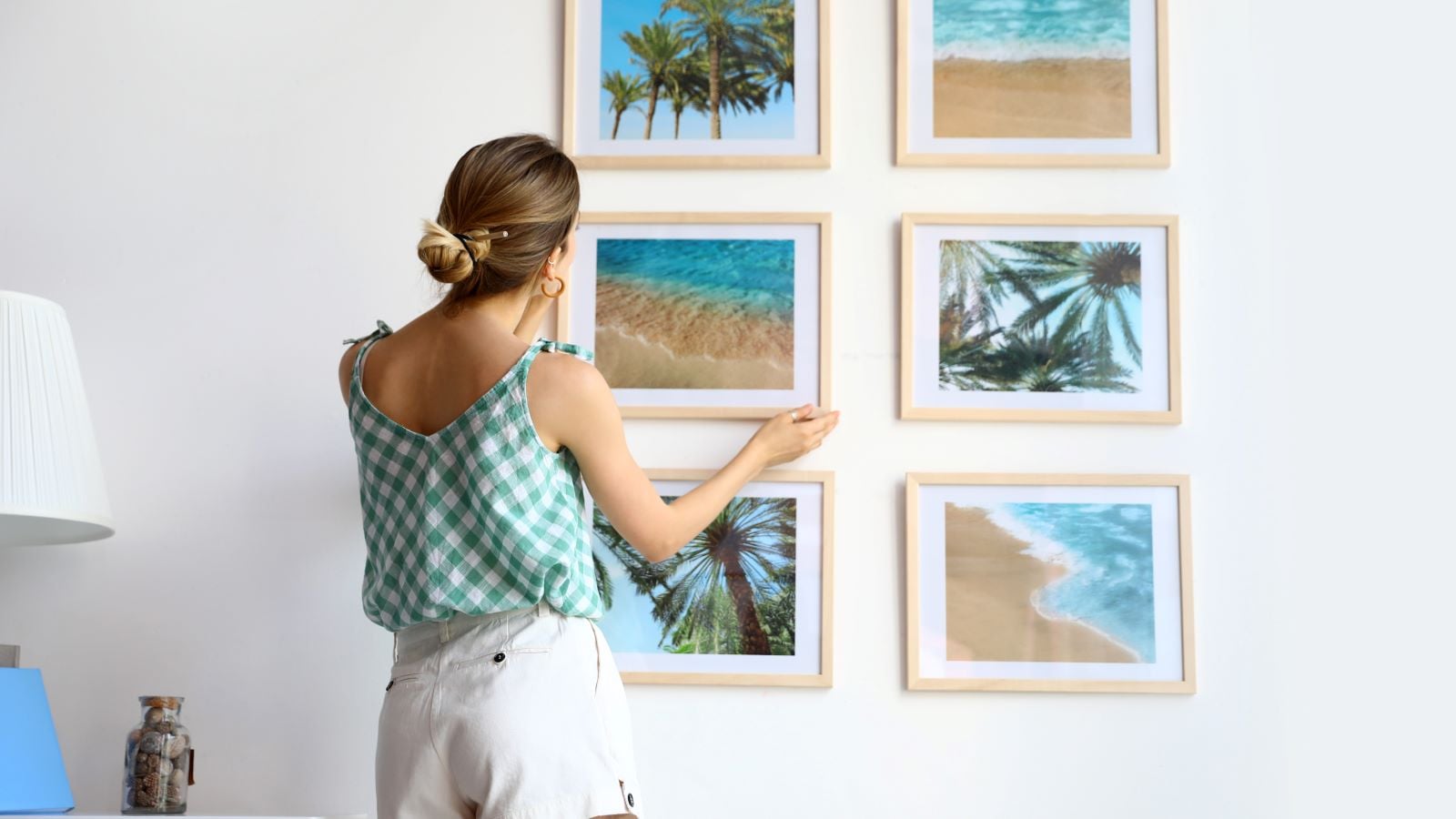
A grid layout works beautifully when you have four, six, or nine prints in matching frames. It is ideal for minimalist art, typography, family photographs, botanical illustrations, or travel photos. The structure makes a group of inexpensive prints feel intentional and tidy.
Measure carefully, keep the gaps consistent, and lay everything out on the floor first. A grid gallery wall rewards patience and punishes “close enough.”
The Eclectic Gallery Wall
An eclectic gallery wall mixes sizes, frame finishes, and subjects. It can include printable art, family photos, postcards, mirrors, small shelves, pressed flowers, or thrifted finds. The secret is one unifying element, such as a limited color palette, a shared theme, or similar frame tones.
Start with the largest piece near the center, then build outward. Arrange the frames on the floor or trace them onto paper and tape the paper to the wall. This step may feel fussy, but it prevents the classic gallery-wall experience of hanging everything first and realizing your final frame needs to live on the ceiling.
How High Should You Hang Printable Wall Art?
Wall art is often hung too high, which can make even beautiful prints feel disconnected from the room. For many spaces, the center of the artwork should sit around eye level. If the art hangs above furniture, leave a comfortable but not enormous gap between the top of the furniture and the bottom of the frame.
In rooms with tall ceilings, resist the urge to send every frame upward just because there is open wall space. Art should relate to the furniture and the people using the room. A frame hung near the ceiling is not dramatic. It is simply on vacation.
Easy Printable Art Ideas for Every Room
Living Room
Try abstract art, neutral landscapes, vintage travel posters, black-and-white photography, or a large family photo. Choose art that feels personal but not overly precious. The living room should look lived in, not like a museum where everyone is afraid to sit down.
Bedroom
Soft botanical art, calming seascapes, moon phases, minimalist line art, and gentle typography can make a bedroom feel restful. Use colors that support sleep and relaxation, such as muted blue, sage green, warm beige, dusty rose, or soft gray.
Kitchen and Dining Area
Food illustrations, coffee-themed prints, vintage recipe art, fruit studies, wine labels, farmers’ market posters, or cheerful typography can add personality. Keep paper art away from heavy moisture, grease splatter, and direct stove heat unless it is protected behind glass.
Home Office
Try motivational phrases that do not make you roll your eyes, architectural sketches, colorful abstract art, maps, or personal travel photos. A home office is a good place for artwork that makes you feel focused, optimistic, or pleasantly distracted when spreadsheets begin acting suspiciously.
Kids’ Rooms and Nurseries
Printable alphabet art, animals, outer-space illustrations, storybook-inspired art, colorful maps, and simple educational prints can be easy to update as children grow. Use lightweight frames or secure hanging methods, especially in areas where little hands might decide to investigate gravity.
Common Printable Wall Art Mistakes to Avoid
Printable art is affordable, but it can still look thoughtful. Avoid printing a beautiful design on flimsy paper, choosing frames that are too small, hanging everything too high, or mixing too many unrelated styles in one area.
Also avoid using artwork without understanding its license. A file that appears on a search engine is not automatically free to print, repost, sell, or use commercially. Respect artists, read licensing terms, and choose legitimate sources. Budget decor should save money, not create a copyright headache.
Finally, do not overfill every wall. Empty space is not a decorating failure. Sometimes a room needs a single well-placed printable, a good lamp, and the confidence to stop before it becomes a scrapbook with furniture.
Experiences and Lessons From Decorating With Printable Wall Art
People often assume budget decor has to look temporary, but printable wall art proves that the opposite can be true. The most successful printable art projects tend to come from slow decisions rather than rushed downloading. A print chosen because it fits the colors, scale, and mood of a room usually feels far more expensive than something purchased just because it was free.
One common lesson is that frames matter more than expected. Many decorators begin by focusing entirely on the artwork, then discover that a clean frame and generous mat can completely change the result. A simple botanical illustration on heavyweight matte paper can look elegant in a thrifted wood frame. The same image on thin paper inside a plastic frame can look like it was awarded for perfect attendance.
Another useful experience is learning that large art does not always require a large budget. Instead of buying one oversized canvas, some people create visual impact by using an inexpensive poster-size printable, adding a large mat, or grouping several smaller prints together. A three-piece set over a sofa can feel substantial, especially when the colors repeat across the room through pillows, rugs, or curtains.
Printable wall art also encourages experimentation. A person may be nervous about hanging a bold red abstract print, a dramatic vintage portrait, or a funny kitchen quote if it costs hundreds of dollars. When the artwork is affordable, the risk is much lower. You can test a new style, live with it for a few weeks, and replace it if it does not feel right. Decorating becomes less about finding the single “perfect” object and more about discovering what makes your home feel like yours.
Seasonal swaps are another reason printable art works so well. A neutral frame can hold cheerful citrus prints in summer, warm autumn landscapes in fall, cozy holiday art in winter, and fresh botanical illustrations in spring. This approach adds seasonal personality without requiring a storage closet the size of a small airport terminal.
There is also something satisfying about using meaningful images. Printable art does not have to be generic. A favorite photo from a road trip, a scan of an old family recipe, a child’s drawing, a map of a hometown, or a vintage image connected to family history can become decor with emotional value. These pieces tell a story, and stories are what make homes feel collected rather than copied.
The biggest takeaway is simple: printable wall art looks best when it is treated as real art. Print it well, frame it thoughtfully, hang it at a sensible height, and give it enough space to shine. You do not need an unlimited decor budget to create a home with warmth and personality. You just need a good file, a decent frame, and perhaps the self-control not to download forty-seven inspirational quotes before breakfast.
Note: Before printing, sharing, selling, or republishing any downloadable artwork, confirm the license and permitted use. Public-domain, open-access, and personal-use files can have different rules.