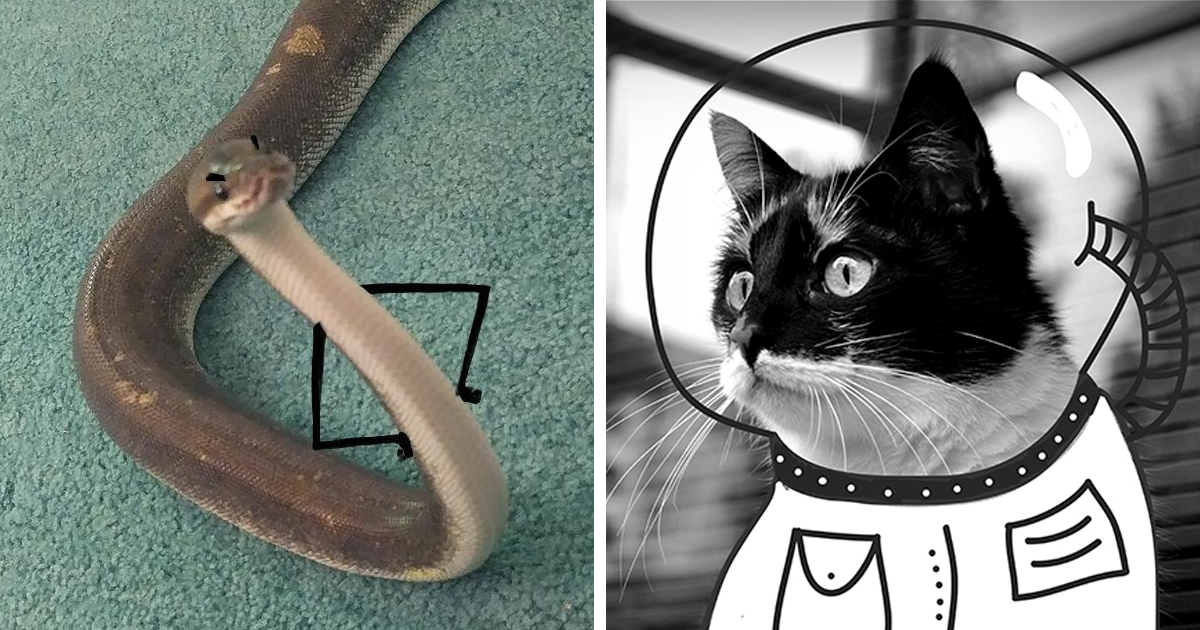
Your dog may never captain a pirate ship. Your cat probably should not be trusted with a rocket. And allowing a hamster to lead an expedition through an ancient jungle would create several insurance questions. On paper, however, every pet is qualified for adventure.
When you doodle your pets, an ordinary nap on the couch can become a royal banquet, an interplanetary mission, or a daring escape from the Kingdom of Vacuum Cleaners. The activity requires no expensive equipment, formal art training, or agreement from your pet, who will almost certainly continue sleeping through the entire production.
Pet doodling combines observation, imagination, visual storytelling, and affection. It can be a five-minute sketch in the corner of a notebook or the beginning of a complete illustrated series. Best of all, the finished drawing does not need to be anatomically perfect. It only needs to capture the features and personality that make your animal unmistakably yours.
Why Pet Doodling Is More Than a Cute Art Project
Pets already provide endless story material. Dogs investigate grocery bags as if conducting federal inspections. Cats stare into empty hallways with the confidence of someone watching a ghost pay rent. Rabbits rearrange their surroundings like tiny interior designers who strongly oppose your original floor plan.
Doodling gives those familiar behaviors a fictional explanation. Perhaps your dog is not sniffing the laundry basket; perhaps he is searching for a lost civilization. Maybe your cat is not knocking a pen off the desk; she is testing gravity before presenting her findings at an international science conference.
It Encourages You to Observe Your Pet Closely
To draw your pet convincingly, you begin noticing small details: the angle of an ear, the shape of a nose, the way the tail curves, and the expression that appears seconds before something falls off a shelf. This careful observation can help you create a cartoon pet portrait that feels recognizable even when the body is made from three circles and a suspicious-looking oval.
Observation also helps you identify the natural behaviors that make a good adventure theme. Animal-welfare organizations recommend enrichment that gives pets safe opportunities to explore, sniff, chase, climb, forage, solve problems, and play. Those same behaviors provide excellent material for imaginative stories. A scavenger hunt can become a treasure quest, a climbing session can become a mountain expedition, and a cardboard box can become a lunar command center.
It Makes Creativity Feel Approachable
A blank page can feel intimidating when the goal is to create “serious art.” It becomes much friendlier when the goal is to draw a corgi wearing swim fins. Humor lowers the stakes. Instead of worrying about whether the sketch belongs in a gallery, you start wondering whether the corgi also needs a snorkel.
Research on art-making suggests that creative activity may support relaxation and stress management. One frequently cited pilot study found lower cortisol levels after participants spent time making art, although such findings should not be interpreted as a medical guarantee. Museums and art educators also describe sketching as a way to think visually, record ideas, and explore the imagination.
It Creates a Personal Record of Everyday Life
Photographs capture how your pet looked. Doodles can capture how living with your pet felt. A sketch of a senior dog piloting an airship might reflect his calm dignity. A comic about a kitten battling a curtain may preserve the delightful chaos of her first year.
Over time, a collection of pet adventure art becomes a visual diary. The drawings can document favorite toys, strange habits, household routines, memorable trips, and the changing relationship between an animal and the people who love them.
How to Doodle Your Pet, Even If You “Cannot Draw”
Nearly everyone can make a pet doodle because doodling is built from simplified shapes rather than perfect realism. Start small, work quickly, and allow the drawing to be a little ridiculous. Ridiculousness is not a defect here. It is practically a supply.
Step 1: Choose a Clear Reference Photo
Select a photo that shows your pet’s most recognizable features. A front-facing picture is useful for studying facial markings, while a side view helps with body shape, posture, and tail position. Action photos are ideal for energetic scenes, but a calm image is usually easier for a first attempt.
Natural light helps reveal fur texture, facial structure, and color changes. Take several photographs rather than expecting your pet to hold a perfect pose. Professional photography guidance emphasizes preparation, adaptability, composition, and patience because animals rarely follow posing instructions with the dedication of paid human models.
Step 2: Break the Body Into Basic Shapes
Ignore the fur at first. Look for the simple forms underneath it:
- A circle or oval for the head
- A larger oval or bean shape for the body
- Triangles, semicircles, or floppy rectangles for the ears
- Short cylinders or curved lines for the legs
- A sweeping line for the tail
Sketch lightly so you can adjust the proportions. Your first version may resemble a potato with ears. This is normal. Many excellent pet characters begin their careers as potatoes.
Step 3: Identify Two or Three Signature Features
You do not need to reproduce every strand of fur. Concentrate on the traits that make your pet recognizable. These might include one bent ear, a round muzzle, oversized paws, a white chest patch, long whiskers, unusual coloring, or an expression of constant concern about dinner.
Exaggeration can improve a cartoon drawing. Make the floppy ears floppier, the fluffy tail fluffier, or the suspicious eyebrows more suspicious. A successful doodle often communicates personality through a few carefully chosen details.
Step 4: Add a Simple Expression
Small changes in the eyes and mouth can transform the character. Wide eyes suggest surprise. Half-closed eyes create confidence or boredom. Raised eyebrows communicate alarm, curiosity, or the realization that the treats are stored on a higher shelf.
Try drawing several tiny versions of the face before adding it to the final scene. Create a happy expression, a determined expression, and a “you have disappointed me by being five minutes late with breakfast” expression.
Step 5: Give Your Pet a Role
The role should fit the pet’s personality, contradict it for comic effect, or do both at once. A fearless terrier might become a monster hunter. A nervous Chihuahua could be an unexpectedly powerful wizard. A cat who avoids water could command a submarine while complaining about every operational decision.
Ask three questions:
- What does my pet want?
- What obstacle is in the way?
- What funny object or companion could help?
For example, a food-obsessed Labrador wants to recover the Golden Biscuit. The biscuit is protected by the Dragon of Portion Control. His only equipment is a squeaky chicken and an optimism unsupported by evidence. You now have a story.
Pet Adventure Ideas Worth Putting on Paper
Send Your Pet Into Space
Draw a round helmet around your pet’s head, add a small spacesuit, and place the character on a moon made from cheese. Food bowls become control panels. Tennis balls become distant planets. A litter scoop can become a surprisingly effective satellite dish.
Keep the background simple with stars, craters, and one dramatic flag. Label the spacecraft with a playful name such as the U.S.S. Good Boy, the Feline Falcon, or Mission Snack Recovery.
Create a Fantasy Quest
Fantasy adventures are perfect for dramatic pets. Give your animal a cape, a map, a glowing collar, or a tiny sword that would be completely impractical in real life. Turn household objects into fantasy landmarks: the sofa becomes a mountain range, the kitchen becomes the Banquet Hall, and the closed bathroom door becomes the Forbidden Gate.
A group drawing can include several animals with different roles. The dog is the knight, the cat is the morally ambiguous sorcerer, the parrot is the navigator, and the guinea pig is the quiet hero who has secretly understood the map all along.
Design an Underwater Expedition
Transform your pet’s bed into a submarine and surround it with fish, coral, bubbles, and treasure chests. Long-haired pets make excellent underwater explorers because their fur can float dramatically in every direction.
Realistic anatomy is optional. Your dachshund can wear six flippers. Your rabbit can interview an octopus. Your cat can discover an underwater kingdom and immediately demand ownership of it.
Turn a Daily Walk Into an Epic Journey
A familiar neighborhood route can become a map filled with landmarks. The fire hydrant becomes the Tower of Important Messages. The corner store becomes the Supply Outpost. The local squirrel becomes a recurring rival whose motives remain unclear.
This idea is especially useful for a pet doodle journal. Draw one moment from each walk, add a caption, and record the imaginary mission. Even uneventful walks become entertaining when viewed through the eyes of an explorer who considers every leaf urgent.
Build a Time-Traveling Pet Series
Place your pet in different historical or futuristic settings. Draw a Victorian detective, a Wild West sheriff, a prehistoric cave explorer, a medieval court musician, or a robot mechanic working in the year 3026.
Use the same basic pet character in every drawing while changing the costume and scenery. Repetition makes the project manageable and helps you develop a consistent cartoon style.
Turn One Drawing Into a Complete Pet Story
A single image can become a comic strip, illustrated journal, greeting card, calendar, short animation, or handmade children’s book. Begin with three scenes: the introduction, the problem, and the amusing solution.
For example:
- Introduction: Captain Whiskers receives a message from the Moon Mice.
- Problem: Their cheese-powered spaceship has stopped working.
- Solution: Captain Whiskers repairs it by pushing every control off the dashboard.
Drawing can serve as a springboard for storytelling, particularly for children who may find it easier to invent a narrative after creating a character or scene. Museum and educational resources regularly connect visual art with imagination, animal symbolism, story writing, and dramatic play.
Add Captions in Your Pet’s Voice
Imagine how your pet would describe the adventure. A dog might narrate everything with enthusiastic confidence. A cat might sound like a disappointed monarch. A bird could provide constant commentary, including information nobody requested.
Keep captions short and specific. “We entered the cave” is functional. “I entered the cave because the humans had once again failed to locate the snacks” reveals character.
Use Recurring Jokes and Objects
Running jokes make a series memorable. Perhaps a tennis ball appears in every historical period. Maybe a grumpy vacuum cleaner is always the villain. A particular sock could repeatedly become a flag, parachute, sleeping bag, or formal hat.
These repeated elements also reduce the pressure to invent everything from scratch. Familiar objects become part of your pet’s fictional universe.
Traditional and Digital Tools for Pet Doodles
For traditional drawing, all you need is paper, a pencil, an eraser, and something for adding color. Fine-liner pens create crisp outlines, while colored pencils offer control without requiring a complicated setup. Markers produce bold cartoon art but may bleed through thin notebook pages.
Digital drawing provides layers, an undo button, easy resizing, and the ability to duplicate a pet character across several scenes. A smartphone, tablet, computer mouse, or drawing stylus can all work. Free browser-based drawing tools are useful for experimentation, while advanced illustration software offers more control over brushes, textures, and animation.
You can also combine traditional and digital methods. Draw the pet in pencil, photograph or scan the page, and add color digitally. Another option is to print a pet photograph and doodle costumes or backgrounds around it. The result becomes a playful mixture of real life and imagination.
Keep the Activity Safe and Enjoyable for Your Pet
Your pet does not need to wear a real costume, pose for long periods, or interact with unfamiliar objects for you to create an adventure drawing. Use an existing photograph whenever the animal appears tired, nervous, or uninterested.
Keep pencils, erasers, marker caps, strings, paint, and other small art materials out of reach. Cats and dogs may chew or swallow craft supplies, and string-like items can be especially hazardous. Cornell’s feline guidance recommends supervising play, avoiding detachable small parts, and selecting objects appropriate for the animal.
Pet enrichment should suit the animal’s age, health, mobility, and individual preferences. Some pets love active games, while others prefer sniffing, watching, gentle training, or quiet interaction. Never force a pet to participate simply because the scene would look adorable online. An uncooperative model is not a failed project; it is an excellent excuse to draw from memory.
Share Your Pet Adventures Without Chasing Perfection
Before posting a drawing, decide what you want viewers to notice first. A clear silhouette, expressive face, and uncluttered background usually communicate more effectively than dozens of tiny decorations. You can photograph traditional artwork near a window or scan it for a cleaner result.
Consider posting a sequence showing the reference photo, rough shapes, completed character, and final adventure. People often enjoy seeing how an ordinary pet photograph evolves into an absurd heroic scene.
Most importantly, resist comparing your first sketch with a professional illustrator’s thousandth project. Your pet does not care about perspective, line weight, or artistic credentials. Your pet cares about snacks and may attempt to sit on the drawing. This is both an interruption and a review.
A Weekend Pet-Doodle Adventure: An Illustrative Experience
The following composite example shows how a casual pet-doodling project might develop.
The project began with Pepper, a small mixed-breed dog whose greatest talents were locating crumbs and barking at delivery boxes after they had already been delivered. The original plan was modest: draw Pepper as a pirate standing on the living-room rug. Ten minutes later, the rug had become an ocean, the coffee table was a storm cloud, and Pepper was commanding a ship called the Bark Pearl.
The first sketch was not impressive. Pepper’s head was too large, the front legs looked like breadsticks, and the pirate hat appeared to be attacking him. Instead of starting over, the artist leaned into the mistakes. The enormous head became part of the cartoon style. The breadstick legs were shortened and hidden behind the ship’s wheel. The hat received an equally crooked feather, making the entire outfit look intentional.
Observing Pepper provided the next piece of the story. Whenever someone opened a snack wrapper, one ear rose before the other. That asymmetrical listening pose became his special navigation ability. Captain Pepper could detect hidden treasure by hearing a cheese package open from three islands away.
A second pet, Juniper the cat, joined the picture as the ship’s navigator. Juniper was drawn from a photograph taken while she sat on a bookshelf looking down at everyone with professional disapproval. In the adventure, she became Admiral Juniper, an experienced sailor who believed Captain Pepper lacked discipline, planning skills, and basic table manners.
The drawing soon expanded into four comic panels. In the first, Pepper discovered a treasure map beneath his food bowl. In the second, he and Juniper crossed the Sea of Vacuum Cleaners. In the third, they reached Snack Island and encountered a giant squirrel guarding a golden biscuit. In the final panel, Pepper offered the squirrel half the biscuit, Juniper claimed this had been her strategy all along, and everyone returned home before dinner.
The most enjoyable part was not producing a technically polished illustration. It was translating familiar household behavior into a fictional world. Pepper’s habit of carrying one sock became pirate equipment. Juniper’s tendency to occupy cardboard boxes inspired the ship. A scratched section of the sofa became a dangerous reef marked on the map.
The finished comic was placed on the refrigerator, where it attracted more conversation than a realistic portrait probably would have. Family members began suggesting sequels: Captain Pepper in Antarctica, Admiral Juniper solving a museum mystery, and both pets traveling back in time to prevent the invention of the vacuum cleaner.
By Sunday evening, the project had produced several rough drawings, one finished comic, and a list of future adventures. More importantly, it changed the way ordinary moments were noticed. A pet staring under the couch was no longer merely staring under the couch. He was examining the entrance to a hidden kingdom. A cat climbing into a paper bag was beginning a top-secret expedition.
That shift in perspective is the real reward of pet adventure art. The page becomes a place where affection, observation, and imagination meet. The drawing may be imperfect, but the story belongs entirely to the household that inspired it.
Conclusion: Every Pet Has an Adventure Waiting
You do not need advanced drawing skills to doodle your pets and take them on new adventures. Begin with simple shapes, emphasize a few recognizable features, choose a role that fits your animal’s personality, and build a small story around familiar behavior.
A sleepy dog can explore Mars. A bossy cat can rule a medieval kingdom. A rabbit can become a famous architect specializing in cardboard structures. Every scribble adds another detail to a world that could exist only because you know your pet so well.
Start with one photograph and one ridiculous question: “Where would my pet go if absolutely nothing were impossible?” Then draw the answer before your creative director knocks the pencil onto the floor.
Note: Pet participation should always be voluntary and supervised. This article synthesizes creative, educational, photography, animal-behavior, and enrichment guidance from established U.S. resources including the American Kennel Club, ASPCA, Humane Society of the United States, Smithsonian, Cornell University College of Veterinary Medicine, AAHA, NIH-indexed research, Adobe, the National Gallery of Art, The Metropolitan Museum of Art, and PBS.